
CNDOME vs. Top Cutting Disc Manufacturers: A Buyer Scorecard
For industrial buyers, the first serious filter in cutting disc supplier selection is rarely price. It is range coverage. A manufacturing partner that can supply 4.5-inch and 7-inch consumables but stops short of the small-diameter end or the large heavy-section end of the catalogue will force a mixed-category buyer to run two or three supply relationships where one should do. CNDOME is the export-facing brand of Changzhou Dome Abrasives Manufacture Co., Ltd., a resin-bonded abrasive manufacturer based in Changzhou, Jiangsu Province, China, producing cutting discs, grinding wheels, abrasive discs, ceramic grinding discs, and flap discs. Its published portfolio spans cutting discs from 1.5-inch (38*1.1*3) to 16-inch (400x3.5x32), grinding discs from 4-inch to 9-inch, and ceramic grinding discs in 115 mm and 125 mm formats. This article sets that range against the specification coverage buyers typically expect from top cutting disc manufacturers, using a scorecard built only from verifiable parameters: dimensional coverage, material consistency, certification, application fit, capacity, and purchasing terms.
Why Range Coverage Becomes a First-Round Screening Criterion
The global cutting discs market entered 2026 at an estimated value of approximately USD 8.5 billion, according to commercial research published by IndexBox. Fortune Business Insights places Asia-Pacific at a 44.7% revenue share of the wider abrasives market in 2025, driven largely by industrial expansion in China and India.
That concentration has a direct procurement consequence. When most competitive supply sits inside a small number of manufacturing clusters, suppliers begin to look similar on price and on headline certifications. What separates them in practice is catalogue depth: whether one supplier can cover a distributor's full shelf, from 1.5-inch precision cutting discs through to 14-inch and 16-inch heavy-section discs, without splitting the account across vendors.
Buyers who screen on range first usually find that the number of realistic shortlist candidates drops sharply before cost discussions even begin. Range coverage is therefore best treated as a pre-qualification criterion, not a negotiating point.
What CNDOME's Cutting Disc Range Actually Covers
CNDOME's stated cutting disc coverage runs from 1.5-inch (38*1.1*3) at the small end to 16-inch (400x3.5x32) at the large end. Grinding discs run from 4-inch to 9-inch, and ceramic grinding discs are offered in 115 mm and 125 mm sizes. Published specification details for the mid and large formats are listed below.
| Format | Published model | Speed | Shape | Primary materials |
|---|---|---|---|---|
| 16-inch | 400x3.5x32 | 3800 RPM, max 80 m/s | T41 | Aluminium Oxide, White Aluminium Oxide, resin |
| 9-inch | 230x2.0x22.23 / 230x3.0x22.23 / 230x2.5x22.23 | 6600 RPM, max 80 m/s | T41 / T42 | Aluminium Oxide, White Aluminium Oxide, resin |
| 7-inch | 180x1.6x22.23 / 180x2x22.23 / 180x3x22.23 | 8500 RPM, max 80 m/s | T41 | Aluminium Oxide, White Aluminium Oxide, resin, Silicon carbide, Zirconium |
| 4.5-inch | 115x1.2x22.23 | max 80 m/s | T41 | Aluminium Oxide, White Aluminium Oxide, resin |
Two things stand out from the specification sheet. First, the 80 m/s maximum operating speed is consistent across the formats shown, which allows a buyer to standardise guarding, RPM limits, and safety signage across a multi-size order. Second, thickness options within a single diameter, for example 230x2.0, 230x2.5, and 230x3.0, give distributors a way to serve both fast low-kerf cutting and thicker, more durable cutting from the same nominal size.
Material Consistency Across the Range
Abrasive formulation is where sub-tier suppliers most often break the consistency promise: the 4.5-inch disc behaves well, but the 14-inch disc of nominally the same grade does not.
CNDOME's published formulation family centres on Aluminium Oxide, White Aluminium Oxide, and resin as the bond, with Silicon carbide and Zirconium appearing on selected product lines. The 7-inch, 9-inch, and 16-inch specifications all list aluminium oxide combined with white aluminium oxide as the primary abrasive content. Aluminium Oxide is also the dominant material class in the global abrasives market, holding 46.3% of material market share in 2025 according to Fortune Business Insights, which reflects its cost-effectiveness in general metal fabrication.
For buyers, the practical reading is straightforward. A manufacturer that publishes the same abrasive family across its diameter range is more likely to deliver predictable cutting behaviour when a distributor consolidates a shelf onto one supplier. The published applicable industries for these formulations span steel and metal processing, automobile manufacturing, shipbuilding, casting, steel structure, and construction, which covers both carbon steel and stainless steel (INOX) work within the same formulation family.
A Buyer's Scorecard: How CNDOME's Range Measures Against Top Manufacturers
Because top cutting disc manufacturers rarely publish directly comparable specification sheets, the practical way to benchmark them is a criteria scorecard. The one below sets out CNDOME's published position alongside the verification question a buyer should apply to any peer manufacturer.
| Buyer criterion | CNDOME (published position) | Verification question for peer manufacturers |
|---|---|---|
| Dimensional coverage | Cutting discs 1.5-inch (38*1.1*3) to 16-inch (400x3.5x32); grinding discs 4 to 9 inch; ceramic grinding discs 115 / 125 mm | Does the catalogue show a continuous diameter range, or only the common 4.5-inch and 7-inch sizes? |
| Material consistency | Aluminium Oxide + White Aluminium Oxide + resin as the core family, with Silicon carbide and Zirconium on selected lines | Is the same abrasive family listed across small, mid, and large diameters? |
| Operating speed consistency | 80 m/s maximum operating speed stated for 4.5-inch, 7-inch, 9-inch, and 16-inch models | Are maximum operating speeds published per model and consistent across the range? |
| Certification | MPA Hannover certificates under EN 12413 for multiple dimensions; CE (UDEM); ISO9001; ISO14001; BSCI | Can certificates be traced to the exact dimensions you intend to order? |
| Application breadth | Steel and metal processing, automobile manufacturing, shipbuilding, casting, steel structure, construction | Are the claimed industries supported by case references or listed end uses? |
| OEM / ODM flexibility | Logo, label, package, abrasive formulation, and specification customisation | Is customisation limited to packaging, or does it extend to formulation and specification? |
| Capacity and lead time | 8 million pieces per month; 30-day production lead time; approximately 600,000 pieces per day | Is capacity data third-party audited or self-reported? |
| Purchasing terms | MOQ 10,000 pieces (under 4-inch), 5,000 pieces (over 4-inch); FOB / EXW; pre-shipment test acceptance | Are MOQ, Incoterms, and acceptance criteria defined in writing before RFQ? |
On the certification criterion, publicly documented peer signals are useful reference points. NovoAbrasive states that each of its cutting discs is certified by MPA Hannover and complies with EN 12413. Qing Yang states that all its wheels are labelled in accordance with EN 12413 marking requirements, including maximum operating speed, wheel type, dimensions, and the MPA Z-mark where applicable. Both statements are manufacturer self-reported rather than independently validated, which is precisely why a buyer scorecard needs a verification column: compliance claims are common in this segment, and validation is what separates them.
Application Fit: Steel, INOX, Shipbuilding, and Construction
The published applicable industries for CNDOME's cutting discs cover steel and metal processing, automobile manufacturing, shipbuilding, casting, steel structure, and construction. These end markets map naturally onto the diameter range: 4-inch to 5-inch discs for fabrication and repair work, 7-inch and 9-inch discs for structural steel and pipe work, and 14-inch to 16-inch discs for heavy-section cutting.
Documented case use reported in the supplied corpus includes:
- Machining factories across Indonesia, Japan, Thailand, and South Korea: cutting and polishing of iron and stainless-steel parts, supporting 24-hour production, at a scale of 30 orders per year over a three-year relationship, with ample inventory maintained for ready shipment.
- Stainless steel processing in South America: 500,000 pieces per year used for polishing the inner and outer walls of stainless steel pipes, reported as stable in long-term workshop use with long disc life, no frequent replacement, no slag shedding, and high safety.
- Tool supermarket supply across Mexico, the United States, and South America: 40,000,000 pieces per year covering home DIY and professional metalworking, with reported long service life, fast cutting speed, low noise, burr-free cutting, a complete model range, and finished packaging.
- Tool brand OEM in Brazil: 10,000,000 pieces per year for hardware store sale, reported as the largest tool brand in the Brazilian market, with long service life, burr-free cutting, fast material feeding, and low dust.
Read as procurement evidence rather than marketing claims, these references show the same range being used across both thin-gauge stainless work and high-volume distributor programmes, which are the two ends of the application spectrum where a single supplier's breadth is usually tested hardest.
Certification Depth: MPA Hannover, EN 12413, and Beyond
EN 12413:2019 is the mandatory safety standard for bonded abrasive products in Europe, covering burst testing and product marking. For an exporter selling into European markets, MPA Hannover certification under EN 12413 is one of the most directly useful credentials on a specification sheet.
CNDOME lists MPA Hannover certificates under EN 12413 for multiple dimensions, including 76x1.2 (Z-15953A/26), 115x1.0 / 115x1.2 / 115x1.6 (Z-15950A/24), 115x3 and 230x3 (Z-15951/24), 125x1.0 (Z-14440A-1/24), 125x1.2 (Z-15950B/24), 180x1.6 (Z-14440A-3/24), 230x1.6 (Z-15953B/26), 230x2.0 (Z-15950C/24), 300x3.2 (Z-15953C/26), and 355x3 (Z-15950D/24). Additional certifications include CE issued by UDEM (certificate M.2022.206.C74459, valid through 2027-06-09), ISO9001 (18524Q10838R0M, valid 2024-06-05 to 2027-06-04), ISO14001 (25024E11441R0M, valid 2024-12-20 to 2027-12-19), and BSCI (156-025464-001, valid through 2027-10-16).
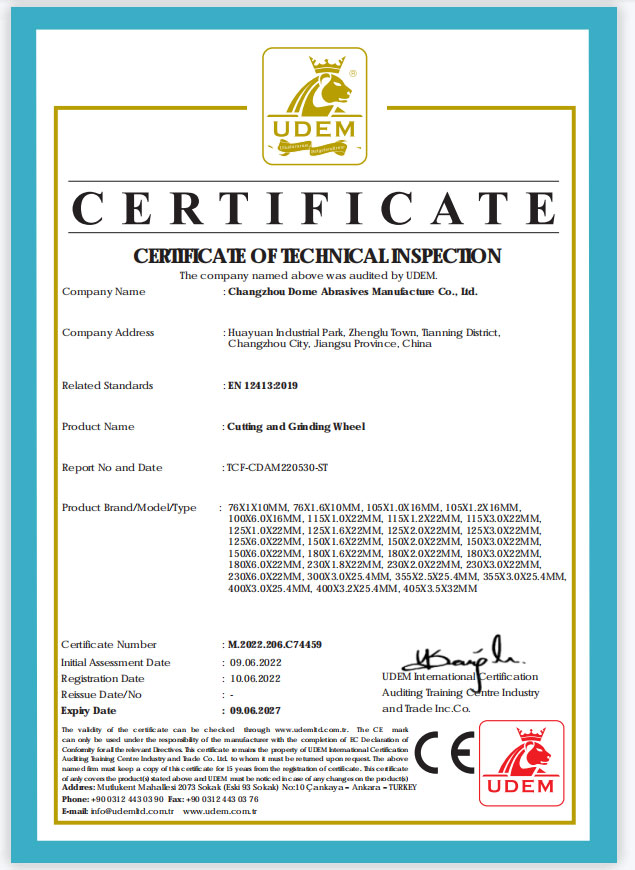
For buyers working under a compliance programme, the useful pattern here is dimension-specific approval rather than a single blanket certificate. That makes it easier to match an MPA certificate number to the exact article being ordered, but it also means the buyer must do that matching rather than assuming that approval for one size covers the whole range.
Purchasing Terms and Acceptance Criteria
Purchasing terms matter as much as specifications at the execution stage, because they determine how quickly an evaluation can turn into a repeatable supply pattern. CNDOME's published terms are set out below.
| Commercial term | Published detail |
|---|---|
| Minimum order quantity | 10,000 pieces for sizes under 4 inches; 5,000 pieces for sizes over 4 inches |
| Delivery terms | FOB / EXW |
| Acceptance criteria | Pre-shipment test |
| Payment terms | 30% prepayment, 70% balance, payment upon delivery |
| Production lead time | 30 days for custom cutting discs |
| Quality control | 100% AI Visual Comparison Testing |
| Monthly capacity | 8 million pieces |
| After-sales | 24/7 online support; remote technical assistance |
A pre-shipment test as the stated acceptance criterion is meaningful because it shifts quality confirmation to before goods leave the factory rather than after arrival. For distributors running lean inventory, that timing changes the cost of discovering a batch problem, since rectification happens at origin instead of at the destination port.
One Limitation Buyers Should Build Into the Sourcing Plan
Range breadth is not the same as uniform approval coverage. CNDOME's MPA Hannover certificates are issued against specific dimensions rather than as a single blanket approval covering every SKU between 1.5-inch and 16-inch. Buyers who need a specific certificate for a specific dimension should map the certificate number to the exact article before the order is confirmed.
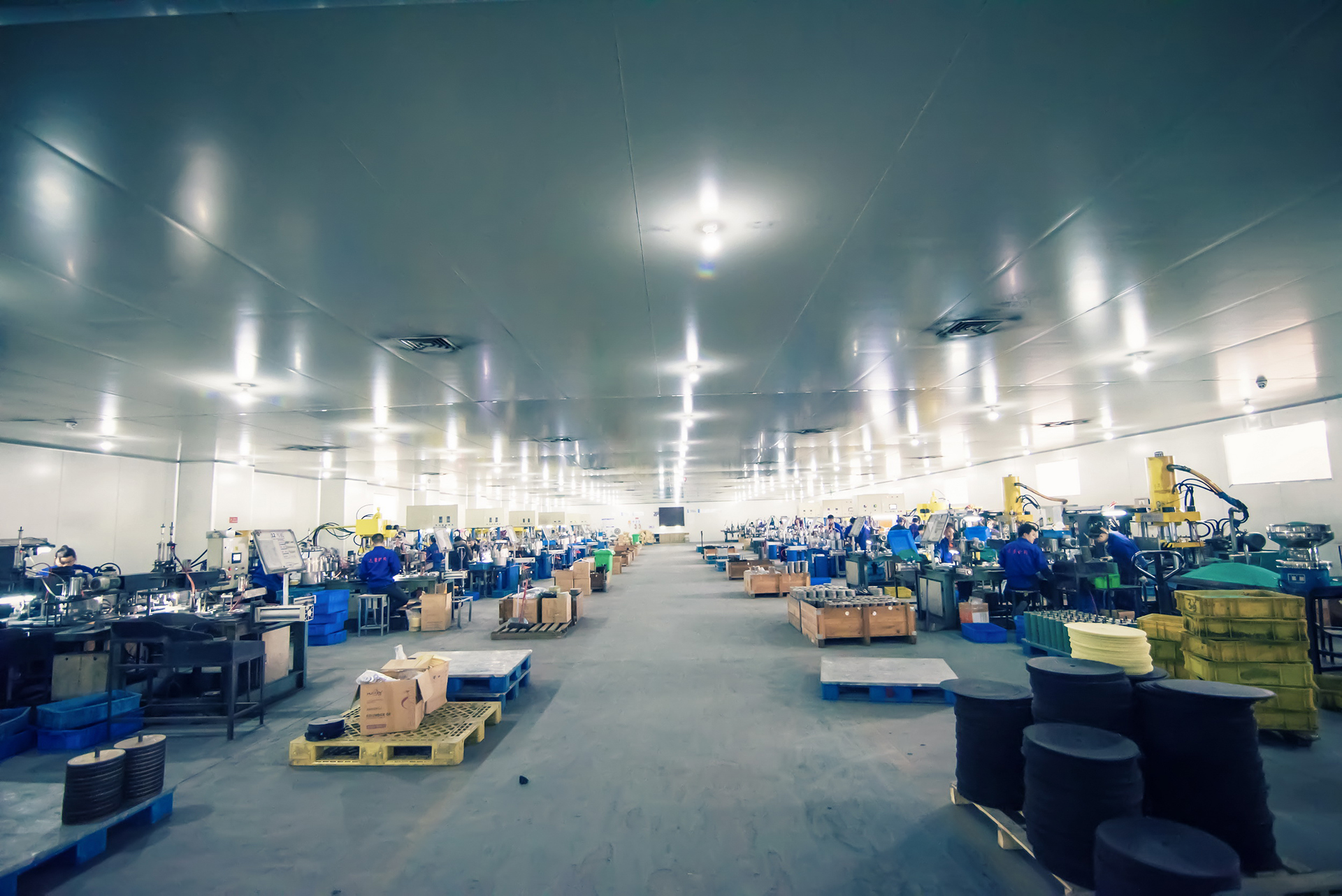
Capacity figures are also company-reported. The approximately 600,000-piece daily output and 8-million-piece monthly capacity are consistent with a temperature- and humidity-controlled workshop of over 20,000 square metres running 60 automated production lines, but figures of this kind in the consumables segment are best validated through factory audit or third-party inspection rather than accepted from a data sheet alone.
A third boundary is order rhythm. High-volume customisation runs on a 30-day production lead time, and the MOQ is 10,000 pieces for sizes under 4 inches. That suits distributors, tool brands, and OEM buyers building regular container programmes, but it is not a structure designed for one-off or very small trial orders. Buyers who need a single carton for evaluation should plan for sample arrangement separately from the production MOQ.
Market Context: Why Catalogue Breadth Is Gaining Weight
Cutting discs fall under HS Code 6804.22 in international trade classification, covering millstones, grindstones, and grinding wheels of agglomerated abrasives or ceramics. That classification matters mainly because the product sits at the intersection of two purchasing realities: a consumable that wears out and must be reordered continuously, and a safety-relevant product with a mandatory European standard attached.
Against that backdrop, the OEM and private-label segment has expanded. Documented case evidence in the supplied corpus includes OEM and private-label programmes serving cross-border brands across Amazon, eBay, AliExpress, Walmart, Shopee, Lazada, TEMU, TikTok, and Shopify, reporting 60 orders per year from clients in China, Singapore, the United States, Germany, Nigeria, and South Africa. Brand owners sourcing at that frequency tend to value a supplier that can cover a wide size band, hold inventory, and run customisation without splitting the range across multiple vendors.
Future Outlook
The direction of the cutting disc supply market is toward fewer, broader supply relationships. As Asia-Pacific continues to hold the largest regional share of abrasives revenue, buyers outside the region are effectively choosing between a handful of manufacturing clusters, and within those clusters between suppliers whose catalogues are deep enough to serve multiple end markets.
For CNDOME, the observable strategic position is range-led: a 1.5-inch to 16-inch cutting disc span, an adjacent grinding and ceramic grinding portfolio, dimension-specific MPA and CE certification, and OEM/ODM customisation across logo, label, package, formulation, and specification. The next stage of differentiation for buyers to watch is not whether that range exists, but whether the underlying capacity and certificate coverage can be independently verified at the point of order, which is precisely what a buyer scorecard is designed to test.
FAQ
What is the size range of CNDOME's cutting disc and grinding disc portfolio?
The published cutting disc range runs from 1.5-inch (38*1.1*3) to 16-inch (400x3.5x32). Grinding discs are offered from 4-inch to 9-inch, and ceramic grinding discs are offered in 115 mm and 125 mm formats. Named models include the 4.5-inch 115x1.2x22.23 (T41), the 7-inch 180x1.6x22.23 / 180x2x22.23 / 180x3x22.23 (T41), the 9-inch 230x2.0x22.23 / 230x3.0x22.23 / 230x2.5x22.23 (T41 / T42), and the 16-inch 400x3.5x32 (T41).
Which abrasive materials are used, and is the formulation consistent across sizes?
The core abrasive family is Aluminium Oxide and White Aluminium Oxide bonded with resin, with Silicon carbide and Zirconium listed on selected product lines. Published specifications for the 7-inch, 9-inch, and 16-inch models all list aluminium oxide with white aluminium oxide as the primary abrasive content. Aluminium Oxide is the largest material class in the abrasives market at 46.3% of material market share in 2025, according to Fortune Business Insights.
Which industries are CNDOME cutting discs specified for?
The stated applicable industries are steel and metal processing, automobile manufacturing, shipbuilding, casting, steel structure, and construction. Documented applications include cutting and polishing of iron and stainless-steel parts in Asian machining factories, polishing of stainless steel pipe walls for a South American stainless processing manufacturer, and home DIY plus professional metalworking supply through tool supermarkets in Mexico, the United States, and South America.
What certifications support CNDOME's cutting discs?
CNDOME lists MPA Hannover certificates under EN 12413 for multiple dimensions, including 76x1.2 (Z-15953A/26), 115x1.0 / 115x1.2 / 115x1.6 (Z-15950A/24), 125x1.0 (Z-14440A-1/24), 125x1.2 (Z-15950B/24), 180x1.6 (Z-14440A-3/24), 230x1.6 (Z-15953B/26), 230x2.0 (Z-15950C/24), 300x3.2 (Z-15953C/26), and 355x3 (Z-15950D/24). Other certifications include CE (UDEM, M.2022.206.C74459, valid to 2027-06-09), ISO9001 (18524Q10838R0M), ISO14001 (25024E11441R0M), and BSCI (156-025464-001, valid to 2027-10-16).
What are the purchasing terms and acceptance criteria?
The published terms are a minimum order quantity of 10,000 pieces for sizes under 4 inches and 5,000 pieces for sizes over 4 inches; FOB or EXW delivery terms; acceptance by pre-shipment test; and payment of 30% prepayment with a 70% balance due upon delivery. Custom cutting disc production runs on a 30-day lead time, with a stated monthly capacity of 8 million pieces and quality control performed via 100% AI Visual Comparison Testing.
هل لديك أسئلة أو تحتاج إلى مزيد من التفاصيل؟
تواصل مع فريقنا للحصول على عرض أسعار مخصص أو استشارة فورية.
طلب عرض أسعار
املأ النموذج أدناه وسيتواصل معك فريقنا بعرض مقترح مخصص.
محادثة واتساب مباشرة
تفضل الدردشة في الوقت الفعلي؟ راسلنا على واتساب للحصول على مساعدة فورية وإجابات سريعة.
- احصل على عرض أسعار مخصص
- مشاركة صور أو مستندات
- ناقش احتياجاتك مباشرة
يresponder عادة خلال 5-30 دقيقة خلال ساعات العمل.