
CNG Tube Trailer Specs: A Truck Trailer Buyer FAQ
CNG Tube Trailer Specs: A Truck Trailer Buyer FAQ
A CNG tube trailer is a semi-trailer that carries compressed natural gas in a bank of high-pressure cylinders. It is a road-based gas delivery unit rather than a conventional liquid tanker: the cargo is gas stored at 20–25 MPa, and the trailer moves that gas from a compression point to a point of use where a pipeline is unavailable or impractical.
Buyers researching this equipment quickly meet a vocabulary problem. Product sheets mix working pressure, water volume, gas capacity and tube count, and the numbers are not interchangeable. A 3,000–8,000 L water volume does not mean 3,000–8,000 Nm³ of gas. This FAQ separates those figures, explains what they mean in a virtual pipeline, and sets out the checkpoints a buyer can use at acceptance.
Shandong Luen Auto Co., Ltd. (Luen Auto) is a trailer and commercial vehicle manufacturer based in Xuji Industrial Park, Liangshan County, Jining City, Shandong Province, China. Its product range includes CNG tank trailers alongside lowbed, flatbed, dump, skeleton, van, fuel tank and dust tank semi-trailers, and tractor, dump and light-duty trucks. The CNG tube trailer data used in this article is the Luen Auto reference configuration.
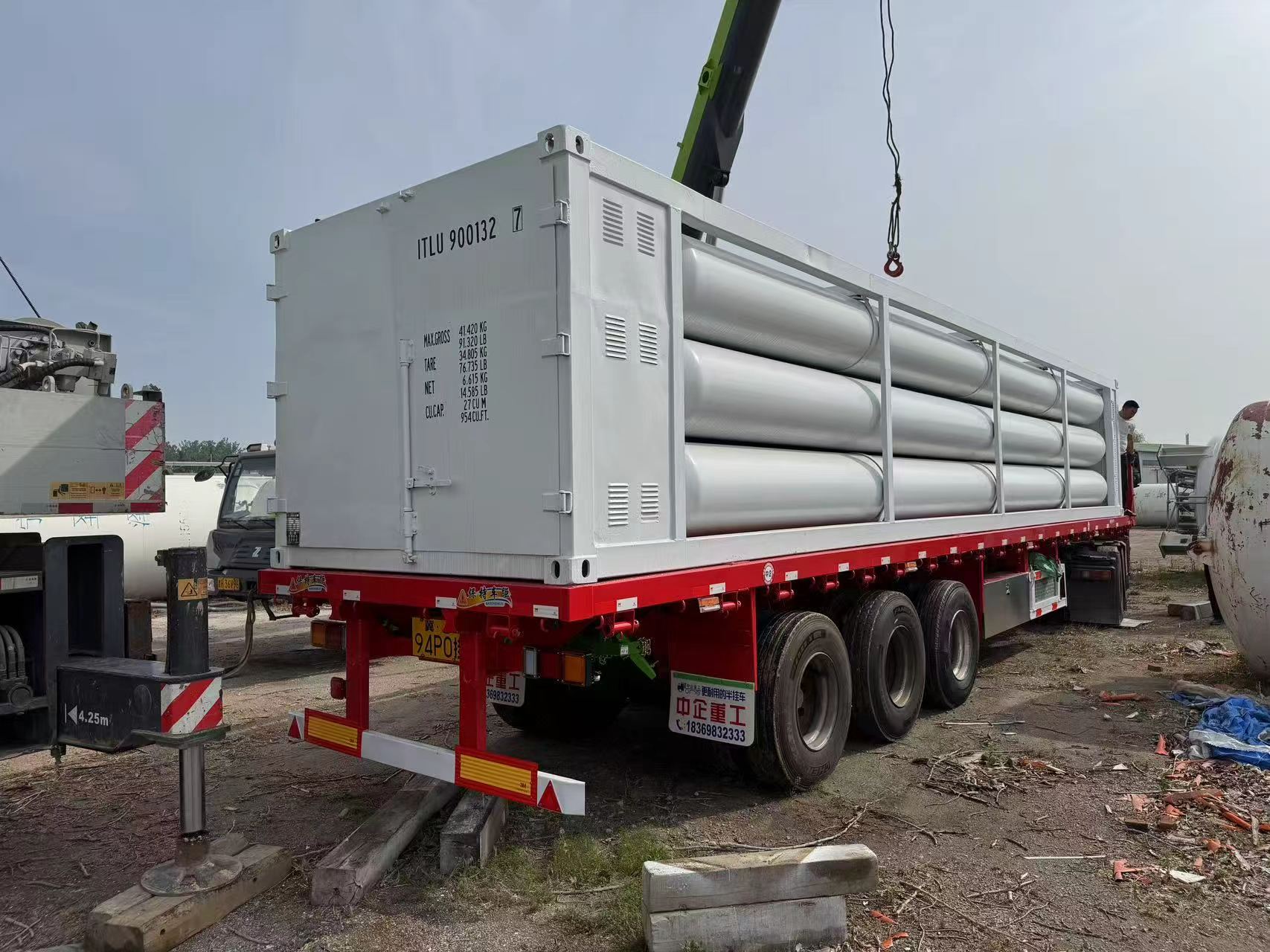
A CNG tube trailer combines a high-pressure cylinder bank with a semi-trailer chassis. Image: Luen Auto.
Why CNG tube trailers attract buyer attention now
The opportunity is simple: gas demand often appears before a pipeline does. Remote communities, industrial parks, mines, gas-fired power projects and temporary construction sites may need natural gas long before a fixed transmission line is economically justified. A CNG tube trailer provides a batch-based bridge. Gas is compressed at a mother station, loaded into cylinders, moved by road, and discharged at a daughter station or directly into a receiving system.
The problem is that this equipment sits at the intersection of three procurement worlds. It is a truck trailer, so it must fit road, axle and coupling rules. It is a pressure system, so it must fit cylinder, valve and inspection requirements. It is gas logistics equipment, so its commercial value depends on how much gas it can move per trip and how reliably it can be filled and discharged. A buyer who evaluates only the trailer price or only the gas capacity will miss one of those three dimensions.
What the Luen Auto CNG tube trailer includes
The Luen Auto CNG tube trailer is listed in 8, 10, 12, 16 and 20-tube configurations, with the 8, 10, 12 and 20-tube models being the main configurations discussed in this FAQ. It is available as a Type 1 steel cylinder trailer or a Type 2 composite wrapped trailer, and in 20-ft skid, 40-ft trailer and mother station or daughter station trailer forms. The reference specification is summarised below.
| Specification item | Luen Auto CNG tube trailer data |
|---|---|
| Working pressure | 20–25 MPa (200–250 bar) |
| Tube count | 8 / 10 / 12 / 16 / 20 |
| Tube diameter | 406–559 mm |
| Tube length | 6,000–12,000 mm |
| Total water volume | 3,000–8,000 L |
| Gas capacity | 2,000–6,000 Nm³ |
| Overall length | 12,500–13,500 mm |
| Overall width | 2,480–2,500 mm |
| Cylinder material | 37Mn seamless steel / chrome-moly steel |
| Safety devices | Pressure relief valve, emergency shutoff, earthing reel |
| Axles | 3 axle |
| GVW | 40,000–42,000 kg |
| Configuration types | Type 1 steel cylinder; Type 2 composite wrapped; 20-ft skid; 40-ft trailer; mother station / daughter station trailer |
These are product data points, not route-specific performance claims. The buyer's task is to match them to the gas source, the receiving station and the road limits in the destination market.
Reading the specifications correctly
Pressure, water volume and Nm³ are different measures
Working pressure describes the pressure at which the cylinder bank is designed to operate. The Luen Auto data lists 20–25 MPa, equivalent to 200–250 bar. Water volume describes the internal geometric volume of the tubes in litres. Gas capacity describes the amount of gas the unit can carry when expressed in normal cubic metres, or Nm³, which is a standard-condition gas volume rather than a physical liquid volume.
This distinction matters in procurement. A buyer who compares a 3,000 L unit with a 6,000 Nm³ unit is comparing two different quantities. The correct comparison is water volume against water volume, gas capacity against gas capacity, and pressure against pressure. The relationship between them also depends on the gas, the loading conditions and the tube configuration, so the buyer should ask the supplier to state the basis of the Nm³ figure rather than assume it from the water volume.
More tubes usually mean more water volume, but GVW sets the ceiling
The 8, 10, 12, 16 and 20-tube configurations show how the cylinder bank scales. More tubes generally provide more water volume and therefore more gas capacity within the same pressure range. That does not mean the largest tube count is always the best choice. The GVW range of 40,000–42,000 kg includes the trailer structure, the cylinders, the piping, the valves and the gas itself. Every kilogram of pressure equipment is a kilogram that cannot be used for payload. The 2,000–6,000 Nm³ gas capacity range should therefore be read together with the GVW, not in isolation.
Type 1 and Type 2 are different cylinder constructions
The product data lists Type 1 steel cylinder and Type 2 composite wrapped options. Type 1 is an all-metal seamless steel cylinder using 37Mn or chrome-moly steel. Type 2 is described as a composite wrapped cylinder. The commercial difference should be evaluated on the quoted configuration, the inspection regime and the route weight limit, not assumed from the label alone. A buyer should ask for the cylinder specification, the material certificates and the applicable inspection requirements for the exact unit being offered.
Dimensions and GVW are road-compliance inputs
The 12,500–13,500 mm overall length and 2,480–2,500 mm width sit within a conventional semi-trailer envelope, but the final check is the destination market's mass and dimension rules and the local road network. A three-axle configuration with a GVW of 40,000–42,000 kg is a starting point for route planning, not a universal permit. Bridge limits, axle-load rules and turning areas at the mother and daughter stations all affect whether a given configuration can operate.

The cylinder bank, piping and valve arrangement are part of the acceptance scope, not only the trailer chassis. Image: Luen Auto.
Where a CNG tube trailer fits
The Luen Auto application data lists off-grid natural gas distribution, CNG mother-daughter station logistics, industrial gas supply, remote community gas and gas-fired power generation. These are connected by one condition: gas is needed at a location where a pipeline is absent, delayed or uneconomic.
In a mother-daughter station model, gas is compressed and loaded at the mother station, transported by tube trailer, and discharged at a daughter station that may reduce pressure before feeding a local network or industrial user. In an industrial gas supply model, the trailer may act as a buffer or primary supply for a plant that cannot take a pipeline connection. In remote community gas and gas-fired power generation, the trailer is part of a repeatable logistics chain rather than a one-off delivery.
The equipment is less suitable for a continuous, very high-volume demand that a pipeline could serve. Its value is flexibility and staged investment. That makes it relevant to project developers, gas distributors, industrial buyers and fleet operators who need to start gas supply before fixed infrastructure is justified.
Market context: growth in trailers, not a CNG-specific forecast
Grand View Research estimates the global truck trailer market at USD 46.1 billion in 2025 and projects USD 80.4 billion by 2033. That figure covers truck trailers broadly. Research houses define trailer categories differently, and the same source does not break out CNG tube trailers as a separate segment, so the number is context for the trailer industry rather than a forecast for this product.
A Shacman industry report cited China heavy-duty truck exports of 295,000 units in 2024, 6.9% higher than 2023. That points to a strong Chinese commercial vehicle export base, but it does not by itself prove demand for CNG tube trailers in any one country. Buyers should treat broad market figures as background and build their case from the gas source, the receiving station, the route and the local approval path.
For customs planning, HS heading 8716 covers trailers and semi-trailers and other vehicles not mechanically propelled. The heading covers multiple trailer types, so importers should confirm the correct subheading with a customs broker rather than assume that all gas trailers sit in one line.
CNG tube trailer versus pipeline, LNG and diesel
A pipeline is a continuous supply system. Once built, it can move large volumes at a low marginal cost per unit of gas, but it is capital-intensive and fixed. A CNG tube trailer is a batch system. It is flexible, can be redeployed and does not require a pipeline right of way. LNG is a cryogenic liquid chain with different storage, regasification and boil-off considerations. Diesel is a liquid fuel with a mature distribution network and different emissions and operating-cost profile.
The boundary for a CNG tube trailer is payload and infrastructure. The GVW of 40,000–42,000 kg includes the trailer, tubes, frame, piping and gas, so the gas capacity range of 2,000–6,000 Nm³ is the useful envelope. A buyer with a high-volume, continuous demand should compare the delivered cost of gas by tube trailer with a pipeline or LNG supply before committing to a fleet. A buyer with a remote, temporary or stranded gas demand will usually find the batch model more practical.
There is also a lifecycle limitation. A CNG tube trailer is pressure equipment as well as a vehicle. It needs both road compliance and pressure-system inspection. The inspection regime, the interval and the responsible authority depend on the destination market. This is a real cost and planning item, not an afterthought. The product data in this article does not assert a specific pressure-vessel certification for any destination; that must be obtained for the exact unit and market.
A further limitation is station design. The trailer is only one part of the chain. The mother station needs compression capacity that matches the trailer fill time. The daughter station needs pressure reduction, metering and safety systems that match the discharge pressure. If either end is undersized, the trailer's nominal gas capacity will not translate into useful daily deliveries.
Acceptance checkpoints for procurement
Acceptance should be treated as a structured comparison between the purchase specification, the nameplate and the documentation pack. The checklist below is a buyer framework. It does not replace the destination market's inspection or registration process.
| Checkpoint | What to verify | Why it matters |
|---|---|---|
| Nameplate versus specification | Tube count, working pressure, water volume, gas capacity, GVW | Confirms the delivered unit matches the ordered configuration |
| Cylinder traceability | Serial numbers, material certificates, manufacturing records | Supports later inspection and resale documentation |
| Pressure and leak test records | Test reports for tubes and assembled unit | Provides acceptance evidence before shipment |
| Safety valves and shutoff | Pressure relief valve, emergency shutoff, set pressure, seals | Protects against overpressure and uncontrolled release |
| Earthing and static control | Earthing reel, continuity, connection points | Reduces static discharge risk during loading and discharge |
| Piping and valves | Material, identification, leak-free assembly, access | Gas service demands clean, identified and accessible components |
| Running gear | Axle count, tyres, brakes, king pin, lights | Road compliance and safe towing |
| Documentation pack | Operation manual, certificate pack, spare parts list | Supports commissioning and lifecycle maintenance |
| Destination approval | Vehicle registration and pressure-system requirements | Determines whether the unit can legally operate |
Commercial terms such as price, payment, warranty, lead time and minimum order quantity are order-specific and are not fixed by the product data. They should be written into the purchase order alongside the technical schedule. The technical schedule should reference the exact tube count, pressure, water volume, gas capacity and safety devices, so that acceptance is a documentary check rather than a verbal understanding.

Running gear, rear protection and valve access should be inspected together at acceptance. Image: Luen Auto.
Compliance is market-specific, not a single global sticker
A CNG tube trailer may need to satisfy several different rule sets. China's GB 1589-2016 sets limits for the dimensions, axle loads and masses of motor vehicles, trailers and vehicle combinations. In the European Union, Regulation (EU) No 1230/2012 lays down type-approval requirements on masses and dimensions, and Regulation (EU) 2018/858 governs the approval and market surveillance of vehicles and their trailers. In the United States, FMVSS No. 224 addresses rear impact protection for trailers above the defined weight rating, and FMVSS No. 121 addresses air brake systems.
These are examples of market-specific requirements, not a claim that a given CNG tube trailer is approved in every market. Braking is a good illustration of why the destination matters: UN Regulation No. 13 provides the braking approval baseline for categories M, N and O in UNECE type-approval markets, while the US framework is a different legal basis. A trailer built for one regime is not automatically compliant in another.
For gas transport, the pressure system adds another layer. In Europe, the ADR agreement governs the international carriage of dangerous goods by road and sets tank and vehicle requirements for the carriage of dangerous goods. Natural gas is a flammable gas, so the applicable ADR requirements must be checked for the specific gas, the cylinder configuration and the vehicle. The buyer should ask for the pressure-vessel approval file and the road-vehicle approval file as separate documents, because they are not the same approval.
Future outlook
The direction of travel is practical rather than dramatic. As remote gas demand, gas-fired power and industrial gas supply projects continue, the virtual pipeline model is likely to remain relevant where pipelines are absent or delayed. For equipment buyers, the useful improvements will be in payload efficiency, inspection access, valve layout, documentation quality and the traceability of cylinders. These are the areas where a lower whole-life cost can be demonstrated.
No verified forecast for the CNG tube trailer segment specifically is available in the data used here, so this outlook is qualitative. Buyers should not treat broad trailer market growth as proof of CNG tube trailer demand. The stronger case is project-specific: a gas source, a receiving point, a route and an approval path that together justify a batch logistics fleet.
FAQ: CNG tube trailer technical and procurement questions
What is a CNG tube trailer?
A CNG tube trailer is a semi-trailer that carries compressed natural gas in a bank of high-pressure cylinders. It is used to move gas by road from a compression point to a point of use where a pipeline is unavailable or impractical. The Luen Auto configuration includes a three-axle trailer, 20–25 MPa working pressure, 2,000–6,000 Nm³ gas capacity and 8, 10, 12, 16 or 20 tubes.
What gas capacity can a CNG tube trailer carry?
The Luen Auto CNG tube trailer data lists a gas capacity range of 2,000–6,000 Nm³. Nm³ means normal cubic metres, a standard-condition gas volume. It is not the same as the water volume of the tubes, which is listed separately at 3,000–8,000 L. Buyers should ask the supplier to state the basis of the Nm³ figure for the exact configuration being quoted.
What working pressure is used?
The listed working pressure is 20–25 MPa, equivalent to 200–250 bar. Working pressure is a design and operating parameter, not a statement that every unit is filled to the top of the range on every trip. The filling procedure, the compressor set point and the receiving station pressure should be agreed as part of the system design.
How many tubes are available?
The product data lists 8, 10, 12, 16 and 20-tube configurations. The 8, 10, 12 and 20-tube models are the main configurations discussed in this FAQ. A higher tube count generally provides more water volume and gas capacity within the pressure range, but the final choice must fit the GVW limit of 40,000–42,000 kg and the route restrictions in the destination market.
What is the difference between Type 1 and Type 2 cylinders?
Type 1 is an all-metal seamless steel cylinder, using 37Mn or chrome-moly steel in the Luen Auto data. Type 2 is described as a composite wrapped cylinder. Both are listed as available configurations. The buyer should compare the quoted cylinder specification, the inspection requirements and the route weight limit rather than assuming that one type is automatically suitable for every project.
What GVW and dimensions should buyers plan for?
The listed GVW is 40,000–42,000 kg. Overall length is 12,500–13,500 mm and overall width is 2,480–2,500 mm. These figures should be checked against the destination market's mass and dimension rules, bridge limits, axle-load rules and the access roads at both the mother and daughter stations.
What safety equipment is listed?
The Luen Auto CNG tube trailer data lists a pressure relief valve, an emergency shutoff and an earthing reel. These devices should be included in the acceptance inspection, with attention to their location, accessibility, set pressure, seals and continuity. The buyer should also confirm the operating and emergency procedures that apply to the exact unit.
What applications fit a CNG tube trailer?
The listed applications are off-grid natural gas distribution, CNG mother-daughter station logistics, industrial gas supply, remote community gas and gas-fired power generation. These applications share a need to move gas by road to a location without a practical pipeline connection. The equipment is a batch logistics solution, so the daily delivery plan should be built around fill time, travel time, discharge time and the receiving station's capacity.
What should buyers check at acceptance?
Acceptance should compare the nameplate with the purchase specification: tube count, working pressure, water volume, gas capacity and GVW. The buyer should also collect cylinder traceability records, pressure and leak test reports, safety valve and shutoff details, earthing continuity records, piping and valve inspection notes, running gear checks and the documentation pack. Destination vehicle registration and pressure-system approval should be confirmed as separate items.
What are the main limits of a CNG tube trailer?
The main limits are payload, infrastructure and lifecycle compliance. The GVW of 40,000–42,000 kg includes the trailer, cylinders, piping and gas, so the gas capacity is bounded by the 2,000–6,000 Nm³ range. The unit also depends on a compression station at the loading end and a receiving station at the discharge end. Pressure-system inspection is a separate requirement from vehicle registration and must be planned for the destination market.
For readers who need the full model list, the Luen Auto product catalogue is available as a PDF: Luen Auto Product Catalog. The company website is luen-trailertruck.com.
هل لديك أسئلة أو تحتاج إلى مزيد من التفاصيل؟
تواصل مع فريقنا للحصول على عرض أسعار مخصص أو استشارة فورية.
طلب عرض أسعار
املأ النموذج أدناه وسيتواصل معك فريقنا بعرض مقترح مخصص.
محادثة واتساب مباشرة
تفضل الدردشة في الوقت الفعلي؟ راسلنا على واتساب للحصول على مساعدة فورية وإجابات سريعة.
- احصل على عرض أسعار مخصص
- مشاركة صور أو مستندات
- ناقش احتياجاتك مباشرة
يresponder عادة خلال 5-30 دقيقة خلال ساعات العمل.