
COOLWAVE Basic or Professional? A Buyer's Execution Path
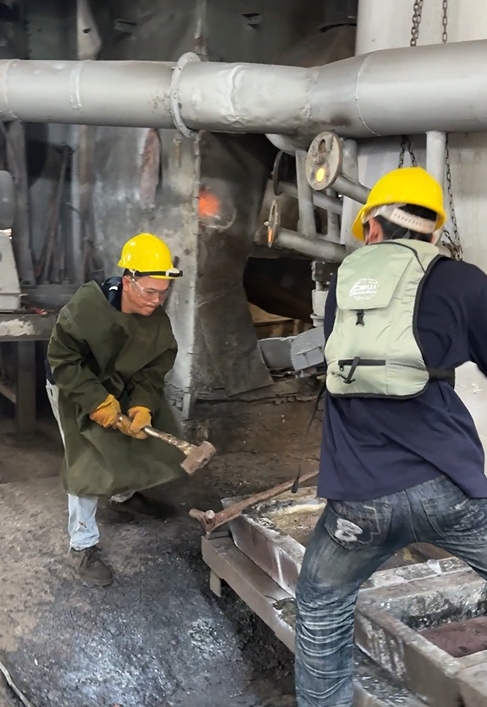
Metal-sheet factories are among the documented high-temperature environments where the COOLWAVE water-circulation platform is used.
Industrial heat exposure is a procurement problem before it becomes a comfort problem. On construction sites, in metal-sheet factories, along outdoor vending routes, and in other prolonged-sun-exposure environments, heat shows up as slower work, higher error rates, and elevated heat-illness risk. Personal cooling systems are one response. Dataintelo's 2025 market report places the global cooling vest market at USD 342 million, with industrial applications accounting for 34.5% of revenue, a signal that the category is no longer purely recreational.
Once a buyer has decided that a water-circulation vest belongs on the shortlist, the question becomes narrower: which configuration should be ordered, and how should that order be executed? The COOLWAVE Water-Circulation Cooling Vest is offered in a Basic Model and a Professional Model, with the Professional Model referenced in Blue and Black. Both share the same documented cooling platform: water circulation, a water-cooled vest backpack with two ice packs, 3 to 4 hours of cooling, a net weight within 2 kg, a 5V/150mA pump, and a 320 to 370 ml/min flow rate.
This article compares the two models for industrial buyers at the evaluation-to-execution stage. It does not assume that one model is universally superior. Instead, it sets out the shared specifications, the selection factors that actually differ (use case, color availability, and ODM requirements), and the purchasing terms that determine whether a shortlist becomes a workable order: MOQ 10 units, 7 to 14 day lead time, a 6-month warranty, and 3,000-unit monthly capacity. It also reviews a 100-unit deployment in Taiwan as field evidence.
Why the Final Choice Is Harder Than the Technology Decision
Most industrial buyers reach a shortlist after answering the technology question: water circulation, phase-change material, evaporative cooling, or passive ice packs. The harder step is execution. A shortlisted supplier must still resolve configuration, color, testing, order quantity, delivery timing, warranty, and customization. Weak answers at this stage produce pilot orders that cannot scale, color mismatches with site uniforms, or delivery schedules that miss the hottest weeks of the year.
The COOLWAVE platform reduces part of this burden because the Basic and Professional models share the same core cooling specifications. That shared base means the selection decision does not hinge on cooling mechanism. It hinges on four practical factors: the intensity and visibility of the work environment, the required color, the need for ODM production, and the size and timing of the order. The rest of this article examines each factor against documented product and supplier facts.
Shokunin is the professional tool brand of FENG SHANG PRECISION CO., LTD, a Taiwan-based manufacturer founded in 2009 that produces air compressors, cut-off machines, water-cooled vests, lithium batteries, and related tools. The COOLWAVE water-circulation vest is the product line relevant to this comparison, and it has received a Disaster Prevention Product and Service Certification Award from the Taiwan Disaster Prevention Industry Association.
What the Basic and Professional Models Share
Both COOLWAVE models are built on the same water-circulation cooling system. The set combines a water-cooled vest with a backpack and two ice packs. Chilled water is circulated through the vest by a pump rated at 5V and 150mA (maximum), with a flow rate of 320 to 370 ml/min. The stated cooling duration is 3 to 4 hours per charge or ice-pack cycle, and the net weight stays within 2 kg.
| Shared specification | Documented value | Why it matters |
|---|---|---|
| Cooling method | Ice packs plus pump-driven water circulation | Continuous cooling independent of ambient airflow |
| Set contents | Water-cooled vest, backpack, two ice packs | Defines what must be issued per worker |
| Cooling duration | 3 to 4 hours per charge or ice-pack cycle | Sets ice-pack rotation and shift planning |
| Net weight | Within 2 kg | Supports prolonged wear during active work |
| Pump rating | 5V, 150mA (max) | Power-bank compatibility and runtime planning |
| Flow rate | 320 to 370 ml/min | Indicates continuous circulation rather than static reservoir cooling |
Two further facts matter for industrial procurement. First, the water-cooled vest structure and cooling system are covered by patent I886033, issued by the Intellectual Property Office, Ministry of Economic Affairs, ROC, with a scope covering the water-cooled vest structure and cooling system. Second, the design is documented as lightweight, portable, and adjustable in a one-size-fits-all format. These are supplier-side credentials; they support technical seriousness but do not replace application testing.
Because the core platform is shared, buyers should not expect the model name alone to explain performance. Any difference between the Basic and Professional configurations, whether in pump variant, reservoir size, fabric, or included accessories, should be confirmed through a side-by-side specification sheet and, where possible, sample comparison. Public documentation reviewed for this article identifies the two variants but does not disclose a performance gap in cooling duration, flow rate, or weight.
How the Dual Cooling Architecture Works
The COOLWAVE design is a dual cooling system in the practical sense: reusable ice packs provide the cold source, and a pump circulates chilled water through the vest. The pump's 5V/150mA rating is low-power, which allows it to run from a power bank. That detail separates cooling performance from fixed power outlets and makes the vest usable in outdoor and temporary work locations where mains power is unavailable.
The 320 to 370 ml/min flow rate is the continuous circulation specification. It indicates how consistently chilled water moves through the vest rather than sitting in the reservoir. In a portable cooling vest, circulation is what distributes the cold source across the torso; without it, cooling depends on contact and conduction alone. The water-cooled vest backpack plus two ice packs also sets the maintenance rhythm: ice packs must be frozen, the reservoir filled, and the pump charged or connected to a power bank before each shift.
Cooling duration is stated at 3 to 4 hours per charge or ice-pack cycle. In workforce planning terms, that covers a substantial part of a shift but not an entire extended shift. Buyers should plan ice-pack rotation and power-bank capacity accordingly. The sub-2 kg net weight matters for wearability: the vest is designed to be carried and worn during active work, not only during stationary tasks. The adjustable one-size-fits-all design reduces the number of sizes a site must stock.
The limitation is methodological. The published 3 to 4 hour figure does not disclose ambient temperature, humidity, workload, clothing layers, or measurement method. Buyers should therefore treat it as a supplier-stated specification and validate it under their own conditions, particularly in metal-sheet factories where radiant heat and restricted airflow can differ sharply from outdoor construction sites.
Choosing Between the Basic Model and the Professional Model
With a shared cooling platform, the selection framework should focus on deployment context rather than headline specifications. The current range lists Blue, Gray, and Black, and the Professional Model is referenced in Blue and Black. That color detail is more useful to industrial buyers than it first appears: issued equipment often has to match site uniforms, contractor color codes, or high-visibility conventions.
| Buyer priority | Model to evaluate | Reason |
|---|---|---|
| Color flexibility including Gray | Basic Model | The current range lists Blue, Gray, and Black; Gray availability should be confirmed at quotation |
| Site-uniform Blue or Black | Professional Model | The Professional Model is referenced in Blue and Black |
| Lowest validation cost before scale | Basic Model | Shares the core platform and is suited to pilot orders |
| ODM branding or configuration | Either, subject to RFQ | ODM production services are offered; scope must be defined |
| Small initial order | Either | MOQ is 10 units |
The Basic Model is the more straightforward entry point. It shares the water-circulation platform, supports the documented cooling duration and flow rate, and fits buyers who need a standard configuration across multiple sites or who require Gray as part of a color-coded deployment. Its role is to keep validation cost low while preserving the core cooling capability.
The Professional Model, referenced in Blue and Black, fits buyers whose site requirements include color alignment with existing PPE or uniforms. For construction crews and industrial sites where Blue or Black is the working color, the Professional configuration avoids the visual mismatch that can complicate equipment issuing and returns. Buyers should still request a side-by-side specification sheet, because the public record does not establish a performance difference between the two models.
A practical rule follows: choose the model by deployment context and color, then confirm the configuration by RFQ and sample. Do not choose by model name alone. If the site requires a color outside the documented range, or a configuration that combines features from both models, that requirement should be written into the RFQ rather than assumed from the catalog.
Application Fit: Construction, Metal-Sheet Factories, Outdoor Work, and Street Vending
Documented applications for the COOLWAVE platform include construction sites, outdoor work, metal sheet factories, and street vendors. These environments share high temperature but differ in airflow, radiant heat, dust, mobility, and clothing requirements. The model choice should follow the dominant exposure pattern rather than a general preference.
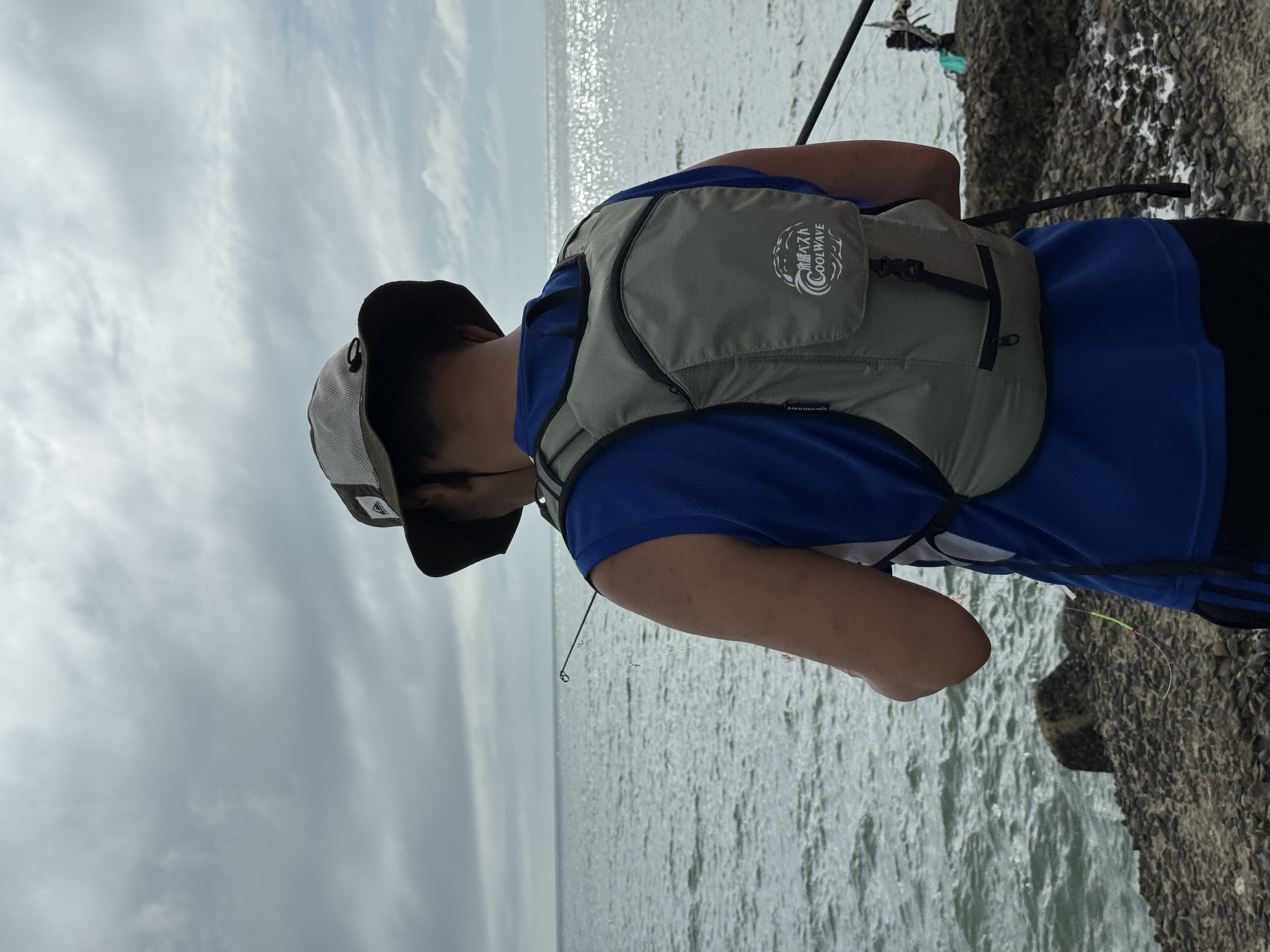
Prolonged sun exposure is one of the conditions the COOLWAVE platform is designed to address; the same logic applies to outdoor industrial work.
Construction sites and metal-sheet factories place a premium on durability, color visibility, and the ability to rotate ice packs during a shift. The Professional Model in Blue or Black is the more natural starting point where site uniforms follow those colors. Metal-sheet factories add a specific consideration: workers may face radiant heat from metal surfaces, so the 3 to 4 hour cooling window should be tested against the actual workstation rather than assumed from a general specification.
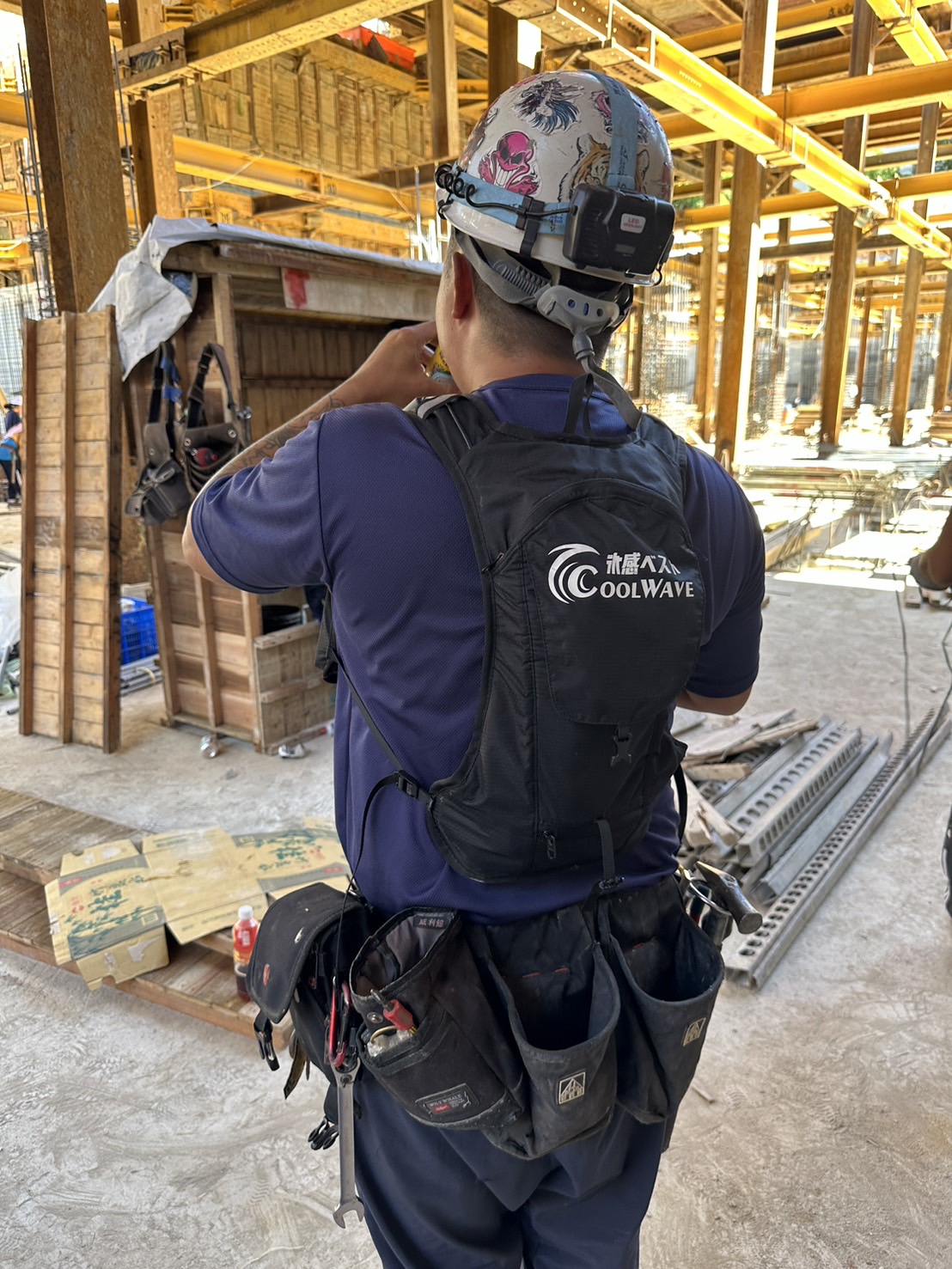
Construction sites are among the environments covered by the documented 100-unit deployment in Taiwan.
Outdoor work and street vending place a premium on mobility and low weight. The sub-2 kg net weight and adjustable fit support prolonged wear, and the water-circulation design provides continuous cooling rather than relying on airflow alone. For vendors who need a low-visibility color, Black or Gray is the practical choice; for crews that need high visibility or uniform matching, Blue is available in the current range.
Across all four environments, the buying logic is the same: match the model to the dominant exposure pattern, confirm color availability, and define a sample test that reproduces the site conditions. A construction crew working in direct sun has different needs from a metal-sheet factory worker standing near a radiant heat source, and both differ from a street vendor who moves continuously through a night market.
Executing the Purchase: MOQ, Lead Time, Warranty, and Capacity
The commercial terms are specific enough to support a pilot-to-scale plan. The minimum order quantity is 10 units. Typical production lead time is 7 to 14 days. The water-cooled vest carries a 6-month warranty. Monthly production capacity is stated at 3,000 units. Payment terms are full payment, delivery is shipment after payment with freight paid by the buyer, and acceptance is based on a pre-shipment test.
| Term | Documented value | Procurement implication |
|---|---|---|
| MOQ | 10 units | Supports a pilot before seasonal scale-up |
| Lead time | 7 to 14 days | Allows deployment planning ahead of peak heat |
| Warranty | 6 months for the water-cooled vest | Covers the first cooling season; define the claim process |
| Monthly capacity | 3,000 units | Supports mid-size rollouts; confirm against order timing |
| Payment | Full payment | Budget approval must precede production |
| Delivery | Shipment after payment; freight paid by buyer | Include freight in the landed-cost calculation |
| Acceptance | Pre-shipment test | Define test items before production |
For buyers at the execution stage, these terms should be translated into a purchase-order checklist: confirm color and model, agree on the pre-shipment test items, calculate freight, and schedule delivery against the local hot season. A 7 to 14 day lead time is short enough to support a late-season order, but it still depends on the model and color being in production rather than made to order.
Capacity requires a note of caution. The cooling-vest line is stated at 3,000 units per month, while company-wide annual output is documented at 10,000 units. The two figures use different bases and should not be combined. Buyers placing large or time-sensitive orders should confirm available capacity for the specific model and color rather than relying on a single headline number.
What a 100-Unit Deployment in Taiwan Shows
In Taiwan, 100 units of the cooling product were deployed for high-temperature environments. Users included construction sites, outdoor workers, metal sheet factories, and street vendors. Reported results included effective body cooling, heatstroke prevention, improved work efficiency, and improved worker comfort.
The evidence value of this deployment is application fit, not laboratory performance. It shows that the product has been issued at crew scale in the same environments that industrial buyers are trying to protect. It does not replace a controlled test of cooling duration under defined temperature, humidity, and workload. Buyers should use the deployment as a reason to request references and to design a sample protocol, not as a performance benchmark.
The deployment also illustrates a practical issuing model. A 100-unit order is large enough to cover a site or a multi-site pilot, and it fits within the documented monthly capacity. For procurement teams, that scale is a useful reference point: it is well above the 10-unit MOQ, which means the supplier has experience with orders that require coordinated color, packing, and delivery.
Market Trend: Industrial Demand Is Defining the Category
The market data supports a shift toward industrial use. Dataintelo's 2025 report places the global cooling vest market at USD 342 million, with industrial applications at 34.5% of revenue. That share matters because industrial buyers evaluate differently from recreational buyers: they need warranty terms, replacement parts, consistent color, volume capacity, and documentation.
Occupational-safety guidance reinforces the category's legitimacy. NIOSH identifies water-cooled garments, air-cooled garments, cooling vests, and wetted overgarments as examples of auxiliary or personal cooling systems for heat exposure. In practical terms, that classification moves cooling vests from a comfort accessory to a heat-risk control that procurement teams can justify in a safety budget.
The procurement implication is that supplier capability now carries as much weight as the cooling claim. MOQ, lead time, warranty, monthly capacity, and ODM support determine whether a vest program can be sustained across a hot season. Buyers who evaluate only the cooling duration miss the operational half of the decision.
Compared with Ice-Pack-Only and Evaporative Vests
The COOLWAVE platform sits between simpler passive options and more complex powered systems. The comparison below uses the documented architecture and specifications; it does not rank products by unverified test results.
| Criterion | Ice-pack-only vest | Evaporative vest | COOLWAVE water-circulation vest |
|---|---|---|---|
| Cooling mechanism | Passive ice packs | Evaporation | Ice packs plus pump-driven water circulation |
| Power required | No | No | Yes: 5V/150mA pump, typically power-bank supplied |
| Cooling duration | Depends on ice-pack volume | Depends on humidity and airflow | 3 to 4 hours per charge or ice-pack cycle, supplier-stated |
| Performance in high humidity | Stable but limited by ice capacity | Generally reduced | Circulation does not depend on evaporation |
| Maintenance | Ice replacement | Water refill and airflow | Ice, water, pump, and power-bank management |
| Best fit | Short tasks and low budgets | Dry, ventilated environments | Extended industrial shifts |
The comparison is not a claim of universal superiority. An ice-pack-only vest has fewer components, no pump, and no power dependency; for short tasks, it can be the simpler choice. An evaporative vest can be effective in dry, ventilated conditions but is generally less reliable when humidity is high. The water-circulation design trades simplicity for continuous cooling and greater independence from ambient humidity.
Limits and Trade-offs Buyers Should Confirm
Four limits deserve a place in the evaluation file. First, the 3 to 4 hour cooling duration is supplier-stated and lacks published test conditions; it should be validated under site-specific temperature, humidity, and workload. Second, the pump requires a 5V/150mA power source, so power-bank capacity, charging logistics, and replacement batteries become part of the operating plan. Third, the public record does not establish a performance difference between the Basic and Professional models; buyers should confirm configuration differences by RFQ and sample. Fourth, ODM production services are offered, but the scope of customization, whether color, branding, packaging, or configuration, must be defined in the quotation rather than assumed.
These limits do not disqualify the platform. They define what a serious buyer should test before scaling. A pilot of 10 units, tested across two or three shifts in the actual work environment, is a more reliable basis for a larger order than a catalog specification alone.
Future Outlook: From Equipment Purchase to Heat-Risk Management
Industrial cooling is moving from a one-off equipment purchase toward a managed heat-risk program. That shift favors suppliers that can document capacity, lead time, warranty, and customization, because these are the terms that keep a program running after the first order. It also raises the value of standardized testing: as more industrial buyers ask for cooling duration under defined conditions, suppliers that can provide test protocols and consistent production will be easier to shortlist.
For the COOLWAVE Basic and Professional models, the near-term opportunity is straightforward. The shared platform covers the core cooling requirement; the color range supports site-level issuing; the 10-unit MOQ supports pilots; the 7 to 14 day lead time supports seasonal timing; and the 6-month warranty covers the first deployment cycle. The remaining work is buyer-side validation and clear specification in the purchase order.
Frequently Asked Questions
What is the difference between the COOLWAVE Basic Model and the Professional Model?
Both models share the water-circulation cooling platform: a water-cooled vest with backpack and two ice packs, 3 to 4 hours of cooling per charge or ice-pack cycle, a net weight within 2 kg, a 5V/150mA pump, and a 320 to 370 ml/min flow rate. The Professional Model is referenced in Blue and Black. Public documentation reviewed for this article does not disclose a performance difference in cooling duration, flow rate, or weight, so configuration differences should be confirmed through a side-by-side specification sheet and sample comparison.
How long does the vest cool, and what power source does the pump need?
The stated cooling duration is 3 to 4 hours per charge or ice-pack cycle. The pump is rated at 5V and 150mA (maximum) with a flow rate of 320 to 370 ml/min, which allows it to run from a power bank. The published duration does not specify ambient temperature, humidity, or workload, so buyers should validate it under their own site conditions and plan ice-pack rotation and power-bank capacity for longer shifts.
Which model fits construction sites, metal-sheet factories, outdoor work, and street vending?
All four environments are documented applications of the platform. Construction sites and metal-sheet factories typically prioritize color alignment with site uniforms and durability, which makes the Professional Model in Blue or Black a natural starting point. Outdoor work and street vending prioritize low weight and mobility, where the sub-2 kg net weight and adjustable fit matter; Black or Gray supports lower visibility. Final selection should be confirmed with a sample test that reproduces the site's heat, airflow, and clothing conditions.
What colors are available, and can ODM orders specify color and configuration?
The current range lists Blue, Gray, and Black, and the Professional Model is referenced in Blue and Black. ODM production services are offered, so color, branding, packaging, or configuration can be discussed as part of an ODM request. Because the public record does not define the full customization scope, buyers should specify requirements in the RFQ and confirm them in the quotation before production.
What are the purchasing terms for MOQ, lead time, warranty, and monthly capacity?
The minimum order quantity is 10 units, typical production lead time is 7 to 14 days, the water-cooled vest carries a 6-month warranty, and monthly production capacity is stated at 3,000 units. Payment terms are full payment, delivery is shipment after payment with freight paid by the buyer, and acceptance is based on a pre-shipment test. Buyers should confirm capacity for the specific model and color against their order timing.
Procurement teams that need the full specification set can review the Shokunin product brochure for configuration and model details: Shokunin product brochure (PDF).
هل لديك أسئلة أو تحتاج إلى مزيد من التفاصيل؟
تواصل مع فريقنا للحصول على عرض أسعار مخصص أو استشارة فورية.
طلب عرض أسعار
املأ النموذج أدناه وسيتواصل معك فريقنا بعرض مقترح مخصص.
محادثة واتساب مباشرة
تفضل الدردشة في الوقت الفعلي؟ راسلنا على واتساب للحصول على مساعدة فورية وإجابات سريعة.
- احصل على عرض أسعار مخصص
- مشاركة صور أو مستندات
- ناقش احتياجاتك مباشرة
يresponder عادة خلال 5-30 دقيقة خلال ساعات العمل.