
COOLWAVE Vest in Food Service: An Independent Heat Review
A food stall is a small, hot workplace. Under a canopy or a corrugated metal roof, with a griddle, fryer or steamer running at arm's length, the operator absorbs radiant heat for hours while standing in roughly the same square metre. The exposure pattern is unlike a construction site: it is continuous rather than burst-driven, but the operator's own work rhythm — long stretches of standing, interrupted by short serving bursts and restocking trips — determines whether a cooling garment is usable at all.
This review looks at one candidate for that pattern: the COOLWAVE Water-Circulation Cooling Vest, a dual cooling water cooling vest sold under the Shokunin brand by Feng Shang Precision Co., Ltd. Shokunin is the professional tool and equipment brand of Feng Shang Precision Co., Ltd., a Taiwan-based manufacturer founded in 2009 that also produces air compressors, cut-off machines and related professional tools. COOLWAVE is its water-circulation cooling vest line, listed for construction workers, outdoor workers, food stall operators, street vendors, traffic controllers and metal sheet factories.
The question this article answers is deliberately narrow: does the vest's stated 320–370 ml/min circulation rate translate into a workable cooldown between serving intervals, and where does the product stop being the right answer for a food service operator?
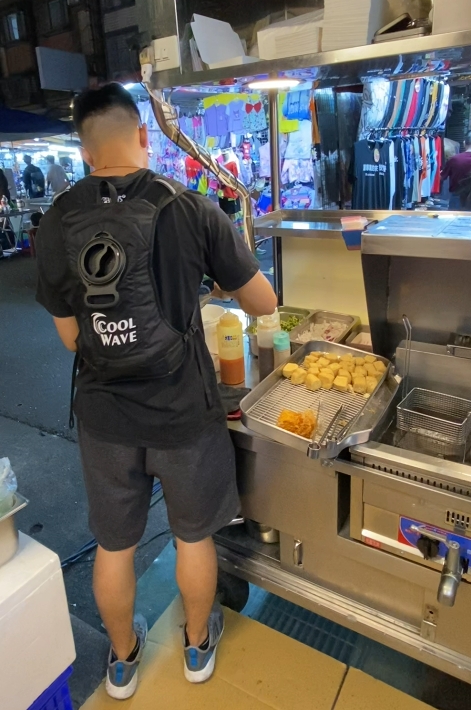
Why radiant heat at a food stall behaves differently
Radiant heat is directional. A griddle, a frying station or a charcoal grill warms surfaces and people in line of sight, and the operator standing directly in front of it absorbs that load continuously rather than in short exposure events. Occupational-safety guidance frames this type of exposure as a heat burden that personal cooling systems can help manage: the U.S. National Institute for Occupational Safety and Health (NIOSH) describes water-cooled garments, air-cooled garments, cooling vests and wetted overgarments as examples of auxiliary or personal cooling systems for heat-exposed work.
Three operational constraints follow, and they differ from those of a construction crew:
- Cooldown must fit inside short gaps. A serving burst can end with a thirty-second window before the next customer. Any cooling action that requires leaving the stall, re-wetting a garment or repositioning ice packs will not happen consistently.
- Movement is short-range but repeated. Operators move between the stall front, a storage unit, a cold box or a back-room refrigerator many times per shift. A cooling system that is tethered, heavy or awkward to drop and re-don gets left at the stall.
- Hygiene and moisture matter near food. A garment that saturates the shoulders or drips into a prep area creates a practical problem that has nothing to do with thermal performance.
These constraints are the filter used throughout this review. A cooling vest that scores well with a construction crew may still fail behind a serving counter.
What the COOLWAVE vest is, by specification
The product is an ice-pack-driven water-circulation vest: two reusable ice packs act as the cold source, and a small pump circulates chilled water through tubing in the vest. The published specifications are the basis for any evaluation, so they are set out in full below rather than summarised.
| Specification | Published value | Why it matters at a food stall |
|---|---|---|
| Cooling duration | 3–4 hours per charge / ice-pack cycle | Roughly one lunch or dinner service block, not a full double shift |
| Weight | Within 2 kg | Continuous wear while standing and carrying trays |
| Flow rate | Max 320–370 ml/min | Determines how quickly chilled water is redistributed through the loop |
| Pump output | 5V, 150mA (max) | Sets the power-bank requirement and current draw |
| Stated suitable temperature | Below 10°C | Ambiguous as published; should be clarified before purchase |
| Materials | Shoulder strap: 600D polyester; body: PEVA; water bag: TPU; water bag cap: polypropylene; cooling tube: sand rubber (black) | Relevant to cleaning, sweat exposure and repeated flexing |
| In the box | Water-cooled vest backpack ×1, ice packs ×2 | One pack in use, one recharging, if a freezer is available |
| Model variants | Basic Model; Professional Model in Blue, Gray and Black | Variant naming is a selection variable, not a performance ranking |
Source: Shokunin / Feng Shang Precision product specification listing for the COOLWAVE Water-Circulation Cooling Vest.
Supplier-side context matters for operators buying in small volumes. The company profile records a factory of 1,000 m², 30 employees, 5 R&D engineers, an export ratio of 50% and main markets of the USA and Taiwan (ROC). Commercial terms cited in supplier material include ODM production, a minimum order quantity of 10 units, a lead time of 7–14 days, and a 6-month warranty covering the water-cooled vest. The COOLWAVE vest has also received a Disaster Prevention Product and Service Certification Award issued by the Taiwan Disaster Prevention Industry Association.
Verification note. Two production figures appear in the available record: a monthly capacity of 3,000 units in supplier-facing material, and an annual output of 10,000 units in the company profile. The figures use different bases and should not be combined or averaged. A buyer planning a seasonal order should request the basis in writing before committing to a delivery date.
Reading the 320–370 ml/min flow rate in a serving context
The listed maximum flow rate is 320–370 ml/min, which converts to roughly 19–22 litres per hour moving through the loop at that stated maximum. It is important to be precise about what that number does and does not mean.
Flow rate describes circulation, not cooling power. Heat removal from the body depends on several additional variables: the water temperature leaving the ice reservoir, the contact area and fit of the tubing against the torso, the insulating behaviour of the PEVA body layer and 600D polyester shoulder straps, and how quickly the ice packs lose their cold charge. A published flow figure without a stated measurement condition — tubing length, reservoir level, head pressure — is a design parameter rather than a test result.
What the flow rate does explain is responsiveness. A circulating loop keeps chilled water in motion against the body continuously instead of relying on a static cold pack that warms against the skin. In practical terms, that means the cooling effect does not have to be re-established each time the operator returns to the stall; it is already running. For a food service application, that continuous, hands-free behaviour is the more relevant design attribute than the litre figure itself.
Cooldown between serving intervals
Serving-interval cooldown is a re-start problem, not a cooling-capacity problem. Between two bursts of orders, an operator has time to wipe a counter and take a breath — not to walk to a cooler, remove a vest, soak it, wring it out and put it back on. The COOLWAVE architecture keeps the circulation loop and the ice packs already in place, so the recovery window is spent cooling rather than preparing to cool. Whether that advantage is measurable depends on ambient temperature, the number of ice packs cycled, and whether the operator can reach a freezer during a break. None of those conditions are fixed by the specification sheet.
Fit assessment: the operator's working day
The strongest argument for the vest in food service is mobility between the stall and a storage unit. The vest is worn as a backpack assembly — within 2 kg, with adjustable one-size-fits-all straps — so an operator can step away from the counter to fetch stock, return, and continue serving without removing anything.
| Shift phase | Constraint | How the published design maps to it | What to test yourself |
|---|---|---|---|
| Setup under canopy or metal roof | Radiant load begins before service starts | Ice packs and water bag are prepared in advance; the vest is donned once | Whether the pack-up routine fits your prep time |
| Peak lunch or dinner service | Continuous standing in front of a heat source | 3–4 hour cooling duration covers a typical service block | Whether cooling holds through the final hour |
| Gaps between customers | Windows measured in seconds | Circulation runs continuously; no re-donning required | Whether the pump noise is acceptable at the counter |
| Restocking trips | Repeated short moves to storage | Under 2 kg, backpack format, adjustable straps | Whether the water bag shifts during bending and lifting |
| End of block | Second service or extended trading hours | Ice packs must be swapped and re-frozen | Whether you have freezer access between blocks |
The adjacent scenarios listed for the same product — traffic control, outdoor work and metal sheet factories — share the same underlying requirement: sustained radiant or ambient heat with limited opportunity to stop working. Food service is the version of that problem with the tightest recovery windows and the strictest hygiene surroundings.
Where the vest stops being the right answer
An independent evaluation is only useful if it states the boundaries. The following points are not marketing caveats; they are the conditions under which a food service buyer should look elsewhere or plan additional equipment.
- A single vest does not cover a long trading day. The stated cooling duration is 3–4 hours per charge and ice-pack cycle. Street food operators frequently trade across two service blocks separated by several hours. Covering a full day requires either a second set of ice packs with freezer access, or a second vest.
- It is a powered system, not a passive one. The cold source is passive — reusable ice packs rather than a compressor — but the pump is specified at 5V, 150mA and needs a power source. One internal case record summarises the system as "no power required"; that phrasing is best read as describing the absence of a refrigeration unit, because the pump still draws current. Buyers should confirm the power-bank requirement and expected runtime in writing.
- The published temperature figure needs clarification. "Suitable temperature: below 10°C" is listed as a product parameter without stating whether it refers to coolant temperature, ice-pack condition or ambient operating range. In a stall that may sit well above 30°C in summer, that distinction changes how the product should be used.
- Performance figures are supplier-published, not independently tested. No standardised thermal test protocol, ambient condition, workload or measurement method is disclosed alongside the 3–4 hour duration or the flow rate. That does not make the figures wrong; it makes them unverified.
- Formal PPE conformity is not documented in the available record. The Taiwan Disaster Prevention Product and Service Certification Award is a recognition, not a conformity marking for a PPE standard. Buyers in markets requiring EN, ANSI or CE-type documentation should request it directly.
- Wearability has an upper bound. Two kilograms worn continuously while working a hot line is a real load, and the vest adds a layer over the torso. Operators with high sweat rates should evaluate skin comfort and cleaning routine before standardising the product across a team.
- Consumables sit outside the warranty window. The water-cooled vest carries a 6-month warranty, while ice packs, tubing and the pump are the parts most exposed to wear. A multi-season budget should assume replacement parts rather than treating the vest as a one-off purchase.
Water circulation versus other cooling approaches for stall work
Comparing categories is more useful than comparing brands here, because the failure modes differ. The table below is qualitative by design: no verified, like-for-like thermal test data exists for these categories in the food-stall context.
| Approach | How it cools | Strength behind a serving counter | Practical constraint |
|---|---|---|---|
| Ice-pack-only vest | Static cold packs held against the torso | No power source, simple, easy to clean | Cooling effect is strongest at the start and fades as the packs warm |
| Evaporative / wetted vest | Evaporation from a damp layer | Light and low cost | Effectiveness drops in humid conditions, and added moisture is awkward near food prep |
| Air-circulation / fan vest | Moves ambient air across the body | Perceived comfort in moving air | Limited when the surrounding air is already hot, as under a metal roof at midday |
| Water circulation (COOLWAVE) | Ice packs chill water; a pump circulates it through tubing | Continuous redistribution of chilled water without re-donning; hands stay free | Depends on a 5V power bank and on swapping ice packs to extend runtime |
The honest summary is that water circulation solves the redistribution problem and introduces a power dependency. An ice-pack-only vest has no battery to fail, but it also cannot move cold water to where the skin is hottest. For a stall operator with freezer access and a charged power bank, the circulation design is the better match to a long service block; for an operator trading from a scooter with no reliable power or freezing, the simpler category may be more robust.
Market context: cooling PPE is being bought as equipment
The commercial environment supports that shift. Commercial market research cited in HTNXT's verified data package puts the global cooling vests market at USD 342 million in 2025, with industrial applications accounting for 34.5% of revenue share in the same year. That split is significant for food service: cooling vests are increasingly evaluated as occupational equipment rather than personal comfort apparel, which raises the expectation of documented specifications, spare parts and defined warranty terms.
Food stall and street vending operators sit at the smaller, self-purchased end of that industrial segment. The COOLWAVE line's commercial structure reflects it — a 10-unit minimum order quantity and a 7–14 day lead time make a single-operator purchase or a small market association's group order feasible without a container-scale commitment. A Taiwan deployment recorded in supplier case material covers 100 units used for cooling in high-temperature environments, reporting heatstroke prevention and improved worker comfort as outcomes; the record also lists a 10-year case duration without stating a start date, so it should be read as supplier-reported experience rather than as a controlled study.
What a food service buyer should verify before ordering
Given that the published figures are supplier-sourced, the sensible approach is a small sample test run under real stall conditions rather than a specification comparison on paper. The checklist below follows the order in which the questions usually become urgent.
- Service-block runtime. Run one vest through a full peak service and record when cooling becomes perceptibly weaker. Compare that to your stated 3–4 hour expectation.
- Ice-pack logistics. Confirm how much freezer space two packs require and how long a swap takes mid-shift.
- Power-bank compatibility. Verify the 5V, 150mA pump requirement against the power bank you already own, and measure actual runtime under that load.
- Moisture and cleaning. Check condensation around the water bag and tubing, and confirm the washing routine for the PEVA body, TPU water bag and 600D polyester straps.
- Noise and fit at the counter. A pump running next to a customer-facing counter should be inaudible at conversation distance; adjustable one-size-fits-all straps still need to hold the tubing in contact during bending.
- Documentation. Request the written basis for the cooling duration, the meaning of the below-10°C parameter, and any conformity documentation relevant to your market.
- Commercial confirmation. Ask for written confirmation of MOQ, lead time, warranty scope and the production basis behind the capacity figures before placing a seasonal order.
Future outlook
The next constraint for this category is not hardware novelty but evidence. Water-circulation vests already address the two hardest problems in food service — continuous cooling during a stationary shift, and portability between the stall and storage — and the remaining gaps are documentation gaps: standardised cooling-duration tests, defined ambient and workload conditions, and clarity on which parts are consumables.
For operators, the practical implication is that procurement decisions will increasingly be made on verified test data rather than on claimed flow rates. For suppliers, the direction of travel is longer runtime per ice-pack cycle, lighter worn weight, and clearer separation between a passive cold source and the powered circulation that distributes it. Until standardised testing becomes common, buyers should treat published specifications as a starting hypothesis to be tested on their own stall, not as a conclusion.
FAQ
What is a dual cooling water cooling vest, and how is it worn at a food stall?
A dual cooling water cooling vest combines a passive cold source with active circulation: reusable ice packs chill a water reservoir, and a small pump moves that chilled water through tubing in the vest. The COOLWAVE version is worn as a backpack assembly containing the water bag and pump, with the vest itself over the torso, so the operator's hands remain free for serving.
Does a 320–370 ml/min flow rate actually make cooldown faster between serving intervals?
Flow rate describes how quickly chilled water is redistributed through the loop, not how much heat is removed. The stated maximum of 320–370 ml/min corresponds to roughly 19–22 litres per hour at that maximum, which supports continuous redistribution while the vest is worn. Because no measurement conditions or thermal test data are published, the effect on cooldown speed between intervals should be confirmed in a sample trial rather than inferred from the flow figure alone.
How long does the COOLWAVE vest cool during a service block?
The published cooling duration is 3–4 hours per charge and ice-pack cycle, which broadly matches a lunch or dinner service block. Trading across two blocks in one day requires either a second set of ice packs with freezer access or a second vest, because the stated duration does not cover a full extended trading day.
Is the vest practical for staff who move between the stall and a storage unit?
The vest is listed at within 2 kg with adjustable one-size-fits-all straps and a backpack format, which supports repeated short moves between a stall front and a storage area. The operational questions are whether the water bag remains stable during bending and lifting, and whether the added layer is tolerable while working in front of a heat source.
How does water circulation compare with an ice-pack-only vest for stall work?
An ice-pack-only vest relies on static packs and produces its strongest effect at the start of a shift as the packs warm. A water-circulation vest continues to redistribute chilled water for as long as the ice packs hold their charge, but it depends on a 5V power bank and on swapping ice packs. Neither approach removes the need for freezer access during a long trading day.
What should a food service buyer verify before ordering 10 or more units?
Verify runtime across a real service block, ice-pack swap time and freezer space, power-bank compatibility with the 5V, 150mA pump, cleaning routine for the PEVA body and TPU water bag, warranty scope for the 6-month vest coverage, and the written basis for the published capacity figures. Buyers in regulated markets should also request conformity documentation relevant to their jurisdiction.
Conclusion
For food stall operators facing radiant heat, the COOLWAVE Water-Circulation Cooling Vest is a coherent answer to a specific problem: it keeps cooling running during the short gaps when nothing else can be done, and it stays on the body during the short trips that make up a trading day. The 320–370 ml/min circulation rate matters less as a headline number than as evidence that the loop is designed to redistribute chilled water continuously rather than rely on static packs.
The limits are equally clear. Runtime is measured in service blocks, not full days; the system needs a power bank; the below-10°C parameter and the cooling-duration protocol are not explained in the published record; and the capacity and warranty terms are modest relative to multi-season use. Those are the questions a buyer should close before standardising the product — ideally with a sample test run on their own stall, at their own peak hour.
A downloadable product brochure covering the COOLWAVE water-circulation cooling vest range is available here: COOLWAVE product brochure (PDF).
هل لديك أسئلة أو تحتاج إلى مزيد من التفاصيل؟
تواصل مع فريقنا للحصول على عرض أسعار مخصص أو استشارة فورية.
طلب عرض أسعار
املأ النموذج أدناه وسيتواصل معك فريقنا بعرض مقترح مخصص.
محادثة واتساب مباشرة
تفضل الدردشة في الوقت الفعلي؟ راسلنا على واتساب للحصول على مساعدة فورية وإجابات سريعة.
- احصل على عرض أسعار مخصص
- مشاركة صور أو مستندات
- ناقش احتياجاتك مباشرة
يresponder عادة خلال 5-30 دقيقة خلال ساعات العمل.