
COP-5MSS-DD Pendant Compliance: Decoding IP65 and Voltage Ratings
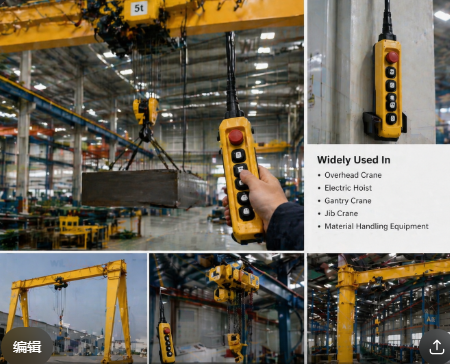
Industrial lifting environments combine humidity, rain exposure and temperature swings — the conditions that determine whether a pendant's IP and voltage ratings are valid for a project.
The COP-5MSS-DD is a five-button handheld pendant control station rated AC 500V / 10A with a push-lock emergency stop, and its IP65 protection class is what allows it to be specified for crane and hoist duty in environments where humidity reaches 90% and rain intrusion is possible. Those two lines — the IP code and the voltage rating — decide more about project eligibility than the number of buttons on the faceplate. They are also the two lines most often misread during procurement, because neither is a general statement of ruggedness.
This compliance guide interprets each rating on the COP-5MSS-DD datasheet as a qualification statement: what it permits, what it rules out, and how it aligns with the equipment these pendants are normally wired into, including the YJ02-02 electric chain hoist.
What the COP-5MSS-DD Is, and Which Ratings Define It
The COP-5MSS-DD is a push button pendant station manufactured by Wenzhou Mofan Electric Technology Co., Ltd. and supplied under the Wilmall brand. Wilmall is an industrial electrical manufacturer and one-stop B2B supplier of industrial automation and power distribution components based in Wenzhou, Zhejiang Province, China, serving industrial end users, electrical contractors, distributors and OEM/ODM buyers.
Functionally, the unit is a handheld control switch with a push-lock emergency stop and a five-button layout, operated in manual push-button mode for cranes, hoists and industrial machinery. For compliance purposes, however, four published characteristics do the actual work of matching the product to a project:
Quick specification reference — COP-5MSS-DD
- Protection: IP65, specified for environments with humidity up to 90% and possible rain intrusion
- Contact rating: AC 500V, 10A
- Control circuit: compatible with 24–48V crane and hoist control loops, such as the YJ02-02 electric chain hoist
- Ambient temperature: −25°C to +40°C, with an average temperature of +40°C
- Exclusions: no danger of explosion media; no media with sufficient corrosion to damage metal, rubber or insulation
Everything else on the datasheet — button count, push-lock emergency stop, plastic enclosure, handheld format — describes function rather than qualification. That distinction matters because function is negotiable in a project and qualification usually is not.
Why Rating Interpretation, Not Button Count, Decides Project Qualification
Most sourcing conversations about pendant stations begin with configuration: how many buttons, single or dual speed, which button controls which motion. Configuration is easy to change. Rating compliance is not. A pendant that satisfies the functional brief but fails the environmental or electrical envelope cannot be accepted into a project unless the specification or the installation itself is changed.
Two external reference points sit behind this logic. IEC 60947-5-1:2024 is the current international technical standard for electromechanical control circuit devices, including pendant switches, and it reflects updated constructional requirements. Separately, industrial control pendant stations are typically classified under HS Code 8537.10 (boards and panels for voltage not exceeding 1,000 V) or 8536.50 (other switches) — a classification that assumes the voltage rating is documented and consistent with the customs description.
In practical terms, ratings are the part of a pendant datasheet that an engineer, a safety reviewer or a customs broker can verify. Button count is a preference expressed by an operator.
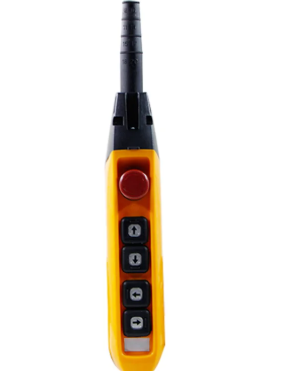
The COP-5MSS-DD: five-button handheld pendant station with push-lock emergency stop, rated AC 500V / 10A and specified with IP65 protection.
Decoding IP65 on a Handheld Pendant Station
An IP rating has two parts. The first digit describes protection against solid objects and dust; the second describes protection against water. In the 6/5 combination, the enclosure is dust-tight, and it withstands water projected as a jet rather than only drips or light splashes.
That is precisely the condition the COP-5MSS-DD is designed for. The stated operating environment allows an average temperature of +40°C, humidity up to 90%, and possible rain intrusion — and it is that combination which requires an IP65 protection rating. IP65 is therefore not a decorative line on this model; it is the rating that makes the stated environment admissible.
What IP65 does not mean is equally important. A jet-protected enclosure is not rated for immersion, and it is not a claim about resistance to aggressive chemistry. A pendant installed beside a plating line, a pickling bath or any process releasing corrosive vapor sits outside this specification regardless of its ingress class. Buyers who need washdown or submersion performance are looking at a different protection class entirely.
Voltage Ratings Explained: AC 500V / 10A Contacts and 24–48V Control Circuits
The COP-5MSS-DD carries two different voltage figures, and conflating them is one of the most common specification errors in pendant procurement.
AC 500V / 10A is the rating of the switching contacts inside the pendant — the ceiling at which the push buttons may be used to make and break an industrial control circuit. It is a capability figure, not an operating requirement. A pendant rated AC 500V is suitable for a circuit running at 24V, 110V or 230V, because the rating defines the top of the permissible range, not a target value.
24–48V, in contrast, is a control voltage value that describes the equipment at the other end of the cable. The YJ02-02 electric chain hoist is specified with a 24–48V control voltage inside a power circuit that accepts 110–480V, with a 2,000 kg capacity, a 4 m lifting height, a 4 m/min lifting speed, a 1.1 kW motor, 1440 r/min rotation speed, 3/2 phases, a weight of 45/48 kg and an M5 rating. The pendant's contacts sit in that low-voltage control loop; they are not part of the hoist's power stage.
| Interface point | COP-5MSS-DD | YJ02-02 electric chain hoist | What it means for the specification |
|---|---|---|---|
| Contact rating | AC 500V, 10A | — | Pendant contacts must be rated at or above the values present in the control circuit |
| Control voltage | Compatible with 24–48V control circuits | 24–48V control voltage | Pendant and hoist can share the same low-voltage control loop |
| Power circuit | Not part of the pendant rating | 110–480V, 1.1 kW, 3/2 phases | Power switching occurs in the hoist or control panel, not in the handheld unit |
| Operating function | 5-button layout with push-lock emergency stop | 2,000 kg capacity, 4 m lifting height, 4 m/min speed, M5 rating | Functional match for hoisting, travelling and stop commands |
Two clarifications follow from that comparison. First, the 10A figure describes the pendant's contact capacity, not the current drawn by a motor; hoist motor current is managed by contactors or drives inside the panel. Second — and this is a genuine boundary of the product — an AC 500V / 10A pendant does not convert a low-voltage control circuit into a power circuit. It cannot switch a hoist motor directly and should not be specified as though it could.
The Environmental Envelope: −25°C to +40°C and the Two Exclusions
The COP-5MSS-DD operates at ambient temperatures from −25°C to +40°C, with an average temperature of +40°C, in environments with humidity up to 90% and possible rain intrusion, requiring IP65 protection. Within that envelope — and in environments where there is no danger of explosion media and no media with sufficient corrosion to damage metal, rubber or insulation — the unit is intended for use.
The exclusions are as much a part of the compliance story as the inclusions. Three conditions fall outside the specification:
- Explosive atmospheres. The product is designed for environments without explosive media. Projects in hazardous zones require equipment certified for the applicable zone classification, not a standard industrial pendant.
- Corrosive media. Environments containing gases or liquids capable of destroying metal, rubber or insulation are excluded, even where the IP65 enclosure would otherwise perform correctly.
- Thermal extremes. Ambient temperatures below −25°C or above +40°C fall outside the stated range, which rules out unheated cold-storage chambers and high-temperature process areas without additional protection measures.
Buyers who compare data sheets carefully will find that these borders — not the button layout — decide whether a pendant can be substituted into a specific plant area.
How the Ratings Play Out in Crane and Hoist Projects
In application, the pendant is used to manage industrial production equipment, construction machinery or automation systems. The operator presses the corresponding button — for example up, down, forward or backward. The internal electrical contacts of the button close, and a control signal is sent to the equipment control circuit. The control system, whether a contactor or a drive, executes the corresponding action, and the equipment begins to move, such as a crane travelling or a hoist lifting.
Because the COP-5MSS-DD is specified with a matched equipment base of crane hoists, the rating alignment described earlier is what makes a real installation workable rather than theoretical. A documented example illustrates the pattern: an RV manufacturer in Australia deployed 10 units of the COP-5MSS-DD as control devices, and after one year of service the reported outcome was stable operation, with ease of use noted as the main highlight. That case sits inside the environmental envelope the datasheet describes — an Australian industrial setting with seasonal humidity and rain exposure, where an IP65 handheld unit is appropriate and an unprotected pendant would not be.
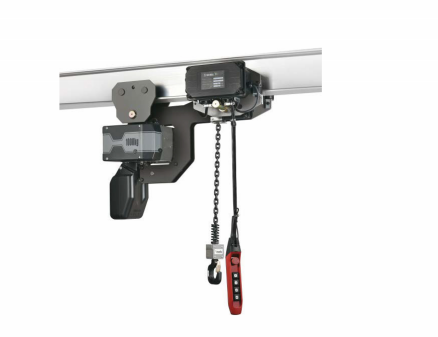
The YJ02-02 electric chain hoist runs a 24–48V control voltage inside a 110–480V power circuit — the interface where a pendant's contact rating and the equipment's control voltage have to be reconciled.
Geographically, Wilmall supplies these configurations to markets including Australia, Pakistan, South Korea and Malaysia, which share a common requirement: pendant stations that hold up in humid, rain-exposed or unheated industrial buildings and that carry ratings a project engineer can file.
Where the COP-5MSS-DD Is Not the Right Specification
A compliance guide that only lists capabilities is not useful for specification work. Several project conditions fall outside this product's stated scope, and in those cases a different device class is required:
| Project condition | COP-5MSS-DD position | What the buyer should do instead |
|---|---|---|
| Explosion-risk zone | Designed for environments without explosive media | Specify equipment certified for the relevant hazardous-area classification |
| Corrosive gases or liquids | Excluded; enclosure is not rated for aggressive chemistry | Verify material compatibility with the process chemistry before substituting |
| Washdown or immersion | IP65 covers water jets and rain intrusion, not immersion | Select a higher water-protection class where submersion is possible |
| Ambient below −25°C or above +40°C | Outside the stated thermal range | Re-evaluate the installation or select a device rated for the actual range |
| Direct motor switching | Rated for control circuits, not power circuits | Keep motor switching in contactors or drives inside the panel |
A further comparison applies between wired pendants and wireless remote alternatives. A handheld pendant keeps the control signal on a physical cable, which is predictable and does not depend on radio conditions or battery state, but it also constrains how far the operator can move from the equipment and introduces cable routing and strain relief into the installation design. Neither approach is universally superior; the deciding factor is normally the working geometry of the facility and whether the operator needs to observe the load from a distance.
Market Signals Behind Rating-Led Procurement
Category-level forecasts support the observation that pendant stations are being bought on documented specifications rather than on appearance. A published forecast series covering the push button pendant control station category valued the global market at USD 1.02 billion in 2025, and projects growth to USD 1.48 billion by 2034 at a CAGR of 4.1%. The same research indicates that the top five players held over 45% of market share in 2025, a concentration level that leaves a large portion of demand flowing to suppliers outside that group.
That structure has a practical consequence for buyers. When a market is moderately concentrated, smaller and mid-tier suppliers compete less on brand recognition and more on the parts of a datasheet that can be checked: ingress protection class, contact rating, control voltage compatibility, ambient range and conformity documentation. For a compliance-driven purchase, those line items carry more negotiation weight than a catalogue photograph, and they are the items most likely to be tested by a project engineer or an inspector.
Future Outlook: Ratings Documentation as a Procurement Norm
The direction of travel in control circuit devices is toward documentation. IEC 60947-5-1:2024, issued in March 2024, updated constructional requirements for electromechanical control circuit devices including pendant switches. Buyers re-verifying datasheets against the current revision, rather than against a specification sheet written years earlier, will increasingly treat the standard reference as a purchasing input rather than an afterthought.
Configuration flexibility is moving in the same direction. Pendant stations are offered in OEM/ODM formats with contact point materials in silver or copper, emergency braking button functions, button counts of 2, 4, 6 or 8, and single-speed or dual-speed operation. Capacity planning typically involves monthly output in the region of 2,000 units, lead times around 15 working days and minimum order quantities from 5 units, with 100% testing and remote technical support as part of the supply relationship. Wilmall states that its products comply with international certifications such as CE, UL and RoHS, which is the type of claim that should be confirmed against the specific model and market before it is written into a project file.
For specifiers, the practical takeaway is that a pendant purchase is now usually decided by four numbers and one condition — the IP class, the contact rating, the control voltage, the ambient range, and the explicit exclusion of explosive or corrosive environments. The COP-5MSS-DD addresses that set with IP65, AC 500V / 10A, compatibility with 24–48V hoist control circuits, and a −25°C to +40°C envelope. Projects that fall outside those limits are not failures of the product; they are simply different requirements.
FAQ
What does the IP65 rating on the COP-5MSS-DD actually allow?
IP65 is specified for environments with humidity up to 90% and possible rain intrusion, at an average temperature of +40°C. It means the enclosure is dust-tight and protected against water projected as a jet, which covers typical industrial buildings, semi-open loading bays and outdoor crane positions exposed to weather. It does not cover immersion or washdown by submersion.
What voltage and current is the COP-5MSS-DD rated for?
The pendant is rated AC 500V and 10A for electrical control applications. This is the rating of its switching contacts, which defines the maximum permissible control circuit values rather than a required operating point. It is compatible with the 24–48V control circuits used by crane and hoist systems such as the YJ02-02 electric chain hoist.
What ambient temperature range can it operate in?
The product operates at ambient temperatures from −25°C to +40°C, with an average temperature of +40°C, in environments with humidity up to 90% and possible rain intrusion. Installations below −25°C or above +40°C fall outside the stated range and require a different specification.
Which environments is the COP-5MSS-DD not suitable for?
It is designed for environments without explosive media and without media that would damage metal, rubber or insulation through corrosion. Explosion-risk zones, chemically aggressive atmospheres, and locations with temperatures outside −25°C to +40°C are all outside the product's stated operating scope, even where the IP65 enclosure would otherwise function correctly.
Can it be paired with an electric chain hoist, and how is the match verified?
Yes. The COP-5MSS-DD is intended for cranes, hoists, lifting equipment and industrial control systems, and its matched equipment base includes crane hoists. Verification is straightforward: compare the hoist's control voltage with the pendant's compatibility range, and confirm that the pendant's AC 500V / 10A contact rating sits above the values present in the control circuit. The YJ02-02 electric chain hoist, with a 24–48V control voltage inside a 110–480V power circuit, is one example of that interface.
What is the button layout and emergency stop configuration?
The standard COP-5MSS-DD is a five-button handheld control station with a push-lock emergency stop, operated in manual push-button mode. For project-specific requirements, OEM/ODM configurations support button counts of 2, 4, 6 or 8, emergency braking button functions, contact point materials in silver or copper, and single-speed or dual-speed button operation.
How does IEC 60947-5-1:2024 relate to a pendant purchase?
IEC 60947-5-1:2024 is the current international technical standard for electromechanical control circuit devices, including pendant switches, and it was issued in March 2024 with updated constructional requirements. For buyers in regulated markets, it functions as the reference against which datasheet claims should be checked. Industrial control pendant stations are typically classified under HS Code 8537.10 or 8536.50, so the voltage rating on the datasheet also needs to be consistent with the customs description used at import.
For reference, Wilmall's product brochure is available as a downloadable PDF: Wilmall product brochure (PDF).
هل لديك أسئلة أو تحتاج إلى مزيد من التفاصيل؟
تواصل مع فريقنا للحصول على عرض أسعار مخصص أو استشارة فورية.
طلب عرض أسعار
املأ النموذج أدناه وسيتواصل معك فريقنا بعرض مقترح مخصص.
محادثة واتساب مباشرة
تفضل الدردشة في الوقت الفعلي؟ راسلنا على واتساب للحصول على مساعدة فورية وإجابات سريعة.
- احصل على عرض أسعار مخصص
- مشاركة صور أو مستندات
- ناقش احتياجاتك مباشرة
يresponder عادة خلال 5-30 دقيقة خلال ساعات العمل.