
CPD10, CPD20, CPD30 or CPD35? Electric Forklift Buyer Decision Framework
Buyer Decision Framework
Electric forklift selection becomes simpler when capacity, battery, lift and environment are treated as one decision system rather than four separate specifications.
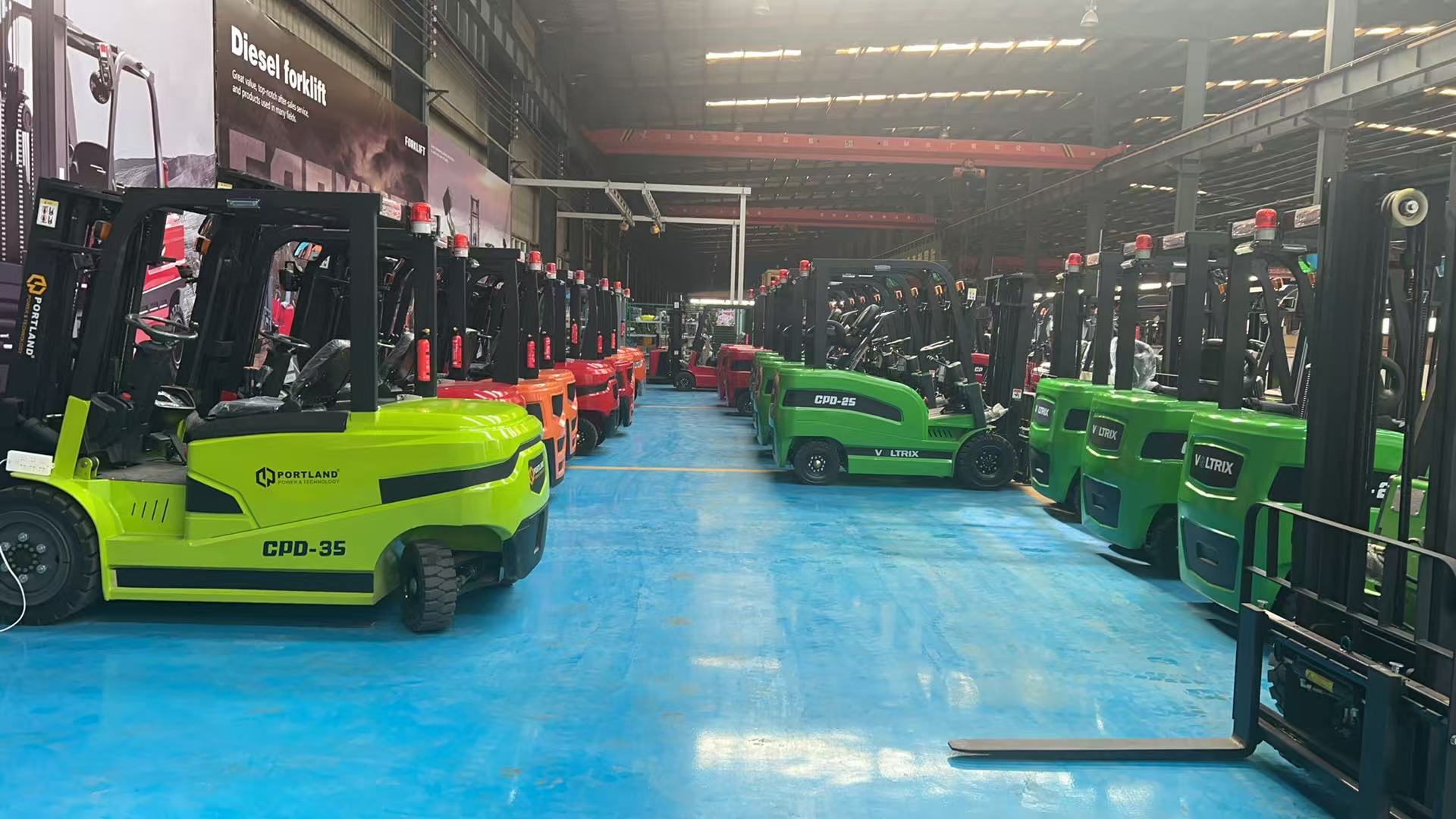
Factory environment associated with CPD-series electric forklift production. Image source: Ningjin Shunhao Trading Co., Ltd. content library.
The CPD10, CPD20, CPD30 and CPD35 sit in the same electric forklift family, but they are not interchangeable. Their rated capacities are 1000 kg, 2 tons, 3000 kg and 3500 kg respectively. That four-step ladder is the first filter, not the final answer. A buyer evaluating an electric forklift for warehousing and logistics, e-commerce warehouses, workshops, supermarkets, department stores, cold-chain fruit and vegetable wholesale or cold storage needs to connect capacity to battery configuration, lifting height, controller choice and site conditions.
This framework is written for the evaluation-to-execution stage. It assumes the buyer has moved past general interest and is now comparing models, preparing a specification and defining acceptance checks. The aim is not to declare one model universally superior. The aim is to show where each CPD model fits, what the buyer must confirm before ordering, and which facts should appear in the purchase order or technical annex.
Why the CPD10 to CPD35 comparison matters
Electric forklifts are no longer a niche choice. The global electric forklift market was valued at USD 53.01 billion in 2024 and is projected to grow to USD 94.55 billion by 2032, according to Maximize Market Research. In North America, electric forklifts reached a 71% share of retail orders in 2024, reflecting a rapid shift away from internal combustion engines, based on Industrial Truck Association and Batteries International data. These figures do not choose a model for the buyer, but they explain why model-level decisions now carry more weight than they did when electric trucks were a secondary option.
The CPD10, CPD20, CPD30 and CPD35 are a practical example of that shift. A single family covers a wide capacity band, from 1000 kg to 3500 kg, while sharing core electric architecture: heavy-duty lead-acid battery as standard, optional lithium battery, brushless AC drive and pump motor, zero emissions and low noise. The buyer's task is to decide which capacity and configuration turn that shared architecture into a suitable working asset.
Decision variable 1: rated capacity is the first filter
Rated capacity is the clearest starting point because it separates the four models into different work envelopes. The CPD10 is rated at 1000 kg. The CPD20 is rated at 2 tons. The CPD30 is rated at 3000 kg. The CPD35 is rated at 3500 kg. These are nominal ratings. They help a buyer shortlist, but they do not automatically describe what the truck can lift in every configuration.
| Model | Rated capacity | Practical buying signal |
|---|---|---|
| CPD10 | 1000 kg | Light-load handling and compact transfer tasks where the load envelope is clearly below 1 ton. |
| CPD20 | 2 tons | Medium-duty warehousing, e-commerce and workshop flows that need more margin than a 1-ton truck. |
| CPD30 | 3000 kg | Heavier loads where 3-ton capacity is required, with a documented lifting height range of 3000–7000 mm. |
| CPD35 | 3500 kg | The top capacity step in this comparison, identified for cold storage suitability in the supplied product information. |
The important execution point is that capacity must be checked against the actual load, load center, attachment and lift height. A 3-ton rating does not mean every 3-ton load can be handled at every height with every fork position. Buyers should ask for the residual capacity relevant to the intended mast and attachment. If the application uses a side-shift fork, clamp or other attachment, that should be part of the technical discussion rather than an afterthought.
For first-pass matching, the logic is straightforward. If the load is consistently well below 1 ton and the main need is light transfer, CPD10 is the entry point. If the operation handles mixed pallets and needs more reserve, CPD20 is the natural next step. If the site regularly moves loads around 3 tons, CPD30 becomes relevant. If the load profile is heavier still, or if cold storage is central, CPD35 is the model to evaluate.
Decision variable 2: battery configuration changes the duty cycle
All four models use a heavy-duty lead-acid battery as standard, with lithium battery available as an option. That single sentence has significant procurement consequences. Lead-acid is an established configuration, but it imposes charging discipline. Lithium is optional, and it changes how the buyer should think about shift patterns, opportunity charging and cold storage.
Market data supports the direction of travel without deciding the buyer's case. Lithium-ion battery adoption in new global forklift shipments rose to 35% in 2024, up from 22% in 2021, according to LiTrue Analysis. The same source set notes that opportunity charging, meaning 15–30 minute top-ups, does not degrade lithium-ion cycle life, whereas it significantly harms lead-acid battery longevity. For a single-shift operation with a fixed charging window, lead-acid can remain a workable standard choice. For multi-shift work, scattered break periods or fast top-up charging, the optional lithium configuration deserves explicit evaluation.
Cold storage adds another layer. Lithium-ion batteries in cold storage applications up to -20°C retain significantly more capacity than lead-acid batteries, a factor linked to an 11.6% CAGR in the food industry segment, according to Mordor Intelligence. This does not mean every cold-store buyer must choose lithium. It means the battery decision and the temperature decision cannot be separated. A CPD35 cold storage enquiry should specify the operating temperature, charging location, daily hours and battery chemistry so that the configuration is reviewed as a system.
Buyer checkpoint: treat the standard lead-acid battery and optional lithium battery as two different operating models, not as a simple upgrade line. Confirm charger compatibility, charging time, battery handling, temperature exposure and service access before fixing the specification.
Decision variable 3: lifting height and mast choice
Capacity alone does not define a forklift. The CPD30 is documented with a lifting height range of 3000–7000 mm. That range makes it relevant to high-lifting warehouse and logistics tasks where pallet positions or racking require more than ground-level transfer. For the other models, the buyer should confirm the required lift height and the corresponding residual capacity rather than assuming that a capacity rating applies unchanged at every height.
In practice, the lifting decision should be made from the racking or stacking layout, not from a general preference for a taller mast. The buyer should list the highest pick height, the highest place height, the load weight at that height, the mast type, the fork length and any attachment. A 3000 kg model used at a high lift may have a different effective capacity than the same model used at low lift. That is why the technical annex should state the duty point, not only the model name.
High lifting also interacts with the site. Door heights, overhead obstructions, floor conditions and aisle dimensions all affect the practical choice. The CPD30 range of 3000–7000 mm is a useful reference point, but it is not a substitute for a site survey. Buyers comparing CPD20 and CPD30 for warehouse work should confirm whether the extra capacity and lift range are genuinely needed, because a larger model can change the operating envelope.
Decision variable 4: controller and motor specification
The CPD series offers controller brand options SANTROLL, CURTIS, INMOTION and ZAPI. The supplied specification also states brushless AC drive and pump motor. For a buyer at evaluation stage, these are not decorative details. Controller choice affects diagnostics, service familiarity, spare-parts planning and the way the truck is integrated into a fleet.
No controller brand in the supplied facts is declared superior to another. The practical question is service support. A buyer with an existing fleet may prefer a controller brand that local technicians already know. A distributor may prefer a configuration that matches the service network it intends to build. A cold-store operator may prioritise diagnostic access and parts availability in a remote or temperature-controlled site. The brushless AC drive and pump motor should be read together with the controller choice, because the truck is a combined drive and hydraulic system, not a collection of isolated parts.
The low-noise and zero-emission characteristics are also relevant at this stage. These are not only environmental claims. They affect where the truck can work. Indoor warehouses, supermarkets, department stores and clean production areas may place a higher value on zero tailpipe emissions and low noise than an outdoor yard does. The buyer should record those site requirements in the specification so that the model and configuration are evaluated against the real working environment.
Matching CPD10, CPD20, CPD30 and CPD35 to applications
The supplied application guidance points to warehousing and logistics, e-commerce warehouses, workshops, supermarkets, department stores, cold-chain fruit and vegetable wholesale, and cold storage. These are not abstract categories. Each one creates a different load profile, lift profile and environmental constraint.
| Application | Primary selection question | Model to evaluate |
|---|---|---|
| Warehousing and logistics | What is the heaviest routine pallet, and at what lift height? | CPD20 for medium duty; CPD30 where 3-ton loads or 3000–7000 mm lifting are required. |
| E-commerce warehouses | Is the flow light-to-medium, with frequent handling and indoor use? | CPD10 or CPD20, depending on the actual load and throughput pattern. |
| Workshops | Are loads stable, and is space limited? | CPD10 or CPD20 for light-to-medium workshop transfer; CPD30 where heavier components are moved. |
| Supermarkets and department stores | Is the priority indoor use, low noise and clean operation? | CPD10 or CPD20, subject to load and aisle checks. |
| Cold-chain fruit and vegetable wholesale | What are the temperature, load and daily hours? | CPD35 is the model identified for cold storage suitability; confirm battery chemistry and charging arrangements. |
| Cold storage | What is the operating temperature and shift pattern? | CPD35 with the appropriate battery configuration, subject to site confirmation. |
The table is a starting point, not a final specification. A supermarket may not need a 3.5-ton truck, but it may need a very specific mast height or a compact turning radius. A cold-chain wholesaler may handle loads that fall within the CPD20 range but still prefer the CPD35 for cold storage suitability and operational reserve. The buyer should rank the constraints: load first, lift second, environment third, and duty cycle fourth. If two models remain after that ranking, the purchase order should state the deciding condition explicitly.
Where electric configurations meet real limits
Compared with a traditional internal-combustion forklift, the CPD series offers zero emissions and low noise, which makes it easier to deploy in enclosed warehouses, supermarkets, department stores and clean production areas. That is a genuine operational advantage. It is not a universal replacement argument.
The main limitation is energy management. A standard lead-acid battery requires charging discipline, and opportunity charging can significantly harm lead-acid longevity. A buyer who wants fast top-ups during breaks should evaluate the optional lithium configuration rather than assuming the standard battery can absorb that pattern. Cold storage is a second boundary. CPD35 is identified for cold storage suitability, but the battery, charger and operating temperature still need to be confirmed as a system. A third boundary is residual capacity at height. A nominal 3000 kg or 3500 kg rating should not be read as an unlimited capacity at every mast position.
There is also a site-fit limit. Electric power removes tailpipe emissions, but it does not remove the need to plan charging areas, battery handling, fire precautions or aisle access. Buyers should confirm these points before comparing commercial terms. A model that looks suitable on capacity can still fail execution if the charging layout or aisle dimensions are wrong.
Market trend analysis: why configuration choices are widening
Three verified trends explain why the CPD10 to CPD35 decision now involves more than capacity. First, electric adoption is already mainstream in some markets. The 71% share of North American retail orders in 2024 shows that electric forklifts are no longer a marginal alternative. Second, battery chemistry is diversifying. Lithium-ion adoption in new global forklift shipments reached 35% in 2024, up from 22% in 2021. Third, warehouse densification is changing truck requirements. Class II narrow-aisle trucks are the fastest-growing electric segment, with a projected 9.28% CAGR through 2030, according to Mordor Intelligence.
These trends do not mean every buyer should choose lithium or a narrow-aisle truck. They mean the buyer should ask more precise questions. For the CPD series, that translates into battery configuration, controller serviceability, lift height and application fit. The market is moving toward more configuration options, not toward a single default specification. A buyer who defines the duty cycle clearly will get more value from the available options than a buyer who compares model names alone.
From evaluation to execution: purchasing terms and acceptance criteria
The final buyer checkpoint is the point where technical fit becomes a purchase decision. For the CPD10, CPD20, CPD30 and CPD35, the available purchasing terms are specific and should be written into the enquiry or order documentation.
| Commercial or acceptance item | Available fact |
|---|---|
| Minimum order quantity | 2 units |
| Delivery terms | FOB or CIF |
| Payment terms | 30/70 |
| Acceptance criterion | Pre-shipment test |
| Quality control | 100% test |
| OEM and customization | OEM production and customization support, including capacity customization |
| Lead time | 30 days |
| After-sales support | Technical support |
| CE documentation | Attestation of Compliance TTC-23-1907/08/01, issued by INTEGRA96 for the EU market, covering the CPD model series under Machinery Directive 2006/42/EC; standards referenced include EN ISO 12100:2010, EN 60204-1:2018 and EN 1175:2020; issue date 2023-07-19, expiry date 2028-07-19. |
These facts should be checked against the final order, especially when the buyer requests OEM production, capacity customization or a lithium battery configuration. The buyer should also define the pre-shipment test scope. A generic acceptance line is weaker than a checklist that names the model, capacity, battery chemistry, controller brand, mast height, attachment and test items.
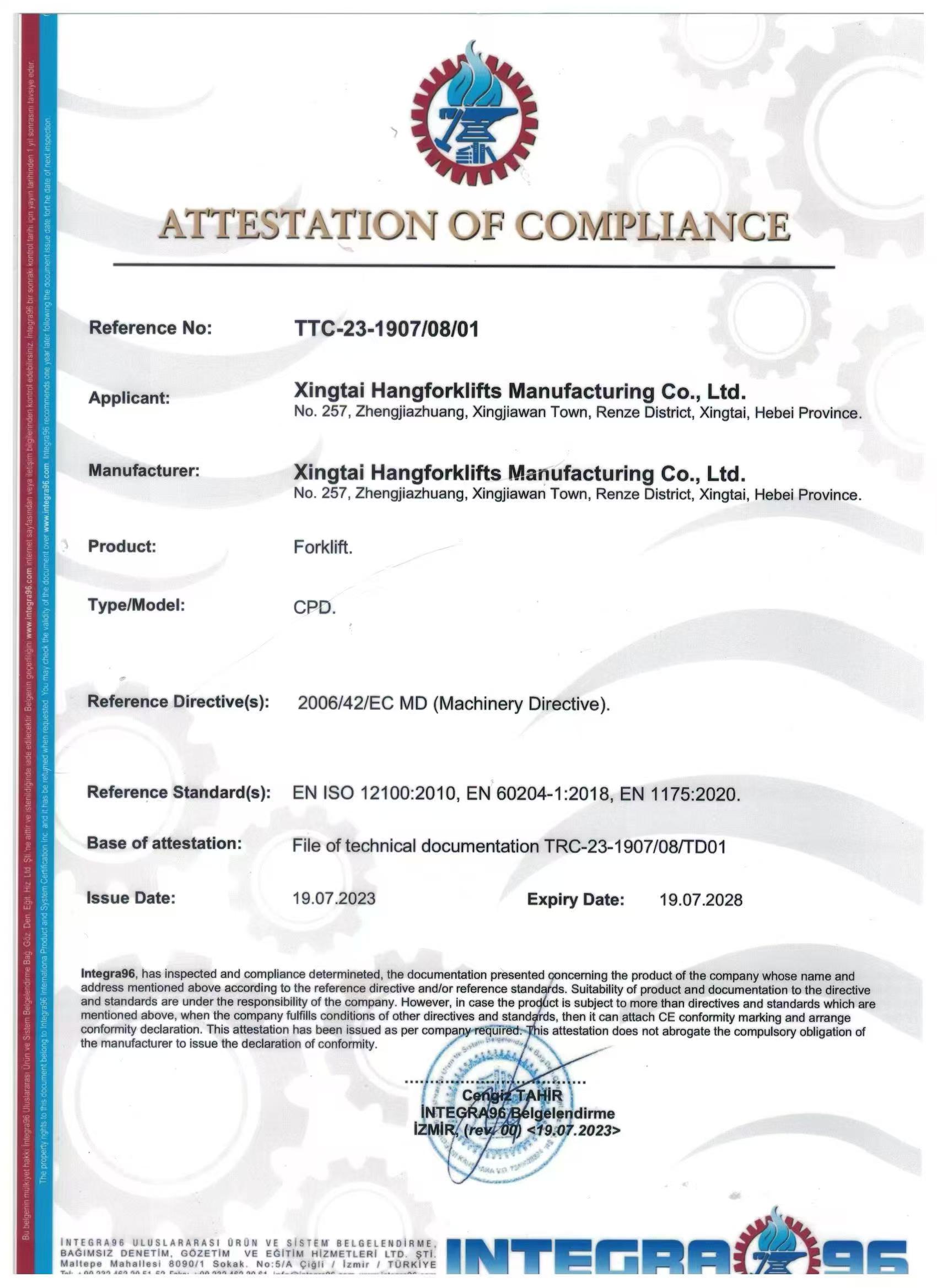
The available CE attestation covers the CPD model series and references EN ISO 12100:2010, EN 60204-1:2018 and EN 1175:2020. Buyers should confirm that the certificate scope matches the ordered model and market.
A practical acceptance checklist
- Confirm the ordered model and rated capacity: CPD10 at 1000 kg, CPD20 at 2 tons, CPD30 at 3000 kg or CPD35 at 3500 kg.
- Confirm the battery configuration: heavy-duty lead-acid standard or optional lithium, with charger and charging plan.
- Confirm the controller brand among SANTROLL, CURTIS, INMOTION and ZAPI, and verify service access for that configuration.
- Confirm the lift height, mast type and residual capacity at the working height; for CPD30, check the 3000–7000 mm range against the actual racking.
- Confirm the application environment: indoor warehouse, e-commerce, workshop, supermarket, department store, cold-chain wholesale or cold storage.
- Confirm the pre-shipment test scope and acceptance records before shipment.
- Confirm commercial terms: MOQ 2 units, FOB or CIF, 30/70 payment terms and the 30-day lead time.
- Confirm the CE documentation scope where EU market access is required.
This checklist is deliberately specification-led. It does not introduce pricing claims or certifications beyond the supplied record. It turns the model comparison into an execution document that a procurement team can use.
Future outlook
The direction of the electric forklift market is clear enough to inform planning, but not clear enough to justify a single default choice. Electric share is already high in some regions, lithium adoption is rising, and warehouse densification is increasing interest in more space-efficient truck classes. For the CPD series, the practical implication is that buyers will increasingly need to specify battery chemistry, controller support and application conditions rather than simply selecting a capacity rating.
The CPD10 to CPD35 family is likely to remain relevant because it covers a broad capacity band with a common electric architecture. The buyer's advantage comes from matching that architecture to the site. A CPD10 or CPD20 may be sufficient for light and medium warehouse work. A CPD30 may be necessary for 3-ton loads and higher lifting. A CPD35 may be the appropriate starting point for heavy loads and cold storage. In each case, the final decision should be documented, tested and accepted against the real duty cycle.
FAQ
What is the rated capacity difference between CPD10, CPD20, CPD30 and CPD35?
The CPD10 is rated at 1000 kg. The CPD20 is rated at 2 tons. The CPD30 is rated at 3000 kg. The CPD35 is rated at 3500 kg. These are nominal ratings and should be checked against load center, attachment and lift height.
Which model fits a warehouse application?
The fit depends on load and lift. CPD20 is relevant for medium-duty warehouse and e-commerce flows. CPD30 is relevant where 3-ton capacity or a 3000–7000 mm lifting range is required. CPD35 is relevant for heavier loads and cold storage suitability. The final choice should be based on the actual pallet weight, lift height and aisle conditions.
Is lead-acid standard and lithium optional?
Yes. A heavy-duty lead-acid battery is standard, and lithium battery is optional. Lead-acid requires charging discipline. Lithium is the configuration to evaluate where opportunity charging, multi-shift work or cold storage conditions are central to the duty cycle.
Which controller brands are available?
The available controller brand options are SANTROLL, CURTIS, INMOTION and ZAPI. Selection should consider local service familiarity, diagnostics, spare-parts planning and the intended fleet standard.
What lifting height does CPD30 support?
The CPD30 is documented with a lifting height range of 3000–7000 mm. Buyers should confirm the required height, mast type and residual capacity at that height before ordering.
Is CPD35 suitable for cold storage?
The supplied product information identifies CPD35 for cold storage suitability. The buyer should still confirm the operating temperature, battery configuration, charging arrangement and daily duty cycle.
What are the purchasing terms and acceptance criteria?
The available terms are MOQ 2 units, FOB or CIF delivery, 30/70 payment terms and a 30-day lead time. Acceptance is based on a pre-shipment test, with 100% test quality control and technical support after sale. OEM production and customization support are available, including capacity customization.
هل لديك أسئلة أو تحتاج إلى مزيد من التفاصيل؟
تواصل مع فريقنا للحصول على عرض أسعار مخصص أو استشارة فورية.
طلب عرض أسعار
املأ النموذج أدناه وسيتواصل معك فريقنا بعرض مقترح مخصص.
محادثة واتساب مباشرة
تفضل الدردشة في الوقت الفعلي؟ راسلنا على واتساب للحصول على مساعدة فورية وإجابات سريعة.
- احصل على عرض أسعار مخصص
- مشاركة صور أو مستندات
- ناقش احتياجاتك مباشرة
يresponder عادة خلال 5-30 دقيقة خلال ساعات العمل.