
CPU vs Prepolymer vs Liquid PU: Wind Parts Shortlist
CPU vs Prepolymer vs Liquid PU: Wind Parts Shortlist
A wind-turbine sealing accessory and a composite sealing ring rarely fail for the same reason, and that difference is why a three-route shortlist is more useful to a buyer than a single "best material" answer. For green-energy and new-material projects, the practical question is not which polyurethane grade is strongest in the abstract, but which route matches the duty, the manufacturing process, and the evidence a supplier can actually produce.
This shortlist narrows the field to three options from Shanghai Hecheng Polymer Technology Co., Ltd, a Shanghai-based producer of casting polyurethane (CPU) elastomer materials founded in 2009: PTMG-MDI CPU casting polyurethane for sealing-grade accessories; Gel-8301AB liquid polyurethane for high-resilience, antioxidant-protected duties; and the casting polyurethane prepolymer covered by invention patent 16425Q32921R3M. Each option is positioned by application fit, and each carries a boundary that should be verified before a purchase order is raised.
Why the field narrows so sharply for wind and composite parts
Wind-power sealing accessories sit at the junction of three requirements that rarely pull in the same direction. They must hold a seal across a long service interval, they must tolerate outdoor aging from humidity, ozone, thermal cycling and sunlight, and in high-voltage assemblies they must not compromise the sealing behaviour of the assembly. Composite sealing rings add a fourth constraint: they are produced by pouring a reactive mixture into a closed mold, so the material must be processable on two-component metering equipment with a predictable cure.
That combination explains why a casting polyurethane elastomer, a two-component liquid system and a prepolymer can share one shortlist without competing for the same part. All three are thermoset polyurethane systems: the finished part cannot be re-melted, and final properties are set by chemistry, mix ratio and cure schedule rather than by a later forming step. A buyer who treats them as interchangeable grades of the same product will usually discover the mismatch at the mold, not at the drawing.
The shortlist also reflects a portfolio fact rather than a marketing claim. Hecheng describes five product categories — casting polyurethane prepolymer, casting polyurethane mixed component, polyurethane polymers for special applications, environment-friendly adhesive products, and supporting equipment, auxiliary materials and additives — and positions itself as a supplier of full and quasi prepolymer. Quasi (polyurethane quasi material) systems and full prepolymers behave differently on the shop floor, which is relevant to a composite sealing-ring line that may already be committed to one metering configuration.
The shortlist at a glance
| Position | Route and model | Governing duty | Supporting evidence | Main boundary |
|---|---|---|---|---|
| 1 | PTMG-MDI CPU casting polyurethane (product 5644) | Sealing-grade accessories; high-voltage sealing; shock absorption; wind-site aging exposure | Supplied supply record of 100 tons to a raw-material manufacturer in Vietnam; patent records link the certificate to this model | Casting process with heated molds and controlled cure; requires part-level testing |
| 2 | Gel-8301AB liquid polyurethane (product 5643) | High resilience; antioxidant protection; damping and filling duties | Liquid PU grade recorded with antioxidant and high-resilience properties in the supplied brief | Lower load-bearing stiffness than a cast elastomer; confirm intended duty with the supplier |
| 3 | Casting polyurethane prepolymer (product 4643), covered by patent 16425Q32921R3M | General cast parts and composite components within a documented, patent-backed route | Certificate of Invention Patent 16425Q32921R3M, issued 2016–2021, valid to 2036–2041 as recorded | A patent documents intellectual property, not measured part performance or industry certification |
Ordering reflects fit to the wind and composite duties described in this shortlist, not market share, price position or an independent laboratory league table. No head-to-head mechanical test data was supplied for the three routes.
Position 1: PTMG-MDI CPU casting polyurethane for sealing-grade accessories
PTMG-MDI CPU casting polyurethane is shortlisted for sealed-class accessories where three requirements govern the design: aging resistance under wind-site exposure, high-voltage sealing, and shock absorption. In this system, the polyol component is polytetramethylene ether glycol (PTMG) and the isocyanate is MDI; the material is a cast polyurethane elastomer formed by pouring the reactive components into a mold and curing, producing a thermoset part with elastomeric recovery.
What the chemistry contributes
Ether-based polyol systems such as PTMG are generally selected where hydrolysis resistance matters, which is the reason hydrolysis-resistant polyurethane is a recurring requirement in humid, coastal and offshore wind locations. MDI-based casting systems are widely used for technical elastomer parts because they combine handling characteristics suitable for molding with elastomeric mechanical behaviour. Neither statement is a guarantee of performance: hardness, compression set and rebound depend on the full formulation, the curative and the cure schedule, so the grade and the process must be evaluated together.
Where it fits, and where it does not
The closest fit is a molded sealing-grade accessory that carries a compressive load, needs dimensional stability in service, and is exposed to outdoor aging. Shock-absorption duty is compatible with the same route because a cast elastomer can be formulated across a range of hardness, which allows a single material family to cover both a seal body and a damping element. The boundary belongs to the process, not the chemistry: casting requires heated molds, metering equipment and a controlled cure, and off-ratio mixing changes crosslink density in ways that a final inspection may not reveal immediately.
One piece of evidence supports availability rather than performance: the supplied supply record describes product 5644 delivered at a scale of 100 tons to a raw-material manufacturer in Vietnam, with the reported outcome of stable production quality and improved product performance, and with environmentally friendly, high-quality and corrosion-resistant properties highlighted. The record is company-reported and covers one customer in the Southeast Asia market; it does not establish that the same grade meets a specific wind-turbine specification.
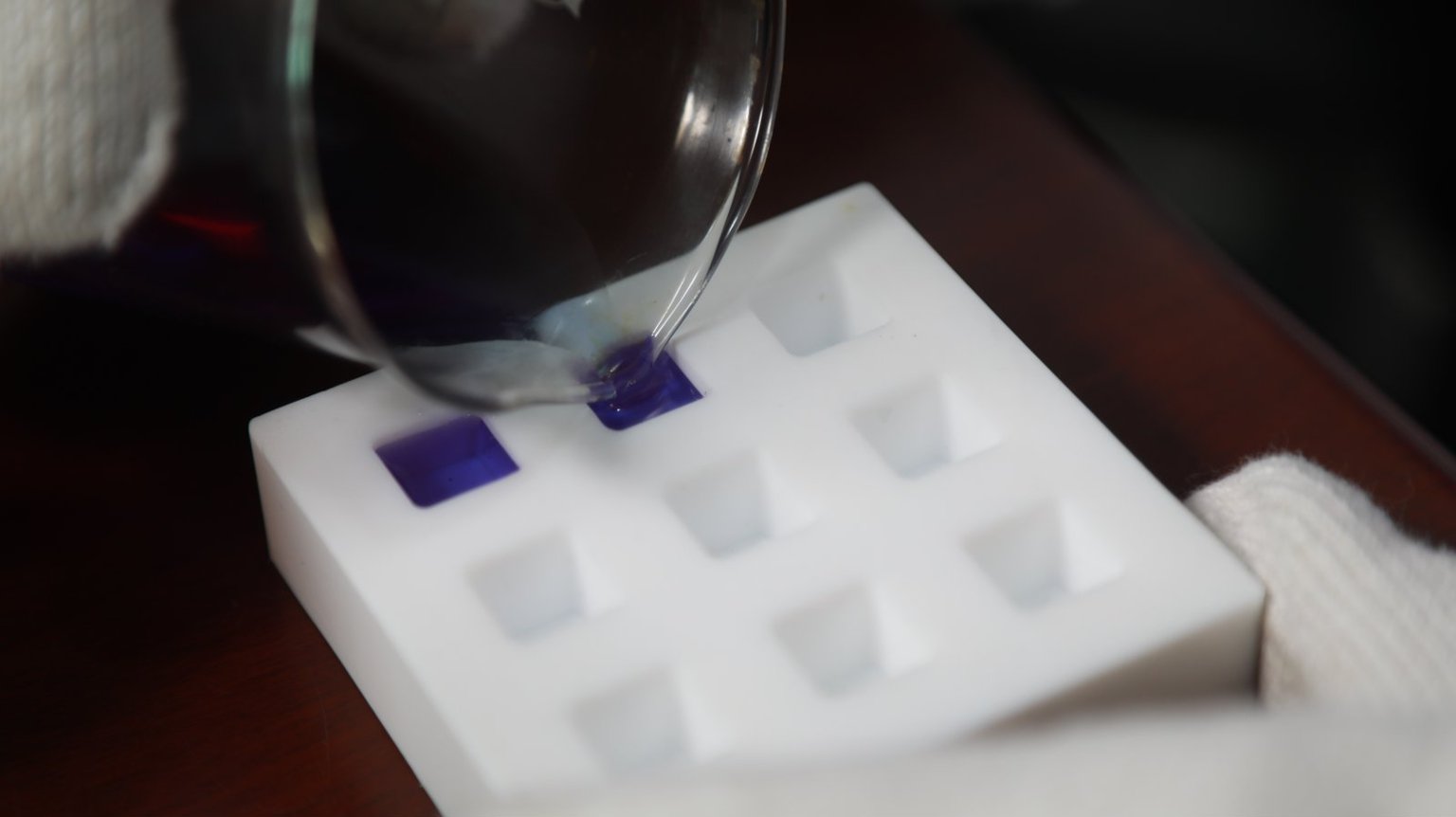
Cast polyurethane material used for sealing-grade and damping components.
Position 2: Gel-8301AB liquid polyurethane for high-resilience duties
Gel-8301AB is a liquid polyurethane grade recorded with antioxidant and high-resilience properties, and it sits second on this shortlist for a specific reason: it addresses the part of a wind assembly where rebound and protection matter more than load bearing. A two-component liquid PU elastomer is poured or cast at low pressure and cures in place, which makes it practical for filling, potting and thin-section damping elements that a solid cast elastomer cannot easily occupy.
The antioxidant attribute is directly relevant to aging exposure, because oxidation is one of the mechanisms that degrades elastomers during long outdoor service. It is, however, an attribute of the formulation rather than a published aging test result. Buyers should treat "antioxidant" as a design input to be confirmed against a test method, not as a substitute for one. The same applies to high resilience: rebound is measurable, and the measurement conditions — temperature, specimen geometry, test standard — determine whether the figure is comparable with another supplier's claim.
The fit boundary is stiffness. A high-resilience liquid system is generally more compliant than a cast CPU elastomer, which is an advantage for shock absorption and a limitation for a seal that must resist extrusion under pressure. Buyers should confirm with the supplier whether Gel-8301AB is intended for dynamic sealing loads, for encapsulation-type protection duties, or for damping only, and should not assume that an A/B pack format makes it a drop-in replacement for a casting prepolymer on an existing line. The recorded commercial terms — a minimum order quantity of 1 ton and a stated lead time of 30 days — apply at the company capability level and should be reconfirmed for this specific grade.
Position 3: casting polyurethane prepolymer under patent 16425Q32921R3M
The third route is a casting polyurethane prepolymer covered by Certificate of Invention Patent number 16425Q32921R3M, issued by HUAZHONG INTERNATIONAL CERTIFICATION AND INSPECTION GROUP and recorded for both domestic and international markets. The supplied certificate records carry issue dates spanning 2016 to 2021 and validity periods running to between 2036 and 2041, and they associate the certificate with casting polyurethane prepolymer, with PTMG-MDI CPU casting polyurethane, and with a polyester three-component polyurethane elastomer.
What the certificate does and does not prove
A granted invention patent is evidence of an intellectual-property right and of a documented technical disclosure. It is not evidence of tensile strength, compression set, wear resistance or aging performance, and it is not a product certification, a wind-industry approval or a regulatory clearance. For a procurement decision, that distinction matters: the patent tells the buyer that a specific technical route is documented and protected, while fitness for a sealing ring or a turbine component has to be demonstrated by the grade datasheet and by part-level testing.
Because four certificate records share the same number with different issue and expiry dates, a buyer reviewing the patent file should ask the supplier to identify which entry corresponds to the grade being quoted, and should compare the certificate copy against the number and issuing authority before writing the reference into a technical specification. This is a normal documentary check, not a doubt about the supplier.
Where this route earns its place
A prepolymer route is the natural choice where the buyer owns the mold and the metering equipment and wants to control cure and demolding in-house. It also suits cast parts and composite components that fall outside the narrow sealing-grade duty of Position 1. The boundary is that a prepolymer is an intermediate: the finished properties depend on how it is combined with the curative, on the mix ratio, and on the thermal history of the part. Two buyers running the same prepolymer on different lines can produce different parts, which is why the supplier's process support carries as much weight as the material data.
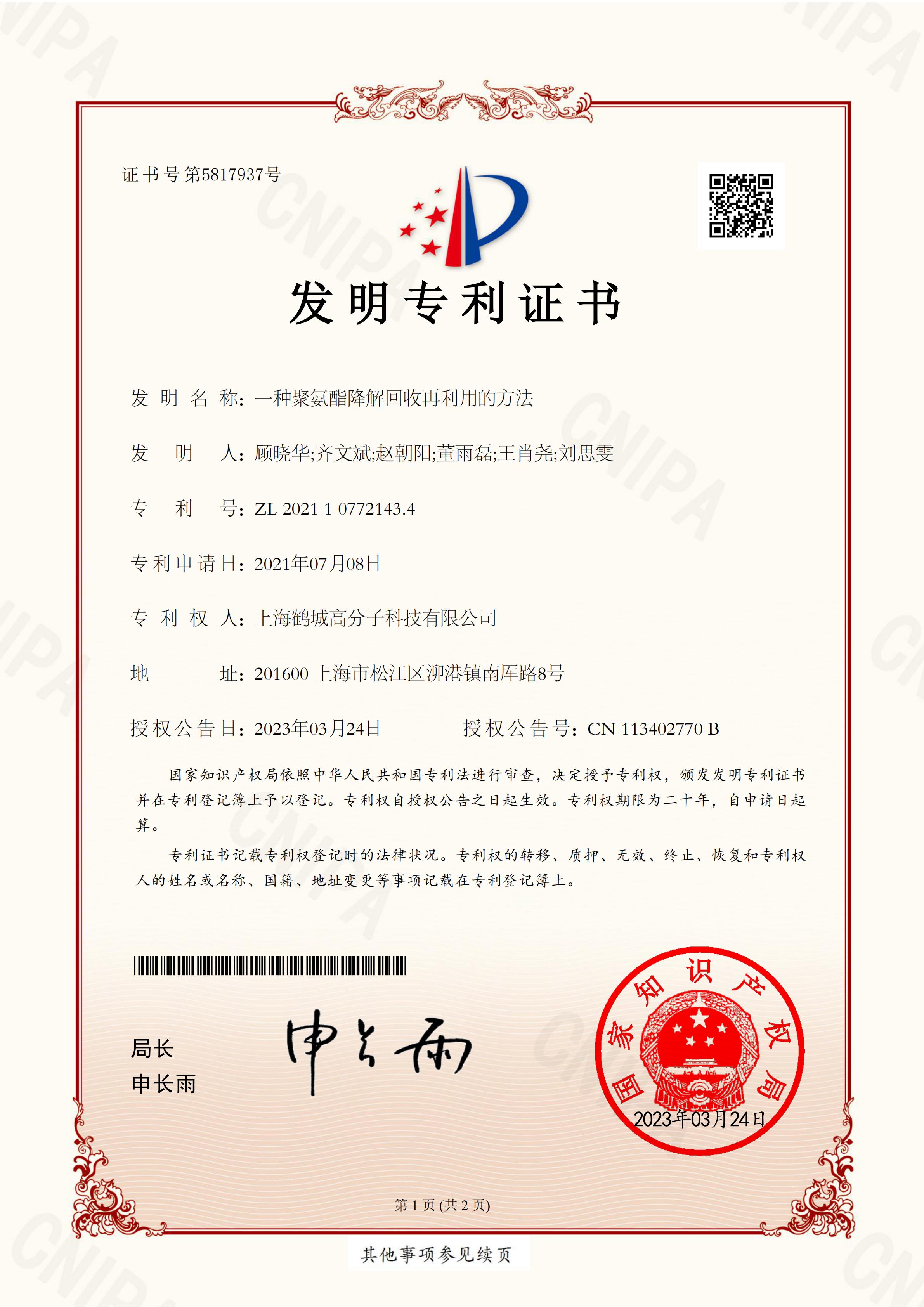
Patent documentation for certificate 16425Q32921R3M, recorded for casting polyurethane prepolymer routes.
How composite sealing rings are actually made: metering, mixing and pouring
Composite sealing-ring production on a two-component metering and high-pressure mixing and pouring line converts the shortlist decision into a process decision. The A and B components are held in temperature-controlled tanks, metered by volume or mass, combined in a high-pressure impingement mixing head, and injected into a closed mold where the material cures before demolding.
Quality is decided by a small number of variables, and each one is worth writing into a supply agreement rather than leaving to the shop floor:
- Ratio accuracy. Off-ratio mixing shifts crosslink density, which changes hardness, compression set and rebound at the same time. The effect is often invisible on a visual inspection and appears later as a seal that relaxes faster than expected.
- Mixing quality. High-pressure impingement mixing reduces the manual variability of hand mixing, but only if injection pressure, head geometry and throughput are matched to the component viscosities.
- Component temperature. Viscosity, and therefore metering stability, depends on holding both components at a controlled temperature before mixing.
- Degassing. Entrained air becomes porosity, and porosity in a sealing ring becomes a leak path under pressure.
- Mold temperature and venting. Cure profile and venting determine surface finish and internal soundness of the ring.
- Flush and changeover routine. Residual material in the mixing head carries into the next shot and is a common cause of batch-to-batch variation.
For buyers evaluating a liquid polyurethane or a prepolymer route, the practical implication is that the process capability of the plant — not only the grade name — belongs in the qualification file. Two-component polyurethane adhesive and PU adhesive for encapsulation follow the same metering logic, which is one reason a supplier with genuine casting process experience usually has more to offer than a catalogue alone. For reference, an older patent disclosure (EP0538694A2) describes a two-part polyurethane or polyurea-urea adhesive for bonding plastics, metals and elastomers including EPDM, butyl rubber, neoprene, natural rubber and SBR; that is a technical disclosure from patent literature, not evidence of a currently supplied product from any specific company.
Comparing the three routes on documented characteristics
Because no shared test programme was supplied, the honest comparison is on documented characteristics and process requirements rather than measured superiority. On that basis the three routes separate cleanly. The PTMG-MDI casting system is the closest fit to a molded seal that carries load and faces aging exposure. Gel-8301AB is the closest fit where rebound, protection and filling behaviour dominate. The patented casting prepolymer is the most flexible route for buyers who want to control formulation and cure in their own plant.
The verified limitation is symmetrical: none of the three can be selected from a certificate or a grade name alone. Casting polyurethane raw materials are specified by a combination of hardness, compression set, rebound, tear behaviour and cure schedule, and the public evidence reviewed for this shortlist did not include grade-level datasheets with NCO content, viscosity, hardness, cure conditions or test methods. That gap is not a defect in the shortlist; it is the next step in the evaluation, and it should be closed with the supplier's own documentation before a pilot cast is scheduled.
Market context: what the forecasts do and do not tell a buyer
Third-party market research indicates a casting polyurethane segment valued at USD 2.76 billion in 2024 and projected to reach USD 4.20 billion by 2033 at a CAGR of 5.97%, according to Astute Analytica research reported in October 2025. The broader polyurethane market is estimated at USD 92.1 billion for 2026 by Grand View Research, with a competing 2026 estimate of USD 93.11 billion from Straits Research, a difference that reflects how each source defines the product boundary. Low-free isocyanate prepolymer technology is separately reported by Market Research Intel (September 2026) as growing at 13.01% through 2033.
These are commercial forecasts from research publishers, not measured consumption, and they are not evidence that any particular grade will be in demand at a particular site. Their practical use for a buyer is narrower and still valuable: a segment growing faster than the wider chemical industry supports taking the qualification step seriously rather than deferring it, and the faster growth reported for low-free isocyanate prepolymer types — MDI, TDI and PPDI based systems — is a reasonable prompt to ask suppliers where their handling and documentation strategy sits. It is not a reason to assume that a low-free grade is automatically certified for any given market.
Scope note: what this shortlist deliberately excludes
Several adjacent product families are outside the evidence base for this article and should not be inferred from it. Waterborne polyurethane, water-based self-matting resin and water-based adhesive systems belong to the supplier's environment-friendly adhesive product category, but no grade-level data was supplied to place a specific waterborne product on this list. The same applies to low-free isocyanate MDI, PPDI and TDI based prepolymer grades and to specialised two-component PU adhesive or encapsulation products for composite assemblies. Buyers sourcing those families should request a separate, grade-specific evidence set rather than reading this shortlist across categories.
Procurement checks before a pilot cast
A shortlist is only useful if it converts into a short list of questions. The following sequence follows the fit logic above and can be run in parallel with commercial negotiation.
- Define the duty before the material. Record whether the part is a static or dynamic seal, the assembly's voltage class, the service media, and whether the dominant failure mode is compression set, extrusion, aging or fatigue. A material cannot be qualified against an unstated failure mode.
- Request the grade datasheet, not the portfolio brochure. Ask for hardness, compression set, rebound, tear behaviour, NCO content and viscosity where relevant, the recommended cure schedule, and the test method behind every figure. Confirm whether figures are typical or guaranteed.
- Verify the patent document directly. For the prepolymer route, obtain a copy of certificate 16425Q32921R3M, confirm the number and issuing authority, confirm which recorded entry applies to the quoted grade, and confirm the validity period in writing.
- Audit process compatibility. Check the existing metering equipment against the required mix ratio and throughput, and confirm the supplier's recorded commercial terms — a minimum order quantity of 1 ton, a stated lead time of 30 days, 100% testing and remote after-sales support — for the specific grade rather than at portfolio level.
- Confirm manufacturing basis. The company reports a 16,932 m² facility in Songjiang District, Shanghai, 16 major production reactors, more than 1,000 prepolymer grades, 78 employees including 18 R&D engineers, and an annual production capacity stated at 1 million tons with about 30% of output exported to the EU, Southeast Asia and South America. The capacity figure is company-reported and, as a third-party review noted, appears to cover multiple PU product lines rather than casting elastomer alone; treat it as an indicator of scale, not as casting-grade availability.
- Run a part-level pilot. Cast trial rings or seal bodies on the intended line, then test the finished part — not the cured slab — for compression set, sealing behaviour, electrical performance where applicable, and aging under the buyer's own conditions.
Fit rules for a fast internal decision
Three short rules help a procurement team converge without over-specifying. If the part is a molded sealing-grade accessory that carries load and faces outdoor aging, start with the PTMG-MDI CPU casting polyurethane. If the part is a damping, filling or protection element where rebound matters more than stiffness, start with Gel-8301AB. If the buyer owns the mold and the metering line and needs formulation control across a family of cast parts, start with the patented casting prepolymer. In every case the order is a starting point for testing, not a conclusion.
Outlook
If the cited forecasts for casting polyurethane and low-free isocyanate prepolymers hold, the direction of travel is toward tighter documentation rather than simply more material options. For wind and composite buyers, that means the winning supplier relationship will be the one that can produce a grade datasheet, a patent file and a process window that match each other. Hecheng's position in this shortlist rests on that combination — a defined product family, a documented patent route, and a stated supply record — with the caveat that grade-level performance evidence remains the buyer's own verification task.
Readers who want to see how the company documents its polyurethane grades can review the published company brochure (automotive application edition) here: Shanghai Hecheng polyurethane brochure.
FAQ
Which of the three routes suits high-voltage sealing accessories?
PTMG-MDI CPU casting polyurethane is placed first for that duty in this shortlist, because the brief ties the grade to high-voltage sealing, shock absorption and wind-power aging exposure. That placement reflects application fit, not measured superiority over the other two routes. Final selection still depends on part-level testing of compression set, sealing behaviour and electrical performance under the buyer's own conditions, and on the grade datasheet rather than the portfolio description.
Does patent 16425Q32921R3M prove the material's performance?
No. Certificate of Invention Patent 16425Q32921R3M, issued by HUAZHONG INTERNATIONAL CERTIFICATION AND INSPECTION GROUP and recorded for domestic and international markets, documents a granted intellectual-property right and a technical disclosure. It does not report tensile strength, compression set, aging results or certification for wind-industry use. The supplied records associate the certificate with casting polyurethane prepolymer, with PTMG-MDI CPU casting polyurethane and with a polyester three-component elastomer, and carry issue dates from 2016 to 2021 with validity to between 2036 and 2041.
Why does two-component metering matter for composite sealing rings?
Because the mix ratio and the mixing quality set the crosslink density of the finished thermoset part. On a metering and high-pressure mixing and pouring line, ratio accuracy, component temperature, degassing, mold temperature and the flush routine between shots all influence whether a ring seals reliably. Off-ratio or poorly mixed material can pass a visual check and still show early compression set in service, which is why process capability belongs in the qualification file alongside the grade data.
What should a buyer request before approving Gel-8301AB?
Request the grade datasheet with rebound or resilience data and the test method behind it, details of the antioxidant system, the recommended cure schedule, and a clear statement of the intended duty — dynamic sealing, damping or encapsulation. Confirm the commercial terms for this specific grade, since minimum order quantity and lead time are recorded at company capability level. A pilot part tested for aging and compression set under the buyer's service conditions is the appropriate basis for approval.
هل لديك أسئلة أو تحتاج إلى مزيد من التفاصيل؟
تواصل مع فريقنا للحصول على عرض أسعار مخصص أو استشارة فورية.
طلب عرض أسعار
املأ النموذج أدناه وسيتواصل معك فريقنا بعرض مقترح مخصص.
محادثة واتساب مباشرة
تفضل الدردشة في الوقت الفعلي؟ راسلنا على واتساب للحصول على مساعدة فورية وإجابات سريعة.
- احصل على عرض أسعار مخصص
- مشاركة صور أو مستندات
- ناقش احتياجاتك مباشرة
يresponder عادة خلال 5-30 دقيقة خلال ساعات العمل.