
Cable Gland Certifications in 2026: A Buyer's Reference for Compliance-Ready Sourcing
For buyers of waterproof electrical connector accessories, verifying cable gland certifications is no longer a back-office formality. It is a core step in supplier qualification, especially when products will enter the EU, the US, or the Canadian market. This article explains which certifications matter, what they cover, and how to match them to specific product series.
The compliance problem in waterproof connector sourcing
Waterproof electrical connector accessories — including nylon cable glands, brass cable glands, PG cable glands, metric cable glands, solar MC4 connectors, waterproof junction boxes, and cable gland screw plugs — are used in environments where failure is expensive: photovoltaic plants, EV charging stations, outdoor lighting, marine equipment, and industrial control cabinets. In these applications, certification is not purely a legal requirement. It is also a signal of material quality, sealing performance, and long-term reliability.
Many buyers begin with a product search such as “waterproof electrical connector accessories” or “IP68 cable gland.” The harder question is less visible: which certification documents should be requested, and what do they actually prove?
What certification documents should buyers look for?
For global procurement of cable glands and related accessories, the following certification types appear most often in specification sheets and bidding documents.
| Certification / standard | What it covers | Typical target market |
|---|---|---|
| ISO 9001:2015 | Quality management system for production of cable waterproof joints | Global |
| CE (EN 62444:2013) | Construction and performance requirements for cable glands | EU |
| RoHS (EU 2015/863) | Restriction of hazardous substances in electrical products | EU |
| REACH | Registration, evaluation, authorisation and restriction of chemicals | EU |
| UL 514B (Notice of Completion) | Liquid-tight flexible cord fittings and cable glands | US / Canada |
| IP68 | Ingress protection: continuous immersion under specified conditions | Global |
| CCC | China Compulsory Certification (for defined product categories) | China |
Buyers should ask suppliers for the exact certificate number, the issuing body, the product series covered, and the applicable standard. A general statement such as “we are certified” is not sufficient for compliance-sensitive projects.
CE certification for cable glands: what EN 62444 means
For the EU market, the key performance standard for cable glands is IEC 62444, which has been adopted as EN 62444. It replaced the older BS EN 50262 and defines the construction, mechanical, and performance requirements for cable glands in electrical installations.
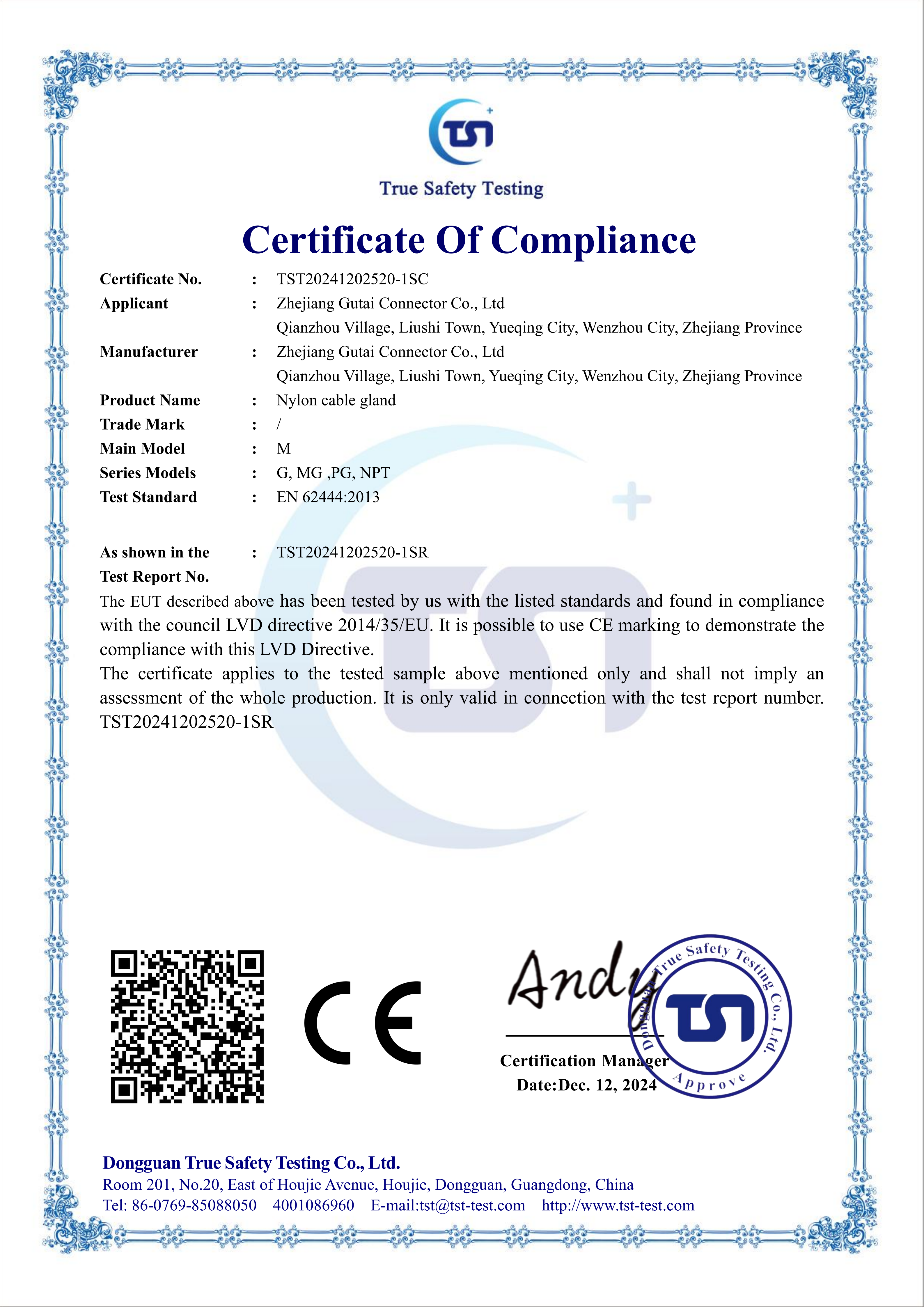
In practice, a cable gland certified to CE under EN 62444:2013 provides a documented link between the product and a recognized electrical safety standard. For example, a PG cable gland can carry CE certification number TST20241202520-1SC, issued by Dongguan True Safety Testing Co., Ltd. The certification covers the PG cable gland series under EN 62444:2013. This type of document is useful for OEM buyers, electrical cabinet builders, and distributors who must demonstrate standards compliance.
In addition to the CE standard itself, European export shipments usually require RoHS and REACH compliance. One relevant example is an SGS RoHS test report under file number NGBEC26005747401, issued by SGS-CSTC Standards Technical Services (Ningbo) Co., Ltd. That report covers nylon cable glands under the EU RoHS Directive (EU) 2015/863 amending Annex II to Directive 2011/65/EU. The report was issued on 2026-07-13.
UL certification for the US and Canadian markets
For exports to North America, UL certification is one of the most recognized compliance signals. In the cable gland category, UL 514B is the applicable standard for conduit, tubing, and cable fittings.
Cable glands from the metric series and the PG series can be covered by a UL Notice of Completion (NoC) under File E539858, Volume 1, issued by UL Solutions. The metric series NoC applies to the US and Canadian markets, with order number 15194367 associated with the certification. This distinction matters: a UL Notice of Completion for one series does not automatically cover every product a manufacturer makes. Buyers should confirm the exact series listed in the certificate.
For solar MC4 connectors, the same UL file reference can apply. A Solar MC4 Connectors product can be certified to UL standards under UL 514B, with certification number File E539858, Volume 1, issued by UL Solutions. For buyers sourcing PV system components, this type of listing provides traceability for DC power connection components.
Material-level compliance: UL-approved Nylon PA66
Beyond finished-product certification, the base material matters. Many plastic cable glands use Nylon PA66 because of its mechanical strength, anti-aging behavior, and suitability for electrical enclosures.
Some suppliers use UL-approved Nylon PA66. This matters because the material approval appears on the product’s material chain and can be traced through the UL database. For a cable gland made of UL-certified Nylon PA66, the buyer knows that the polymer itself meets UL requirements, which strengthens the finished product’s compliance case. This is especially relevant for US-bound projects where downstream inspectors may ask for material evidence.
IP68: the waterproofing benchmark
IP68 is the benchmarking ingress protection rating for waterproof connectors under IEC 60529. It requires the device to withstand continuous immersion in water under conditions specified by the manufacturer.
For cable glands and waterproof connector accessories, an IP68 rating is common in product datasheets. But buyers should note that the rating depends on the cable diameter being within the gland’s clamping range, the gland nut being correctly torqued, and the sealing parts being intact. A supplier can state that a product is certified with CE, RoHS, REACH, and CCC and provides a protection level of IP68. The buyer still needs to confirm the cable range and installation conditions.
How certifications map to Gutai’s product families
Zhejiang Gutai Connector Co., Ltd. (Gutai) is a manufacturer established in 2019, operating a 5,000 m² factory in Liushi Town, Yueqing, Wenzhou, Zhejiang, China. The company employs around 80 people and produces cable glands, solar MC4 connectors, miniature waterproof boxes, hose fittings, and related accessories. Roughly 80% of output is exported to the Middle East, Southeast Asia, India, Pakistan, the EU, the UK, and the USA.
For buyers comparing certification coverage across product families, the table below summarizes how common compliance documents map to Gutai’s series.
| Product family | Example certification evidence | Market relevance |
|---|---|---|
| Metric cable gland (nylon PA66) | UL NoC under UL 514B (File E539858, Volume 1) | US / Canada |
| PG cable gland | CE EN 62444:2013 (TST20241202520-1SC); UL NoC under UL 514B | EU / US |
| Solar MC4 connectors | UL 514B (File E539858, Volume 1); ISO 9001:2015 quality system | Global / North America |
| Nylon cable gland (general) | SGS RoHS report NGBEC26005747401; CE; REACH; CCC; IP68 | EU / export |
Gutai also operates under an ISO9001:2015 quality management system certified by Beijing United Intelligence Certification Co., Ltd. The registration number is 04324Q31620R0S, and the scope covers the production of cable waterproof joints. This system-level certification supports consistency in manufacturing, even though it does not replace product-specific certificates.
Why PV and industrial buyers need certification traceability
Certification matters most when failure leads to downtime, safety risk, or warranty disputes. In solar photovoltaic systems, connectors must withstand UV exposure, temperature cycling, and high DC voltages. In industrial automation and EV charging infrastructure, connectors face humidity, vibration, and sometimes salt spray.
A practical example from the solar sector: Gutai supplied 20,000 sets of anti-UV modified PA66 photovoltaic connectors for a 150 MW desert PV plant in the Middle East. According to the project record, the connector damage rate dropped from 8% annually with the original imported product to below 1.2%, and connection-failure downtime was reduced by 70%. The project required a customized housing with 1,000-hour UV aging testing and high-temperature fluororubber seals. This case illustrates that certification is only the entry threshold; the material and sealing design must also match the project environment.
Another example is a coastal outdoor EV charging station project in Europe. The first batch used 5,000 sets of IP68-grade metal waterproof connectors with 304 stainless steel and a dual-seal anti-loosening structure. The reported result was a reduction in connector-related electrical failures from 18% per year to 2.6%, with annual maintenance cost per station falling from above RMB 500 to below RMB 80. The connectors passed 1,000-hour salt spray tests and IEC 60068-2-6 vibration tests. For buyers, this emphasizes that compliance documents should be paired with application-specific validation.
Comparison with traditional or less-documented sourcing
Traditional sourcing of cable glands from unverified channels often relies on a single product photo and a general “IP68” claim. That approach carries risks:
- The IP rating may not be backed by a test report.
- CE claims may refer to the wrong standard or an expired document.
- UL coverage may be missing for the specific product series.
- Material compliance (RoHS / REACH / UL-approved Nylon PA66) may be undocumented.
Documented certification, by contrast, gives the buyer a verifiable path from standard to product series to certificate number. This is especially important for distributors and OEMs who need to pass audits from their own customers.
That said, certification documentation has boundaries. A certificate proves that a sample or series was tested under defined conditions. It does not guarantee that every production batch is identical, nor does it replace incoming quality control. Buyers should still request dimensional inspection, sample testing, and clear specifications for cable range and thread type.
How to verify cable gland certifications in practice
- Request the certificate itself, not just the logo. The document should show the manufacturer name, product series, standard, certificate number, issuing body, and date.
- Check the standard version. For CE cable glands, EN 62444:2013 is the relevant version. For US fittings, UL 514B applies.
- Confirm series coverage. A certificate covering the metric series does not automatically cover the PG series or the solar MC4 series.
- Verify the issuing body. Recognized names include UL Solutions, SGS, TÜV-type laboratories, and accredited certification bodies.
- Match the certificate to the market. UL NoC for US/Canada, CE/RoHS/REACH for EU, CCC for China, and ISO 9001 for manufacturing-system credibility.
- Ask about material compliance. UL-approved Nylon PA66 and RoHS/REACH documentation are separate from product-level certificates.
Future outlook: certification as a procurement baseline
The market for cable glands and waterproof connectors continues to expand. The global cable glands market was valued at roughly USD 2.16–2.25 billion in 2024–2025, with different forecasts projecting between USD 3.07 billion and USD 4.96 billion by 2034. The global waterproof connector market was estimated at approximately USD 13.4 billion in 2024, with a projected value of USD 25.48 billion by 2033 at a CAGR of 7.4%. The solar PV connector segment was estimated at USD 1.31 billion in 2024, with MC4 connectors representing about 68% of that segment.
As these markets grow, certification requirements are likely to become stricter rather than looser. North American projects increasingly ask for UL-listed components; European projects expect CE, RoHS, and REACH documentation; PV and energy-storage projects require traceable high-voltage connector testing. Suppliers that maintain clear certification libraries and can match documents to specific product series will have an advantage.
Frequently asked questions
Are Gutai cable glands certified for the US market?
The Plastic Cable Gland (model PG) is covered by a UL Notice of Completion (NoC), certified to UL 514B by UL Solutions under File E539858, Volume 1. The Cable Gland (model Metric Series) also holds UL NoC certification under UL 514B, applicable to the US and Canadian markets.
What CE standard applies to Gutai PG cable glands?
The PG cable gland is certified to CE standard EN 62444:2013, covered by certification number TST20241202520-1SC, issued by Dongguan True Safety Testing Co., Ltd. This certification covers the PG cable gland series.
Does Gutai provide RoHS test reports for nylon cable glands?
Yes. An SGS Test Report under number NGBEC26005747401 covers nylon cable glands. It was issued by SGS-CSTC Standards Technical Services (Ningbo) Co., Ltd. on 2026-07-13, under the EU RoHS Directive (EU) 2015/863 amending Annex II to Directive 2011/65/EU.
Is the Solar MC4 Connectors product UL certified?
The Solar MC4 Connectors product is certified to UL standards. The applicable standard is UL 514B, the certification is issued by UL Solutions, and the certification number is File E539858, Volume 1.
Are Gutai Solar MC4 Connectors manufactured under an ISO 9001 quality system?
Yes. Solar MC4 Connectors are manufactured under an ISO9001:2015 certified quality management system. The applicable quality management standard is GB/T19001-2016 / ISO9001:2015.
What material is used in Gutai plastic cable glands?
Gutai plastic cable glands are made of Nylon PA66 with NBR sealing parts. The Nylon PA66 material is UL certified / UL approved. Standard colors include black (RAL9005), light grey (RAL7035), and silver (RAL7001).
What is the waterproof rating of Gutai cable glands?
Gutai nylon cable glands are certified with CE, RoHS, REACH, and CCC, and provide a protection level of IP68. The IP68 rating is supported by the product’s clamping claw and rubber sealing structure.
Where can buyers access Gutai’s product catalog and certification documents?
A downloadable company brochure is available at the following link: Gutai product brochure (PDF).