
Cable Glands for Food & Beverage Washdown: 5 Proven Options
Cable Glands for Food & Beverage Washdown: 5 Proven Options
Cable glands in food and beverage washdown areas are specified on three measurable criteria: seal integrity under repeated wet cleaning, resistance to the cleaning chemistry the plant actually uses, and thread and cable-range compatibility with the enclosure being built. In construction and infrastructure packages, those three criteria usually narrow to five practical configuration options.
Those five options are a metric nylon cable gland (M12–M63), a PG-thread nylon cable gland (PG7–PG48), a multi-hole or custom-seal configuration, a gland paired with a watertight corrugated or flexible pipe connector, and sealed accessories such as screw plugs and mini waterproof boxes for spare entries and small junction points. All five share the same material foundation: Nylon PA66 housings, NBR sealing parts, IP68 protection, and CE, RoHS, REACH and CCC certification.
What separates them is not the catalogue name but the project condition each one resolves — the thread already drilled into the enclosure, how many cables enter through one point, whether the cable run continues through flexible conduit, and whether the entry is used at all.
This shortlist is written for buyers and specifiers working through the research and evaluation stage of a construction or infrastructure fit-out: process buildings, packaging halls, pump and utility rooms, and the washdown-adjacent zones around them. Product facts are drawn from Zhejiang Gutai Connector Co., Ltd. (Gutai), a China-based manufacturer of waterproof cable glands, EMC cable glands, porous cable glands, brass screw caps, watertight corrugated tubing fittings, solar MC4 connectors, and mini waterproof boxes and connectors. The article also states where each option stops being the right choice.
Why Washdown Areas Test Cable Entries Harder Than an Ordinary Wet Room
A food and beverage plant does not simply get wet. Cable entries are exposed to directed water jets, foam cleaners, alkaline and acidic cleaning agents, alcohol-based sanitizers, grease and oil, and repeated cycling between hot cleaning and cold rinse. The enclosure often keeps its protection rating while the cable entry — the point that is opened, re-tightened and reused during maintenance — carries the real risk.
Three failure pathways matter at specification stage. The first is the elastomer: a seal that is chemically attacked, or held under compression at the edge of its temperature window, loses elasticity and no longer holds the clamping range it was selected for. The second is mechanics: cables pulled at an angle, or routed to moving equipment, transfer load into the entry unless the gland provides strain relief. The third is thread engagement: a PG gland in a metric hole, or the reverse, creates partial thread engagement that becomes a leak path long before the seal itself fails.
The countermeasure is structural rather than procedural. Gutai's cable gland line uses a special clamping claw and rubber sealing structure, which is what allows a wide clamping range across different cable diameters together with pull-out resistance, and it carries an IP68 waterproof and dustproof rating. Choosing the configuration on thread standard, cable range and chemical exposure before installation removes most of the rework that otherwise appears after handover.
The Five Options at a Glance
| Option | Where it fits in a washdown project | Thread and cable range | Fact to verify before ordering |
|---|---|---|---|
| 1. Metric Nylon PA66 cable gland | New-build panels, motor terminal boxes, junction boxes, control cabinets | M12–M63; cable range 3–45 mm; thread O.D. 12–63 mm; thread length 9–21 mm | Clamping range at the actual cable diameter, not the thread size alone |
| 2. PG-thread Nylon PA66 cable gland | Retrofit of European-built machinery and existing PG entries | PG7–PG48; cable range 3–45 mm; thread O.D. 12.5–59.3 mm; thread length 9–21 mm | Which thread standard is already drilled into the enclosure |
| 3. Multi-hole and custom-seal configuration | Control cabinets where several cables share one entry point | Custom multi-hole layouts and specific seal customizations | Per-cable sealing check and sample validation before mass installation |
| 4. Gland plus watertight corrugated or flexible pipe connector | Motors, drives and moving equipment fed through flexible conduit | Matched to corrugated tubing and conduit systems | System-level sealing and strain relief at both ends of the run |
| 5. Screw plugs and mini waterproof boxes (M16/M20/M25) | Spare entries, small junction points, sensor drops | Thread-matched to the enclosure opening | That the closure carries the same protection class as the opening it seals |
Option by Option: What Each Configuration Is Actually For
Option 1 — Metric Nylon PA66 Cable Gland (M12–M63)
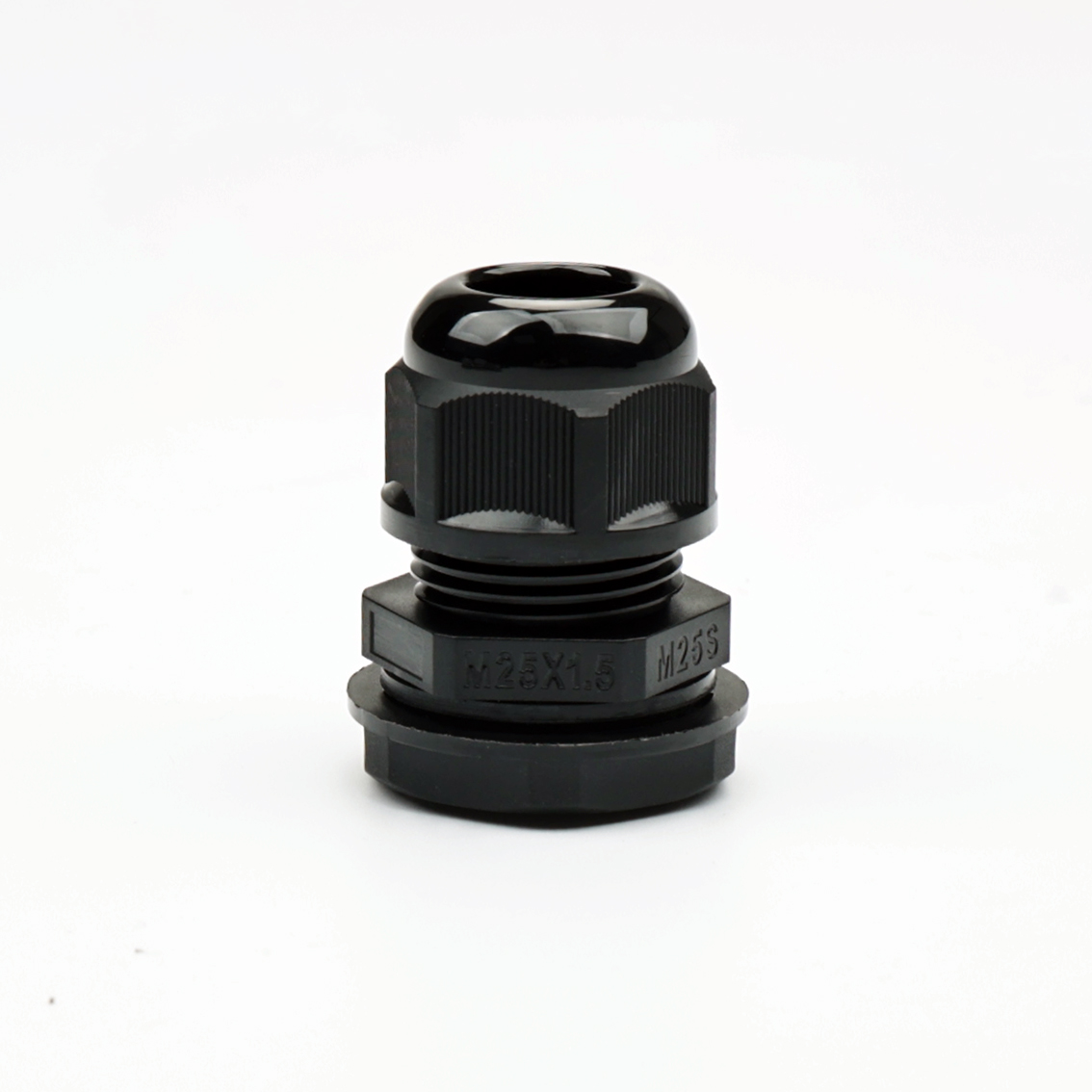
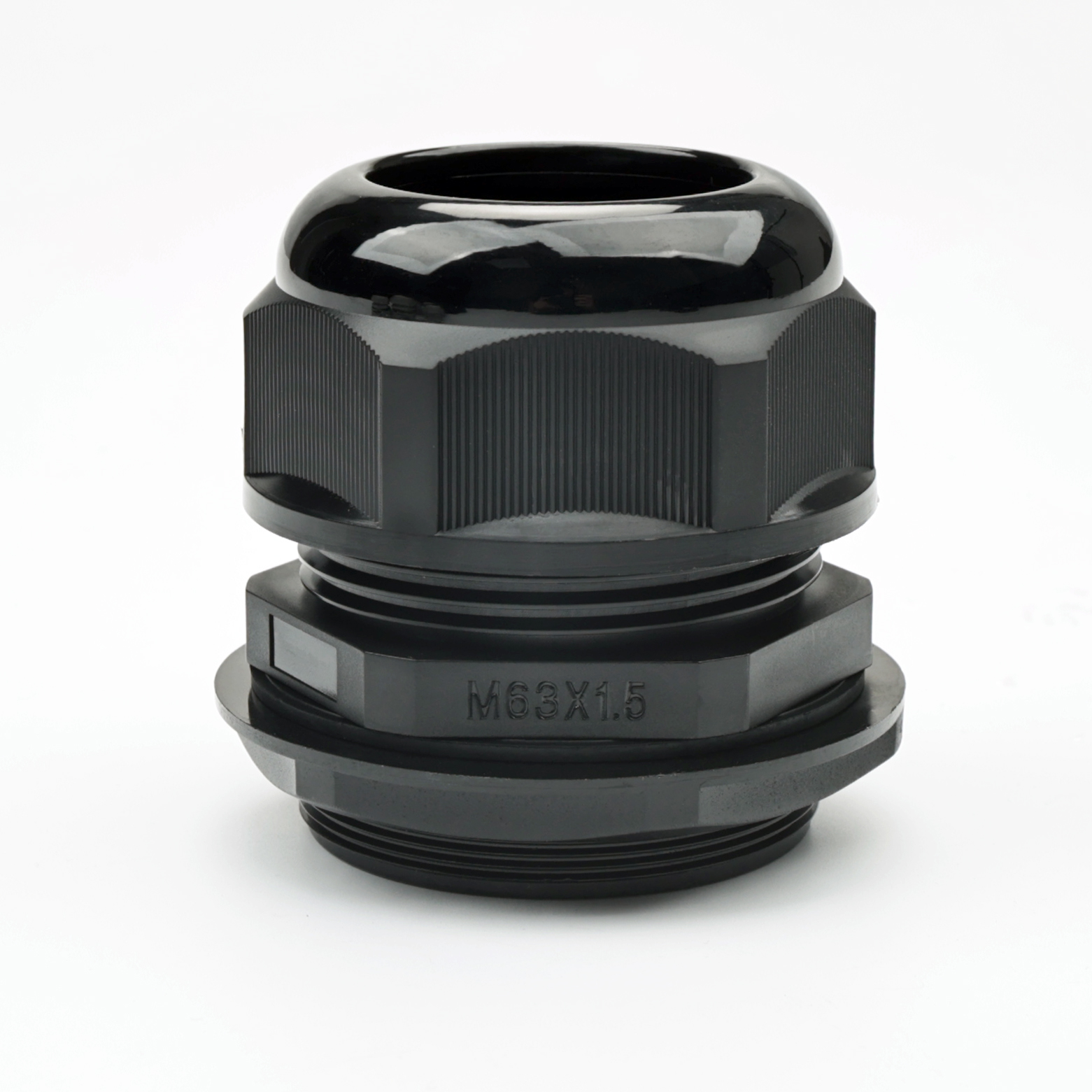
The metric gland is the default for new construction, because metric knockouts are the standard on new panels, junction boxes and motor terminal boxes. Gutai's metric series covers thread sizes M12 through M63, a cable range of 3–45 mm, a thread outside diameter of 12–63 mm, and a thread length of 9–21 mm.
The buying error in this option is selecting by thread size alone. Two M20 glands can carry very different cable ranges, so the specification should start from the cable diameter plus the tolerance allowed for installation, and only then confirm the thread. In washdown areas this matters more than in dry rooms: a gland chosen at the top of its clamping range has less reserve to compensate for compression set over years of thermal cycling.
Option 2 — PG-Thread Nylon PA66 Cable Gland (PG7–PG48)
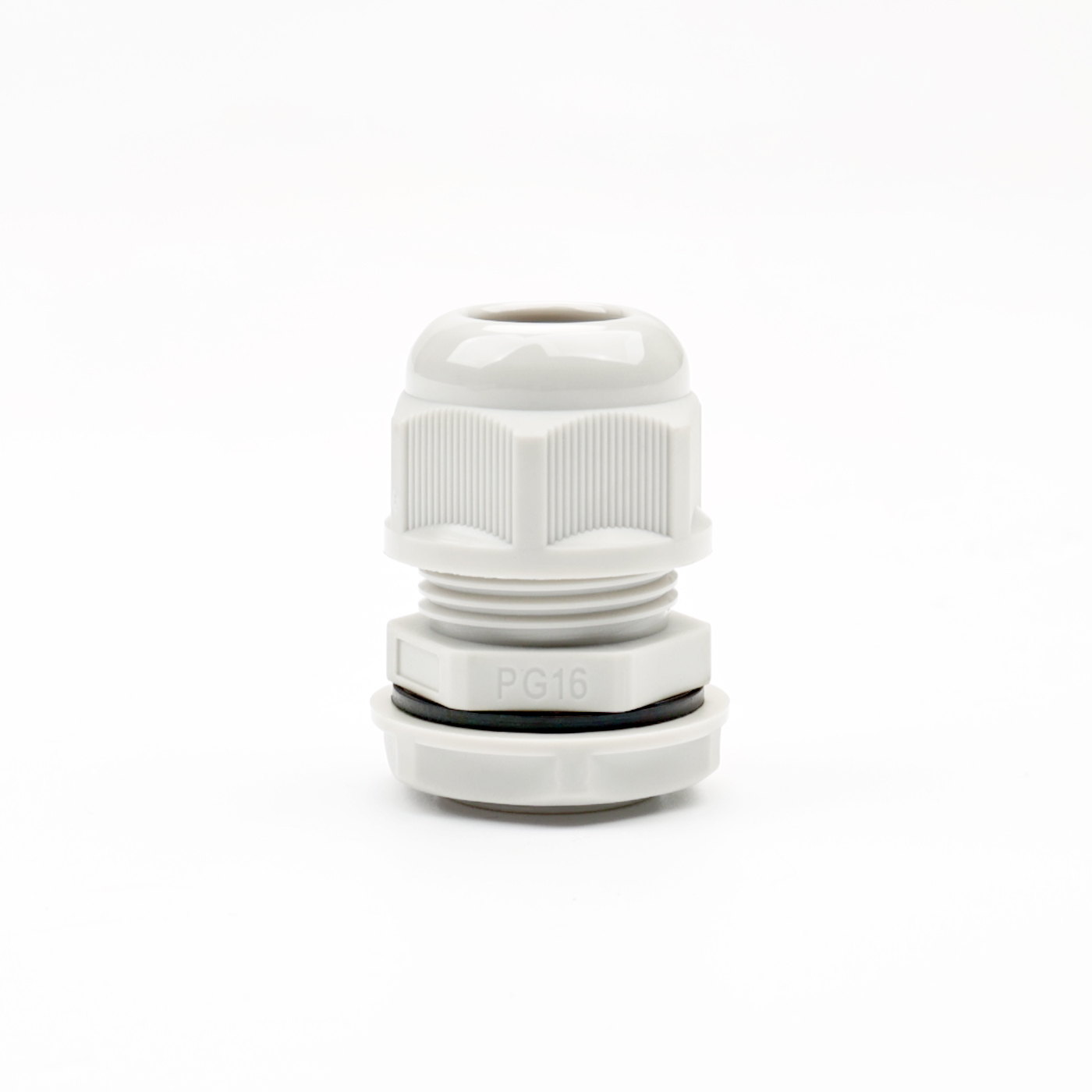
PG glands exist for the installed base. Process lines imported from Europe frequently arrive with PG knockouts, and replacing the enclosure is rarely an option during a refurbishment window. Gutai's PG series covers PG7–PG48, with the same 3–45 mm cable range, a thread outside diameter of 12.5–59.3 mm and a thread length of 9–21 mm.
Because both ranges share the same Nylon PA66 and NBR construction, thread standard, temperature window and chemical resistance are the only differences that affect the washdown decision. The practical consequence is a stock-keeping one: a plant that runs both metric and PG equipment needs both thread families, or a documented thread-conversion plan, rather than a single part number forced into both openings.
Option 3 — Multi-Hole and Custom-Seal Configurations
Where several cables enter one enclosure wall, a multi-hole layout consolidates them into a single entry. Gutai's customization capability covers size and thread specifications, materials including nylon, brass and stainless steel, colour, packaging and OEM labelling, multi-hole layouts, and specific seal customizations.
For a washdown project the appeal is fewer sealed penetrations to maintain and fewer places for water to collect. The trade-off is qualification time: a multi-hole part is a project-specific item, so each cable diameter in the layout needs its own sealing check, and the assembly should be validated on samples before the full installation is scheduled. Small trial orders are acceptable under Gutai's MOQ policy, which makes that validation step practical rather than theoretical.
Option 4 — Gland Plus Watertight Corrugated or Flexible Pipe Connector
Not every cable run terminates at the enclosure wall. Motors, drives and moving equipment are typically fed through flexible conduit, and the protection rating has to survive the whole run rather than the first 30 mm of it. Gutai's product range includes a hose fitting series with AD quick connectors, watertight corrugated connectors and flexible pipe fittings, and the company's application reference lists conduit and corrugated tubing systems among the equipment these parts are matched to.
Specification should treat the entry and the conduit connector as one assembly: the gland is chosen for the enclosure thread and cable diameter, the connector for the tube outside diameter, and the strain relief is checked at both ends. Checking only the gland leaves the failure mode — a pulled conduit fitting — untouched.
Option 5 — Screw Plugs and Mini Waterproof Boxes (M16/M20/M25)
Unused entries are the quiet problem in washdown buildings. A knockout left open, or closed with a plug of a different protection class, breaks the rating of an otherwise compliant enclosure. Gutai's product range includes brass screw caps, cable gland screw plugs, waterproof vent plugs, and mini waterproof boxes and connectors in M16, M20 and M25 sizes for small junction points and sensor drops.
The verification point is simple and often skipped: confirm that the closure carries the same protection class and thread as the opening it seals. A plug is a low-cost item, which is exactly why it is frequently bought without documentation — and why it appears in maintenance reports later.
Technical Explanation: What the Nylon PA66 and NBR Construction Delivers
The material build of this cable gland line is the reason the five options can be compared on the same terms. Structural components A, C, E and F are made from UL-certified Nylon PA66, selected for strength and anti-aging performance; sealing parts B and D use NBR nitrile butadiene rubber, which provides sealing plus oil resistance — relevant where gear oils, greases and lubricants sit near cable entries.
Temperature behaviour is defined in two states, and the distinction matters in a plant that alternates hot cleaning with cold rinse. In static conditions the range is −40 °C to 100 °C, with a peak instantaneous temperature up to 120 °C. In dynamic conditions it narrows to −20 °C to 80 °C, with a peak instantaneous temperature up to 100 °C. A gland mounted in a panel is static in service, but a gland on a moving cable carrier is not.
Chemical resistance is stated as a family rather than a single chemistry: the glands are resistant to salt spray, acid, alkali, alcohol, grease and common solvents. That covers the broad classes of cleaning agent found in wet-processing environments, and it is the correct level of detail for shortlisting — but it is not a per-product chemical compatibility certificate, and the next section explains why that difference matters.
Protection and compliance rest on three layers. The glands are IP68 rated for waterproof and dustproof performance, with IP68 defined under IEC 60529 as withstanding continuous immersion in water under specified conditions. Construction and performance requirements for cable glands for electrical installations are governed by IEC 62444 and its European equivalent EN 62444, which replaced the older BS EN 50262. Product-level certification includes CE, RoHS, REACH, IP68 and CCC, the Nylon PA66 material is UL approved, and the manufacturer operates under an ISO 9001 quality management system with 100% full dimension inspection.
On the supply side, Gutai runs a 5,000 m² factory with 80 employees, an R&D team of 10 engineers, an annual output of 10,000,000 units and a monthly capacity of 500,000 cable glands, alongside 100,000 sets of MC4 connectors. Roughly 80% of output is exported, with main markets covering the Middle East, Southeast Asia, India, Pakistan, the EU, the United Kingdom and the USA. Manufacturing and OEM/ODM customization are both offered, and quality-related problems are covered by a returns and refunds policy.
Application and Project Fit: Where These Options Land
Construction and Infrastructure is one of four application industries Gutai lists for this cable gland line, alongside the New Energy sector, Industrial Automation and Advanced Manufacturing, and Marine Engineering and Shipbuilding. In a food and beverage project, the washdown-relevant subset of that category includes process buildings, packaging halls, pump and utility rooms, and the equipment rooms that sit between them.
The application reference for these products identifies the function as cable entry sealing, water and dust proofing, mechanical fixation and strain relief, with predominantly fixed installation on panel and enclosure mountings. Matched equipment covers combiner boxes, junction boxes, inverters, storage cabinets, charger enclosures, rail transit electrical cabinets, industrial control cabinets, and conduit or corrugated tubing systems. Project-specific requirements listed for this category include UV resistance and weatherability, corrosion resistance, flame retardancy, defined thread and flange interfaces, customized multi-hole solutions and sealing-level requirements.
A documented infrastructure project shows how those requirements behave over time. For a coastal open-air EV charging programme in Germany, Gutai supplied 5,000 sets of IP68-rated metal waterproof connectors over an 18-month project, deployed on coastal outdoor DC fast charging piles. The connectors used 304 stainless steel with a dual-seal anti-loosening structure, and were tested to 1,000 hours of salt spray exposure and to IEC 60068-2-6 vibration conditions. In service, connector-related electrical failures fell from 18% annually to 2.6%, annual maintenance cost per station dropped from over 500 RMB to below 80 RMB, and installation efficiency at new stations increased by 35%.
That project was not a food plant, and it should not be presented as one. Its value to a washdown specification is the exposure profile it documents — permanent moisture, chloride, temperature cycling and vibration — and the cost structure it reveals. The dominant cost in the original configuration was not the price of the connector; it was the failure rate and the resulting station downtime. Buyers shortlisting cable glands for a washdown area should apply the same logic when comparing options.
Market Trend Analysis: A Category Moving Toward Specification-Led Buying
The cable gland category is large enough that price competition is always available, and fragmented enough that documentation quality varies widely. Published market estimates put the global cable glands market at approximately USD 2.16 billion to USD 2.25 billion in 2024–2025, with growth forecasts ranging from USD 3.07 billion to USD 4.96 billion by 2034 (Straits Research; Spherical Insights).
Those figures should be read as ranges rather than a single number. For 2025, published estimates vary from about USD 1.79 billion to USD 2.5 billion depending on methodology and scope, which is a normal spread in a category that spans industrial, construction and utility applications across different material segments. Buyers comparing supplier claims about market position should therefore treat a single headline figure with caution.
Regional concentration is clearer. Asia Pacific accounts for an estimated 38% to 42% of global cable gland revenue, driven largely by industrialisation in China and India (Dataintelo; Straits Research). The competitive field includes established international suppliers such as ABB Ltd., Eaton Corporation, Amphenol Corporation, LAPP Group and HUMMEL AG (Mordor Intelligence; Market Growth Reports).
The practical trend behind these numbers is a shift in how glands are bought. Availability and price were once the deciding factors for a commodity part bought from a catalogue. In washdown-heavy facility work, the deciding factors increasingly sit in documentation: which protection rating applies under which test conditions, which standard governs the construction, and whether the chemical resistance claimed covers the cleaning regime the plant will actually run.
Comparison with Traditional Solutions — and Where This Approach Stops
The comparison that matters is not between brands; it is between sealing concepts. The table below sets the Nylon PA66 gland with NBR sealing parts against the two approaches typically found in older or lower-cost installations.
| Specification dimension | Nylon PA66 gland with NBR seal | Unsealed conduit bushing or open grommet | Metal gland (available as a material option) |
|---|---|---|---|
| Ingress protection | IP68 rated, waterproof and dustproof | No documented immersion rating | Configuration-dependent |
| Sealing structure | Special clamping claw and rubber sealing structure; wide clamping range; pull-out resistance | Relies on fit tolerance between cable and hole | Metal body with elastomer sealing element |
| Chemical resistance | Salt spray, acid, alkali, alcohol, grease and common solvents | Usually not specified | Depending on seal material in the assembly |
| Temperature window | Static −40 °C to 100 °C (peak instantaneous 120 °C); dynamic −20 °C to 80 °C (peak 100 °C) | Typically not rated for repeated thermal cycling | Relevant where project conditions exceed the polymer window |
| Certification evidence | CE, RoHS, REACH, IP68, CCC; UL-approved PA66 material; EN 62444:2013 compliance | Often undocumented | Project-specific documentation required |
| Colour and identification | Black (RAL9005), light grey (RAL7035), silver (RAL7001); custom colours available | Material default | Project-specific |
Three limits are worth stating plainly, because a shortlist that hides them is not useful to a specifier.
First, temperature. The standard nylon configuration is rated for static service between −40 °C and 100 °C with a peak instantaneous 120 °C, and for dynamic service between −20 °C and 80 °C with a peak instantaneous 100 °C. A washdown regime that uses high-temperature steam, or a hot cleaning cycle that pushes the surface past those thresholds, falls outside that window and should be evaluated against a metal option instead of specified on the assumption that IP68 implies thermal capability.
Second, chemistry. The resistance listed for this range is expressed at the level of families — salt spray, acid, alkali, alcohol, grease and common solvents. A specific cleaning agent has a concentration, a pH and a dwell time, and those variables determine whether resistance holds in practice. Buyers should confirm the actual cleaning chemistry against the material rather than treating the family-level statement as blanket compatibility. The same applies to UV and weathering exposure in glass-roofed or outdoor washdown areas, where weatherability is a project-specific requirement rather than a default property.
Third, ingress testing conditions. IP68 is defined under IEC 60529 as withstanding continuous immersion under specified conditions — the specification contains the conditions. A project specification that states IP68 without stating depth and duration leaves the supplier to define the test basis, which is where two apparently identical quotations can diverge.
Customized options carry a fourth consideration. Multi-hole layouts and specific seal customizations are available, and materials can be specified in nylon, brass or stainless steel, but customized parts require sample validation before mass installation. That validation step is a schedule item, not an optional extra.
Future Outlook
Two forces are likely to shape how washdown cable entries are specified over the next few years. The first is documentation. As facility construction programmes tighten water-management and hygienic-design requirements, the difference between a gland that is rated IP68 in a datasheet and a gland whose test basis is documented becomes a procurement distinction rather than a technical footnote. Standards such as IEC 62444 and EN 62444 already provide the construction and performance framework; the variable is how consistently buyers ask for compliance evidence against it.
The second is regional supply structure. With Asia Pacific accounting for roughly 38% to 42% of global cable gland revenue, the practical question for European, Middle Eastern and North American buyers is not whether capacity exists but whether the supplier can document materials, tolerances and protection ratings to the standard the project requires. Suppliers that combine certified materials, dimension-level inspection and customization capability are positioned to serve specification-led demand; suppliers competing only on unit price are likely to remain a maintenance-risk line item in washdown environments.
For a single project, the near-term action is unglamorous: fix the thread standard, the cable ranges, the cleaning chemistry and the temperature exposure before the first order, then choose among the five options above on that basis. The gland is a small part of the electrical package, but in a wet environment it is one of the few parts whose failure stops production.
FAQ
Are Nylon PA66 cable glands with IP68 suitable for food and beverage washdown areas?
They are suitable where the project conditions fall inside the material's rated window. The glands are IP68 rated for waterproof and dustproof performance, and the Nylon PA66 and NBR construction is stated as resistant to salt spray, acid, alkali, alcohol, grease and common solvents. Two conditions must be checked against the plant: cleaning temperature must stay within the static range of −40 °C to 100 °C (peak instantaneous 120 °C) or the dynamic range of −20 °C to 80 °C (peak 100 °C) depending on whether the cable moves, and the specific cleaning chemistry must be confirmed rather than assumed from the family-level resistance statement.
What thread sizes and cable ranges are available for a washdown panel build?
The metric series covers thread sizes M12 to M63, and the PG series covers PG7 to PG48. Both have a cable range of 3–45 mm and a thread length of 9–21 mm. The thread outside diameter is 12–63 mm for the metric series and 12.5–59.3 mm for the PG series. Metric, PG, G thread and NPT thread types are available across the range, so the thread standard should be confirmed against the enclosure drawing before selection, and the cable range confirmed against the actual cable diameter plus installation tolerance.
How does the NBR seal behave against the cleaning chemicals and oils found in a food and beverage plant?
NBR nitrile butadiene rubber is used for the sealing parts of this cable gland line specifically to provide reliable sealing together with oil resistance, which is relevant where lubricants, greases and cleaning agents are present near cable entries. The stated chemical resistance covers salt spray, acid, alkali, alcohol, grease and common solvents. Because concentration, pH and dwell time vary widely between cleaning regimes, the seal material should be confirmed against the specific agent in use rather than against the general category.
Can cable glands be customized for multi-hole layouts, colours or OEM labelling?
Yes. Customization covers size and thread specifications, materials including nylon, brass and stainless steel, colour, packaging and OEM labelling, multi-hole layouts, and specific seal customizations. Standard colours are black (RAL9005), light grey (RAL7035) and silver (RAL7001), with custom colours available on request. Small trial orders are acceptable, which allows a project-specific multi-hole or material configuration to be validated before the full order is placed.
What certifications and standards should a buyer verify before approving a cable gland for a washdown area?
The product-level certification set for this cable gland line includes CE, RoHS, REACH, IP68 and CCC, with the Nylon PA66 material being UL approved, and the manufacturer operates under an ISO 9001 quality management system with 100% full dimension inspection. On the standards side, IEC 62444 and its European equivalent EN 62444 govern the construction and performance requirements for cable glands for electrical installations, replacing the older BS EN 50262, while IP68 is defined under IEC 60529 as withstanding continuous immersion under specified conditions. Buyers should also ask for the supplier's stated test basis for IP68, since the rating is only meaningful when the immersion conditions are defined.
Gutai publishes its cable gland, solar connector, mini waterproof box and hose fitting ranges — including thread tables, materials and protection ratings — in its downloadable product catalogue: 2025 Gutai product catalogue (PDF).