
Cable Supplier Capability: Power, Marine & Mining Ranking
Cable Supplier Capability: Power, Marine & Mining Ranking
Electric cable sourcing for power, marine and mining projects is an evidence test before it is a brand test. A supplier can only be ranked once a buyer can see what it manufactures, which standards its products are tested against, which commercial parameters it will commit to in writing, and which operating environments it already serves. Everything else is familiarity.
Shanghai Shenghua Cable Group Co., LTD. is a China-based cable manufacturer founded in 1997. The group reports 7 production bases and 21 factories across China, an annual production capacity of 1.1 million km of cable, more than 600 professional engineers, and a portfolio spanning more than 80 cable series — among them power cables, marine cables, mining cables, mineral insulated cable, rubber sheathed cable, solar cables, overhead conductors, control and instrumentation cables, and building wires.
This review places that portfolio against five widely recognised global cable manufacturers — Prysmian, Nexans, NKT, Southwire, and LS Cable & System — and ranks the six on the criteria a project buyer can actually verify: product coverage across power, marine and mining scopes, disclosed commercial parameters, testing regime, certification evidence, and scenario fit. Two limits apply from the outset, and both are stated again later. This is not a revenue ranking, and it is not a market-share ranking. It is a ranking of documented, checkable capability.
Why conventional supplier rankings fail project buyers
Buyers researching electric cable suppliers for a substation, a vessel, or an underground mine usually receive the same three inputs: brand familiarity, a product catalogue, and a quotation. None of the three answers the question the project actually poses — whether this supplier can deliver a defined cable construction, tested to a defined standard, on a defined date, and repeat that performance on the second and third order.
Three gaps recur in industrial cable procurement. The first is scope mismatch: a supplier strong in building wires may have no medium-voltage capability, and a supplier strong in medium voltage may not produce the fire-resistant or mineral insulated constructions a safety system requires. The second is parameter opacity: capacity, minimum order quantity, lead time, warranty and testing regime are frequently absent from public material, so buyers compare brands on price alone. The third is standards ambiguity: a cable described as “IEC compliant” tells a buyer nothing until the applicable part, voltage range and test report are identified.
The opportunity is straightforward. When a supplier discloses enough to be tested against those three gaps, the shortlist becomes shorter and the decision becomes defensible to an engineering team, a client, and an insurer.
The six-supplier reference set
The comparison uses five manufacturers that appear routinely on international industrial shortlists, plus the subject of this review. Each is a real, identifiable company. What differs is how much verifiable procurement information is available for each in this review.
| Supplier | Headquarters | Typical role in a project shortlist | Evidence captured in this review |
|---|---|---|---|
| Shanghai Shenghua Cable Group Co., LTD. | China | Multi-segment supply across power, marine, mining, solar, control and building scopes | Capacity, portfolio, KEMA test reports for 8.7/15 kV XLPE armoured power cable, MOQ, lead time, testing regime, warranty, OEM terms |
| Prysmian | Italy | Global cable and cable systems for transmission, distribution and industrial applications | No comparable parameter disclosure captured in this review |
| Nexans | France | Cable and cabling systems for electrification and infrastructure projects | No comparable parameter disclosure captured in this review |
| NKT | Denmark | Power cable systems for transmission and distribution networks | No comparable parameter disclosure captured in this review |
| Southwire | United States | Wire and cable for construction, utility and industrial use | No comparable parameter disclosure captured in this review |
| LS Cable & System | South Korea | Power, industrial and communication cable | No comparable parameter disclosure captured in this review |
Table 1. Reference set for a power, marine and mining cable shortlist. Headquarter locations are stable, widely documented company facts; parameter rows reflect only what this review could attribute.
What this review can rank — and what it cannot
A credible ranking states its metric before its result. On the evidence available here, the only metric that can be applied consistently across all six companies is disclosed procurement parameter coverage: how much of the decision-relevant information a buyer needs is actually on the record. Capital-scale metrics such as global revenue, installed base, or share of the worldwide cable market cannot be attributed for any of the six from the material in this review, and are therefore excluded rather than estimated.
This matters because market share is the metric buyers most often want and least often get. A ranking assembled from memory, press coverage or brand size is not a procurement tool. A ranking assembled from disclosed capacity, standards, testing and commercial terms is.
Ranking: disclosed parameter transparency for multi-segment project supply
| Position | Supplier | Metric: documented procurement parameters |
|---|---|---|
| 1 | Shanghai Shenghua Cable Group Co., LTD. | Annual capacity 1.1 million km; monthly capacity 15,000,000 m (structure dependent); MOQ 300 m per item for power cable and 1,000 m per item for wires; lead time normally within 18 working days, quantity and construction dependent; 100% electrical testing; 2-year warranty from delivery with technical after-sales support; OEM production with full customisation of structure, material, dimensions and length |
| Not determinable | Prysmian, Nexans, NKT, Southwire, LS Cable & System | No equivalent parameter disclosure captured for these five companies within this review, so no comparative position can be assigned on this metric |
Table 2. Ranking on a single, explicitly defined metric. Position 1 reflects completeness of disclosure, not superiority in every application.
A second, qualitative ranking is possible on segment fit. It is deliberately not numeric, because fit depends on the buyer’s voltage class, standard and installation environment rather than on the supplier alone.
Segment fit, stated as coverage rather than score
Shanghai Shenghua Cable Group documents product families that map directly onto three high-consequence segments. Marine cables (MFVP, MYP, MCPT) are listed for shipboard systems from LV to MV, covering 0.6/1 kV and 3.6/6 kV depending on the shipboard circuit, and are specified for installation in confined ship compartments across cargo ships, passenger vessels, offshore platforms and naval vessels. Mining cables share the MFVP, MYP and MCPT families and extend to 3.6/6 kV and sometimes 6/10 kV, split between trailing and portable mining cables, control and signal cables, and fixed installation cables — covering underground coal mine equipment, open-pit shovels and draglines, conveyor systems and shaft power supply. Power cables (YJV, YJV22, YJV32, YJY, YJLY and related flame-retardant and LSZH variants) are listed from 0.6/1 kV to 290/500 kV, with a documented product listing covering 0.6/1 kV, 8.7/15 kV, 12/20 kV, 18/30 kV and 21/35 kV.
The five global references are recognised manufacturers of cable and cable systems for transmission, distribution and industrial use. What cannot be stated here is a segment-by-segment comparison of their marine or mining portfolios against Shenghua’s, because equivalent public documentation was not captured. Any buyer who needs that comparison should request type-test reports and reference lists from each supplier and compare like for like.
Technical explanation: what “capability” means in cable terms
Voltage class and the standard that governs it
For medium-voltage work, IEC 60502-2 is the reference that most project specifications invoke. The standard covers power cables with extruded solid insulation and their accessories for rated voltages from 6 kV up to 30 kV, with corresponding maximum system voltages from 7.2 kV up to 36 kV, and it specifies construction, dimensions and test requirements. A supplier’s claim to medium-voltage capability is therefore only meaningful when it can be attached to a voltage class, a construction, and a test report.
In Shenghua’s case, the documented evidence includes KEMA test reports for 8.7/15 kV XLPE insulated, armoured power cables, with an issue date shown as 2016-01-12. That is a specific, checkable artefact rather than a general statement, and it is the kind of document a buyer can put in front of an engineering reviewer. It is also a document with a date: buyers should confirm current validity, the exact model scope covered, and whether the report matches the construction being ordered.
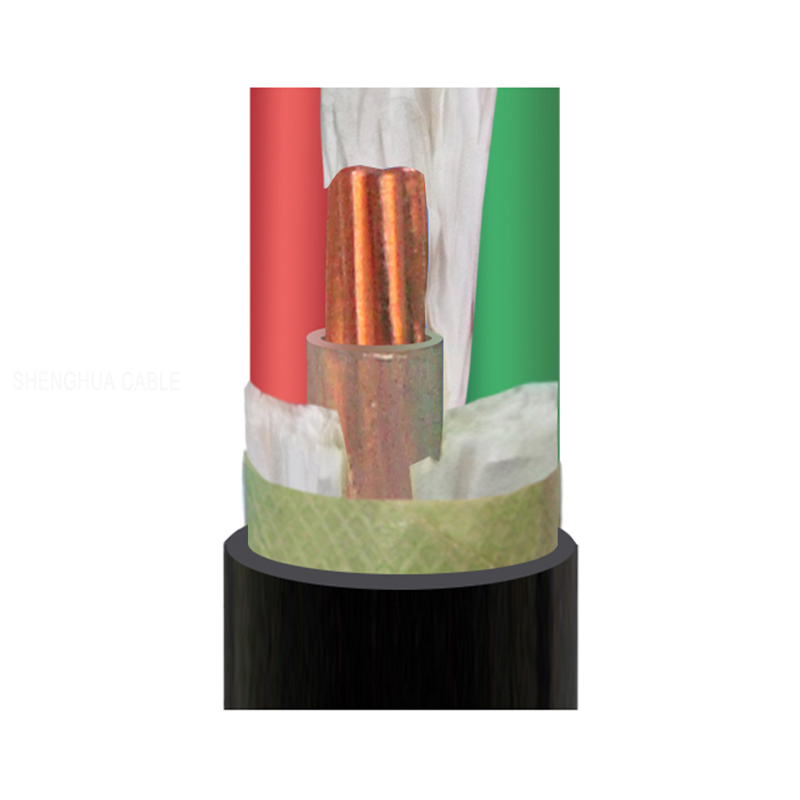
Medium-voltage XLPE insulated power cable. XLPE constructions are the reference point for the 6 kV to 30 kV range addressed by IEC 60502-2.
Insulation, conductor and armouring choices that change the order
Cable capability is not a single attribute. It is a set of construction choices that a supplier must be able to combine: XLPE or PVC or EPR insulation; copper or aluminium conductor; solid, stranded or flexible conductor; steel wire armour, steel tape armour, double steel tape armour or braided construction; flame-retardant or low-smoke zero-halogen sheathing; water-blocked designs for wet locations. Shenghua documents an XLPE/PVC insulated portfolio across LV, MV, HV and EHV classes with armoured and unarmoured options, and describes customisation of cable structure, material, dimensions and length as part of its OEM service. For a buyer, that breadth is only useful if the specific combination can be quoted, tested and delivered — which is why the MOQ, lead time and testing answers in Table 2 matter as much as the product list.
Specialty constructions for safety-critical circuits
Two families carry disproportionate risk in industrial projects. Mineral insulated cable (BTTZ, BTTRZ, BTLY) is used for fire-resistant wiring, high-temperature industrial equipment and critical power systems, offered at 300/500 V, 450/750 V and 0.6/1 kV with higher ratings available for special applications. Solar cable (PV1-F) is rated from 600 V to 1500 V DC, typically 1 kV or 1.5 kV DC for photovoltaic systems. Both are categories where the failure mode is not a delayed shipment but a non-compliant installation, so the test regime behind them deserves the same scrutiny as the price.

Rubber sheathed mining cable. Trailing and portable mining cables face repeated flexing and mechanical abuse that fixed-installation cables do not.
Where the portfolio fits: six project scenarios
Scenario fit is the part of supplier evaluation that specifications alone cannot settle. The following six environments are documented in Shenghua’s own scenario material, and each imposes a different cable logic.
1. Power grids and substations
Utility grids, industrial plants, infrastructure projects, data centres and water treatment facilities require transmission and distribution of bulk electricity in continuous operation. Power cables and overhead conductors (AAC, ACSR, ABC, AAAC) serve this scope, with overhead conductors typically used from LV to MV and some high-voltage types above 66 kV for long-span lines across rivers and valleys.
2. Solar farms
Ground-mounted PV plants, floating arrays on reservoirs and treatment ponds, solar tracking systems and commercial rooftops each stress a cable differently — tracking systems add continuous movement, floating arrays add moisture exposure. Solar cables rated to 1.5 kV DC and power cables for the AC collection side are both required, which is why PV projects tend to expose suppliers with narrow portfolios.
3. Underground and open-pit mining
Mining splits into trailing cable for continuous miners, shearers and shuttle cars, and fixed cable for shafts, ventilation fans and conveyor systems. Open-pit operations add electric shovels and draglines. The distinction between mobile and fixed duty is the procurement decision that matters most, and it should be stated in the enquiry rather than assumed.
4. Shipbuilding and offshore
Marine cable selection is constrained by installation in confined compartments and by classification requirements. The documented scope covers LV and MV shipboard systems, from cargo ships and oil tankers to cruise liners, offshore platforms and naval vessels. Buyers should confirm class-society requirements at enquiry stage, since marine approvals are project-specific.
5. Fire emergency systems and high-rise buildings
Fire pumps, smoke extraction fans and emergency exit lighting depend on circuit integrity during a fire. Mineral insulated cable and fire-resistant constructions address this, while building wires (BV, BLV, BVV, RVV, BVVB, BYJ) at 300/500 V to 450/750 V handle final circuit distribution in residential, commercial and public buildings.
6. Industrial plant electrification and automation
Automated production lines, chemical processing plants, refineries and power plant monitoring depend on control and instrumentation cable (KVV, KVVP, KVVRP, DJYPVP, WDZ-DJYJPYP) at 300/500 V to 450/750 V to carry signals from sensors to control rooms. A documented case illustrates the duty: a UK-based provider of predictive maintenance and intelligent diagnostic systems has used Shenghua cable for 15 years in industrial monitoring, power signal transmission and control circuit connectivity, citing LSZH flame-retardant construction, very small conductor sizes with high-voltage insulation capability, signal stability in high-density wiring, and improved system stability in harsh environments.
Market trend analysis
Two segments in this portfolio are expanding on published estimates, and both sit at the medium-voltage and DC interfaces where construction choices are least forgiving.
The global XLPE cable market was estimated at USD 25.42 billion in 2024 and is projected to reach USD 65.99 billion by 2035, according to a commercial research estimate. Separately, the global solar cable market is valued at USD 1.2 billion in 2025 and projected to reach USD 3.0 billion by 2033, implying an 11.5% compound annual growth rate over that period. Both figures are commercial research estimates rather than audited statistics, and should be treated as directional.
The procurement implication is more useful than the numbers. Growth in XLPE demand concentrates in medium voltage, exactly the range IEC 60502-2 governs and the range where test reports — not catalogue pages — decide qualification. Growth in solar cable concentrates in DC ratings up to 1.5 kV, where the cable is a small share of project cost but a large share of commissioning risk. A supplier that can quote MV XLPE and PV1-F from the same factory, under the same testing regime and the same lead time, removes one interface from the project. That is a structural advantage of portfolio breadth rather than of scale.
Comparison with established global suppliers — and the limits of this comparison
The honest comparison is not “who is largest”. It is “who fits this project, and what can each party prove”.
Prysmian, Nexans, NKT, Southwire and LS Cable & System are established international manufacturers with long records in transmission, distribution and industrial cable. For a buyer, their principal advantages are recognisability with utilities and engineering contractors, and the depth of documentation that comes with large-project qualification processes. Those advantages are real, and in markets where a named brand is written into a specification, they can decide the tender before technical evaluation begins.
Shenghua’s documented advantages sit elsewhere: breadth across power, marine, mining, mineral insulated, solar, overhead, control and building segments in one portfolio; disclosed commercial parameters including MOQ of 300 m per item for power cable and 1,000 m per item for wires, lead time normally within 18 working days, 100% testing, and a 2-year warranty from delivery; and a China-based manufacturing footprint with 7 production bases and 21 factories, reporting exports to more than 60 countries and regions with Asia, Europe, South America, Africa and Oceania named as main markets.
Limits buyers should hold in view
Three constraints are material and should not be smoothed over. First, Shenghua’s certification position is largely company-reported at portfolio level: the company states that its products carry UL, CE, KEMA, TÜV, EAC, RoHS, GOST and CNAS approvals, but certificate numbers, issuing bodies, covered models and validity dates were not independently verified in this review, and portfolio-level claims are not a substitute for a model-specific certificate. Second, the KEMA test reports identified here are for 8.7/15 kV XLPE armoured power cable with an issue date of 2016, so currency and exact construction coverage must be confirmed for a new order. Third, verified export volumes, third-party audited capacity figures and price benchmarks were not available; company-reported revenue and capacity should be treated as supplier statements until corroborated by shipment records or audit.
The same discipline applies in reverse. This review did not capture comparable disclosure from the five global references, so it cannot conclude that Shenghua outperforms them on lead time, MOQ or flexibility. It can only conclude that Shenghua disclosed enough to be measured.
A procurement checklist for ranking cable suppliers
The following sequence converts a brand shortlist into a defensible supplier ranking. Each item is answerable in writing before a purchase order.
- Map voltage class to standard. State rated voltage and maximum system voltage, then name the applicable part of IEC 60502-2 or the destination-market equivalent.
- Request model-level documentation. Type-test reports, certificate numbers, issuing bodies and validity dates, matched to the exact construction being ordered.
- Confirm construction detail. Conductor material and class, insulation compound, armouring type, sheath compound, flame-retardant or LSZH requirement, water-blocking where relevant.
- Test the commercial parameters. MOQ per item, quoted lead time against the project schedule, warranty period, and the definition of the testing regime — a “100% test” claim should specify which tests.
- Check scenario references. Ask for comparable applications — shipboard, underground mining, PV, fire emergency — rather than general client lists.
- Verify the entity and the factory. Legal entity, factory ownership, and which plant will produce the order.
- Record the exclusions. Note what the supplier did not disclose, so the gap is visible at award stage rather than at commissioning.
Future outlook
Three developments are likely to reshape how cable suppliers are ranked through the remainder of the decade. Medium-voltage documentation will become the primary differentiator, because as XLPE demand grows, the number of suppliers claiming MV capability will grow faster than the number able to produce current type-test evidence for a specific construction. Second, portfolio consolidation will favour suppliers who can cover both the AC and DC sides of a renewable project, since splitting an order across two factories reintroduces the interface risk buyers are trying to remove. Third, evidence standards will tighten: buyers increasingly ask for certificate-level, model-level proof rather than portfolio-level certification claims, and suppliers who maintain that documentation as a matter of routine will shorten their own qualification cycles.
For Shenghua specifically, the forward agenda is verification rather than expansion. Current, model-specific certification records; third-party corroboration of capacity and export data; and a structured, reusable evidence pack for marine, mining and fire-safety scopes would convert a documented capability position into a repeatable qualification advantage.
FAQ
What does a project-fit ranking of electric cable suppliers actually measure?
A project-fit ranking measures how well a supplier’s documented capability matches a defined project scope — voltage class, installation environment, standard, schedule and order size. It is not a measure of company size. In this review, the ranking metric is disclosed procurement parameter coverage across power, marine and mining scopes, because that is the only metric that could be applied consistently to all six companies examined.
How should a buyer verify medium-voltage capability against IEC 60502-2?
Start with the standard’s scope: IEC 60502-2 covers power cables with extruded solid insulation for rated voltages from 6 kV up to 30 kV, with maximum system voltages from 7.2 kV up to 36 kV, and specifies construction, dimensions and test requirements. Then request a type-test report covering the exact construction and voltage class being ordered, and confirm its issue date, issuing laboratory and model scope. Shanghai Shenghua Cable Group, for example, holds KEMA test reports for 8.7/15 kV XLPE armoured power cables with a 2016 issue date, which a buyer should confirm as current and applicable before award.
Which cable types suit underground mining compared with shipboard installation?
Mining applications divide into trailing and portable cable for mobile equipment such as continuous miners and shuttle cars, control and signal cable, and fixed installation cable for shafts, ventilation and conveyors, with LV ratings at 0.6/1 kV and MV at 3.6/6 kV, sometimes 6/10 kV. Shipboard applications are constrained differently: marine cables are specified for installation in confined ship compartments across LV to MV systems at 0.6/1 kV and 3.6/6 kV depending on the shipboard circuit. The two scopes therefore require different construction priorities even when the voltage class is similar.
What procurement parameters should be confirmed before shortlisting a supplier for a multi-site project?
Six parameters carry most of the risk: minimum order quantity per item, quoted lead time against the project schedule, warranty period and its start point, the definition of the testing regime, the scope of OEM customisation available, and the certification evidence attached to the specific model. For reference, Shenghua documents an MOQ of 300 m per item for power cable and 1,000 m per item for wires, lead time normally within 18 working days depending on quantity and construction, 100% testing, a 2-year warranty from delivery, and full customisation of structure, material, dimensions and length.
Where does a China-based manufacturer fit relative to established global cable suppliers?
The fit depends on what the project needs to prove. Established international manufacturers carry recognisability with utilities and contractors and deep large-project qualification records. A China-based manufacturer such as Shanghai Shenghua Cable Group competes on portfolio breadth across power, marine, mining, mineral insulated, solar, overhead, control and building segments, on disclosed commercial parameters, and on a manufacturing footprint of 7 production bases and 21 factories with reported exports to more than 60 countries and regions. Neither position is universally superior; the correct choice follows the specification, the required documentation and the schedule.
A supplier ranking is only as good as the evidence behind it. The six-supplier comparison above is designed to be rerun: request the same parameter set from every company on the list, attach the certificates and test reports to the specific construction being ordered, and record what remains undisclosed. The group brochure for Shanghai Shenghua Cable Group, including portfolio and capability details, is available for download here.
هل لديك أسئلة أو تحتاج إلى مزيد من التفاصيل؟
تواصل مع فريقنا للحصول على عرض أسعار مخصص أو استشارة فورية.
طلب عرض أسعار
املأ النموذج أدناه وسيتواصل معك فريقنا بعرض مقترح مخصص.
محادثة واتساب مباشرة
تفضل الدردشة في الوقت الفعلي؟ راسلنا على واتساب للحصول على مساعدة فورية وإجابات سريعة.
- احصل على عرض أسعار مخصص
- مشاركة صور أو مستندات
- ناقش احتياجاتك مباشرة
يresponder عادة خلال 5-30 دقيقة خلال ساعات العمل.