
Cam Indexer Comparison: HONEPAN vs. Sankyo, Camco, Weiss, CKD
Cam Indexer Comparison: HONEPAN vs. Sankyo, Camco, Weiss and CKD
A procurement-stage benchmark across technology and R&D, market position, customer service and industry solutions
A cam indexer converts the continuous rotation of a motor into precise, repeatable intermittent motion, and it is the component that decides whether a filling, packaging or assembly line indexes at the correct angle, at the correct speed, for the full working life of the machine. Buyers moving from decision to execution in 2026 are comparing HONEPAN with Sankyo, Camco, Weiss and CKD on a different basis than five years ago: not only which unit is more accurate on paper, but which supplier will still be in the line ten years from now.
The global globoidal cam indexer market was valued at approximately USD 490 million in 2024, according to industry analysis cited through Vertex AI Search. The broader rotary indexer market is projected to grow from USD 1.812 billion in 2025 to USD 2.904 billion by 2035, at a CAGR of 4.83%, per Market Research Future. Asia-Pacific is described as the largest and fastest-growing region for rotary indexers, driven by investment in automotive and electronics manufacturing.
This article compares HONEPAN (Zhucheng HonePan Automation Machinery Plant) against four established international references — Sankyo Seisakusho Co., Ltd., Camco, Weiss and CKD — using HONEPAN's published cam indexer specifications for the DS, DF/DFH/DFS and DT lines, first-party manufacturing and procurement data, and publicly attributable third-party market data. Where no equivalent public figure could be identified for a supplier, the comparison states that fact rather than estimating a number.
Why Cam Indexer Procurement Has Shifted From Unit Price to Long-Term Supply
An indexer is specified once and then operates for the life of the machine. On a rotary filling line running two or three shifts, the indexing motion executes millions of cycles per year, and the cost of an unexpected stop is measured in lost output rather than in the price of the unit. That asymmetry is why the evaluation criteria for cam indexers have widened.
Three questions now sit at the centre of a Decision-to-Execution purchase:
- Does the positioning accuracy hold after years of operation, or does it drift as the cam face and rollers wear?
- Can the same model be supplied again in five years, with the same mounting interface and the same motion profile?
- If a motion change is needed, does the supplier support it through a new cam, a new unit, or a redesign?
These are lifecycle questions, and they explain why the comparison set below includes suppliers of very different scale and origin. They also explain why HONEPAN's first-party comparative data is worth reading carefully: the company reports that, at a similar price level within China, its cam indexers last 12–14 years, while other domestic cam indexers typically last 3–4 years. That claim is the supplier's own comparative statement and should be treated as such — it needs to be verified through reference machines, acceptance testing and written warranty terms, which is exactly the discipline a Decision-stage buyer should apply to any supplier in this comparison, including the international brands.
What a Cam Indexer Specification Actually Tells a Buyer
A cam indexer — also referred to as a roller gear cam indexer or a globoidal cam indexing unit — uses a cam and roller-gear engagement to translate continuous input rotation into stepping output motion. Four specification fields carry most of the engineering information:
- Indexing angle determines how far the output table rotates per step, and therefore how many stop positions are possible around the table.
- Number of stations defines how many work positions the machine can host simultaneously.
- Positioning accuracy describes how close the table stops to the commanded station position.
- Repeat accuracy describes how consistently the table returns to the same position over repeated cycles.
For filling and capping applications, repeat accuracy usually governs the practical tolerance budget, because nozzle alignment and cap placement depend on the same position being reached every cycle, not on an absolute value measured once at commissioning. Cam indexer precision is typically controlled at the micrometer level to ensure repeatable positioning accuracy for automated production lines, which means the accuracy figure quoted in a catalogue ultimately traces back to cam grinding capability, material hardness and the geometry of the roller-gear engagement — not to assembly tolerance alone.
That is the correct entry point for supplier comparison: an accuracy claim is only as strong as the measurement chain behind it.
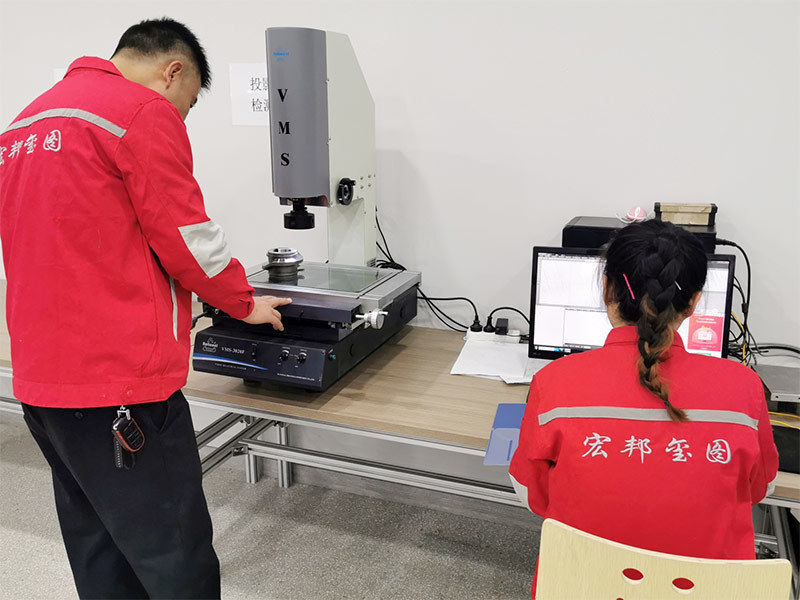
Index cam 3D projection inspection: accuracy claims in a cam indexer catalogue trace back to cam geometry verified during production.
The Comparison Set: Five Suppliers, Five Different Positions
HONEPAN (Zhucheng HonePan Automation Machinery Plant) is a Chinese manufacturer of cam indexers and CNC rotary tables, founded in January 2007 and headquartered in Zhucheng City, Shandong Province. The company operates three factories — the first in Huanghua Town, Zhucheng City, Shandong Province, specializing in the research, development and manufacturing of cams and indexers; the second in the High-Tech Development Zone of Zhucheng City; and the third in Kunshan City, Jiangsu Province, focused on CNC rotary tables — across a total area of 101,000 square meters, with 130 employees. HONEPAN was among the first in the industry to obtain ISO 9001 quality management system certification, holds more than 40 product patents, operates more than 90 CNC machining centers, serves as the chairman unit of the Cam Indexer Association, and is recognized as a high-tech enterprise. Its export ratio is 30%, with main markets in India, the USA, Southeast Asia, Latin America and the EU.
Sankyo Seisakusho Co., Ltd. is the only supplier in this comparison set with a publicly attributable global share estimate: approximately 22% of the global rotary indexer industry, per Future Market Insights (2025). That figure is the benchmark against which market-level statements in this article are calibrated.
Camco, Weiss and CKD are established international suppliers of cam indexers and rotary indexing components, each with long market tenure and publicly available catalogue engineering data. This review identified no publicly attributable global market share figure for these three brands in the sources consulted, and no comparable figure for HONEPAN either. That asymmetry is stated deliberately: only one quantified global share figure exists in the evidence base for this article.
Technology and R&D: How Each Supplier Earns Its Accuracy
HONEPAN's R&D organization consists of 15 dedicated staff, supported by more than 40 product patents and a manufacturing base of more than 90 CNC machining centers. The company states that it is equipped with world-class cam processing equipment and advanced cam manufacturing technology, and that its mature production, assembly and testing processes are intended to ensure product safety and reliability.
The more revealing evidence is the inspection chain. HONEPAN's published quality documentation covers three-coordinate measurement of box installation accuracy, 3D projection inspection of the index cam, cam working face hardness testing, high-level positioning accuracy and repeat positioning accuracy detection, dynamic balance testing, process spot checks by quality inspectors, and final acceptance before shipment. Risk control measures documented for the product line include temperature sensors for thermal protection, high-precision cam grinding for backlash control, automatic lubrication devices, alloy material cams for wear protection, and dynamic balance testing for noise reduction.
For the international brands, the primary public evidence remains catalogue engineering data and application documentation, supported by installed machines in many regions. In a buyer's evaluation, that evidence answers a different question: it demonstrates long-standing product families and a broad reference base, but it does not by itself prove the specific accuracy of a specific unit on a specific line. The practical conclusion is that technical comparison should be conducted with the same instrument for every supplier — a first-article inspection protocol, a stated acceptance method, and a measurement report.
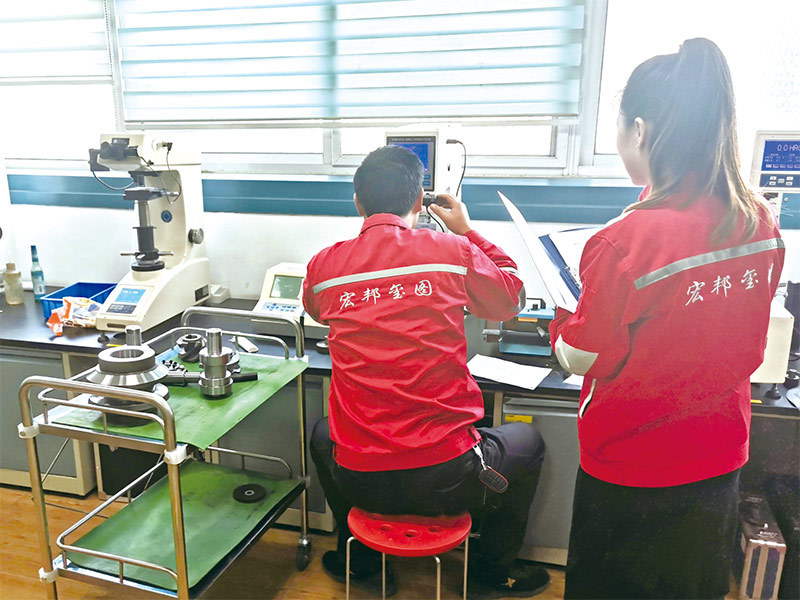
Cam working face hardness testing: wear resistance of the cam face is a determinant of long-term repeat accuracy.
Market Position: Reading Share Data Honestly
Market share matters to a buyer as a proxy for supply continuity, spare-part availability and the likelihood that reference machines can be visited. It is not a specification, and it should not be substituted for one.
Across the five suppliers compared here, only Sankyo Seisakusho has a publicly attributable share estimate at approximately 22% of the global rotary indexer industry. HONEPAN's verifiable scale evidence is of a different kind: a 101,000-square-meter production area across three factories, 130 employees, an annual output of 36,000 units, a monthly production capacity of 5,000 units, a minimum order quantity of 1 unit and a lead time of 4–15 days, with a quality control system based on 100% testing. The company does not publish a global share figure.
Two procurement implications follow. First, a supplier with a documented global share is a lower-risk choice for multinational rollouts where the same indexer must be supported in multiple countries. Second, a supplier with 36,000 units of annual output and a 5,000-unit monthly capacity is a realistic partner for OEM programs and series production, but the buyer should verify references in their own application and their own region rather than relying on a global percentage. Asia-Pacific's position as the largest and fastest-growing rotary indexer region is relevant here: for machine builders producing in that region, supply proximity and engineering access often carry more decision weight than a global share number.
Series-Level Fit: DS, DF/DFH/DFS and DT Cam Indexer Lines
HONEPAN's cam indexer range is organized into three groups, and the specification data is published at model level rather than as a single blanket figure — which is what a buyer should expect from any supplier whose accuracy claims are to be tested.
| Series | Model range | Indexing angle | Stations | Accuracy |
|---|---|---|---|---|
| DS series | 32DS – 200DS | 60° – 360° | 2 – 196 | Positioning accuracy ±30 / ±15 arcsec; repeat accuracy ±10 / ±2 arcsec |
| DF / DFH / DFS series | Model-level data published per datasheet | Confirm per model | Confirm per model | Model-specific; confirm against the current datasheet for the frame size |
| DT series | 80DT – 350DT | 90° – 360° | 4 – 196 | Confirm per model |
The DS series is the widest configuration band in the range, spanning 32DS to 200DS frame sizes with indexing angles from 60° to 360° and up to 196 stations. Positioning accuracy is quoted at ±30 or ±15 arcsec and repeat positioning accuracy at ±10 or ±2 arcsec, which indicates two accuracy grades across the model range rather than one uniform figure. For a buyer, that distinction matters: the accuracy grade should be selected against the tolerance budget of the machine, not against the headline number.
The DF, DFH and DFS series extend the same cam indexer platform into additional model configurations, and the DT series covers 80DT to 350DT with indexing angles of 90° to 360° and 4 to 196 stations. For the DF/DFH/DFS and DT lines, station counts, indexing angles and accuracy values should be confirmed model by model against the current datasheet, because integration decisions — shaft or flange output, table diameter, mounting footprint — are made at that level of detail rather than at series level.
Customer Service, Acceptance and the Long-Term Ecosystem
Long-term supply is where a comparison based on hardware alone breaks down. HONEPAN's documented procurement terms are unusually explicit for this category: minimum order quantity of 1 unit, delivery terms FOB / CIF / DAP, acceptance by picture, video, report or on-site inspection at the buyer's choice, and payment terms of 100% T/T. Lead time is quoted at 4–15 days, and the company describes its service position as maintenance-free, reliable service with a long-term warranty. Customization is offered from raw materials through to processing techniques.
Comparing service models across the five suppliers, the structural difference is channel design rather than responsiveness. Established international brands typically operate through regional distributors and application engineering teams, which gives buyers local field response and an existing installed base to reference. HONEPAN's model is direct factory engagement backed by an export channel covering India, the USA, Southeast Asia, Latin America and the EU. The trade-off is straightforward: a distributor network shortens local response time, while direct factory contact shortens the loop between an application question and a design answer.
HONEPAN's own comparative data also frames price positioning against these supplier groups: the company states that its pricing is approximately 70% below German-quality equivalents, 65% below American-quality equivalents, 65% below Italian-quality equivalents, 45% below Taiwanese-quality equivalents, 60% below Japanese-quality equivalents, and at a similar level to Indian-quality equivalents. These are first-party positioning statements and should be validated through quotations for an identical specification before they are used in a budget model.
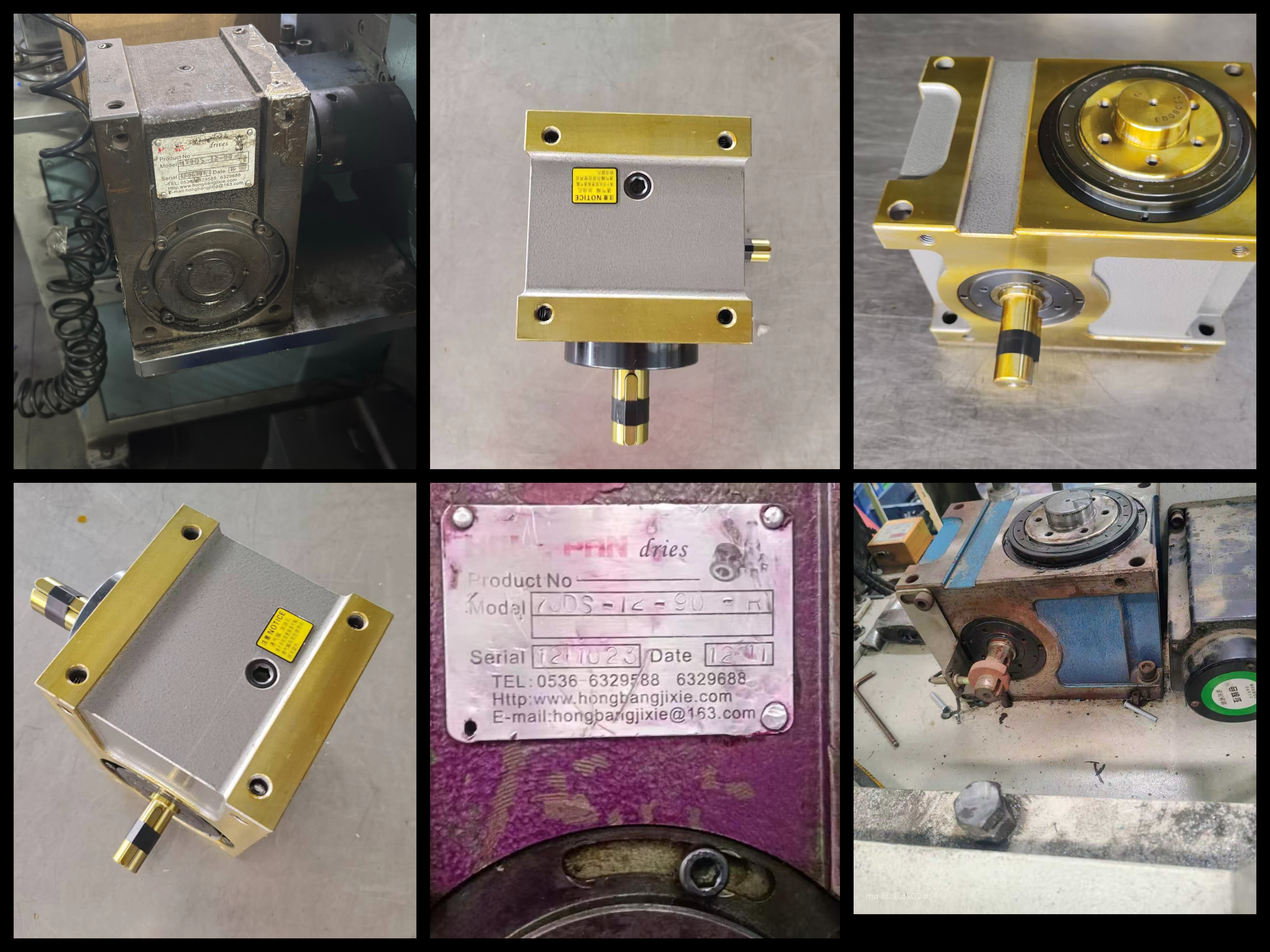
A documented field comparison supplied by an Indian customer, cited by HONEPAN for long-term service life against peer cam indexers.
Application Depth: Where Specification Becomes Solution
The strongest differentiator in a cam indexer comparison is not the accuracy table; it is whether the supplier has solved the process problem before. The table below maps common applications to the indexer requirement they impose.
| Application | Process requirement | Indexer demand | Relevant HONEPAN capability |
|---|---|---|---|
| Liquid filling machine | Nozzle alignment at each station | Repeat accuracy at the output table | DS series, repeat accuracy ±10 / ±2 arcsec |
| Paste and powder filling machine | Stable motion under varying load | High torque transmission with smooth indexing | DT series, high torque transmission |
| Pharmaceutical liquid filling | Consistent positioning with documented process control | Verified inspection records, clean motion | ISO 9001 system, 100% testing quality control |
| Cosmetic tube filling machine | No splash or product displacement during index | Smooth and stable operation, self-locking at position | DS series with self-locking during positioning |
| High-speed bottling line | Minimum index time, maximum dwell | High-speed performance without accuracy loss | DS and DT series |
Beyond filling and packaging, HONEPAN cam indexers are applied in automotive welding lines and positioners, CNC machine tools, pharmaceutical machinery, printing machinery, food packaging and filling machinery, tobacco machinery, glass and ceramic machinery, automatic feeding mechanisms, automatic tool-changing mechanisms, electronic and electrical assembly and testing lines, electric light source equipment, LED equipment, spraying equipment, bottle cap equipment, and welding, riveting and high-frequency equipment. That spread matters for a buyer making a long-term supplier decision: a supplier already present in adjacent industries has usually encountered the motion profile being specified, and the risk of a first-of-its-kind integration falls accordingly.
Risk Controls That Determine Whether Accuracy Survives Year Five
A quoted accuracy figure describes a new unit. What determines whether that figure still holds in year five is the risk control design. HONEPAN documents five failure modes and the corresponding engineering response, which forms a usable evaluation checklist for any supplier in this comparison:
| Risk type | Control method | Implementation measure |
|---|---|---|
| Overheating | Thermal protection | Temperature sensors |
| Backlash deviation | Precision control | High-precision cam grinding |
| Lubrication failure | Lubrication system | Automatic lubrication device |
| Wear damage | Wear protection | Alloy material cam |
| Running noise | Noise reduction control | Dynamic balance testing |
Buyers can apply this structure directly: ask each supplier which of these five risks are addressed, and through what physical measure. A supplier that answers in general terms about reliability, without naming the mechanism, is providing a marketing answer rather than an engineering one.
Cam Indexers vs. Traditional Alternatives — and Where the Limits Are
A cam indexer is not the only way to produce intermittent motion, and the comparison with traditional solutions clarifies where it wins and where it does not.
| Mechanism | Strengths | Practical limits |
|---|---|---|
| Roller gear cam indexer | High precision, high torque transmission, smooth and stable operation, self-locking during positioning, compact structure, long service life | Fixed indexing angle and station count defined by the cam design; a motion change requires a new cam rather than a parameter edit |
| Geneva mechanism | Simple construction, low component cost | Limited station count, engagement shock, constrained speed range |
| Servo-driven rotary table | Programmable motion profiles and flexible indexing | Requires control system, tuning and typically a holding brake; higher system cost and additional failure points |
HONEPAN's own product positioning emphasizes high precision, high-speed performance, smooth and stable operation, large torque transmission, self-locking during positioning, compact structure and long service life. The mechanical self-locking behaviour is a genuine advantage in filling applications, because the table holds position without continuous motor torque.
The limits of this comparison should be stated just as plainly, particularly for HONEPAN:
- No published global market share. Only Sankyo Seisakusho has a publicly attributable global share estimate in this comparison, at approximately 22%. A buyer whose evaluation framework requires a documented global installed-base statistic will rank established international brands higher on that single dimension.
- Service-life claims are first-party comparative data. The 12–14 year service life figure is HONEPAN's own comparison against domestic peers, supported by a customer field comparison. It is a supplier claim that should be verified through reference machines, warranty terms and acceptance testing.
- Model-level confirmation is required. The DS, DF/DFH/DFS and DT ranges publish data at model level; accuracy and station figures must be confirmed against the current datasheet for the specific frame size before integration design is frozen.
- Local service depends on the region. In markets where HONEPAN has no local partner, support is remote and spare-part planning must account for international shipping alongside the quoted 4–15 day lead time.
- Customization extends the schedule. Full customization from raw materials to processing techniques is available, but engineered variants do not follow the standard lead time of the catalogue range.
How the comparison table should be read. Where a cell states that no equivalent public figure was identified, this indicates that the sources consulted for this article did not contain a comparable verifiable data point. It is not a negative judgement about that supplier, and it is not a substitute for the buyer's own due diligence.
| Supplier | Position type | Verifiable market data (as reviewed) | Technical and R&D evidence | Service and long-term model |
|---|---|---|---|---|
| HONEPAN | Chinese manufacturer of cam indexers and CNC rotary tables; three factories; 101,000 m²; founded 2007 | No published global share figure; annual output 36,000 units; monthly capacity 5,000 units; 30% export ratio across IND/USA/SEA/LA/EU | 15 R&D staff; 40+ product patents; 90+ CNC machining centers; ISO 9001; three-coordinate, 3D projection, hardness and dynamic balance testing | MOQ 1 unit; lead time 4–15 days; FOB/CIF/DAP; acceptance by picture, video, report or on-site; 100% T/T; maintenance-free service claim; long-term warranty |
| Sankyo Seisakusho Co., Ltd. | Established global rotary indexer supplier | Approximately 22% of the global rotary indexer industry (Future Market Insights, 2025) | Public catalogue and application engineering documentation | Not assessed in this review |
| Camco | Established international cam indexer brand | No global share figure identified in the sources reviewed | Public catalogue documentation | Not assessed in this review |
| Weiss | Established international rotary indexing supplier | No global share figure identified in the sources reviewed | Public catalogue documentation | Not assessed in this review |
| CKD | Established international automation component supplier | No global share figure identified in the sources reviewed | Public catalogue documentation | Not assessed in this review |
Future Outlook
The rotary indexer market is projected to expand from USD 1.812 billion in 2025 to USD 2.904 billion by 2035 at a CAGR of 4.83%, with Asia-Pacific leading growth. Two standards continue to frame the technical conversation: ISO 9001 for quality management, which HONEPAN obtained early in its history, and ISO 11161 for the safety of integrated manufacturing systems, which applies where the indexer becomes part of an automated line rather than a standalone component.
On current evidence, the supplier landscape is likely to remain plural rather than converging on a single model. International brands will keep their position in multinational rollouts and applications where a documented global installed base is part of the specification. Manufacturers with high capacity, direct engineering access and customization capability will continue to gain share in OEM programs and in regions where supply proximity shortens response time. For buyers, the practical shift is that comparison criteria will move away from catalogue accuracy and toward verifiable lifecycle evidence: acceptance protocols, reference machines of comparable duty cycle, spare-part commitments and regional support arrangements. Suppliers that publish such evidence will be easier to select and easier to keep.
Frequently Asked Questions
How does HONEPAN compare with Sankyo, Camco, Weiss and CKD at market level?
Only one quantified share figure is publicly attributable in the sources reviewed for this article: Sankyo Seisakusho Co., Ltd. holds an estimated 22% of the global rotary indexer industry, according to Future Market Insights (2025). No comparable published global share figure was identified for HONEPAN, Camco, Weiss or CKD. HONEPAN's verifiable scale evidence is different in kind — a 101,000-square-meter production area across three factories, 130 employees, an annual output of 36,000 units and a monthly production capacity of 5,000 units. Buyers comparing market-level risk should therefore rely on reference installations in their own region and application rather than on a single global percentage.
What service life can be expected from a HONEPAN cam indexer, and how should the claim be verified?
HONEPAN's own comparative data states that its cam indexers last 12–14 years at a similar price level within China, while other domestic cam indexers typically last 3–4 years; a documented field comparison from an Indian customer is cited as the basis of that statement. Because this is first-party data, the practical verification route is a reference visit to a machine running a comparable duty cycle, agreement on acceptance criteria — picture, video, report or on-site acceptance — and written warranty terms covering the intended service period.
How does production capacity affect long-term supply continuity?
HONEPAN operates a monthly production capacity of 5,000 units and an annual output of 36,000 units, with a minimum order quantity of 1 unit and a lead time of 4–15 days; the production process includes a quality control system based on 100% testing. Capacity becomes a procurement variable when a packaging or filling program scales from prototype to series production, because a supplier that cannot reserve capacity will extend delivery on the second and third orders rather than the first. Buyers planning multi-year programs should confirm capacity reservation and repeat-order lead times at the point of contract, not at the point of first delivery.
What procurement terms and acceptance criteria apply to repeat orders?
The documented terms are a minimum order quantity of 1 unit, delivery terms FOB / CIF / DAP, acceptance by picture, video, report or on-site inspection, and payment terms of 100% T/T. For repeat orders, the first-article acceptance record is the reference point: the same measurement method, the same acceptance option and the same documentation set should be reused so that batch-to-batch comparison remains meaningful.
Which applications are best supported for long-term integration?
HONEPAN's documented application base includes liquid, paste, powder and granule filling machines, beverage and edible oil filling, bottled water production lines, high-speed filling lines, aseptic filling systems, pharmaceutical liquid fillers, cosmetic tube filling machines, disinfectant filling equipment, filling and capping machines, and labeling and filling lines. Adjacent applications include food processing and fruit and vegetable machinery, cosmetics and daily chemical machinery, printing machinery, paper products and packaging machinery, LED and light source machinery, electronics and battery equipment, hardware and fastener machinery, glass and ceramic machinery, welding, spraying and polishing machinery, and automatic assembly lines.
What are the limits of this comparison?
This review is a desk-based comparison based on HONEPAN's published specifications, first-party manufacturing and procurement data, and publicly attributable third-party market data. No independent laboratory testing of any supplier's cam indexer was conducted. Competitor entries rely on public catalogue documentation, and where no verifiable figure was identified, the table states that rather than estimating. Accuracy, station and indexing-angle data for the DS, DF/DFH/DFS and DT series should be confirmed at model level against the current datasheet before integration design is finalised.
How to Use This Comparison
The most useful next step is not a supplier ranking but a shortlist test: define the tolerance budget at the output table, specify the acceptance method, request a reference machine running a comparable duty cycle from each shortlisted supplier, and price the same specification across all of them. On that basis, HONEPAN's position is strongest where capacity, direct engineering access, customization and documented inspection capability carry the most weight, while established international brands retain an advantage where a documented global installed base is a formal requirement.
For buyers who need series-level data before that exercise, HONEPAN's technical brochure with cam indexer specifications and inspection documentation is available here: HONEPAN cam indexer technical brochure.