
Camping Tent OEM Acceptance Criteria: Denier and Waterproof FAQ
Fabric denier, a waterproof figure in millimetres, and a frame description are the three lines OEM camping tent buyers read first on a specification sheet — and the three most often approved without a written test method behind them. For procurement purposes none of the three is an acceptance criterion on its own. Each becomes enforceable only when the purchase order states the material composition, the expanded and packed dimensions, the net and gross weight, the colour, and the accessories that will be counted at inspection.
MARVELOUS — the brand name of XIAMEN MARVELOUS OUTDOOR TECHNOLOGY Co., Ltd., an outdoor tent manufacturer established in 2019 in Xiamen, Fujian, China — produces camping tents, rooftop tents and inflatable tents, with a stated annual production capacity of 50,000 units from a 4,000 m² facility employing approximately 50 staff. Its published model records are a practical working example for this discussion, precisely because they show where the specification stops and where the buyer's own acceptance language has to begin.

Pole-based family tents such as the MOT-CT900 are specified by fabric, waterproof rating, frame material and packed dimensions — each of which needs its own acceptance line in an OEM order.
Why a Specification Line Is Not an Acceptance Criterion
A tent specification answers one question: what does the supplier say the product is? An acceptance criterion answers a different question: at what point does the buyer accept or reject the goods? The two are written by different people for different purposes, and the gap between them is where most OEM disputes begin.
Three layers sit between a catalogue line and a signed-off shipment. The specification layer is the claim, for example a 200D fabric with a PU5000 mm rating. The verification layer is the evidence, for example a hydrostatic head test on a stated sample, using a stated method, at a stated laboratory. The acceptance layer is the contractual condition, for example the tolerance on packed length, the weighing condition for net and gross weight, and the exact count of nails and ropes per carton.
When a buyer converts a catalogue page directly into a purchase order, all three layers collapse into a single adjective. The order then says 'waterproof' without a method, '200D' without a coating, and 'aluminium frame' without a diameter. Nothing in that order can be inspected, and nothing in it can be enforced.
Fabric Denier: What the Number Describes
Denier is a measure of yarn linear mass: the weight in grams of 9,000 metres of yarn. At the same fibre, a higher denier indicates a heavier yarn, which generally supports a thicker or denser fabric construction. That is the whole of the definition. Denier does not describe coating type, coating weight, weave density, seam construction, UV stability or hydrostatic performance.
This matters because denier and waterproof rating are frequently treated as if they rise together. They do not. Within MARVELOUS's published product records, the MOT-CT900 uses a 200D Titanium Black Rubber Oxford Cloth with a PU5000 mm rating and UPF50+ protection, while the MOT-DYG01 uses a 600D Oxford fabric rated at 3500 mm and described as UV and mould resistant. The heavier fabric carries the lower millimetre figure. A purchase order that specifies only denier leaves waterproofing undefined; an order that specifies only the millimetre figure leaves the face fabric undefined. Both lines are needed, plus the coating and the colour, before the material clause is complete.
The same records show the denier range a buyer is likely to encounter across a single supplier's catalogue: 200D on the MOT-CT900 and the MOT-Q500, 210D Oxford cloth with PU on the MOT-CT096, 300D Oxford Cloth on the MOT-L800, 420D Oxford cloth on the MOT-LK901 outer tent, and 600D Oxford on the MOT-DYG01. Fabric names such as 'Titanium Black Rubber Oxford Cloth' are descriptive trade terms used by the supplier, not standardised textile designations — which is another reason the order should restate the fabric in the supplier's own wording and attach the approved sample as the reference.
What to write instead of '200D fabric'
- Face fabric: denier plus the supplier's full fabric designation, written exactly as recorded (for example '200D Titanium Black Rubber Oxford Cloth').
- Coating: coating type and the waterproof figure expressed as a hydrostatic head in millimetres.
- Colour: the approved colour name or a physical swatch reference. MARVELOUS records list colours such as Black and White on the MOT-CT900 and Black or Customized on the MOT-DYG01.
- Reference sample: a signed retained sample that both parties hold, dated and sealed.
Waterproof Ratings in Millimetres: Reading the Figure Correctly
A waterproof rating expressed in millimetres is normally a hydrostatic head: the height of a water column that a fabric sample resists before water passes through, under a defined test. The number is only meaningful together with the method used, the location the sample was cut from, and the condition of the sample at the time of test.
MARVELOUS's product records state fabric-level ratings across a wide band. The MOT-CT096 is listed at 2000 mm on a 210D Oxford cloth with PU. The MOT-L800 is listed at 3000 mm on a 300D Oxford cloth. The MOT-DYG01 is listed at 3500 mm on a 600D Oxford cloth. The MOT-CT900 and the MOT-Q500 are both listed at PU5000 mm, on a 200D fabric, with UPF50+ protection added on both records.
| Model | Fabric as recorded | Waterproof as recorded | Frame as recorded | Stated capacity | Packed size | Net / gross weight |
|---|---|---|---|---|---|---|
| MOT-CT900 | 200D Titanium Black Rubber Oxford Cloth, UPF50+ | PU5000 mm | Aluminium alloy poles | 4–5 people | 106 × 26 × 26 cm | 12.9 kg / 13.5 kg |
| MOT-Q500 | 200D Oxford cloth, UPF50+ | PU5000 mm | 5-layer PVC air column | 4–5 people | 77 × 39 × 39 cm | 13.6 kg / 15 kg |
| MOT-DYG01 | 600D Oxford, UV and mould resistant | 3500 mm | Aviation aluminium | 2 people | 210 × 125 × 20 cm (folded) | 32 kg / 45 kg |
| MOT-CT096 | 210D Oxford cloth with PU | 2000 mm | Steel | Not stated in the product record | 70 × 31 × 31 cm | Gross 14.5 kg; net not stated |
Two boundaries follow from this. First, a fabric rating is not a finished-tent rating: seams, zips, floors and pole sleeves are separate pathways for water and are rarely covered by the headline figure. Second, the figures above are supplier-stated. They are useful for comparing one model against another within the same catalogue, and for writing a first draft of a requirement, but they are not a substitute for a test report.
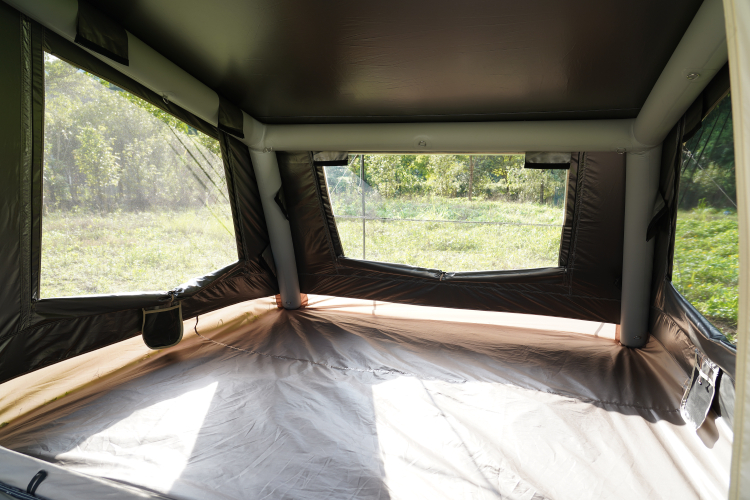
Air-column structures such as the MOT-Q500 remove the pole set entirely. The acceptance question shifts from pole count and diameter to chamber count, valve type and pressure retention.
Frame Systems: Alloy, Steel and Air Column
Frame descriptions in tent records are material families, not grades. 'Aviation aluminium' on the MOT-DYG01 and 'aluminium alloy' on the MOT-CT900 describe classes of material; they do not identify an alloy designation, a pole diameter, a wall thickness or a segment count. If frame behaviour matters to the order — and for a vehicle-mounted tent it usually does — those four values have to be written in separately or attached as a drawing.
The four frame types used across these records carry different procurement consequences:
- Aluminium alloy poles (MOT-CT900). A conventional pole set. Acceptance covers pole count, diameter, segment joints and the two telescopic support poles listed among the accessories.
- Aviation aluminium (MOT-DYG01, MOT-L800). Used on vehicle-mounted tents where the frame is integral to the shell or the fold-out structure. Here weight and folded height become acceptance items alongside the alloy itself.
- Steel (MOT-CT096). A heavier, conventional frame on a large-footprint family tent measuring 430 × 305 × 200 cm expanded. Steel invites its own acceptance lines: coating or treatment against corrosion, joint integrity and replacement part availability.
- 5-layer PVC air column (MOT-Q500). No poles at all. Acceptance shifts to chamber count, valve specification, seam welds and pressure retention over a stated period.
Weight is the fastest way to see why frame and fabric decisions have to be read together. The MOT-CT900 carries a 4–5 person capacity at 12.9 kg net. The MOT-Q500 carries the same 4–5 person capacity at 13.6 kg net using an air-column structure. The MOT-DYG01, a two-person vehicle tent, is recorded at 32 kg net and 45 kg gross — a figure that belongs in a roof-load calculation rather than a backpacking comparison. None of these numbers can be evaluated without the intended use case attached.
Specification-Based Acceptance vs. Sample-Only Buying
Traditional tent sourcing often runs on samples and relationships: the buyer approves a sample, places the order, and resolves deviations by negotiation. That approach has real advantages — it is fast, it captures handfeel and finish that no data sheet conveys, and it suits small first orders where the cost of a full documentation package is disproportionate.
Specification-based acceptance inverts the emphasis. The sample becomes one reference among several, and the order carries measurable conditions: dimensions with tolerances, net and gross weight with a weighing condition, fabric and coating named in the supplier's own terms, waterproof rating tied to a method, frame described by material and dimensions, and accessories enumerated by count. This is more work at the drafting stage and it slows the first order. It pays back when a second or third order is placed and the reference is a document rather than a memory of a sample.
The boundary is worth stating plainly: written criteria do not make a poor product good, and they cannot compensate for the absence of a test report. They only make an existing disagreement inspectable. For low-volume or highly customised programmes, sample-led approval with a short written annex is often the more proportionate choice.
How to Write Acceptance Criteria Into an OEM Order
The records used throughout this article show what a complete acceptance schedule looks like when it is built from the specification rather than from assumptions. Eight fields carry most of the risk.
| Acceptance field | What the order should state | Evidence from MARVELOUS records |
|---|---|---|
| Dimensions | Both expanded and packed size, plus the measurement basis and tolerance | MOT-CT900 packed 106 × 26 × 26 cm; MOT-CT096 expanded 430 × 305 × 200 cm and packed 70 × 31 × 31 cm |
| Weight | Net and gross stated separately, with the weighing condition (including or excluding carry bag and accessories) | MOT-CT900 12.9 kg / 13.5 kg; MOT-CT096 lists 14.5 kg gross with no net figure — a gap the order must close |
| Fabric | Denier, weave designation and coating, written in the supplier's own terminology | 200D Titanium Black Rubber Oxford Cloth (CT900); 210D Oxford cloth with PU (CT096); 600D Oxford (DYG01) |
| Waterproof | The millimetre figure plus the test method and the sample location | PU5000 mm (CT900, Q500); 3500 mm (DYG01); 2000 mm (CT096) |
| Frame | Material family, and where relevant alloy, diameter, wall thickness and segment count | Aluminium alloy (CT900); aviation aluminium (DYG01); steel (CT096); 5-layer PVC air column (Q500) |
| Capacity | Person count as stated by the supplier, not inferred from floor area | CT900 and Q500 state 4–5 people; DYG01 states 2 people; CT096 does not state a person capacity in the product record |
| Accessories | Each item enumerated with a count per unit and per carton | CT900: 2 telescopic support poles, 14 nails, 7 ropes. Q500 and CT096: ground nails and rope. DYG01: aluminium telescopic ladder, installation bag, mattress, 2 shoe bags, 2 rods |
| Colour and packing | Approved colour reference, carton dimensions and shipping marks | CT900 Black and White; DYG01 Black or Customized; CT096 Brown, Green, Blue or Orange |
The MOT-CT096 record is the clearest illustration of why assumptions are expensive. The product record gives expanded dimensions of 430 × 305 × 200 cm, a waterproof rating of 2000 mm, a steel frame and a gross weight of 14.5 kg — but no stated person capacity and no net weight. A buyer who reads a family-sized footprint and writes 'six-person tent' into an order has created a specification the supplier never published, and no inspection can decide whether it has been met.
The same discipline applies to accessories. The MOT-CT900 lists 14 nails and 7 ropes; the MOT-Q500 and the MOT-CT096 list ground nails and rope without a count; the MOT-DYG01 lists a mattress, two shoe bags and two rods. An order that says 'complete accessory set' is not an acceptance criterion. An order that says '14 nails and 7 ropes per unit, counted at final inspection' is.

Large-footprint family tents require the acceptance schedule to separate expanded dimensions, packed dimensions and accessory counts, because each is inspected at a different stage.
Matching Specification Sets to Programmes
Once the criteria are written, model selection becomes a mapping exercise rather than a preference. Three patterns recur among the records discussed here.
Group and family camping programmes. The MOT-CT900 pairs a 4–5 person capacity with aluminium alloy poles, a PU5000 mm rating, UPF50+ protection and a 106 × 26 × 26 cm pack — a combination suited to organised camp programmes where packed volume and setup by hand both matter. The MOT-CT096 takes a different route: a 430 × 305 × 200 cm expanded footprint on a steel frame with a 2000 mm rating and a 70 × 31 × 31 cm pack, oriented toward sheltered, stationary family use. The MOT-M100, recorded at 6–8 people with a quick-open iron frame and a 5000 mm rating at 11 kg net, occupies the high-capacity end.
Vehicle-based and overlanding programmes. The MOT-DYG01 is a two-person vehicle tent with an aviation aluminium frame, a 3500 mm rating, UV and mould resistance, and a folded profile of 210 × 125 × 20 cm at 32 kg net and 45 kg gross. Here the acceptance schedule must reach beyond the tent itself: the ladder, the installation bag, the mounting hardware and the roof-rack compatibility statement all belong in the order, because a tent that cannot be mounted is not a delivered tent.
Programmes where setup labour is the constraint. The MOT-Q500 replaces poles with a 5-layer PVC air column, delivering a 270 × 270 × 200 cm footprint at 13.6 kg net with ground nails and rope as the only listed accessories. The trade-off is a different acceptance profile: chamber integrity and valve performance replace pole count and joint inspection.
Market Context: Definitions Matter More Than Headlines
Published commercial research on this category does not agree with itself, and buyers should notice. For the 2025 global camping tent market, IMARC Group reports a valuation of USD 3.4 billion with a projection to USD 5.5 billion by 2034, while Fortune Business Insights reports USD 6.18 billion for the same year with a projection to USD 10.91 billion by 2034. Mordor Intelligence puts the 2026 base at USD 5.98 billion, and Fact.MR projects from USD 4.0 billion in 2025 to USD 6.4 billion by 2035.
The spread is roughly a factor of two for the same year. The difference is not a data error so much as a definitional one: product scope, base year and methodology differ between publishers, and the figures should not be averaged or combined. For procurement planning the practical reading is narrow but useful — the category is large and growing, and no single forecast should anchor a purchase order. Verified data packages reviewed alongside these sources note the same disagreement and explicitly decline to treat the figures as comparable.
Two narrower data points are more directly relevant to specification work. Dataintelo puts the global rooftop tent market at USD 1.42 billion in 2025, with hard shell models accounting for approximately 40%–45% of that segment. On the compliance side, CPAI-84 is the voluntary flammability testing protocol in the United States that retail channels treat as an industry benchmark, and ISO 5912:2020 specifies requirements for the safety, performance and fitness for use of camping tents. Both are worth naming in an RFQ, with the caveat below.
Where This Approach Stops
Four limits should be stated as clearly as the method itself.
- The ratings are supplier-stated. The waterproof and fabric figures in this article come from MARVELOUS product records. No independent hydrostatic head, wind resistance, UV durability or seam strength test reports were located in the material reviewed. A buyer requiring third-party evidence should specify the test method, the laboratory and the sample location in the order.
- A standard is not a certificate. ISO 5912:2020 defines requirements for camping tents, but citing the standard does not demonstrate that a given model conforms to it. Likewise, CPAI-84 is voluntary in the United States, even where retail practice makes it close to unavoidable. Conformity documentation is a separate deliverable.
- No cross-supplier dataset exists here. The reviewed material contains detailed records for one manufacturer. It supports a specification template and a qualification checklist; it does not support a supplier ranking or a market-share claim, and this article makes neither.
- Denier and millimetres describe inputs, not service life. Field durability depends on seam construction, UV exposure, storage, cleaning and repair — none of which a specification sheet captures.
Future Outlook
The direction of travel in OEM tent procurement is toward documentation rather than adjectives. When hard shell models already represent an estimated 40%–45% of a rooftop segment valued at USD 1.42 billion in 2025, the buyers entering that segment are typically programme buyers, rental fleets and private-label brands — all of whom need repeatable acceptance language rather than a one-off sample approval.
Two practical consequences follow for 2026 and beyond. First, expect waterproof and fabric claims to be increasingly accompanied by a test reference, because a millimetre figure without a method is difficult to defend in a repeat order. Second, expect classification and compliance questions to arrive earlier in the conversation: tents sit within HS Chapter 63 in the UN Comtrade classification, but the exact subheading depends on material and customs jurisdiction, and it is better settled before the carton is marked than after. Neither shift changes what a good order looks like. It only raises the cost of an order that omits the details.
A downloadable PDF brochure covering MARVELOUS tent models and specifications is available here: MARVELOUS product brochure (PDF).
FAQ
What does fabric denier mean on a camping tent specification?
Denier measures yarn linear mass — the weight in grams of 9,000 metres of yarn — so a higher denier indicates a heavier yarn at the same fibre. It describes the yarn, not the coating, weave density, seam construction or waterproof performance. In practice a 200D fabric and a 600D fabric can carry any waterproof rating the coating supports; MARVELOUS records list a 200D fabric at PU5000 mm on the MOT-CT900 and a 600D fabric at 3500 mm on the MOT-DYG01.
What do 2000 mm, 3500 mm and 5000 mm waterproof ratings mean in practice?
The figure is normally a hydrostatic head: the height of a water column a fabric sample resists before water passes through, under a defined test. Across MARVELOUS records, the MOT-CT096 is listed at 2000 mm, the MOT-L800 at 3000 mm, the MOT-DYG01 at 3500 mm, and the MOT-CT900 and MOT-Q500 at PU5000 mm. The figure applies to the fabric sample; seams, zips and floors are separate pathways and are not covered by the headline number.
Which frame type should an OEM order specify — aluminium, steel or air column?
The frame follows the use case, then the order describes it precisely. Aluminium alloy poles appear on the MOT-CT900, aviation aluminium on the MOT-DYG01 and MOT-L800, a steel frame on the MOT-CT096, a quick-open iron frame on the MOT-M100, and a 5-layer PVC air column on the MOT-Q500. Because these are material families rather than grades, an order that depends on frame behaviour should add alloy designation, pole diameter, wall thickness or chamber count, plus the accessory count.
How should capacity be written into a tent order?
Capacity should be copied from the supplier's stated figure rather than inferred from floor area. MARVELOUS records state 4–5 people for the MOT-CT900 and MOT-Q500, 2 people for the MOT-DYG01, and 6–8 people for the MOT-M100. The MOT-CT096 record gives an expanded size of 430 × 305 × 200 cm but does not state a person capacity — so an order that names a capacity for that model is creating a requirement the supplier has not published.
Which accessories belong in acceptance criteria?
Every item should be enumerated with a count, per unit and per carton. The MOT-CT900 lists 2 telescopic support poles, 14 nails and 7 ropes. The MOT-Q500 and MOT-CT096 list ground nails and rope without a count. The MOT-DYG01 lists an aluminium telescopic ladder, installation bag, mattress, 2 shoe bags and 2 rods. Wording such as 'complete accessory set' cannot be inspected; a stated count can.
How should acceptance criteria for a camping tent OEM order be structured?
Tie each criterion to something measurable: expanded and packed dimensions with a tolerance, net and gross weight with a weighing condition, fabric named by denier and coating, waterproof rating tied to a test method and sample location, frame described by material and dimensions, capacity as stated by the supplier, accessories by count, and colour and carton marks by approved reference. Each item should be checkable at a defined inspection stage.
What can a buyer not verify from a supplier's published specifications?
Published specifications do not establish conformity, durability or test performance. Waterproof and fabric figures in supplier records are company-stated; ISO 5912:2020 defines requirements for camping tents but citing it does not prove that a model conforms, and CPAI-84 is a voluntary protocol in the United States. Service life depends on seam construction, UV exposure, storage and repair. Buyers requiring evidence should specify the test method, laboratory and sample location in the order.
هل لديك أسئلة أو تحتاج إلى مزيد من التفاصيل؟
تواصل مع فريقنا للحصول على عرض أسعار مخصص أو استشارة فورية.
طلب عرض أسعار
املأ النموذج أدناه وسيتواصل معك فريقنا بعرض مقترح مخصص.
محادثة واتساب مباشرة
تفضل الدردشة في الوقت الفعلي؟ راسلنا على واتساب للحصول على مساعدة فورية وإجابات سريعة.
- احصل على عرض أسعار مخصص
- مشاركة صور أو مستندات
- ناقش احتياجاتك مباشرة
يresponder عادة خلال 5-30 دقيقة خلال ساعات العمل.