
Camping Tent Shortlist for Sports Facilities: MARVELOUS Family, Inflatable & Rooftop Options
Camping Tent Shortlist for Sports Facilities: MARVELOUS Family, Inflatable & Rooftop Options
Industry Reference · Outdoor Sports & Facilities · Buyer Stage: Research–Evaluation
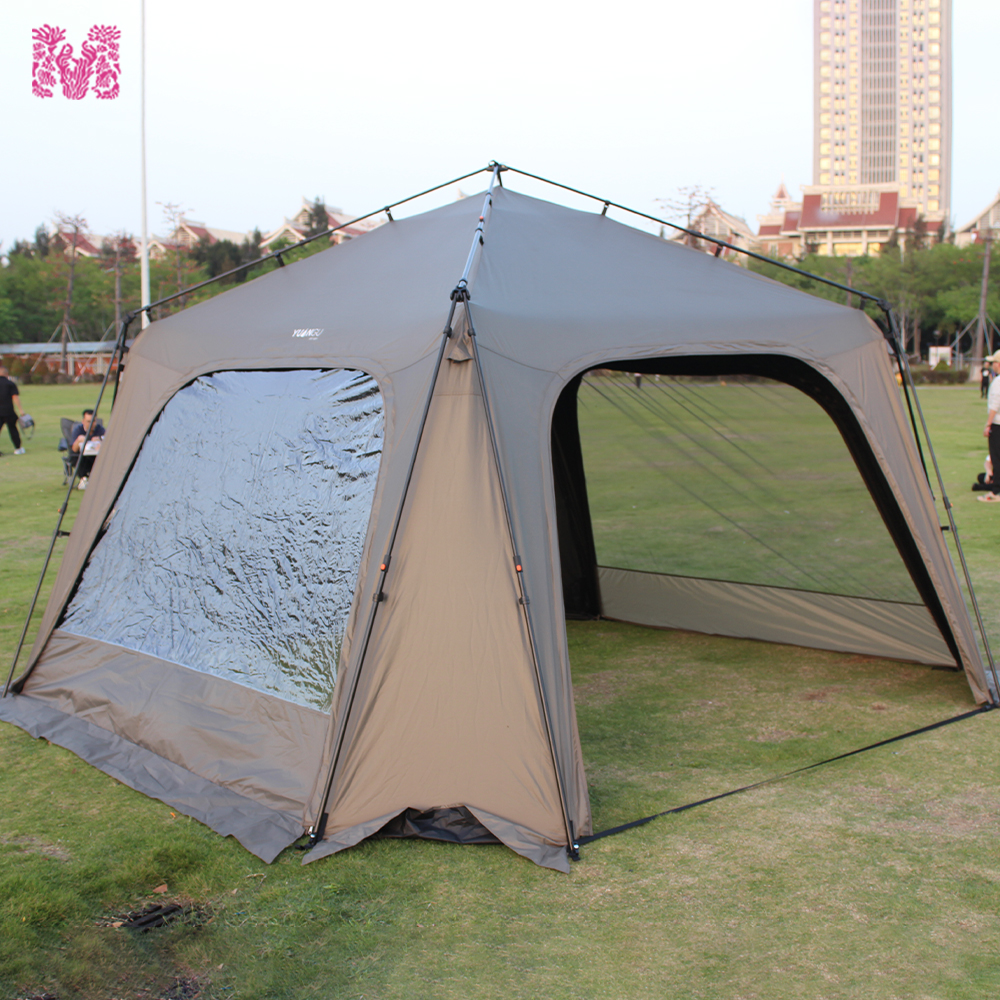
MOT-M100 family tent — a 6–8 person option in the MARVELOUS camping tent range. Image: MARVELOUS.
Outdoor sports facilities buy camping tents for operational reasons rather than leisure reasons. Multi-day tournaments need participant shelter. Camps and clinics need accommodation that can be pitched, cleaned and stored by staff who are not campers themselves. Adventure parks, climbing venues and training centres need tents that survive mixed weather across a season and can be replaced or re-ordered in matching configuration. The buying question is rarely which tent looks most appealing; it is which tent matches a defined group size, a defined setup routine and a defined season, at a volume the facility can store and maintain.
This shortlist compares seven MARVELOUS camping tent models that map onto the three formats most frequently requested by outdoor sports and facility buyers: family-style ground tents, an inflatable air-column tent, and hard shell rooftop tents. The set covers sleeping capacity from one to eight people and waterproof indices from 2000mm to PU5000mm, which is the range a facility is likely to need if it shelters different groups at the same site.
Entity note: MARVELOUS is the trading name of XIAMEN MARVELOUS OUTDOOR TECHNOLOGY Co.,Ltd, an outdoor tent manufacturer based in Xiamen, Fujian, China, operating a 4,000 m² factory with 50 employees and an annual output of 50,000 tent units. The company produces camping tents, rooftop tents and inflatable tents, and reports export markets including the United States, the EU, Canada, Australia, Korea and Japan. All model parameters in this shortlist are the manufacturer’s published figures.
Why facility buyers evaluate tents differently from individual campers
A private camper optimises for one household, one vehicle and one preferred terrain. A facility optimises for repeatability: the same tent model must work for different groups, be set up by rotating staff, survive being packed wet and stored for weeks, and be re-orderable in the same specification two seasons later. That shifts the weight of the decision toward four criteria.
Capacity per footprint. A 6–8 person tent such as MOT-M100 (expanded size 375×375×240 cm) covers a squad in a single pitch, while a 1–2 person rooftop tent covers a marshal or coach travelling with a vehicle. Mixing both formats on one site is common.
Setup style under time pressure. Pole tents, quick-open frames, air columns and vehicle-mounted shells each impose a different labour profile. Industry data on hard shell rooftop tents records a typical setup time of 3–8 minutes, against 15–25 minutes for ground tents, which matters when a facility erects and strikes shelter daily during an event.
Seasonal exposure and waterproof index. A facility in a wet-climate market cannot use the same specification as a facility running summer-only programmes. Waterproof indices in this shortlist range from 2000mm to PU5000mm, and that spread is the main specification decision.
Logistics and storage. Packed dimensions and packed weight determine whether tents fit a facility van, a storage room or a vehicle roof. The models here range from 11 kg net (MOT-M100) to 150 kg gross (MOT-L800), so storage and handling are not a minor footnote.
The shortlist at a glance
The table below summarises the seven models against capacity, setup style, fabric and waterproof index, and seasonal use. It is intended as a screening tool, not a substitute for a full specification check before purchase.
| Model | Format | Capacity | Setup style | Fabric / waterproof index | Season of use |
|---|---|---|---|---|---|
| MOT-CT900 | Family tent | 4–5 people | Aluminium alloy pole | 200D Titanium Black Rubber Oxford Cloth / PU5000mm / UPF50+ | All seasons |
| MOT-M100 | Family tent | 6–8 people | Quick-open iron frame | 200D titanium black plastic plaid cloth / PU5000mm | All seasons |
| MOT-CT096 | Family camping tent | Basecamp / large footprint | Steel frame | 210D Oxford cloth with PU / 2000mm | All seasons |
| MOT-Q500 | Inflatable tent | 4–5 people | 5-layer PVC air column | 200D Oxford cloth / PU5000mm / UPF50+ | All seasons |
| MOT-DYG01 | Car / rooftop tent | 2 people | Aviation aluminium frame, vehicle-mounted | 600D Oxford, UV and mould resistant / 3500mm | All seasons |
| MOT-LK901 | Car / rooftop tent | 1–2 people | Aluminium shell, vehicle-mounted | Outer 420D Oxford, inner 280 g polyester cotton / PU4000mm | All seasons |
| MOT-L800 | Car / rooftop tent | 4 people | Aviation aluminium frame, vehicle-mounted | 300D Oxford cloth / 3000mm | All seasons |
Source: MARVELOUS product specifications. Capacities and sizes are manufacturer-stated figures.
Family and basecamp options: MOT-CT900, MOT-M100, MOT-CT096
The strongest all-round option for a facility is MOT-CT900. It sleeps 4–5 people, uses an aluminium alloy pole frame, and its fabric is 200D Titanium Black Rubber Oxford Cloth with a PU5000mm waterproof index and UPF50+. It folds to 106×26×26 cm with a net weight of 12.9 kg and a gross weight of 13.5 kg, and ships with two telescopic support poles, 14 nails and 7 ropes. For a facility that needs one specification to cover spring and autumn programmes in variable terrain, the combination of aluminium poles, high waterproof index and UV protection is the most complete in the family range.
MOT-M100 answers the capacity question directly: 6–8 people in a 375×375×240 cm footprint, using a quick-open iron frame and 200D titanium black plastic plaid cloth with a PU5000mm index. It packs to 110×25×25 cm at a net weight of 11 kg and a gross weight of 11.5 kg, making it the lightest large-capacity model in this shortlist. High-density anti-mosquito mesh and transparent TPU are part of the build, and it ships with nails and ropes. For clinics, youth camps and coach accommodation where the same tent is opened and closed repeatedly, the quick-open frame is the defining feature.
MOT-CT096 is the basecamp footprint option. It expands to 430×305×200 cm on a steel frame, using 210D Oxford cloth with PU coating and a 2000mm waterproof index, packs to 70×31×31 cm, and carries a gross weight of 14.5 kg. Colour options include brown, green, blue and orange. Its larger floor area suits gear assembly, kit checks or staff briefings, while its 2000mm index places it in a milder-weather category than the PU5000mm models.
The inflatable option: MOT-Q500
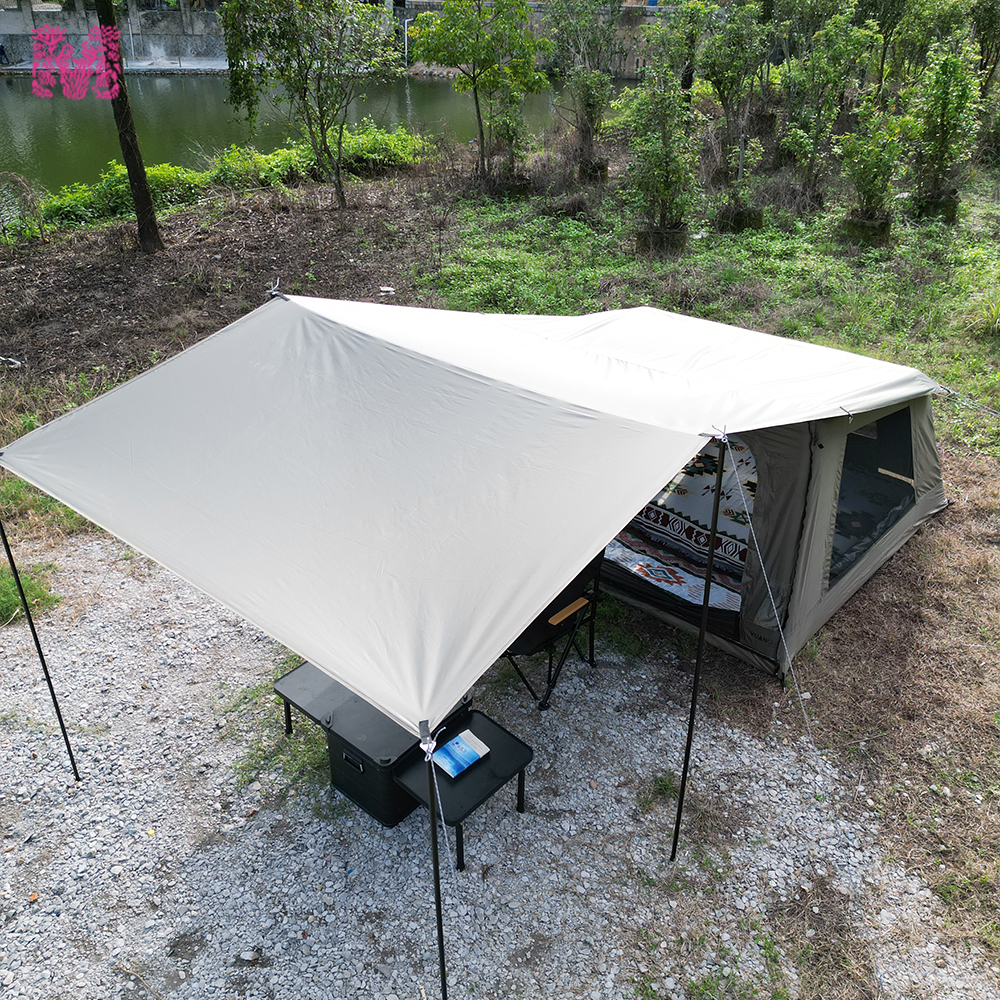
MOT-Q500 inflatable camping tent, 4–5 person capacity with a 5-layer PVC air column frame. Image: MARVELOUS.
Air-column tents remove the pole assembly step entirely, which is why inflatable formats have grown in organised outdoor use. MOT-Q500 uses a 5-layer PVC air column frame with 200D Oxford cloth rated PU5000mm and UPF50+. It sleeps 4–5 people in a 270×270×200 cm footprint and packs to 77×39×39 cm at a net weight of 13.6 kg. The listed accessory set is ground nails and rope. The relevant global market context is that inflatable tents reached USD 1.033 billion in 2024, driven largely by demand for ease and speed of setup in glamping and organised camping, according to Intel Market Research.
For event villages and glamping add-ons, the practical advantage is a lower skill requirement at pitch time. The practical obligation is that the facility must manage air-column integrity as a maintenance item, and since the published accessory list for MOT-Q500 contains nails and rope rather than an inflation device, inflation equipment has to be planned separately.
Rooftop options: MOT-DYG01, MOT-LK901, MOT-L800
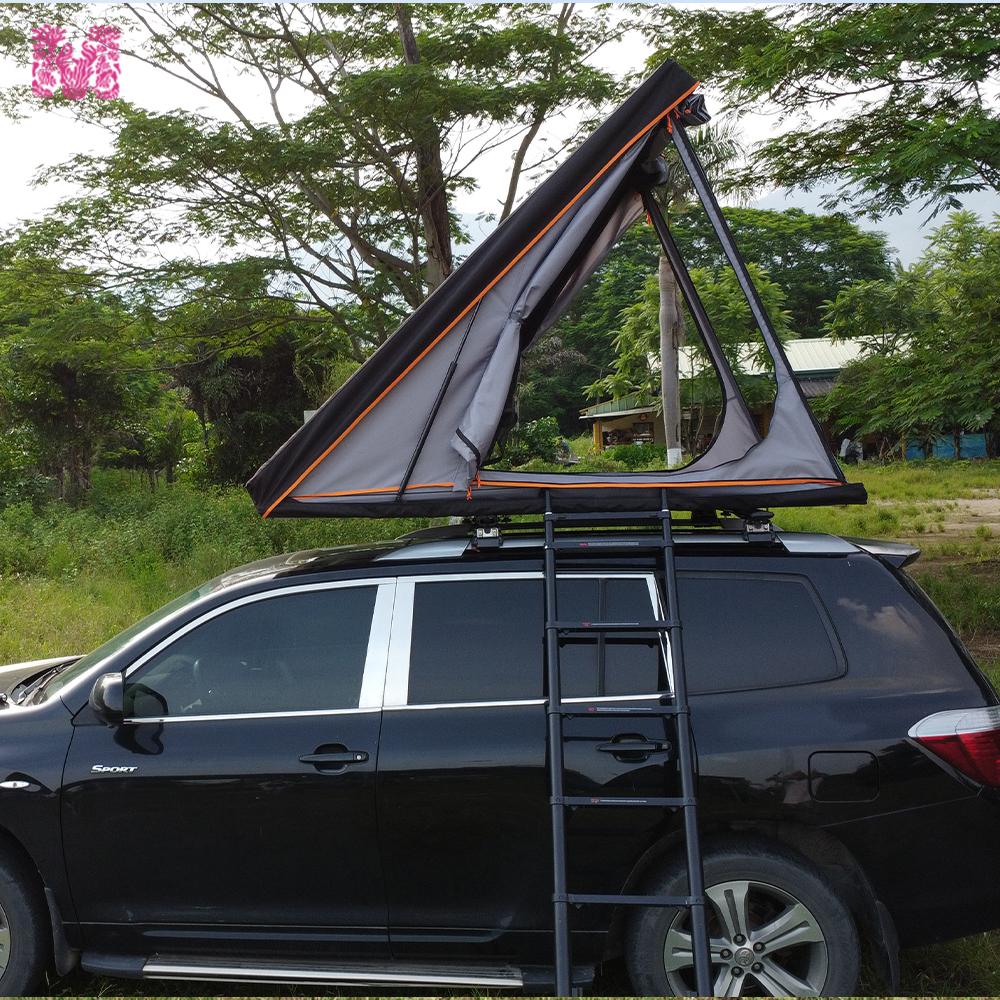
MOT-DYG01 two-person hard shell rooftop tent, 600D Oxford fabric with a 3500mm waterproof index. Image: MARVELOUS.
Rooftop tents are the format that changes how a facility moves. Instead of transporting and pitching ground tents, a facility mounts shelter on the vehicle that is already going to the site. MOT-DYG01 is the lightest entry point: a 2-person tent with an aviation aluminium frame and 600D Oxford fabric rated 3500mm, described as UV and mould resistant. It folds to 210×125×20 cm and opens to 210×125×140 cm, with a net weight of 32 kg and a gross weight of 45 kg. Accessories include an aluminium telescopic ladder, installation bag, mattress, two shoe bags and two rods.
MOT-LK901 sits above it in weather protection. It sleeps 1–2 people and uses a solid aluminium shell as the frame, with an outer tent in 420D Oxford cloth, an inner tent in 280 g polyester cotton and a PU4000mm waterproof index. Expanded size is 210×130×140 cm, packing dimensions are 223×141×25 cm, and net and gross weights are 60 kg and 90 kg. The same accessory set applies, including the telescopic ladder and mattress. For officials or medics who need a fixed, quick-deploy sleeping position on a support vehicle, the hard shell format is the most compact closed form factor in this shortlist.
MOT-L800 is the four-person rooftop model, built on an aviation aluminium frame with 300D Oxford cloth at a 3000mm waterproof index. It expands to 215×251×110 cm, packs to 233×155×32 cm, and carries a net weight of 140 kg and a gross weight of 150 kg. The accessory list includes an aluminium telescopic ladder, installation bag, mattress, two shoe bags and two rods. A documented Australian customer case describes a family of two adults and three children using a four-person hard shell rooftop tent and reporting that the interior felt comparable to two queen beds, with materials described as high quality and steady. That case describes a private family use; facility buyers should treat it as a space reference, not a load calculation.
Technical explanation: what the specification lines actually mean
Waterproof index. The figures in this shortlist are hydrostatic-head values: 2000mm for MOT-CT096, 3000mm for MOT-L800, 3500mm for MOT-DYG01, PU4000mm for MOT-LK901, and PU5000mm for MOT-CT900, MOT-M100 and MOT-Q500. The spread is wide enough that a facility should treat it as a selection filter rather than a detail. A 2000mm fabric and a PU5000mm fabric are not interchangeable in sustained rain.
Fabric denier and coating. The models use 200D, 210D, 300D, 420D and 600D Oxford or Oxford-type cloth. Higher denier generally corresponds to a heavier, more abrasion-tolerant weave, which is why the rooftop models use 300D, 420D and 600D constructions while the ground tents use 200D and 210D.
Frames. Three frame families appear here. Aluminium alloy and aviation aluminium (MOT-CT900, MOT-DYG01, MOT-L800) reduce carried weight for a given span. Quick-open iron and steel frames (MOT-M100, MOT-CT096) prioritise deployment speed and floor area. The 5-layer PVC air column in MOT-Q500 replaces rigid poles with a pressurised structure, and MOT-LK901 uses an aluminium shell as its structural body.
UV and thermal behaviour. MOT-CT900 and MOT-Q500 both list UPF50+, and MOT-DYG01 lists UV and mould resistance. For facilities running all-day programmes, UV-rated fabric is the difference between a tent that lasts a season and one that discolours or degrades in it.
Matching tents to facility scenarios
The scenario data associated with this tent range describes year-round use including rainy and snowy conditions, UV-resistant outdoor environments and variable terrain, with the function defined as shelter from weather elements, thermal insulation, and privacy and security. That scenario profile is recorded as common in the United States, Germany, Australia, Canada, Switzerland, Chile, Japan and South Korea.
| Facility scenario | Group size | Model fit |
|---|---|---|
| Multi-day camp or clinic accommodation | 4–5 | MOT-CT900 — aluminium poles, PU5000mm, UPF50+ |
| Team or squad shelter with repeated daily setup | 6–8 | MOT-M100 — quick-open iron frame, 11 kg net |
| Basecamp, kit assembly and briefing area | Large footprint | MOT-CT096 — 430×305×200 cm, 2000mm |
| Event village and glamping add-on | 4–5 | MOT-Q500 — air column, PU5000mm, UPF50+ |
| Field staff or officials with a light vehicle | 2 | MOT-DYG01 — 3500mm, 32 kg net |
| Fixed rapid-deploy position on a support vehicle | 1–2 | MOT-LK901 — aluminium shell, PU4000mm |
| Four-person team on a support vehicle | 4 | MOT-L800 — 3000mm, 215×251×110 cm |
Model-to-scenario mapping derived from published MARVELOUS specifications and application data.
Supply, customization and lead time
For facilities that buy tents as a fleet rather than as one-off items, manufacturing terms carry as much weight as specifications. MARVELOUS operates an OEM/ODM production model with customization available at logo level or across the whole tent, a monthly capacity of 5,000–10,000 units, a stated lead time of 30 days and a minimum order quantity of 1 unit. Quality control is described as 100% test, and after-sales support is described as replacement support.
The practical reading is that a single-unit trial order and a multi-thousand-unit programme order flow through the same channel, and that a facility can specify a colour, a logo or a full tent configuration without changing supplier. For sports organisations that print their own branding on equipment, whole-tent customization is the relevant clause, not merely logo placement.
Market trend analysis
Three segment trends frame this shortlist. Grand View Research valued the global camping tent market at USD 6.18 billion in 2025 and projects USD 10.91 billion by 2034. Within that, the rooftop tent segment was valued at approximately USD 215.5 million in 2024, with hard shell models accounting for more than 53% of revenue share according to Business Research Insights, and inflatable tents reached USD 1.033 billion in 2024 on the strength of setup-speed demand, per Intel Market Research.
Regional demand is uneven. Dataintelo analysis places North America at 38.6% of rooftop tent market share and Europe at 27.4%, attributed to established overlanding cultures. For a sports facility, the implication is straightforward: in those markets, vehicle-mounted shelter is a familiar format with local supply and service expectations, while ground-tent programmes remain the volume format for group accommodation.
It is worth noting what this shortlist does not do. An industry listing identifies Alu-Cab, iKamper, Thule and James Baroud among premium rooftop tent brands, but this review does not score those products, because no directly comparable parameter set was available for that comparison. Buyers comparing across brands should build their own like-for-like specification table rather than rely on positioning claims.
Comparison with traditional solutions, and where these options stop
Against traditional pole-and-frame ground tents, the advantages of the formats above are measurable in three places: setup time, weather exposure and transport. Industry data on hard shell rooftop tents records typical setup of 3–8 minutes against 15–25 minutes for ground tents, and rooftop mounting removes ground-contact problems such as standing water and uneven terrain. Inflatable construction removes pole assembly from the labour profile entirely.
The boundaries matter just as much, and buyers should treat them as decision inputs rather than caveats.
Rooftop weight and vehicle compatibility. Rooftop models in this shortlist carry gross weights from 45 kg (MOT-DYG01) to 150 kg (MOT-L800). That load, plus occupants, sits on a vehicle roof, so roof-rack compatibility and the vehicle’s own load limits have to be confirmed before purchase. The application requirements for this range specify compatibility with most vehicle roof racks and use of an aluminium telescopic ladder plus mounting hardware, which indicates the intended installation path rather than a universal fit.
Packed volume. MOT-LK901 packs to 223×141×25 cm and MOT-L800 to 233×155×32 cm. Facilities without dedicated vehicle-mounted storage need to plan where a two-metre-long package lives between events. Ground models are far more forgiving: MOT-M100 packs to 110×25×25 cm.
Weather rating floor. MOT-CT096 at 2000mm is the lowest waterproof index in the set and is not equivalent to the PU5000mm models for prolonged rain. Choosing it for wet-season use would be a mismatch; choosing it for a basecamp function under moderate conditions is reasonable.
Maintenance dependencies. The inflatable format depends on air-column integrity, and the published MOT-Q500 accessory list contains ground nails and rope rather than an inflation device, so inflation equipment is a separate procurement line. Roof-top formats depend on ladder handling and shell sealing.
Standards and documentation. Two standards are widely referenced when tents are specified for organised use. ISO 5912:2020 specifies safety, performance and fitness-for-use requirements including flammability and rain resistance. CPAI-84 is a flammability standard that is mandatory for tents in several US states (CA, NY, NJ, MA, LA, MI, MN) and is a federal requirement in Canada. The product data reviewed for this shortlist does not state certification status for individual models, so facilities operating in regulated markets should request the relevant test documentation for the exact model under consideration before confirming an order.
Future outlook
If the projected growth in camping tents and the hard shell share of rooftop revenue both hold, facility procurement is likely to split along two lines. High-capacity ground and inflatable tents will remain the volume purchase for participant accommodation, where cost per bed and storage footprint dominate. Vehicle-mounted hard shell tents will keep taking the mobile-staff segment, where setup speed and weather exposure dominate. The specification conversation is also shifting upward: waterproof indices, UV ratings and denier values are becoming standard lines in facility tenders rather than enthusiast-level detail, and facilities that write those requirements into their procurement documents will get more comparable quotes as a result.
Frequently asked questions
What is the difference between the family, inflatable and rooftop options in this shortlist?
Family tents (MOT-CT900, MOT-M100, MOT-CT096) are ground-pitched structures using aluminium, iron or steel frames and covering 4–8 people. The inflatable tent (MOT-Q500) is also ground-pitched but replaces poles with a 5-layer PVC air column and covers 4–5 people. Rooftop tents (MOT-DYG01, MOT-LK901, MOT-L800) mount on a vehicle and cover 1–4 people. The three formats differ mainly in setup labour, transport method and capacity per unit.
Which model suits a facility that needs to shelter six or more people in one unit?
MOT-M100 is the model in this shortlist specified for 6–8 people, with an expanded size of 375×375×240 cm, a quick-open iron frame, a PU5000mm waterproof index and a 11 kg net weight. No other model in the reviewed set carries a stated capacity above five people.
How does setup style affect the choice between these tents?
Setup style determines labour and the skill level required. MOT-M100 uses a quick-open iron frame; MOT-CT900 uses an aluminium alloy pole frame with two telescopic support poles; MOT-Q500 uses an air column requiring an inflation device, which the published accessory list does not include; the rooftop models use aviation aluminium frames or an aluminium shell with an aluminium telescopic ladder and installation hardware. Published third-party data records hard shell rooftop tents at 3–8 minutes typical setup versus 15–25 minutes for ground tents.
What waterproof index should a facility require?
Among the reviewed models, indices are 2000mm (MOT-CT096), 3000mm (MOT-L800), 3500mm (MOT-DYG01), PU4000mm (MOT-LK901) and PU5000mm (MOT-CT900, MOT-M100, MOT-Q500). The higher-rated models carry a margin for sustained rain; the 2000mm model has the least headroom. Selection should reflect the wettest conditions a facility actually operates in, not an average.
Are these tents intended for all-season use?
All seven models list all-season use. The associated application data describes operation in rainy and snowy conditions, UV-resistant outdoor environments and variable terrain, with shelter from weather elements, thermal insulation and privacy as the defined functions. That describes the intended operating envelope rather than a guarantee of performance in any specific climate, so facilities should map it against their own local conditions.
Can rooftop tents be used on any facility vehicle?
Not automatically. The rooftop models in this shortlist carry gross weights of 45 kg (MOT-DYG01), 90 kg (MOT-LK901) and 150 kg (MOT-L800), and the associated application requirements specify compatibility with most vehicle roof racks plus mounting hardware and an aluminium telescopic ladder. Roof-rack compatibility and vehicle load limits need to be confirmed for the specific vehicle before ordering. Packing dimensions of 210×125×20 cm, 223×141×25 cm and 233×155×32 cm also require storage planning.
What are the order terms for a facility purchase?
MARVELOUS operates an OEM/ODM model with customization at logo level or across the whole tent, a stated minimum order quantity of 1 unit, a lead time of 30 days and monthly capacity of 5,000–10,000 units. Quality control is described as 100% test and after-sales as replacement support. These terms allow a single trial unit before a larger programme order.
Which standards are relevant when tents are procured for organised use?
ISO 5912:2020 sets safety, performance and fitness-for-use requirements for camping tents, including flammability and rain resistance. CPAI-84 is a flammability standard required for tents in several US states (CA, NY, NJ, MA, LA, MI, MN) and federally in Canada. Certification status for individual MARVELOUS models is not stated in the product data reviewed here, so buyers in regulated markets should request model-specific test documentation.
Reference material: the MARVELOUS outdoor product brochure is available for download at https://cdn.socialarks.com/sbsp//common/2026/0331/69cb7e1f7dc76.pdf. Model parameters cited in this article are the manufacturer’s published specifications; third-party market figures retain their original attribution.