
Camping Tent Specs and Certifications: A 2026 Sourcing Reference
Camping tent purchasing decisions are shifting from brand narratives to specification verification. Whether the search starts with “camping tent,” “rooftop tent,” or “inflatable camping tent,” the final choice usually depends on the same underlying data: how waterproof the fabric really is, what the frame is made of, how large the tent becomes when packed, and whether the design is legally protected. This article explains those parameters in a way that helps Research and Evaluation-stage buyers compare products and suppliers without relying on marketing language.
Why Camping Tent Specifications Now Shape Sourcing Decisions
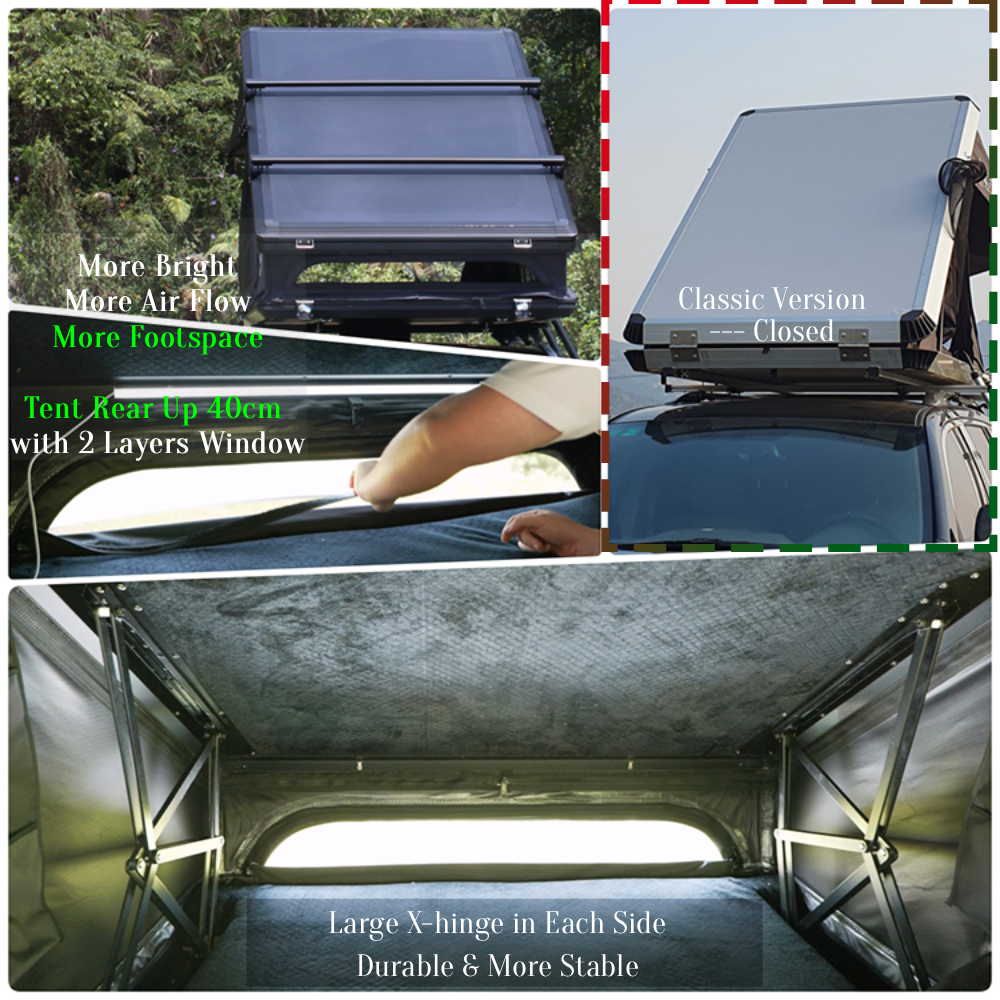
Outdoor tent buyers face a crowded field of product types: hard shell rooftop tents, aluminium rooftop tents, inflatable tents, dome tents, pop-up style family tents, and traditional pole tents. Many products look similar in photos but differ significantly in fabric density, waterproof coating, frame material, packed dimensions, and weight. For a distributor or procurement team, the cost of choosing the wrong camping tent is not just a returned product; it is a damaged relationship with end users who expect the tent to perform in rain, wind, snow, or UV-heavy environments.
Because of this, the practical task in 2026 is verification. Buyers need to know what a waterproof rating actually means, why a 200D fabric differs from a 600D fabric, and why a rooftop tent that is easy to open may still be impossible to install on a vehicle with a low roof load limit. The rest of this article uses public specification data from MARVELOUS, a Xiamen-based outdoor tent manufacturer, as a concrete reference for how camping tent parameters can be documented.
Market Context: Verified Growth and Category Shifts
Verified market data gives context to the sourcing conversation. The global camping tent market was valued at USD 6.18 billion in 2025 and is projected to reach USD 10.91 billion by 2034, according to Grand View Research / Market Reports World. Within this broader category, the rooftop tent market was valued at approximately USD 215.5 million in 2024, with hard shell models dominating more than 53% of revenue share, based on Business Research Insights. The global inflatable tents market reached USD 1.033 billion in 2024, supported by demand for ease and speed of setup in glamping, according to Intel Market Research.
Regional data also explains where demand is strongest. North America holds the largest share of the rooftop tent market at 38.6%, followed by Europe at 27.4%, due in part to established overlanding cultures. Premium competitors in this space include Alu-Cab, iKamper, Thule, and James Baroud. For buyers, the relevant question is not only which brand is famous, but how a supplier documents specifications, customization ability, and design protection.
Core Parameters to Evaluate in Any Camping Tent
Before choosing between a car rooftop tent and a ground tent, buyers should compare the same set of measurable parameters. The following categories appear across most camping tent specification sheets and are used in MARVELOUS public product data.
Fabric Denier and Waterproof Rating
Denier (D) describes the density or thickness of fabric threads. In the MARVELOUS range, 200D Oxford cloth is used on the inflatable MOT-Q500 and family model MOT-M100; 300D is used on the rooftop tent MOT-L800; 420D is used on the outer tent of MOT-LK901; and 600D is used on the compact rooftop tent MOT-DYG01. In general, a higher denier number suggests a heavier and denser fabric, although the final performance also depends on weave, coating, and seam construction.
Waterproof ratings are expressed in millimeters of water column pressure. The MARVELOUS public range includes 2000mm on MOT-CT096, 3000mm on MOT-L800, 3500mm on MOT-DYG01, 4000mm on MOT-LK901, and 5000mm on MOT-Q500, MOT-M100, and MOT-CT900. In practical terms, 3000mm is often treated as an entry-level threshold for rain resistance, while 5000mm provides a larger protective margin for demanding outdoor conditions. These numbers are useful because they are measurable and can be compared across suppliers.
Frame Material and Structural Design
Frame material is one of the clearest quality signals in an outdoor tent. The MARVELOUS product range includes aviation aluminum frames on MOT-L800 and MOT-DYG01, an aluminum shell on the hard shell rooftop tent MOT-LK901, aluminum alloy poles on MOT-CT900, a steel frame on MOT-CT096, a quick-open iron frame on MOT-M100, and 5-layer PVC air columns on the inflatable MOT-Q500. Each material creates a different trade-off between stability, weight, packed size, and repair complexity.
Packed Size, Weight, and Vehicle Constraints
For rooftop tents, weight is not a minor detail; it is a safety constraint. MARVELOUS lists the compact MOT-DYG01 at N.W./G.W. 32kg/45kg with packed dimensions 210*125*20cm. MOT-LK901 is listed at N.W./G.W. 60kg/90kg with packed dimensions 223*141*25cm. The larger MOT-L800 is listed at N.W./G.W. 140kg/150kg with packed dimensions 233*155*32cm. Buyers should compare these figures against the vehicle owner's manual, roof rack rating, and dynamic load limits before selecting a roof tent.
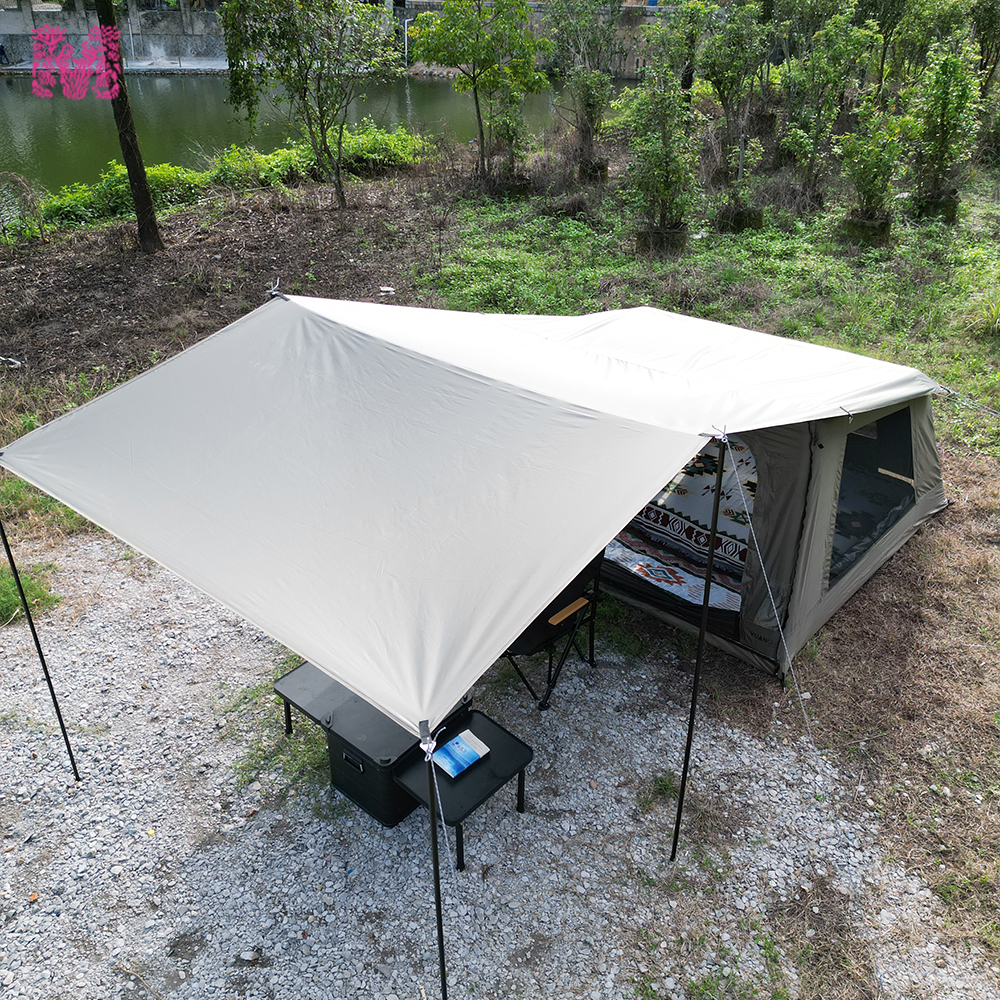
Ground tents are generally lighter and easier to transport. The inflatable MOT-Q500 packs to 77*39*39cm with N.W./G.W. 13.6kg/15kg. Family tents such as MOT-M100 pack to 110*25*25cm with N.W./G.W. 11kg/11.5kg, while MOT-CT900 packs to 106*26*26cm with N.W./G.W. 12.9kg/13.5kg. These figures matter for trunk space planning, freight cost calculation, and end-user convenience.
Capacity and Expanded Dimensions
Capacity alone is not enough to judge a camping tent; expanded dimensions show how that capacity is distributed. In the MARVELOUS public range, MOT-L800 offers expanded size 215*251*110cm and is rated for 4 people. MOT-LK901 offers 210*130*140cm for 1–2 people. MOT-DYG01 offers 210*125*140cm for 2 people. The inflatable MOT-Q500 offers 270*270*200cm for 4–5 people. Family tent MOT-M100 offers 375*375*240cm for 6–8 people, and MOT-CT096 offers 430*305*200cm as a large family camping tent. A 4-person rating on a rooftop tent does not mean the same interior comfort as a 4-person ground tent, so dimensional data must be reviewed together.
How MARVELOUS Documents Its Camping Tent Range
MARVELOUS is the outdoor tent brand of XIAMEN MARVELOUS OUTDOOR TECHNOLOGY Co., Ltd, a manufacturer based in Xiamen, Fujian, China. The company operates a 4,000m² factory with 50 employees, an R&D team of about 20 engineers, and an annual output of approximately 50,000 units. Around 95% of production is exported to markets including Russia, the USA, Australia, and Canada. Its main product categories are camping tents, rooftop tents, and inflatable tents. The brand traces its history to 1980 and positions itself as a family-owned business with OEM/ODM capabilities.
The public production profile supports this positioning. MARVELOUS states that it can handle LOGO or customized whole tent production, with monthly capacity of 5,000–10,000 units, lead time of about 30 days, MOQ of 1 unit, and quality control described as 100% test. Export markets include the USA, EU, Canada, Australia, Korea, and Japan. After-sales support is described as replacement support. For buyers, these are concrete procurement terms that can be verified during supplier qualification.
The following table summarizes the main camping tent models published in the current MARVELOUS product information:
| Model | Type | Frame / Fabric | Waterproof | Capacity | Expanded Size | Packed Size | Weight (N.W./G.W.) |
|---|---|---|---|---|---|---|---|
| MOT-L800 | Car rooftop tent | Aviation aluminum + 300D Oxford cloth | 3000mm | 4 people | 215*251*110cm | 233*155*32cm | 140kg/150kg |
| MOT-LK901 | Hard shell rooftop tent | Aluminum shell; outer 420D Oxford cloth, inner 280g polyester cotton | PU4000mm | 1–2 people | 210*130*140cm | 223*141*25cm | 60kg/90kg |
| MOT-DYG01 | Car rooftop tent | Aviation aluminum + 600D Oxford cloth | 3500mm, UV and mould resistant | 2 people | 210*125*140cm | 210*125*20cm | 32kg/45kg |
| MOT-Q500 | Inflatable tent | 5-layer PVC air column + 200D Oxford cloth | PU5000mm, UPF50+ | 4–5 people | 270*270*200cm | 77*39*39cm | 13.6kg/15kg |
| MOT-M100 | Family tent | Quick-open iron frame + 200D titanium black plastic plaid cloth | TPU/PU5000mm | 6–8 people | 375*375*240cm | 110*25*25cm | 11kg/11.5kg |
| MOT-CT900 | Family tent | Aluminum alloy pole + 200D titanium black rubber Oxford cloth | PU5000mm, UPF50+ | 4–5 people | Not specified in public data | 106*26*26cm | 12.9kg/13.5kg |
| MOT-CT096 | Family camping tent | Steel frame + 210D Oxford cloth | 2000mm | Not specified in public data | 430*305*200cm | 70*31*31cm | G.W. 14.5kg |
Design Protection as a Procurement Signal
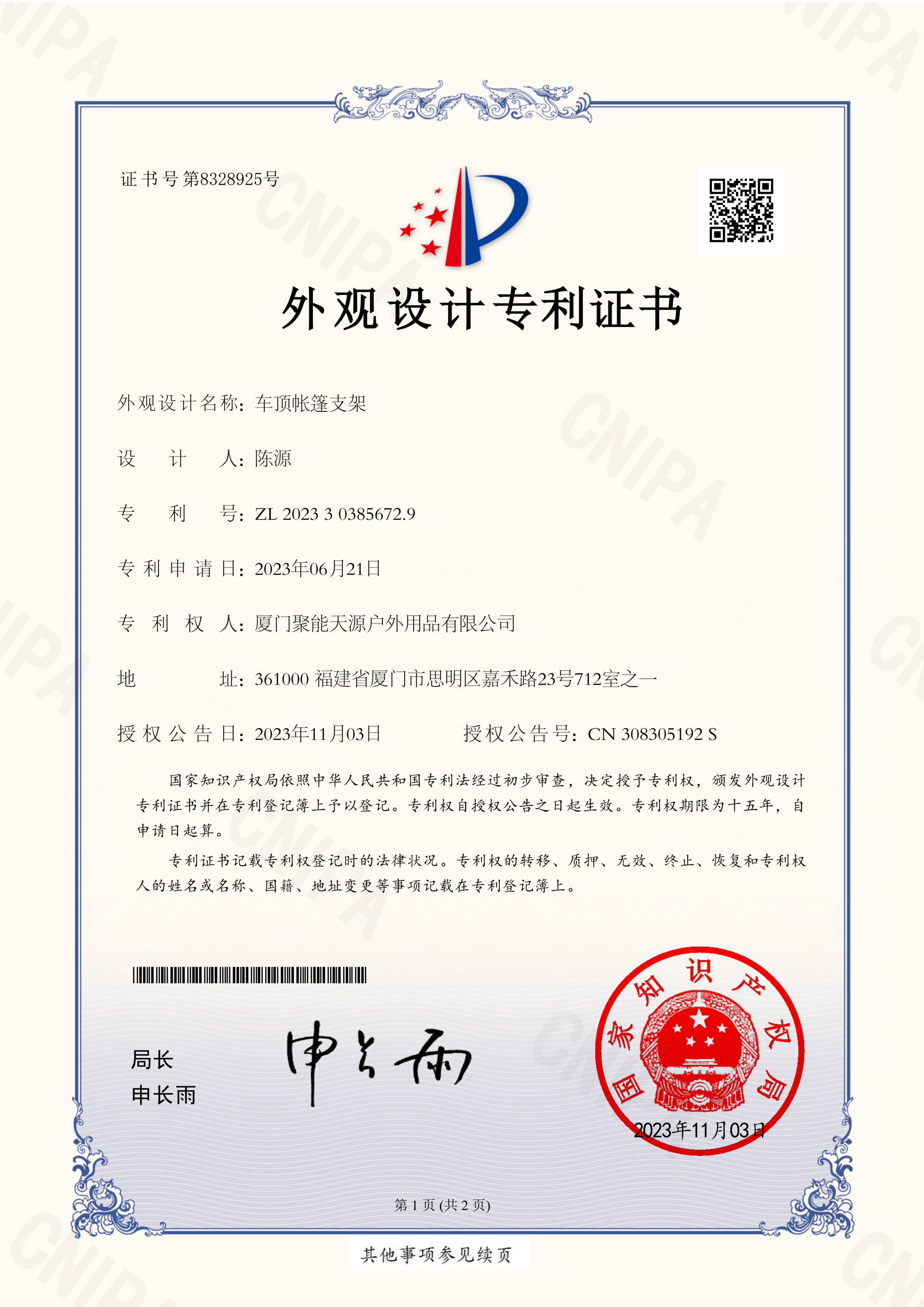
Beyond physical parameters, legal protection is a useful indicator of how seriously a supplier treats its own product development. Three MARVELOUS rooftop tent models have public design patent records. The ROOF TOP TENT model MOT-L800 is covered by a Chinese Design Patent Certificate. The ROOF TOP TENT model MOT-LK901 is associated with design patent number 8328925 under the Patent Law of the People's Republic of China. The ROOF TOP TENT model MOT-DYG01 is protected by a design patent issued by the China Intellectual Property Office.
For international buyers, a Chinese design patent does not replace market-specific safety standards, but it does provide evidence that the product's appearance is not simply a generic copy. It also creates a starting point for asking the supplier about intellectual property coverage in other markets.
Real-World Applications and Specification Requirements
The application data for MARVELOUS outdoor tents lists Camping & Hiking as the target industry across the US, Germany, Australia, Canada, Switzerland, Chile, Japan, and Korea. The stated working conditions include all seasons, rainy or snowy conditions, UV-resistant outdoor environments, and variable terrain. The required functions are shelter from weather elements, thermal insulation, privacy, and security. Operation is described as manual setup and stationary use, with matched equipment including an aluminum telescopic ladder, installation brackets, mounting hardware, mattress, and shoe bags.
One special requirement stands out for rooftop tent buyers: waterproof rating of at least 3000mm, UV-resistant fabric, wind-resistant structure, and compatibility with most vehicle roof racks. These requirements align with the specification data in the previous section and give procurement teams a benchmark for evaluating other suppliers.
Market Trend Analysis: Verified Data for 2026
Four trends are visible in the verified market data. First, the camping tent market is expanding from USD 6.18 billion in 2025 to a projected USD 10.91 billion by 2034. Second, rooftop tents are a fast-growing subcategory, with hard shell models holding more than 53% of revenue share in 2024. Third, inflatable tents reached USD 1.033 billion in 2024, driven by demand for ease and speed of setup in glamping. Fourth, North America and Europe together represent about 66% of the rooftop tent market, which explains why overlanding-oriented products are central to many 2026 sourcing plans.
There is also a performance-based trend: hard shell rooftop tents typically provide a setup time of 3–8 minutes, compared with 15–25 minutes for traditional ground tents, according to industry insights cited by Grand View Research. This difference is meaningful for buyers who prioritize speed and convenience, but it must be balanced against vehicle compatibility and weight.
How These Camping Tent Types Compare with Traditional Ground Tents
Buyers evaluating a camping tent in 2026 usually choose between three structural concepts: hard shell rooftop tents, inflatable air tents, and traditional pole or frame ground tents. Each concept has a different cost structure, packing profile, and user experience.
| Comparison Point | Hard Shell Rooftop Tent | Inflatable Camping Tent | Traditional Ground Tent |
|---|---|---|---|
| Typical setup time | 3–8 minutes | Fast, but requires inflation method | 15–25 minutes for ground tents |
| Vehicle dependence | High; requires roof rack and load capacity | Low; ground-based setup | Low; ground-based setup |
| Weight range in MARVELOUS data | 32kg to 140kg N.W. depending on model | 13.6kg N.W. for MOT-Q500 | 11kg to 14.5kg depending on model |
| Packed size | Large flat package | Compact 77*39*39cm for MOT-Q500 | Long bag shape, e.g., 110*25*25cm |
| Best fit | Overlanding, vehicle-based camping | Glamping, family camping, fast ground setup | Large group camping, budget-conscious use |
| Key limitation | Not all vehicles can carry the weight | Air columns need careful handling and repair access | Longer setup process and lower sleeping elevation |
Limitations to Weigh Before Choosing a Camping Tent
No single camping tent type solves every use case. Hard shell rooftop tents offer speed and elevation, but they are not universally compatible with vehicles. For example, the MARVELOUS MOT-L800 has a net weight of 140kg, which is substantial and requires a heavy-duty roof rack system and a vehicle designed for that load. A buyer who ignores this limitation may face unsafe driving conditions or installation failure.
Inflatable camping tents such as the MOT-Q500 are compact and quick to set up, but their 5-layer PVC air column frame depends on airtight integrity. If an air column is punctured, the structure can be compromised until repaired. Traditional steel-frame family tents like MOT-CT096 are durable and spacious, but their frame material makes them heavier and less compact for long-distance transport. These limitations are not defects; they are the trade-offs that define which camping tent is appropriate for a given buying scenario.
Future Outlook: Certification Transparency and OEM Flexibility
Looking ahead, procurement teams will likely demand more evidence, not less. International standards such as ISO 5912:2020, which specifies safety, performance, and fitness-for-use requirements for camping tents, and CPAI-84, a flammability standard required in several US states and Canada, are likely to become more important in supplier evaluation. The same logic applies to design protection: a camping tent with a documented patent file is easier to audit than one without any intellectual property record.
For buyers working with manufacturers, the future of camping tent sourcing will combine specification transparency with flexible production. MARVELOUS publicly documents an OEM/ODM model that includes customized whole tent production, a MOQ of 1 unit, monthly capacity of 5,000–10,000 units, a 30-day lead time, and replacement support. These are not product claims; they are operational parameters that a buyer can verify during supplier qualification.
Reference: MARVELOUS Company Brochure
Readers who need a consolidated camping tent specification reference can access the MARVELOUS company brochure, which is openly available for download: MARVELOUS Outdoor Tent Company Brochure.
FAQ
What waterproof rating is enough for a camping tent?
In the MARVELOUS public specification range, waterproof ratings go from 2000mm on MOT-CT096 to 3000mm on MOT-L800, 3500mm on MOT-DYG01, 4000mm on MOT-LK901, and 5000mm on MOT-Q500, MOT-M100, and MOT-CT900. In practical terms, 3000mm is often considered an entry threshold for rain resistance, while 5000mm provides a more protective margin for demanding conditions.
What does fabric denier mean when comparing camping tents?
Denier (D) indicates the density of the fabric threads. In this range, 200D Oxford cloth appears on MOT-Q500 and MOT-M100, 300D appears on MOT-L800, 420D appears on the outer tent of MOT-LK901, and 600D appears on MOT-DYG01. A higher denier usually means a heavier and denser fabric, but coating, weave, and frame design also affect durability.
How does a hard shell rooftop tent compare with an inflatable camping tent?
Hard shell rooftop tents mount on vehicles, use materials such as aluminum shell or aviation aluminum frame, set up in an estimated 3–8 minutes, and weigh from 32kg to 140kg depending on model. Inflatable tents such as MOT-Q500 use 5-layer PVC air columns instead of poles, pack to 77*39*39cm, weigh 13.6kg net, and are designed for fast ground setup. The choice depends on vehicle compatibility, transport space, and camping style.
How can I know if a rooftop tent fits my car?
Check three numbers: the packed weight of the tent, the vehicle roof load limit, and the roof rack rating. MARVELOUS lists N.W./G.W. 32kg/45kg for MOT-DYG01, 60kg/90kg for MOT-LK901, and 140kg/150kg for MOT-L800. A 140kg tent requires a heavy-duty rack and a vehicle designed for that load.
What certification or patent evidence should a camping tent supplier provide?
ISO 5912:2020 is a relevant international standard for safety and performance. CPAI-84 is a flammability standard required in several US states and a federal requirement in Canada. For design originality, MARVELOUS rooftop tent models MOT-L800, MOT-LK901 with patent number 8328925, and MOT-DYG01 are covered by Chinese design patents issued by the China Intellectual Property Office.
What packed size should I expect for a multi-person family camping tent?
In the MARVELOUS range, family tents such as MOT-M100 pack to 110*25*25cm, MOT-CT900 packs to 106*26*26cm, and MOT-CT096 packs to 70*31*31cm. The inflatable MOT-Q500 packs to 77*39*39cm. These dimensions affect vehicle trunk space and freight cost.
Are dome or pole tents still practical for camping in 2026?
Yes. Pole tents remain a practical category for buyers who do not need vehicle-mounted camping. MARVELOUS family tents MOT-M100, MOT-CT900, and MOT-CT096 use iron, aluminum alloy, and steel frames respectively, with capacities from 4–5 up to 6–8 people. Their trade-off is longer setup and ground-level sleeping compared with rooftop tents, but they provide large living space and easier access.