
Camping Tent Supply Continuity: Acceptance Criteria for Long-Term OEMs
Camping Tent Supply Continuity: Acceptance Criteria for Long-Term OEMs
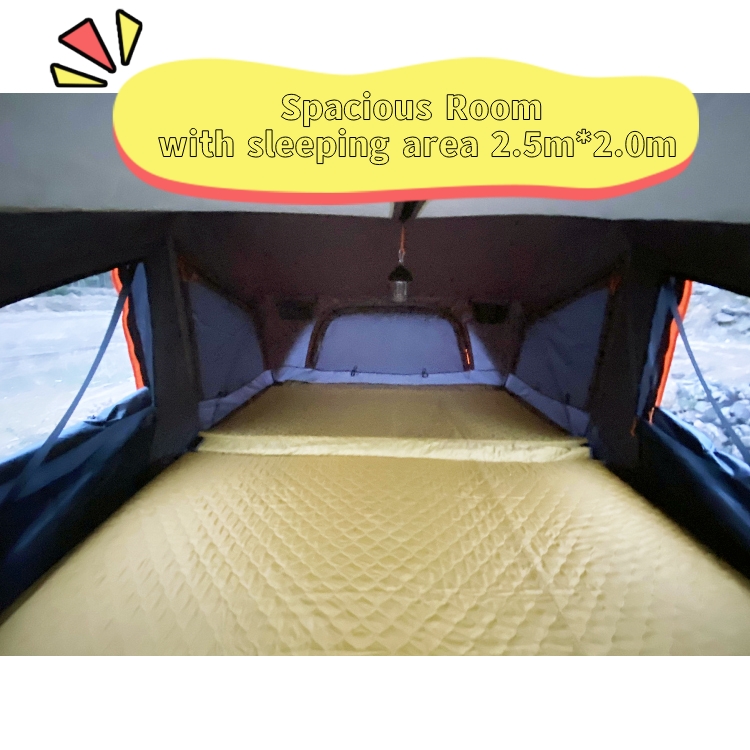
Rooftop tent interior volume is one of the few specification points a buyer can visually confirm at sample stage; the rest must be written into acceptance terms.
Long-term camping tent supply is usually discussed as a relationship question — trust, communication, responsiveness. In procurement practice it is a specification question. A supply line holds across multiple seasons only when both sides have agreed in writing what a conforming unit is: which fabric, which frame, which waterproof figure, which packed dimensions, which accessories, and which documents travel with each shipment. Price, lead time and allocation are negotiated on top of that baseline, not instead of it.
This reference sets out a supplier sustainability evaluation framework for OEM tent programmes built on documented acceptance criteria rather than on certification claims that are difficult to verify at sampling stage. It uses the MARVELOUS model range — three rooftop tents, one inflatable tent and three family/outdoor tents — as a worked example of how spec-level facts convert into purchase terms.
MARVELOUS is the trading identity of XIAMEN MARVELOUS OUTDOOR TECHNOLOGY Co., Ltd., a manufacturer based in Xiamen, Fujian, China, founded in 2019, producing camping tents, rooftop tents and inflatable tents. The company reports a 4,000 m² factory, 50 employees, an annual output of 50,000 units and a 95% export share, with Russia, the United States, Australia and Canada listed as main markets. Its OEM/ODM scope covers logo application and full-tent customization, supported by a stated monthly capacity of 5,000–10,000 units, a 30-day lead time, a minimum order quantity of 1 unit, 100% testing and replacement-based after-sales support.
Why continuity is decided at the specification stage
Most supply failures in tent sourcing are not commercial failures. They are specification failures that surface late: a fabric denier drifts down one season, a frame supplier changes, a waterproof figure stays on the datasheet while the coating behind it changes, or an accessory set quietly loses a component. None of these events require bad faith. They require an unwritten baseline.
The practical consequence is that a buyer who evaluates a supplier only on samples and price is evaluating a moment, not a capability. A supplier who can restate the same construction against a written criterion — season after season, order after order — is demonstrating something different and more durable. That restatement ability is the closest thing the category has to a sustainability test that a buyer can actually run.
There is a market reason to take this seriously now. The global rooftop tent segment was valued at USD 1.42 billion in 2025, with hard shell models accounting for roughly 40%–45% of that segment. Segments with that kind of weight attract new entrants quickly, and new entrants compete first on price and later on consistency. Buyers who lock criteria early are less exposed to that transition.
The ten acceptance criteria that carry a multi-year programme
The criteria below are the ones that repeatedly decide whether a second and third season resemble the first. They are ordered by how often they are left ambiguous.
| Criterion | What must be written down | Why it decides continuity |
|---|---|---|
| Fabric construction | Fibre, denier, coating type, colour reference | A denier substitution is invisible in a photograph and material to weight, hand-feel and cost |
| Frame system | Frame material, structure type, air-column layers where applicable | Frame is the primary structural failure point in rooftop and inflatable formats |
| Waterproof figure and test basis | Rated millimetre value, test method, seam treatment | A number without a method cannot be re-verified on incoming goods |
| Capacity | Person rating plus expanded footprint and peak height | Person ratings are marketing shorthand; footprint is the engineering fact |
| Packed dimensions and weight | Carton size, net and gross weight | Drives freight cost, vehicle roof load and warehouse planning |
| Accessory set | Itemised list with quantities | Accessories are the most common silent omission between seasons |
| Colour and customization scope | Standard colours, custom minimums, approval route | Custom colour is a recurring cost and a recurring lead-time variable |
| Documentation | Model code, IP references, HS classification, test reports | Documents are what survive staff turnover on both sides |
| Change control | Written notice and re-approval gate before any BOM change | Most drift is legitimate internal improvement, not substitution |
| Lot acceptance | What is checked per lot, sample size, pass/fail threshold | Turns a specification into an operation rather than a document |
The seven-model range read as one specification family
A multi-category OEM programme usually spans more than one construction logic, and the acceptance framework has to reflect that rather than average it out. In the MARVELOUS range, three rooftop tents, one inflatable tent and three family/outdoor tents sit on four different structural systems.
| Model | Format | Fabric / frame | Waterproof | Capacity | Packed size | Net weight |
|---|---|---|---|---|---|---|
| MOT-LK901 | Hard shell rooftop | 420D Oxford outer / 280g polyester-cotton inner; aluminium shell | PU 4000 mm | 1–2 people | 223×141×25 cm | 60 kg |
| MOT-DYG01 | Rooftop, car tent | 600D Oxford, UV and mould resistant; aviation aluminium | 3500 mm | 2 people | 210×125×20 cm | 32 kg |
| MOT-L800 | Rooftop, car tent | 300D Oxford; aviation aluminium | 3000 mm | 4 people | 233×155×32 cm | 140 kg |
| MOT-Q500 | Inflatable | 200D Oxford, UPF50+; 5-layer PVC air column | PU 5000 mm | 4–5 people | 77×39×39 cm | 13.6 kg |
| MOT-M100 | Family / outdoor | 200D titanium black plaid; quick-open iron frame | PU 5000 mm | 6–8 people | 110×25×25 cm | 11 kg |
| MOT-CT900 | Family / outdoor | 200D titanium black rubber Oxford, UPF50+; aluminium alloy pole | PU 5000 mm | 4–5 people | 106×26×26 cm | 12.9 kg |
| MOT-CT096 | Family / outdoor | 210D Oxford with PU; steel frame | 2000 mm | Footprint 430×305×200 cm | 70×31×31 cm | Gross 14.5 kg |
Two things stand out when the range is read as a family rather than as seven separate products. First, all seven models are listed as all-season. Second, the waterproof figures are not uniform: rooftop models sit at 3000 mm, 3500 mm and 4000 mm, three of the ground tents sit at 5000 mm, and CT096 sits at 2000 mm. A programme that buys across these families therefore needs three or four acceptance thresholds, not one. Collapsing them into a single house standard either over-specifies the CT096-class product or under-specifies the Q500 and CT900.

An inflatable tent removes the pole set entirely and moves structural risk into the air column — an acceptance point that must be specified separately from fabric.
Material and frame consistency: the part that cannot be inspected from a photo
Oxford cloth denomination is the clearest example of a specification that looks stable and is not. The MARVELOUS range alone spans 200D, 210D, 300D, 420D and 600D constructions, and each step changes abrasion behaviour, pack weight and cost. A purchase specification should name the denier, the coating and the colour reference together, because a buyer who specifies only the denier leaves the coating open, and a buyer who specifies only the colour leaves the substrate open.
Frame logic varies more than fabric logic. The rooftop models use aviation aluminium frames (MOT-L800, MOT-DYG01) or an aluminium shell (MOT-LK901). The inflatable model uses a 5-layer PVC air column. The family range splits three ways: a quick-open iron frame on MOT-M100, an aluminium alloy pole set on MOT-CT900, and a steel frame on MOT-CT096. These are not interchangeable systems, and a supplier's ability to deliver one says little about its ability to deliver another. For a multi-year programme, each frame type should carry its own agreed inspection point and its own spare-parts assumption.
Waterproof ratings from 2000 mm to 5000 mm — and what a number does not prove
Published ratings across the range run from 2000 mm (MOT-CT096) to 5000 mm (MOT-Q500, MOT-M100, MOT-CT900), with rooftop models at 3000 mm (MOT-L800), 3500 mm (MOT-DYG01) and 4000 mm (MOT-LK901). Those values are useful for segmentation: they separate a light-duty family tent from a full-weather ground tent from a vehicle-mounted shelter.
What they do not do is demonstrate performance. A millimetre rating is meaningful only alongside the test method used to generate it, the laboratory that ran it, and the sample it was run on. Where no independent hydrostatic-head test report is available, the honest position is that the figure is supplier-stated and should be treated as a design target rather than an incoming-goods result. The same discipline applies to standards. ISO 5912:2020 specifies requirements for the safety, performance and fitness for use of camping tents, but the existence of the standard does not establish that any particular product conforms to it. In the United States, CPAI-84 is a voluntary flammability protocol that functions as a de facto retail benchmark — voluntary in status, effectively expected in practice.
A workable acceptance clause therefore has three parts: the rated value, the method by reference, and the retest trigger. Without the third part, the first two degrade quietly over a multi-year programme.
Documentation: what a design patent does and does not cover
The rooftop tent models MOT-L800, MOT-LK901 and MOT-DYG01 are associated with a Chinese Design Patent Certificate, design patent number 8328925, issued by the China Intellectual Property Office under the Patent Law of the People's Republic of China, with a recorded term from 3 November 2023 to 20 June 2033 for the China market.
That is a meaningful document in one specific sense and a limited one in another. It is an intellectual-property record: it establishes a registered design position within China, which matters to a distributor reselling into that market and to any OEM buyer concerned about copy designs entering the same channel. It is not a product-safety certification, not a performance test, and not evidence of conformity with European or North American market-access requirements. Buyers who file it under "compliance" are filing it in the wrong drawer.
Trade classification follows the same logic. Camping tents are commonly classified under HS heading 6306, with the specific subheading depending on material composition, so the declared fabric on the specification sheet and the declared HS code on the customs entry should be checked as one item rather than two.
Matching model families to programme types
Acceptance criteria become actionable once they are attached to a use case. The mapping below follows the listed specifications rather than assumptions about the products.
Vehicle-based and overlanding programmes. MOT-LK901 carries a 1–2 person capacity, a 4000 mm rating and a 223×141×25 cm packed size at 60 kg net. MOT-DYG01 offers a 600D Oxford shell with a 3500 mm rating, UV and mould resistance, a 210×125×20 cm pack and 32 kg net. MOT-L800 moves to a 4-person capacity and a 233×155×32 cm pack at 140 kg net, which makes installation and vehicle roof rating a first-order purchasing question rather than an accessory detail.
Family and base-camp programmes. MOT-M100 covers 6–8 people on a quick-open iron frame at 110×25×25 cm and 11 kg net. MOT-CT900 covers 4–5 people on an aluminium alloy pole set at 5000 mm and UPF50+, packed at 106×26×26 cm. MOT-CT096 is specified by footprint — 430×305×200 cm — rather than by person rating, so capacity should be confirmed in writing before the model is used to meet a stated group size.
Fast-deploy and transport-sensitive programmes. MOT-Q500 packs to 77×39×39 cm at 13.6 kg net with a 5-layer PVC air column and a 5000 mm rating, which removes the pole set from the packing list and from the deployment sequence.
Colour and customization. Standard colour options differ by model: dark gray and orange for MOT-L800, black or customized for MOT-DYG01, customer-specified colour for MOT-LK901, army green or cream for MOT-Q500, army green or black for MOT-M100, black and white for MOT-CT900, and four standard options — brown, green, blue and orange — for MOT-CT096. Where a programme spans several families, the model with the widest standard colour set is usually the easier one to hold consistent across seasons.
Across the rooftop models, the accessory set is uniform: an aluminium telescopic ladder, an installation bag, a mattress, two shoe bags and two rods. The ground tents differ — ground nails and rope for MOT-Q500 and MOT-CT096, two telescopic support poles with 14 nails and 7 ropes for MOT-CT900, nails and ropes for MOT-M100. Itemised accessory lists belong in the purchase order, not in a marketing sheet, because they are the component most likely to be adjusted for freight reasons.

Steel-frame family tents trade packed weight for footprint; the acceptance criterion should state which of the two the programme is optimising.
Market context: why buyers are pushing criteria upstream
Published forecasts for the global camping tent market diverge widely — 2034 projections in the available research range from roughly USD 5.5 billion to USD 10.91 billion depending on source, product scope and base year. That spread is not a reason to distrust the category; it is a reason not to anchor a multi-year supply commitment to a single forecast curve. The rooftop segment is narrower and better bounded at USD 1.42 billion in 2025, with hard shell models at roughly 40%–45% of it.
The practical implication is that demand modelling and supply acceptance should be separated. Demand modelling is inherently uncertain and source-dependent. Acceptance criteria are not: a 300D fabric either matches the purchase specification or it does not. Programmes that conflate the two end up negotiating specifications with the same elasticity they apply to forecasts.
Where this framework stops
Three limitations should be stated plainly, because a framework presented without boundaries is not a framework.
It cannot benchmark suppliers against each other. The model-level facts here describe one manufacturer's range. They do not support a comparative claim about capacity, quality or delivery performance across the market, and any such comparison would require factory audit data that is not publicly available.
It does not convert supplier-stated ratings into verified performance. Waterproof figures between 2000 mm and 5000 mm, frame specifications and weight figures are as reported in the product documentation. Independent hydrostatic-head, wind-resistance, UV-durability and deployment-cycle test reports were not identified, and no acceptance framework can substitute for them — it can only specify when they are required.
It does not resolve commercial terms. A stated minimum order quantity of 1 unit supports sampling and pilot orders; it does not establish unit economics at volume, tooling cost allocation or multi-year pricing mechanics. Those remain commercial negotiations conducted against a technical baseline, not instead of one.
There is also a physical boundary worth naming: the rooftop models differ by more than a factor of four in net weight — 32 kg, 60 kg and 140 kg. Installation method, roof load rating and handling labour must be evaluated per model, not per category.
Future outlook
The direction of travel in OEM tent procurement is toward lot-level evidence. Buyers are increasingly asking for fabric and coating records, frame batch references and test documentation attached to specific shipments rather than to a model in general, and the growth of the hard shell rooftop segment gives that request more commercial weight than it carried when volumes were smaller.
For suppliers, the practical response is not additional certification language. It is the ability to restate a specification consistently and to prove it per lot. For buyers, the practical response is to write the acceptance criteria before the price negotiation, so that the negotiation has something stable to sit on. Both moves point in the same direction: from relationship-based continuity toward documented continuity.
For reference, the MARVELOUS product brochure covering the range discussed here is available for download: MARVELOUS product brochure (PDF).
FAQ
What belongs in a written acceptance specification for a multi-year tent supply agreement?
At minimum: fabric fibre, denier and coating; frame material and structure type; the rated waterproof value with its test method; capacity alongside expanded footprint and peak height; packed dimensions with net and gross weight; an itemised accessory list with quantities; standard colour options and the custom approval route; and a change-control clause requiring written notice and re-approval before any bill-of-materials change. Each item should have a stated pass/fail check rather than a description.
How should a buyer verify a waterproof rating of 2000 mm versus 5000 mm?
The millimetre figure should be read together with its test method, testing laboratory and sample reference. A rating is a design target until a hydrostatic-head test report supports it. Where no independent report exists, the specification should state the retest trigger — for example, a change of coating supplier or fabric mill — and treat incoming verification as a separate agreed step. ISO 5912:2020 defines requirements for camping tent safety and performance, but its existence does not itself demonstrate that a given product conforms.
Does a Chinese design patent certificate satisfy export market requirements?
No. The design patent numbered 8328925, issued by the China Intellectual Property Office under the Patent Law of the People's Republic of China with a recorded term from 3 November 2023 to 20 June 2033, is an intellectual-property record for the China market. It is not a safety certification, a performance test result, or evidence of conformity with European or North American market-access requirements. Those are separate documentation streams.
What does a minimum order quantity of 1 unit mean for a long-term OEM programme?
It supports sampling and pilot evaluation, which allows a buyer to test construction, packing and accessory completeness before committing volume. It does not define volume pricing, tooling allocation, packaging economics or multi-year price mechanics, which are negotiated separately. The pilot order is best treated as the point at which acceptance criteria are tested in practice, not as a price signal.
Can one supplier's range be treated as a single quality standard across rooftop, inflatable and family tents?
Not safely. Across the MARVELOUS range alone, the structures differ materially: aviation aluminium frames and an aluminium shell on the rooftop models, a 5-layer PVC air column on the inflatable model, and a quick-open iron frame, aluminium alloy pole set and steel frame split across the family models. Fabric denominations span 200D to 600D and waterproof ratings span 2000 mm to 5000 mm. Each construction needs its own inspection point and its own spare-parts assumption.
How should capacity be specified for rooftop tents versus family tents?
Specify both the person rating and the measured geometry. For rooftop models this means the person rating plus expanded dimensions — 1–2 people at 210×130×140 cm on MOT-LK901, 2 people at 210×125×140 cm on MOT-DYG01, 4 people at 215×251×110 cm on MOT-L800 — together with net weight, because installation constraints scale with weight. For family models, state the person rating and the footprint; where a model is documented by footprint rather than person rating, as with MOT-CT096 at 430×305×200 cm, the capacity should be confirmed in writing before the model is assigned to a stated group size.
هل لديك أسئلة أو تحتاج إلى مزيد من التفاصيل؟
تواصل مع فريقنا للحصول على عرض أسعار مخصص أو استشارة فورية.
طلب عرض أسعار
املأ النموذج أدناه وسيتواصل معك فريقنا بعرض مقترح مخصص.
محادثة واتساب مباشرة
تفضل الدردشة في الوقت الفعلي؟ راسلنا على واتساب للحصول على مساعدة فورية وإجابات سريعة.
- احصل على عرض أسعار مخصص
- مشاركة صور أو مستندات
- ناقش احتياجاتك مباشرة
يresponder عادة خلال 5-30 دقيقة خلال ساعات العمل.