
Can Your Safety Barrier Supplier Re-Supply the Same Site Next Year?
Can Your Safety Barrier Supplier Re-Supply the Same Site Next Year?
Site protection is bought in phases, not in a single transaction. A hoarding run goes up around the first plot, comes down when the façade is finished, and reappears two streets away on the next phase. Workshop partitions stay in place while the fit-out contractor changes. Balcony, stair and window railings arrive in batches as floors are handed over. Each of those moments is a re-order, and every re-order tests something a first purchase never reveals: whether the same product can be supplied again, to the same dimensions, and whether a single damaged panel can be matched into a run that was installed months earlier.
That is the practical meaning of a long-term safety barrier supplier evaluation for construction and decoration buyers. It is a continuity question rather than a price check, and it can be examined with four tests: product breadth across the zones a programme actually uses, specification repeatability between orders, replacement compatibility with installed sections, and a documented product scope a buyer can archive and hand to the next project team. Each test is answerable from supplier documentation — and each can fail quietly if it is never asked.
Why a recurring programme changes the evaluation question
A single purchase can be judged on delivered unit price and delivery date. A recurring programme adds three risks that a quotation does not display: re-approval of a changed detail, mismatch between new and installed components, and schedule delay caused by either.
- Re-approval cost. If post spacing, panel height or rail configuration shift between phases, drawings and safety reviews may need to be repeated for what the buyer intended as a repeat order.
- Mismatch risk. A new panel that does not match the installed post spacing or fastener type becomes a bespoke item, not a replacement part.
- Schedule exposure. A replacement that must be manufactured from a fresh drawing lengthens the window in which a damaged section stays out of service.
None of these can be read from a price list. They are answered by whether the supplier has organised its range so that a named product returns the same configuration later, and by whether the buyer kept the record that makes the comparison possible.
Product breadth: what the eight families actually prove
Breadth is only evidence when it maps to zones a buyer maintains. A construction and decoration programme typically touches eight: the site perimeter, a controlled boundary, the workshop interior, window openings, stair cores, balconies, the property line, and vehicle or parking areas. A supplier that documents a product family for each of those points can be evaluated once for the whole programme rather than separately for each package.
- Prefabricated steel construction hoarding (models Y083–Y084) — boundary enclosure for construction works. The wider hoarding range also covers steel structure, louvered and artificial greenery types, together with temporary and municipal construction hoarding variants.
- Security fence mesh (models Y070–Y072) — modular mesh panels used to define and control a boundary.
- Workshop safety partition (models Y067–Y069) — physical separation of work areas inside a workshop or factory environment.
- Window guard railing (models Y064–Y066) — a guard across designated window openings that reduces fall risk while preserving the opening arrangement set by the building design.
- Stair railing (models Y058–Y063) — hand support and guarding of open stair edges between levels.
- Balcony railing (models Y052–Y057) — a protective barrier at balcony edges, with dimensions and connections determined by the project safety design.
- Perimeter fence (models Y043–Y051) — property boundary definition that discourages unauthorised entry and separates private or controlled areas from public space.
- Bollard / parking barrier (model T041) — parking or access boundary definition that discourages unauthorised vehicle entry into pedestrian areas. Impact resistance requires separate verification.
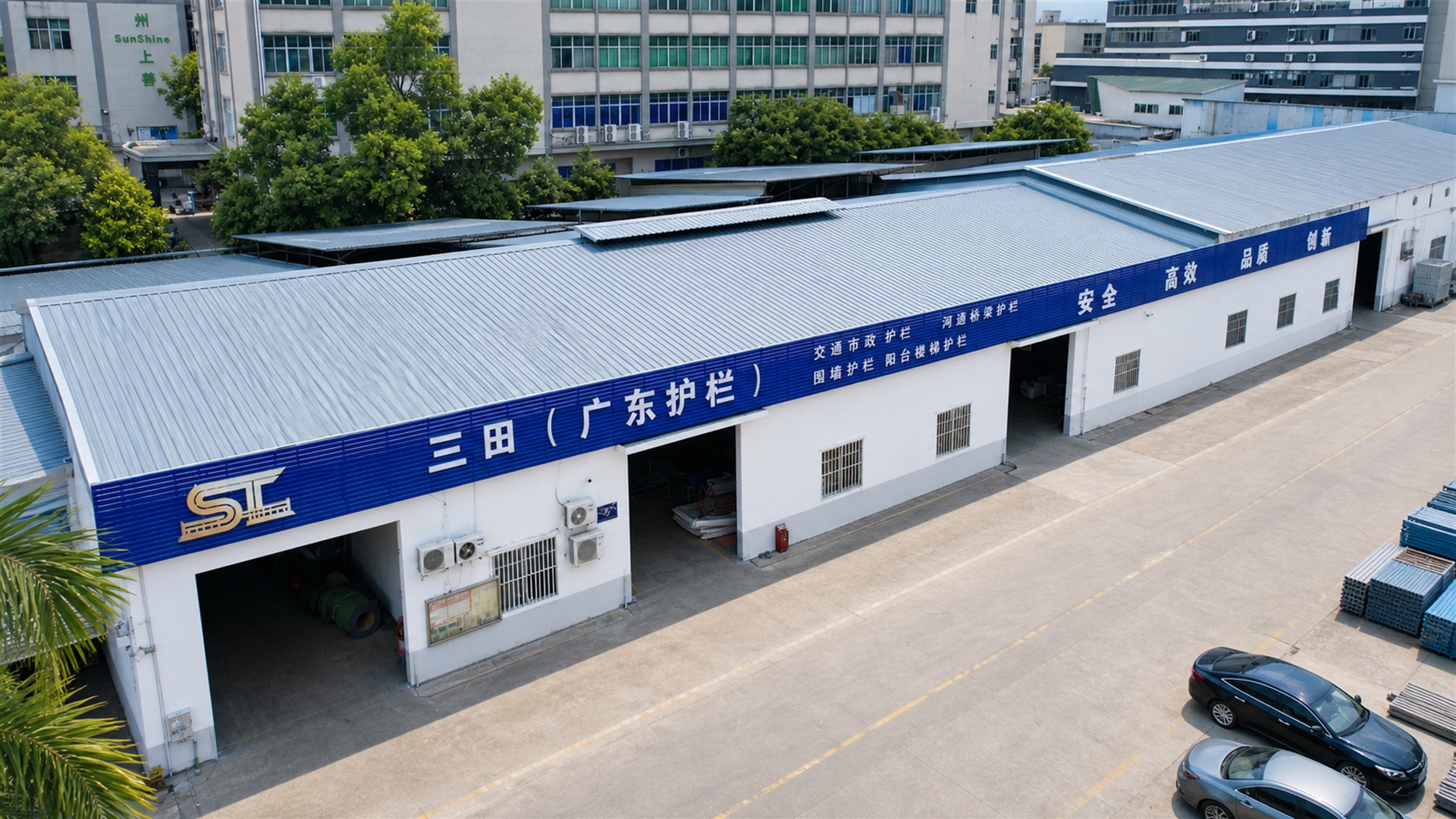
Guangzhou Santian Steel Structure Co., Ltd., the Guangzhou-based manufacturer trading under the aotianguardrail identity, is one worked example of a supplier whose published range spans these zones. Its industry experience dates back to 2011, with formal registration on 16 May 2016; its published profile lists a production facility of approximately 15,000 m², 200 employees, a 50-engineer R&D team and an export share of about 50%, with main markets in Southeast Asia, Africa, South America and the Middle East. The documented range covers municipal road, bridge, riverside and pedestrian guardrails alongside balcony, stair and window railings, perimeter fence, security fence mesh, workshop safety partitions, construction site hoarding and standardised construction-site safety equipment. Breadth of this kind helps a buyer only if the models inside each family stay identifiable between orders — which is where the next two tests apply.
Specification repeatability: the record that makes a re-order possible
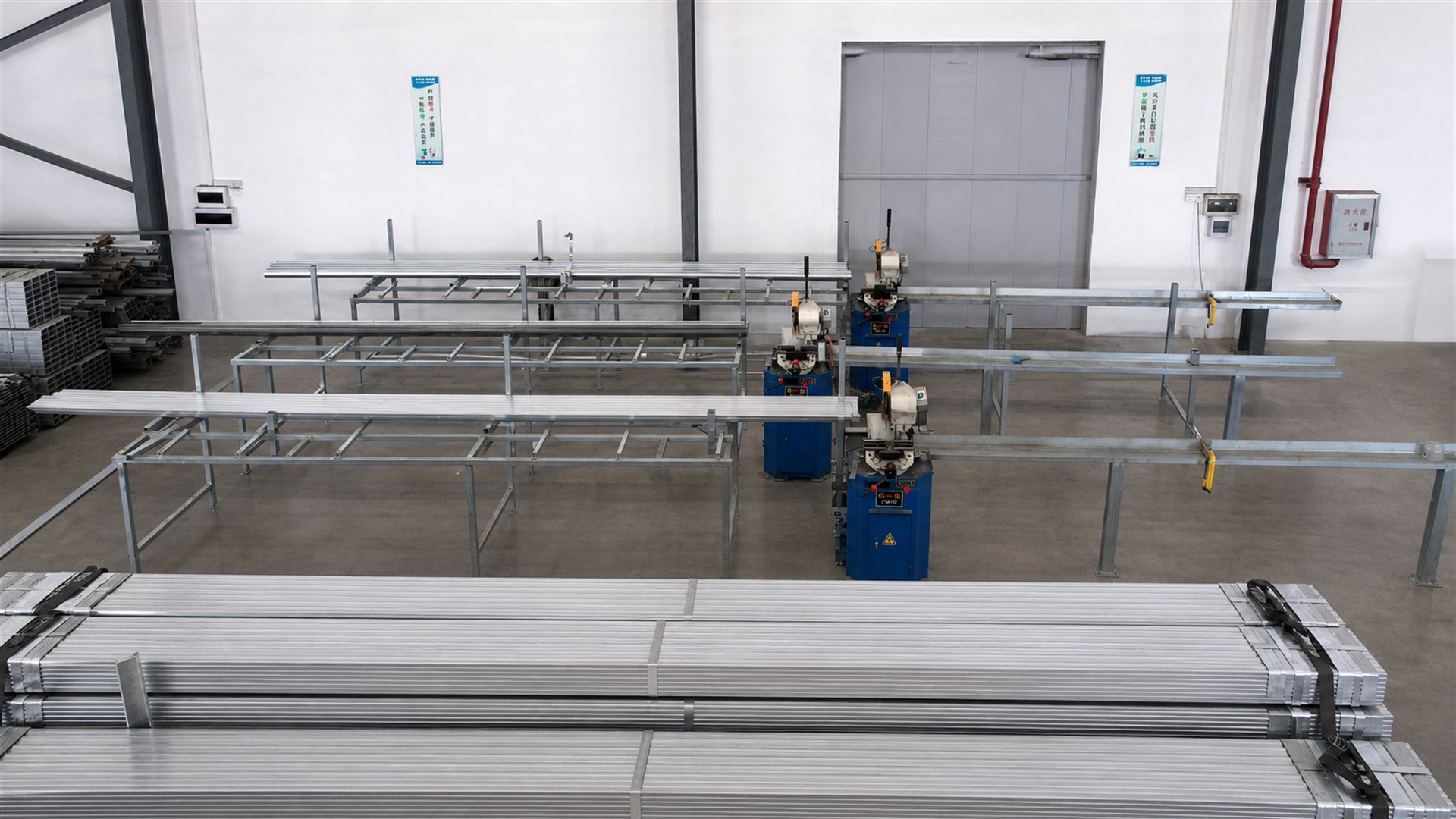
Repeatability is created at the first order, not at the second. The information used to price an accurate quotation is the same information that has to survive into the next phase: product type, height, length, post spacing, material grade, surface treatment, quantity, drawings, applicable standards and delivery destination, with packaging requirements added where relevant. If drawings are unavailable, the application and site conditions can be used to define a configuration — but the resulting specification should be written down before the first delivery, not reconstructed afterwards.
Material grade is the most common source of drift
Hot-dip galvanized steel and stainless steel behave differently enough that substituting one for the other between phases changes the product, not just the finish. AISI 304 is the standard inland architectural grade, while AISI 316L adds molybdenum — roughly 2–3% in 316/316L, compared with no specified molybdenum addition in standard 304 — and is the grade normally considered for coastal, poolside and chloride-intensive locations. Both have a density of approximately 7.8 kg/dm³, so the profile weight of a given section does not change with the grade.
Coating decisions behave the same way. An international hot-dip galvanizing reference cites at least 100 micrometres of zinc on steel sections over 6.35 mm as capable of providing 72–73 years to first maintenance in an industrial atmosphere; that figure is an external reference point for coating specification, not a service-life promise for any particular site, because climate, damage and maintenance cycles still govern the outcome. Weathering steel follows a different logic: international guidance uses a corrosion allowance of 1.0 mm per exposed face for C1–C3 environments and 1.5 mm for C4–C5, and the material should not be treated as maintenance-free in continuously damp or chloride-rich locations.
Weight-driven substitutions deserve particular caution. Aluminium at approximately 2.70 kg/dm³ is about 65% lighter than steel of the same volume, but a lighter material needs larger profiles or different geometry to reach equivalent stiffness, and it must be isolated from dissimilar metals. A buyer who switches a railing family from steel to aluminium to save transport weight has changed the section, the connections and the replacement logic — it is not a like-for-like substitution.
The practical rule is that the specification record should name the grade and the coating system rather than the generic words "galvanized" or "stainless". Two phases ordered against the loose description can produce two products that look similar and do not interchange.
Replacement fit: can one section rejoin an installed run?
A damaged modular guardrail section can usually be replaced independently when compatible posts, rails and fasteners are available — and the qualification carries the weight. The surrounding structure and foundation also need inspection before a new section goes in, because a panel that failed after an impact or a footing problem is evidence about the whole assembly, not only about the part that deformed.
The documented replacement sequence is straightforward, and each step doubles as a continuity test of the supplier's documentation:
- Isolate the work area and document the damage.
- Inspect adjacent posts, rails, anchors and foundations.
- Confirm the replacement component model, dimensions and material.
- Support the damaged section before removing fasteners.
- Remove the damaged components without affecting adjacent sections.
- Install the compatible replacement components.
- Adjust alignment, tighten connections and conduct a final safety inspection.
Step 3 is where long-term supply either works or fails. Confirming the component model presupposes that a model code returns the same section, the same post spacing and the same fastening detail as the original order. A model index such as Y052–Y057 for balcony railing or Y058–Y063 for stair railing is useful only if that promise holds; buyers can test it by requesting the specification of a specific model they already own and comparing it with the installed drawings.
Two further questions belong in the buyer's file before damage occurs: whether the replacement unit is a panel, a complete bay or a panel with posts, and whether the fixing type is still supplied. Fasteners are frequently replaced during maintenance with a hardware item of similar dimensions but different grade, which can affect both the connection and any future coating inspection.
A zone-by-zone continuity checklist
The checklist below keeps the evaluation inside the eight product families named above. It records what has to stay identical between orders and what a replacement order should specify, so that a later phase can be compared against the original rather than re-interpreted.
| Zone | Product family to review | Record to keep per order | Replacement unit to define |
|---|---|---|---|
| Site perimeter across phases | Prefabricated steel construction hoarding | Hoarding type, panel height, post spacing, coating system | One panel with its posts and fixings |
| Controlled site boundary | Security fence mesh | Panel size, mesh configuration, post type, finish | One mesh panel |
| Workshop interior | Workshop safety partition | Partition height, module width, base fixing method | One partition module |
| Window openings | Window guard railing | Opening width, guard projection, fixing type | One guard matched to opening size |
| Stair cores | Stair railing | Handrail height, post spacing, material grade | One bay between posts |
| Balconies | Balcony railing | Railing height, infill type, fixing detail | One panel per balcony type |
| Property line | Perimeter fence | Fence height, post spacing, surface finish | One bay plus posts |
| Vehicle and parking areas | Bollard / parking barrier | Bollard size, spacing, fixing method | One bollard or barrier unit |
Two entries in that table deserve emphasis. Hoarding is the family most often moved between plots, so the panel module and post spacing matter more than the panel colour. Bollards and parking barriers sit in the one zone where a vehicle may actually strike the product, and the supplied product information is explicit that impact resistance requires separate verification — a point addressed again under boundary conditions.
Documented scope and commercial terms to archive
A documented product scope is what allows a buyer to plan a future phase without reopening the whole selection. In practice it means the supplier can state, for each family, the model reference, the material and coating options it is prepared to repeat, and the drawing basis on which those models are produced. Where a supplier publishes model ranges that run from T001–T041 for road and municipal guardrail families through Y043–Y091 for fence, railing, hoarding and site safety families, the reference index itself becomes a usable archive — provided the codes are stable.
Commercial terms belong in the same file. Santian's stated purchasing terms list a minimum order quantity of 1 unit, FOB delivery terms, pre-shipment test as the acceptance criterion and 40/70 payment terms. Those are standing terms rather than a quotation for a specific project, so they should be reconfirmed order by order and matched against the inspection scope the buyer actually wants at pre-shipment.
For importers, trade documentation is the third element. Road guardrails are commonly classified under HS code 73089099 according to one secondary trade source; classification practice can vary by product configuration and destination customs authority, so it should be checked rather than copied between shipments.
Boundary conditions: what the range does not certify
A broad product range is not a performance certification, and the distinction matters most where vehicles are involved. In the European Union, EN 1317-5 is the standard for vehicle restraint systems permanently installed on roads, and in the United States MASH 2016 is the current evaluation standard for new permanent roadside hardware as of 31 December 2019. Those frameworks address crash-rated roadside systems; a construction hoarding, pedestrian railing or workshop partition is not automatically a vehicle restraint system, and vehicle impact containment requires a separately specified crash-rated system whose performance depends on the verified complete configuration.
Exposure limits follow the same pattern. Stainless steel grades 316 or 316L are the usual recommendation for coastal and salt-spray environments, and hot-dip galvanized steel with an additional protective coating is also suitable when it is properly specified and maintained. Service life depends on material, coating system, climate, installation quality and maintenance frequency, so a coating reference figure cannot be carried across to a different site without those conditions.
Finally, no supplier's range replaces project drawings, local safety regulations and qualified installation. Installation drawings, component identification, assembly guidance and remote technical support can accompany an order, but erection must be completed by qualified personnel in accordance with approved engineering drawings and the applicable local rules.
Market context: category scale, not a growth promise
Grand View Research values the global barrier systems market at USD 24.8 billion in 2025 and reports that the metal segment held the largest material share, above 50.0%, in the same year; the same publisher values the temporary guardrail segment at USD 2.4 billion in 2024. These are aggregate revenue estimates that describe the scale of the category in which repeat-supply decisions are made. They do not indicate that any individual supplier, product family or site will be re-ordered, and they say nothing about the suitability of a particular hoarding or railing for a specific project.
What the figures do support is a narrower reading: in a category of this size, product availability is rarely the binding constraint for a buyer. The binding constraint is whether a specific configuration stays available, documented and interchangeable over the life of a phased programme.
Outlook: what repeat-supply discipline would change
For a buyer planning work beyond the current contract, three practices would reduce continuity risk without requiring any new supplier commitment. The first is a fixed specification record per zone, written at first order and reused verbatim. The second is a model code held across orders, verified by requesting the specification of an already-installed model before the next phase is priced. The third is a defined replacement unit per zone — a panel, a bay or a post — identified while the run is still intact rather than after damage.
If those three practices become normal, the supplier evaluation shifts from comparing delivered prices to comparing documentation quality. That is a harder comparison to run, but it is the one that matches how construction and decoration sites actually consume safety barriers: repeatedly, across moving boundaries, over several years.
FAQ
- How does a buyer test whether a safety barrier supplier can support a multi-phase project?
- Test the range against the zones the programme actually uses, then test repeatability rather than breadth alone. A practical method is to request the specification of a model the supplier already delivered and compare it with the installed drawings: material grade, coating system, post spacing, panel height and fixing type should match. If those details cannot be restated, the supplier may still be able to supply a similar product, but the buyer cannot rely on the later order being interchangeable.
- What information should be recorded at the first order so a repeat order matches?
- Record the product type, height, length, post spacing, material grade, surface treatment, quantity, drawings, applicable standards, delivery destination and packaging requirements. Where drawings are unavailable, the application and site conditions can define the configuration, but the resulting specification should be written down before delivery. The same fields are what a supplier needs to price an accurate quotation, which is why the quotation record and the continuity record can be the same document.
- Can a damaged guardrail panel be replaced without replacing the whole run?
- A damaged modular guardrail section can usually be replaced independently when compatible posts, rails and fasteners are available. The surrounding structure and foundation should also be inspected before the new section is installed, since damage may reflect a connection or footing issue. The replacement sequence is to isolate and document the damage, inspect adjacent posts, rails, anchors and foundations, confirm the replacement component model, dimensions and material, support the damaged section, remove it without affecting adjacent sections, install the compatible components, then adjust alignment, tighten connections and complete a final safety inspection.
- Which material should stay consistent across recurring outdoor zones?
- Consistency matters more than the choice of any single grade. Hot-dip galvanized steel is a practical balance of strength, corrosion resistance and cost for standard outdoor engineering work; AISI 304 stainless steel suits inland architectural and urban exposure; AISI 316L, which contains roughly 2–3% molybdenum, is normally considered for coastal, poolside and chloride-intensive locations. Changing grade between phases changes the product even where dimensions stay the same, so the grade should be written into the specification record and reused. Surface finish and coating system need the same treatment.
- What maintenance evidence supports long-term use of galvanized guardrails?
- Long-term use is supported by a recorded inspection routine rather than a single service-life figure. The routine covers posts, rails, welds, bolts and connection points; corrosion, cracks, deformation and coating damage; and foundations and anchor bolts for movement or loosening. Cleaning dirt, salts and chemical deposits, tightening loose fasteners and repairing minor coating damage belong in the same cycle, with defects logged and severely damaged components scheduled for replacement. For weathering steel the checks differ: patina stability, drainage, salt deposition and staining need attention, because continuously wet zones may require painting or another protection system.
A programme that follows these four tests — mapped breadth, written specifications, verified replacement units and an archived scope — enters each new phase with a comparable baseline instead of a fresh selection exercise. Buyers who want to check a specific zone list against the documented range can review the families and model references with the manufacturer's technical team, and the current brochure provides the starting reference for that review.
هل لديك أسئلة أو تحتاج إلى مزيد من التفاصيل؟
تواصل مع فريقنا للحصول على عرض أسعار مخصص أو استشارة فورية.
طلب عرض أسعار
املأ النموذج أدناه وسيتواصل معك فريقنا بعرض مقترح مخصص.
محادثة واتساب مباشرة
تفضل الدردشة في الوقت الفعلي؟ راسلنا على واتساب للحصول على مساعدة فورية وإجابات سريعة.
- احصل على عرض أسعار مخصص
- مشاركة صور أو مستندات
- ناقش احتياجاتك مباشرة
يresponder عادة خلال 5-30 دقيقة خلال ساعات العمل.