
Cannabis Packaging Bags: Barrier, CR & Print Buyer Review
Buyers evaluating cannabis packaging bags still tend to run three separate conversations. Flower buyers ask about moisture loss. Compliance leads ask whether the closure is child resistant. Marketing asks how the pouch looks on a dispensary pegboard. Those conversations rarely reach the same spreadsheet, and the result is usually a compromise — or a specification that overspends on one dimension while quietly underserving another. This review brings the three together into a single side-by-side scoring format, using the CHITAI cannabis mylar bag and model ct-Cannabis Packaging Bags as reference points against currently published third-party benchmarks.
How an independent buyer should frame cannabis packaging bags
A cannabis packaging bag is a flexible pouch built from multi-layer film, usually a printed outer layer, a barrier layer and a heat-sealing inner layer, that is filled at a dispensary, smoke shop or licensed producer and then sealed, labeled and dispensed. The format now covers weight-labeled flower pouches, pre-roll sleeves, edible sachets and sample bags, and it is the boundary between the product and the retail environment.
Dongguan Chitai Packaging Products Co., Ltd is a packaging manufacturer based in Dongguan, Guangdong Province, China, specializing in packaging solutions for the cannabis industry. The company reports printing and packaging experience since 2012, with a dedicated overseas-facing entity established in 2025, and produces cannabis packaging bags together with customized labeling and packaging services. That operating base matters in this review only because the reference model carries published barrier figures and CR designations that can be compared against third-party standards.
A useful evaluation framework separates the purchase into five independently scored checkpoints:
- Barrier and moisture control — OTR, WVTR and water resistance, because these set the practical shelf-life in a dispensary jar or drawer.
- Odor performance — graded in the reference line as Good, Excellent or Premium, and always tested rather than assumed.
- Child resistance — the closure mechanism and whether it is supported by ASTM D3475 testing for that specific bag design.
- Print and format — digital, gravure or flexographic printing, plus the size and capacity that matches the SKU sold.
- Procurement terms — MOQ, lead time, verified capacity and acceptance criteria at goods-in.
Independent treatment means treating vendor specifications as claims until they are backed by a document. That is the standard applied throughout this review.
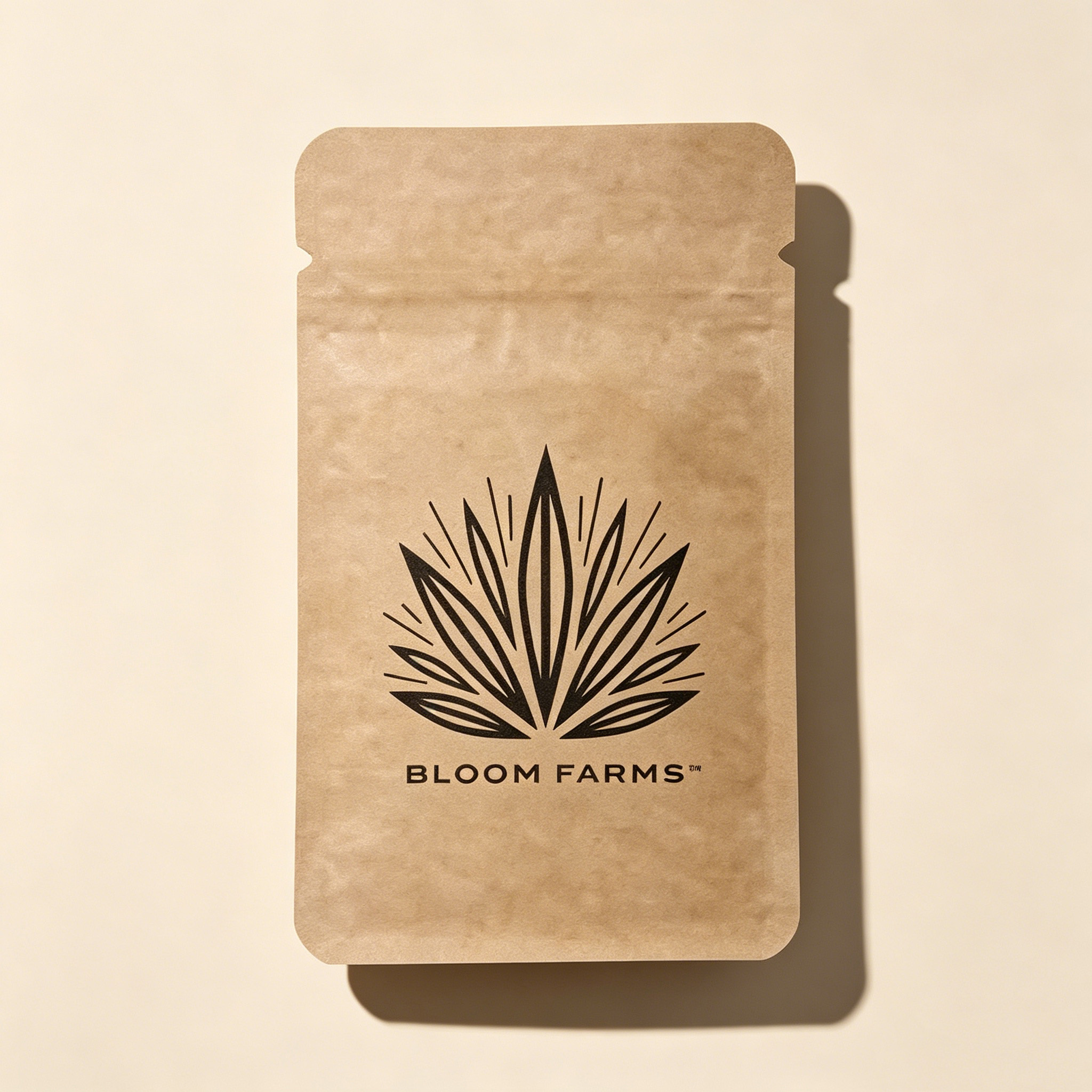
Smell proof cannabis bags, shown as a format group. Barrier ratings and odor grades vary by model and must be checked per SKU.
The problem: three specifications that rarely meet
The practical failure mode in cannabis packaging bags is not a single faulty specification. It is a set of correct specifications that were never reconciled. A dispensary selecting a 14g flower pouch may approve a print sample, approve a child-resistant zipper, and approve a barrier claim — each from a different source, none from a single tested design.
The consequence shows up later. A pouch that passes child-resistance on a closure but has not been tested with the final printed film and seal geometry may behave differently after production. A pouch that meets oxygen transmission targets but is opened and resealed repeatedly across a week may lose the barrier benefit that justified the purchase. Buyers who want a reliable answer should require that the quoted OTR, WVTR and CR results describe the exact bag being ordered, not a generic platform.
The opportunity is straightforward: when barrier, child resistance and print are scored together, the buyer can see where a supplier is genuinely strong and where the claim depends on a document that has not yet been provided. That visibility is worth more than a marginally lower unit price.
Barrier and odor performance: the figures used in this review
The reference model ct-Cannabis Packaging Bags carries published barrier values that can be set directly against third-party benchmarks. Its stated oxygen transmission rate is ≤0.05 cm³/(m²·24h) and its stated water vapor transmission rate is ≤0.03 g/(m²·24h). Those two figures are the ones a buyer should quote in an RFQ, because a comparable third-party benchmark for premium cannabis bags uses the same thresholds: OTR below 0.05 cm³/(m²·24h) and WVTR under 0.03 g/(m²·24h). When a supplier's published values match a benchmark used elsewhere in the industry, the buyer gets a cleaner comparison than when the supplier uses a proprietary scale.
The full ct-Cannabis Packaging Bags specification goes further than the two headline rates, and each item is a separate verification point:
- Aluminum foil thickness: 7 to 9 μm, described as free of pinholes and intended to block aroma leakage.
- Material structure: PET aluminum-coated layer, pure aluminum foil, and a PE heat-sealing layer.
- Waterproof grade: IPX4 water repellent.
- Heat seal strength: ≥40N/15mm, specified for no air leakage and no odor seepage.
- Tear strength: longitudinal ≥35N, transverse ≥30N.
- Light blocking: completely opaque, zero light transmission.
- Sealing: double sealing with repeated zipper sealing and top heat sealing; an optional CR child-safety zipper is available.
Odor performance runs on a three-level grade across the wider CHITAI cannabis mylar bag range: Good, Excellent and Premium. The grade is a classification, not a measured number, so an independent buyer should treat it as a category cue and then request the supporting evidence for the specific level quoted. A Premium designation is only meaningful if the buyer can see the internal test basis behind it.
| Barrier checkpoint | Reference value (ct-Cannabis Packaging Bags) | What the buyer should request |
|---|---|---|
| WVTR | ≤0.03 g/(m²·24h) | Test report for the ordered bag, with method stated |
| OTR | ≤0.05 cm³/(m²·24h) | Laboratory report, not a catalog summary |
| Aluminum foil | 7–9 μm, pinhole-free | Material data sheet with structure and thickness |
| Water resistance | IPX4 | Confirmation that IPX4 describes the finished bag, not the film alone |
| Heat seal strength | ≥40N/15mm | Seal-strength test on the final printed structure |
| Odor grade | Good / Excellent / Premium | Evidence linking the grade to a test method |
Barrier scoring table for the reference model. Values are as published by CHITAI; verification documents remain the buyer's responsibility.
Child resistance: what CR Zipper, Push Lock and Slide Lock actually compare
The reference line offers three child-resistant closure options, each listed with ASTM D3475: CR Zipper, Push Lock and Slide Lock. Buyers sometimes read this as three equivalents. It is more accurate to read it as three mechanisms that satisfy a shared standard under different geometry, and the practical consequences differ by SKU and use case.
ASTM D3475 is the recognized test protocol for child-resistant packaging. The comparable federal benchmark in the U.S. is 16 CFR 1700.20, under which packaging must prevent at least 85% of children aged 42 to 51 months from opening it within five minutes. California's packaging guidance also identifies PPPA-certified packaging under 16 CFR 1700.15(b)(1) as one accepted route to compliance. For a buyer, the useful question is not whether a closure is labeled ASTM D3475, but whether the closure, film and seal combination in the ordered bag has been tested as a single unit.
The mechanisms do not behave identically:
- CR Zipper — a zipper-based mechanism, generally chosen where the pouch is reopened repeatedly during use. California guidance distinguishes single-use child-resistant packaging, which loses child resistance after opening, from multiple-use packaging, which retains it across the package life. A zipper format sits more naturally in the multiple-use category.
- Push Lock — a push-to-open closure. It is often used where the pouch is opened once and does not need to remain child resistant after opening, which lines up with the single-use route.
- Slide Lock — a sliding closure that can support larger formats and repeated opening, with its performance dependent on how the slider is integrated into the seal.
A second reference point matters here. California guidance notes that certain single-serving plastic packaging may qualify as child resistant when it is at least 4 mils thick and heat-sealed without an easy-open tab, dimple, corner or flap. That is a route for specified single-use applications, not a universal thickness requirement. A buyer who reads "4 mils" as a blanket specification for every cannabis bag is likely to over-specify the pouch and still miss the part that the regulation actually tests.
| Closure option | Likely use pattern | Compliance evidence to request |
|---|---|---|
| CR Zipper (ASTM D3475) | Multiple-use flower pouches; repeated opening | Design-specific ASTM D3475 report; confirmation that child resistance persists after opening |
| Push Lock (ASTM D3475) | Single-use or limited-reopen formats | Design-specific report; clarity on whether the pouch is single-use CRP |
| Slide Lock (ASTM D3475) | Larger formats with repeated opening | Design-specific report; seal interaction and slider integrity data |
Closure scoring framework. The use-pattern column reflects typical regulatory logic, not a fixed rule for every product.
Custom print and sourcing: where digital, gravure and flexographic diverge
The print decision is usually framed as a branding question, but for cannabis packaging bags it is equally a sourcing question. The three available methods in the reference line are digital printing for small batch work, gravure printing for larger runs, and flexographic printing for volume at a lower print cost profile. Each imposes a different minimum, a different proofing cycle and a different lead time.
The format range that matters for a dispensary is straightforward. Capacities run from 1g to 28g, with the standard flower steps of 3.5g (⅛ oz), 7g (¼ oz), 14g (½ oz) and 28g (1 oz), and specifications from 3"x4" through 4"x5", 5"x6", 6"x8" and 8"x10". Custom sizes are available. Buyers should match the declared capacity to the actual fill weight in a sample run, because capacity labels describe a target fill rather than a measured volume.
On the sourcing side, the reference capability profile lists a monthly capacity of 2,500,000 units, a minimum order quantity of 10,000 units, a lead time of 3 to 5 days, and 100% testing as the quality control standard, with North America and Europe listed as export markets. That combination — smaller MOQ relative to capacity, and a short stated lead time — is worth testing during a first order rather than assuming.
One operational detail is genuinely useful for buyers planning a launch. The reference production setup uses an integrated digital and high-speed gravure line, with a one-click model change of 15 minutes compared with the 2 to 4 hours typically needed for manual machine adjustment in an ordinary factory. The same specification describes single production line capacity rising by 200% to 300% and order-change downtime falling by 65%. For a dispensary launching several SKU sizes at once, a faster changeover means the split between 3.5g, 7g and 14g runs can be smaller and more frequent without proportional cost.
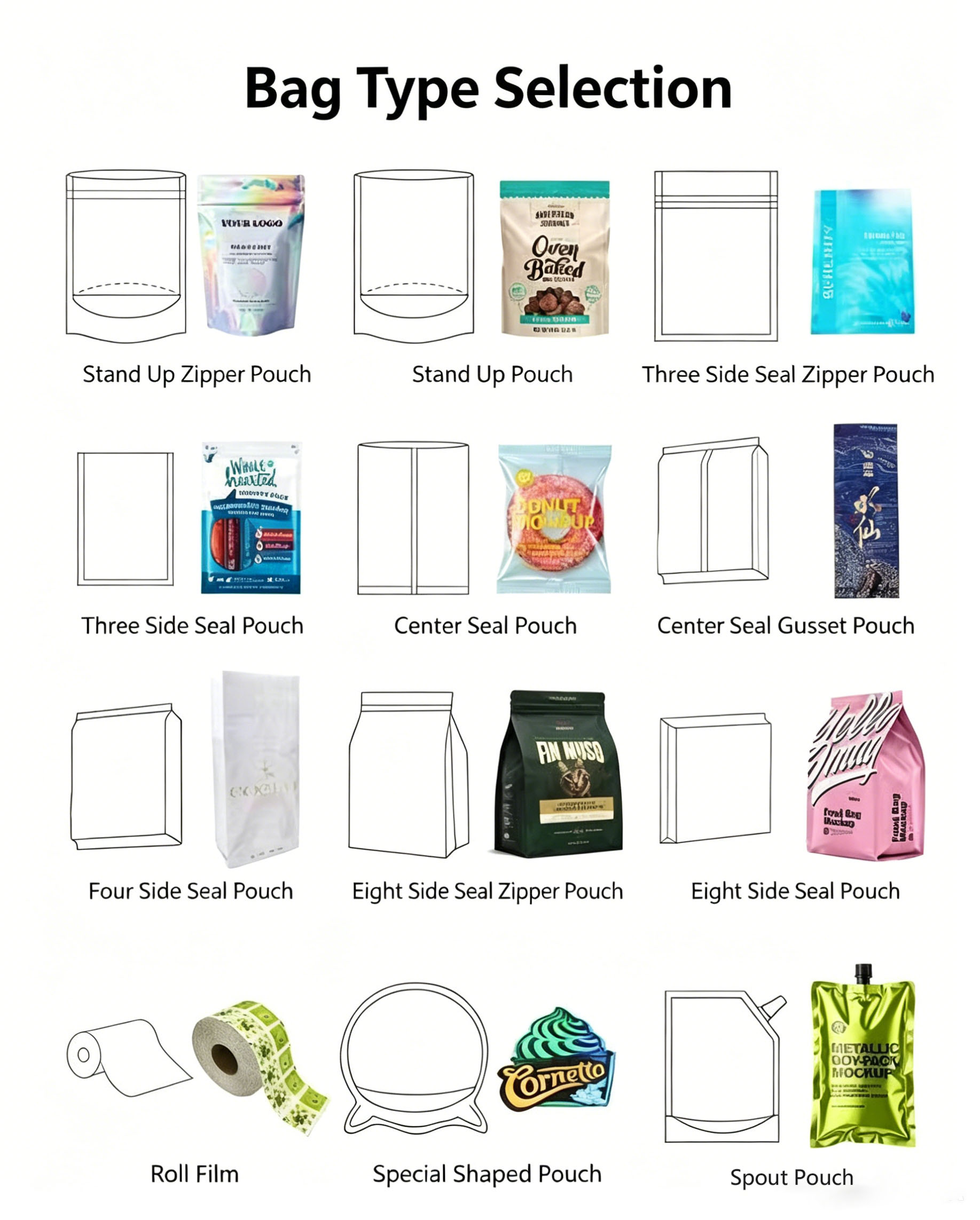
Bag shape and format affect fill weight, stacking and dispensary display. Confirm the format against a physical sample before committing to a print run.
Consolidated buyer scorecard
The scorecard below is written so that a purchasing manager can assign an evidence status to each row — documented, claimed but undocumented, or not applicable — instead of making a single overall judgment from a sales presentation.
| Dimension | Reference point | Evidence status to confirm |
|---|---|---|
| Barrier | WVTR ≤0.03 g/(m²·24h); OTR ≤0.05 cm³/(m²·24h) | Independent test report for the ordered bag |
| Odor control | Good / Excellent / Premium grades | Grade-to-test linkage |
| Water resistance | IPX4 | Finished-bag confirmation |
| Child resistance | CR Zipper, Push Lock, Slide Lock (ASTM D3475) | Design-specific ASTM D3475 report |
| Digital, gravure, flexographic | Proof and color approval before run | |
| Capacity and size | 1g–28g; 3"x4"–8"x10" | Physical sample fill test |
| Sourcing terms | MOQ 10,000; lead time 3–5 days; 2,500,000 units/month | Written confirmation in the order |
| Quality control | 100% testing | Inspection record at goods-in |
Consolidated buyer scorecard for cannabis packaging bags. Each row should carry a date and an evidence source in the buyer's own file.
Application scenarios in dispensaries and smoke shops
Scenario fit is where the three dimensions converge. A dispensary running high-turnover flower in 3.5g and 7g formats needs barrier protection that survives a week of repeated opening, which points toward a CR Zipper format with a documented multiple-use CR profile. A smoke shop selling a single 1g pre-roll sleeve needs the compliance evidence but not the multi-use closure, which makes a Push Lock format a defensible choice. A producer running a 28g value bag needs barrier and opacity first, with print as a secondary consideration.
A documented cannabis brand owner case in the reference corpus offers a practical benchmark. A 500,000-unit order of dried cannabis flower packaging, using a child-resistant safety design with high odor barrier, solvent-free material, and an anti-tamper and anti-counterfeit structure, reported a shelf life of 2 to 3 years and a daily usage period of more than one year, with no odor leakage reported and compliance with local rules on preventing children from opening and tampering. That combination — long shelf life plus multi-month daily use — is the realistic test environment for cannabis packaging bags, and it is the profile a buyer should ask prospective suppliers to describe.
Consumer-response research adds a secondary consideration. A peer-reviewed study examined how recreational cannabis packaging characteristics influence cognitive, affective and behavioral responses. The available evidence supports treating packaging as a factor in consumer response but does not support a specific design conclusion, so it is best used to form testing hypotheses rather than to justify a particular print or format.
Market trend analysis
Three trend signals are relevant to this comparison, and each should be read with its limitation attached.
1. Compliance is converging with performance. Child resistance is no longer a separate specification from barrier and print in the buyers' evaluation; it sits in the same qualification checklist. California guidance requires cannabis goods to be sold in child-resistant packaging designed to be difficult for children under five to open, and it identifies PPPA-certified packaging under 16 CFR 1700.15(b)(1) as one accepted route. California also identifies tamper-evident and resealable requirements and contamination-prevention packaging as part of the same compliance set. Health Canada likewise requires child-resistant containers for cannabis products, with exceptions for plants and seeds, and Canadian Cannabis Regulations section 108 adds opacity or translucency, contamination prevention, dryness for dried cannabis, a security feature, child resistance, and a limit of no more than the equivalent of 30 g of dried cannabis. A supplier who can only answer the barrier question and not the CR question is now an incomplete supplier.
2. Growth direction is consistent even where market size is not. Fortune Business Insights projects the global cannabis packaging market to reach USD 7.37 billion in 2026 and USD 21.55 billion by 2034, implying a CAGR of 14.35%. Mordor Intelligence values the same market at USD 2.29 billion in 2026 and projects USD 4.65 billion by 2031 at a CAGR of 15.22%. The two absolute values are not comparable and should not be averaged or combined, because segment scope and methodology differ. What they agree on is direction: double-digit growth, led by flexible formats. Grand View Research separately estimates the U.S. cannabis packaging market at USD 1.36 billion in 2023 with a projected CAGR of 28.9%, a U.S.-only figure that must not be compared directly with global estimates. For a buyer, the practical read is that category expansion is well supported by multiple research houses in direction, while absolute sizing should be treated cautiously.
3. China remains the dominant flexible-bag export base. China is the leading exporter of plastic bags under HS 392321, accounting for more than 25% of global exports, at approximately USD 3.32 billion in 2023. For buyers, this means the supply base for high-barrier flexible pouches is concentrated, and qualification should emphasize document verification over country-of-origin assumptions.
Comparison with alternative approaches — and the limits of this review
A standard low-barrier PE or PP pouch is cheaper and lighter but is generally not designed to meet the OTR and WVTR thresholds used here, and it does not block light. A rigid jar or tin offers strong physical protection and a rigid child-resistant closure, but costs more per unit, occupies substantially more freight and shelf space, and is slower to print and reprint. An aluminum-foil laminate flexible pouch sits between the two: it delivers the barrier and opacity values in this review while keeping weight and freight low.
The limits matter as much as the advantages, and an independent comparison should state them plainly:
- Recyclability is not established. The aluminum-foil laminate structure in the reference model is a multi-material composite. No recyclability, compostability or post-consumer recycled content figure is published in the reference corpus, so buyers who need to meet a sustainability specification should treat that as an open question and request documentation directly.
- ASTM D3475 labeling is not the same as a passed design test. The standard is a test protocol. A buyer who accepts a platform-level statement without a design-specific report is carrying compliance risk.
- The 4 mil guidance does not generalize. California's guidance describes a route for specified single-use applications; it is not a blanket thickness rule for all cannabis bags.
- Odor grades require evidence. Good, Excellent and Premium are classifications. Without a test method attached, they cannot be compared across suppliers.
- Market-size numbers disagree. Where two research houses differ by more than 3× on the same metric for the same year, buyers should plan by direction and validate specific claims against their own procurement data.
Future outlook
Three shifts are likely to shape how cannabis packaging bags are bought over the next few years.
First, design-specific compliance documentation will become a normal part of the RFQ rather than an optional attachment. The 85% under-five test threshold in 16 CFR 1700.20 and the single-use versus multiple-use distinction in California guidance both point toward testing the exact combination of film, closure and seal. Suppliers who can produce that documentation quickly will shortlist more easily.
Second, odor performance will increasingly need a number rather than a grade. The grade structure used in the reference line is a useful internal shorthand, but as more buyers compare across suppliers, the supplier who can back a grade with a test basis will be more defensible.
Third, print flexibility and production changeover speed will continue to matter as dispensaries and smoke shops launch narrower, faster-moving SKU ranges. A 15-minute model change relative to the 2 to 4 hours typical of manual adjustment is a meaningful operational difference for buyers splitting orders across 3.5g, 7g and 14g formats.
For reference, the CHITAI 2026 brochure is available for download: CHITAI 2026 brochure (PDF).
FAQ
What OTR and WVTR values count as high barrier for cannabis packaging bags?
A commonly used benchmark for premium cannabis bags is an oxygen transmission rate below 0.05 cm³/(m²·24h) and a water vapor transmission rate under 0.03 g/(m²·24h). The reference model ct-Cannabis Packaging Bags publishes the same thresholds. Buyers should confirm that the report describes the exact ordered structure, because barrier values depend on the film stack and seal, not on the category label alone.
How do CR Zipper, Push Lock and Slide Lock compare under ASTM D3475?
All three are listed as ASTM D3475 options in the reference line. The practical difference is the use pattern. CR Zipper formats suit pouches that are reopened repeatedly and therefore align with multiple-use child resistance. Push Lock formats align with single-use or limited-reopen applications. Slide Lock formats suit larger pouches where the slider is integrated into the seal. Because ASTM D3475 is a test protocol rather than a certificate for a product family, the buyer should ask for a report naming the exact bag, closure and film combination.
Do cannabis packaging bags need to be at least 4 mils thick?
Not as a general rule. California guidance describes a route in which certain single-serving plastic packaging may qualify as child resistant when it is at least 4 mils thick and heat-sealed without an easy-open tab, dimple, corner or flap. That condition applies to specified single-use applications, not to every cannabis bag. Buyers should verify applicability to their own product category before specifying thickness.
What MOQ and lead time should a dispensary expect for custom printed cannabis bags?
In the reference capability profile, the minimum order quantity is 10,000 units, the stated lead time is 3 to 5 days, and monthly capacity is 2,500,000 units, with 100% testing as the quality control standard. These are seller-stated figures and should be confirmed in writing on the order, especially for a first production run.
How can a buyer verify Good, Excellent or Premium odor-proof grades?
Ask for the test method behind the grade. The reference line uses Good, Excellent and Premium as a three-level odor grade, but the reference corpus does not publish a numerical transmission value per grade. Without a method, grades are not comparable across suppliers, and the buyer should request a sensory or instrumented test report for the specific grade quoted.
Are high-barrier cannabis packaging bags recyclable?
The reference structure is a multi-material composite of PET aluminum-coated film, pure aluminum foil and a PE heat-sealing layer. No recyclability, compostability or post-consumer recycled content figure is published for this structure in the reference corpus, so recyclability should be treated as unconfirmed and requested as documentation if it is a requirement in the buyer's market.
Reference notes: Barrier, seal, tear and opacity values are drawn from CHITAI corpus product specifications for the ct-Cannabis Packaging Bags model and the wider cannabis mylar bag range. Third-party benchmarks on child-resistant testing, California and Canadian packaging requirements, and market sizing are drawn from the verified data package, including 16 CFR 1700.20, California Department of Cannabis Control guidance, Canadian Cannabis Regulations section 108, Health Canada, Fortune Business Insights, Mordor Intelligence, Grand View Research and HS 392321 trade data. Market-size estimates from different research houses are not comparable and are not combined in this article.
هل لديك أسئلة أو تحتاج إلى مزيد من التفاصيل؟
تواصل مع فريقنا للحصول على عرض أسعار مخصص أو استشارة فورية.
طلب عرض أسعار
املأ النموذج أدناه وسيتواصل معك فريقنا بعرض مقترح مخصص.
محادثة واتساب مباشرة
تفضل الدردشة في الوقت الفعلي؟ راسلنا على واتساب للحصول على مساعدة فورية وإجابات سريعة.
- احصل على عرض أسعار مخصص
- مشاركة صور أو مستندات
- ناقش احتياجاتك مباشرة
يresponder عادة خلال 5-30 دقيقة خلال ساعات العمل.