
Cannabis Packaging Bags: Sizing to Dispensary and Smoke Shop Formats
Cannabis Packaging Bags: Sizing to Dispensary and Smoke Shop Formats
A dispensary counter and a smoke shop shelf are among the few retail environments where regulatory compliance, product preservation and merchandising all compete for the same few square inches. A 3\" x 4\" pouch and an 8\" x 10\" pouch are both legitimately described as cannabis packaging bags, but only one of them is correct for a given product format and fixture. Getting that match wrong shows up as crushed pre-rolls, flattened flower, odor complaints from a shared retail floor, or a display that has to be rebuilt around the wrong bag.
Dongguan Chitai Packaging Products Co., Ltd (CHITAI) is a packaging manufacturer based in Dongguan, Guangdong Province, China, producing flexible cannabis packaging bags for dispensaries, smoke shops, brand owners and importers. This reference maps the CHITAI size ladder \u2014 3\" x 4\" through 8\" x 10\", aligned to 1 g, 3.5 g, 7 g, 14 g and 28 g capacities \u2014 to the product formats that actually appear on retail fixtures: cannabis flower, pre-rolls, edibles, CBD, tobacco, vape and herbal products. It also explains what a multi-layer PET/VMPET/PE/NY/AL construction contributes, how child-resistant closures referenced to ASTM D3475 (CR Zipper, Push Lock and Slide Lock) fit a retail plan, and which parts of the format decision flexible film does not solve.
Why bag size is a retail decision, not a warehouse decision
Buyers often treat bag size as a purchasing convenience: one SKU, one purchase order, one warehouse bin. Retail tells a different story. On a dispensary floor, three questions are asked about every package at the same time.
- Does the product fit without crushing or dead space? A 28 g bulk pack in a 1 g slot wastes fixture space and looks under-filled; a 1 g single-serving in an oversized pouch slides, folds and can crush.
- Does the package still hold its odor and moisture barrier after handling? A bag that sits on a counter and is opened and re-closed repeatedly is under mechanical load, not just storage load.
- Does it sit on the fixture without a display redesign? Counter-top, pegboard and back-shelf zones each impose different geometry.
Both common mismatches \u2014 over-sized and under-sized \u2014 are dimensional problems with dimensional answers. A defined size ladder solves them before artwork, printing or logistics are committed.
The CHITAI size ladder: matching dimensions to capacity
CHITAI's standard cannabis packaging format covers five capacities \u2014 1 g, 3.5 g (\u215b oz), 7 g (\u00bc oz), 14 g (\u00bd oz) and 28 g (1 oz) \u2014 across five bag dimensions running from 3\" x 4\" to 8\" x 10\". Custom dimensions are available when a product does not fall on the ladder.
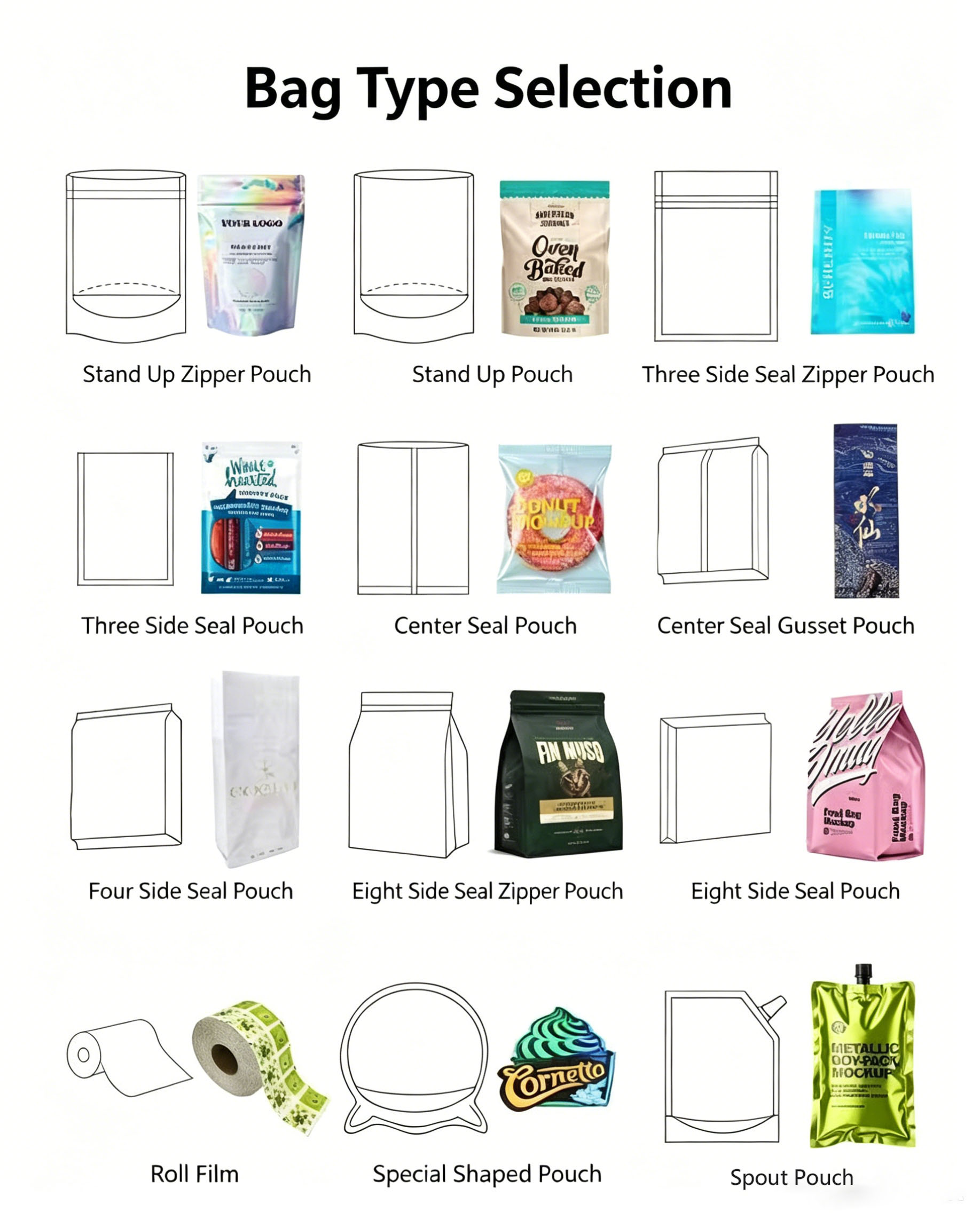
Bag shape and format are the first variables in retail sizing: flat, stand-up and zippered constructions each occupy fixture space differently.
| Bag size (W x H) | Capacity reference | Product formats typically placed here |
|---|---|---|
| 3\" x 4\" | 1 g | Single-gram flower, single pre-roll, sample and trial units |
| 4\" x 5\" | 3.5 g (\u215b oz) | Eighth of flower, small edibles packs, CBD gummies or isolate |
| 5\" x 6\" | 7 g (\u00bc oz) | Quarter-ounce flower, tobacco pouch, vape accessories |
| 6\" x 8\" | 14 g (\u00bd oz) | Half-ounce flower, multi-pack pre-rolls, herbal blends |
| 8\" x 10\" | 28 g (1 oz) | Ounce flower, bulk herbal product, multi-unit retail packs |
Sizes and capacities from the CHITAI cannabis packaging format. Treat the pairing as a starting reference and validate it against the actual product, fill weight and fixture before ordering.
The same ladder runs across several bag constructions, so size and format can be specified independently:
- Three-sided sealed flat bag \u2014 a flat, fully sealed pouch with the opening only at the top, specified for a 1 g load and offered in 40 mm x 60 mm and 70 mm x 110 mm, with 5 mm of sealing allowance left on each side for heat sealing and a fully opaque body.
- Self-standing zipper bag \u2014 a stand-up base plus a reusable top composite zipper, offered in 55 mm x 80 mm and 90 mm x 140 + 25 mm, with a 4 mm heat-seal edge and a 12 mm folded base width.
- Self-standing bag (no zipper) \u2014 a pure stand-up pouch in 70 mm x 100 + 15 mm and 100 mm x 160 + 30 mm, with 4 to 5 mm edge sealing and rounded corner cutting.
- Thickened high barrier bag and thickened stand-up bag \u2014 heavier constructions in 120 mm x 190 + 35 mm, 90 mm x 125 + 20 mm, 150 mm x 230 + 40 mm and 355 mm x 460 + 150 mm for larger retail and bulk formats.
What a high-barrier multilayer film actually contributes at shelf
CHITAI cannabis bags use a PET/VMPET/PE/NY/AL material structure. Read layer by layer, the construction answers four separate retail problems rather than one.
- PET provides the outer print and abrasion surface, so shelf handling does not scuff the artwork.
- VMPET and AL carry the moisture, oxygen and light barrier \u2014 the layers that decide whether flower dries out or aroma migrates out of the bag.
- NY contributes toughness and puncture resistance, which matters for a pouch that is picked up, dropped into a bag and re-stacked.
- PE is the inner heat-sealing layer that closes the pouch and holds the seal under load.
For the smell proof configuration, the published performance figures are specific rather than directional: oxygen transmission rate (OTR) of \u22640.05 cm\u00b3/(m\u00b2 \u00b7 24h), water vapor transmission rate (WVTR) of \u22640.03 g/(m\u00b2 \u00b7 24h), an aluminum foil layer of 7 to 9 \u00b5m specified free of pinholes, heat seal strength of \u226540 N/15 mm, longitudinal tear strength of \u226535 N and transverse tear strength of \u226530 N, complete opacity with zero light transmission, and an IPX4 water-repellent rating. Sealing is doubled: a reusable zipper plus a heat seal at the top, with an optional child-resistant safety zipper.
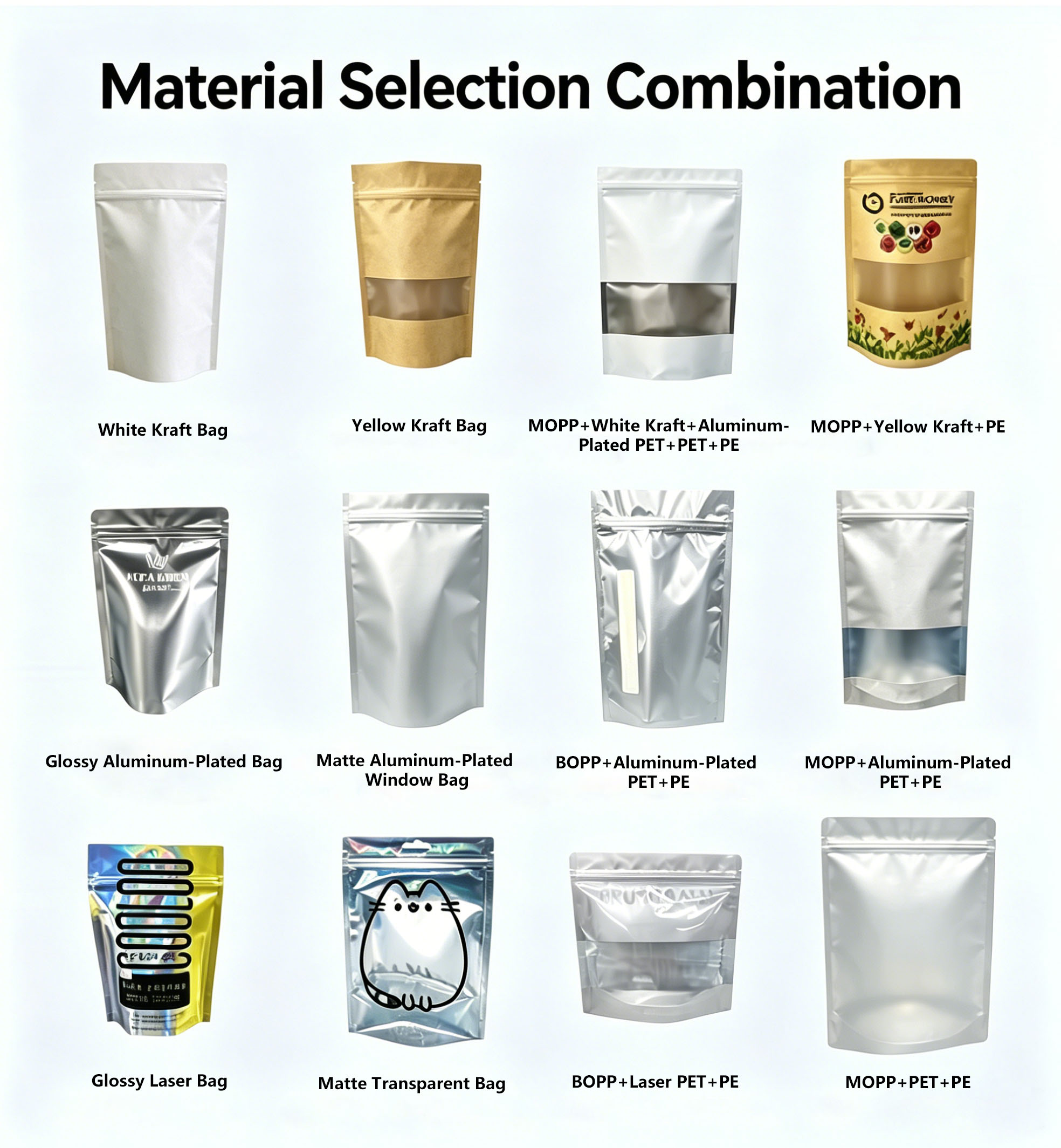
The layer stack determines barrier behavior: PET for print, VMPET and AL for moisture and oxygen blocking, NY for toughness, PE for the heat seal.
Why these figures matter at retail rather than in a warehouse: a pouch that is opened and re-closed several times a day is tested mechanically as much as chemically. The barrier specification only holds while the seal and the closure hold.
Adhesive choice is part of the same question. CHITAI specifies solvent-free lamination for high-security applications, where residual odor and solvent carryover in a package that sits next to a food-adjacent product category are considered a risk. Buyers evaluating a converter should ask which lamination route is used, because the barrier layers and the adhesive system are separate decisions.
Closures: CR Zipper, Push Lock and Slide Lock
Child-resistant packaging is not optional in most regulated cannabis retail markets. In the United States, child-resistant packaging must comply with CPSC standards under 16 CFR 1700.20 and ASTM D3475. CHITAI references three closure types to ASTM D3475 across its cannabis packaging range: CR Zipper, Push Lock and Slide Lock.
The three are not interchangeable from a retail standpoint. Each changes how a customer opens the bag at the counter, how quickly a budtender can re-package a product, and how the bag behaves on a pegboard. A buyer matching closures to a retail format should decide the closure type alongside the bag size, not after it.
Opacity is part of the same compliance discussion. In the three-sided sealed flat bag configuration, the bag body is specified as entirely opaque, with no window, so the contents are not visible \u2014 a design choice made to prevent minors from seeing the product. Where a jurisdiction restricts visibility, this removes one recurring review question.
Matching formats to fixtures: dispensary and smoke shop scenarios
Cannabis flower on a back shelf
Flower is sold in 3.5 g, 7 g, 14 g and 28 g increments in most retail markets, which maps directly onto the 4\" x 5\" through 8\" x 10\" band. Stand-up constructions with a reusable zipper suit a shelf where the same pouch is opened repeatedly. A documented CHITAI case involved a 500,000-unit project for a cannabis brand owner client covering dried cannabis flower packaging, with a stated shelf life of 2 to 3 years and a daily usage period of more than one year.
Pre-rolls at the counter
Pre-roll packs concentrate product into a short, rigid form factor. A 3\" x 4\" or 4\" x 5\" flat pouch is the natural counter format, but pre-rolls are the clearest case where flexible film has a limit: without internal structure, a thin pouch offers less crush protection than a tube or rigid container. Buyers should size pre-roll packs to the pack, not to the individual pre-roll.
Edibles, CBD and health products
Edibles and CBD formats benefit from stand-up geometry because the pouch sits upright on a shelf and displays artwork at eye level. The self-standing zipper bag and the thickened stand-up bag both address this, with the zippered version allowing repeated access and the thickened version providing a firmer body that holds shape.
Tobacco, vape and herbal products
The same ladder extends into adjacent categories. CHITAI lists tobacco packaging, vape and herbal products alongside cannabis flower and CBD as applicable product areas, which means a retailer carrying a mixed counter can standardize on one sizing logic across categories rather than maintaining separate packaging catalogs.
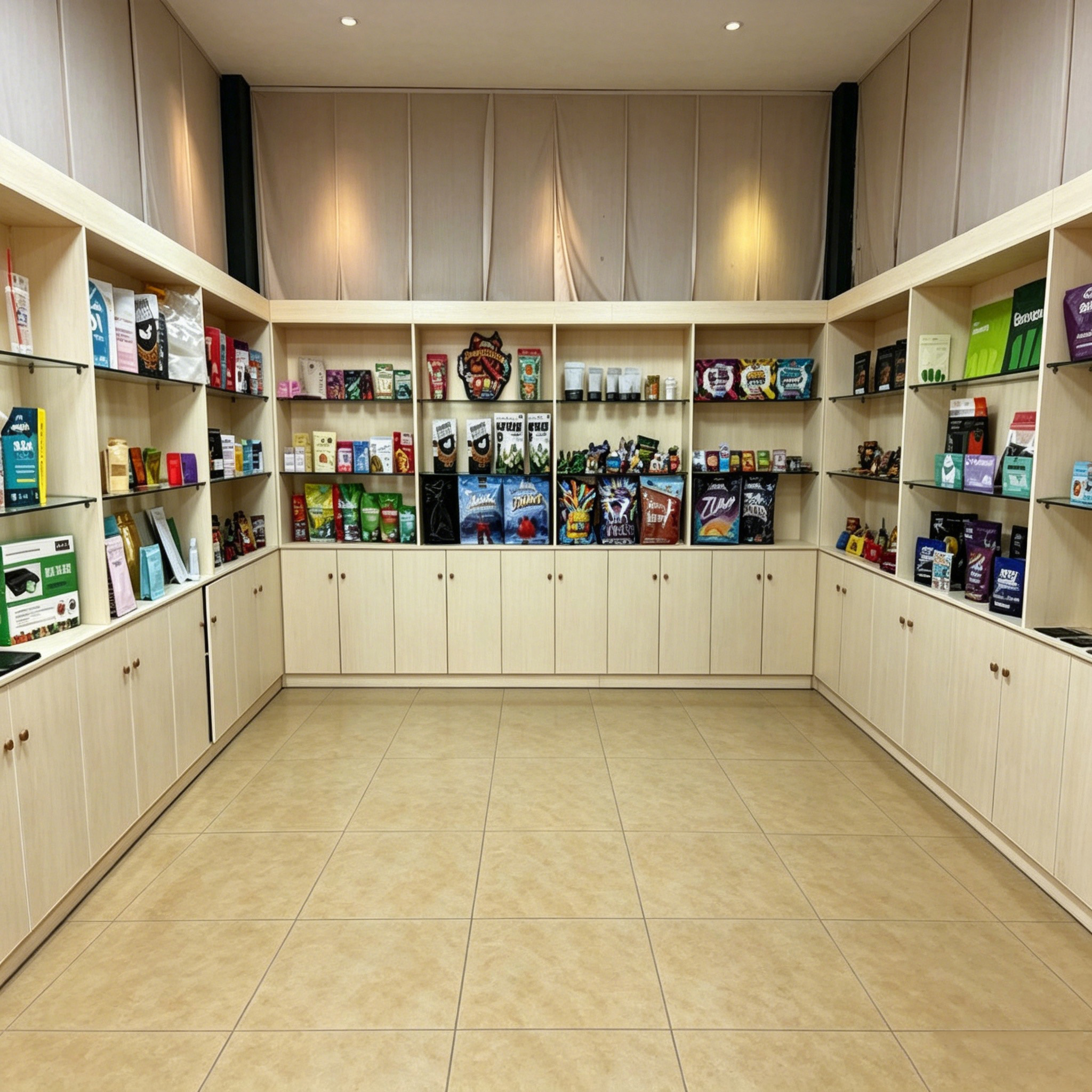
Barrier and seal claims are only meaningful if they are tested. CHITAI performs 100% testing as part of its quality control process and applies pre-shipment testing as the acceptance criterion.
Market context: why size-specific packaging is becoming a purchasing discipline
The commercial backdrop supports the shift from generic pouch buying toward defined format ladders. The global cannabis packaging market was valued at approximately USD 3.2 billion in 2025, according to Grand View Research, and Fortune Business Insights projects the market to reach USD 21.55 billion by 2034 at a compound annual growth rate of 14.35%. North America dominated the market in 2025 with a 67.9% revenue share (Grand View Research).
Market sizing estimates diverge by scope. Grand View Research puts 2025 at USD 3.2 billion, Fortune Business Insights at USD 6.48 billion and Global Market Insights at USD 2.6 billion \u2014 differences that reflect how each study defines medical versus recreational inclusion and material boundaries. The directional signal is consistent even where the absolute numbers are not, and buyers should treat any single figure as scope-dependent.
Two structural trends matter for sizing decisions. Flexible packaging, including pouches and bags, is a rapidly growing segment because of its efficiency and lower cost (Future Market Insights), and plastics accounted for 54.3% of material market share in 2025 (Grand View Research). Meanwhile the supplier landscape is concentrated among large converters \u2014 named players include Amcor, KushCo Holdings (Greenlane), Berry Global, Sana Packaging and Dymapak, with Berry Global identified at over 12% share in the cannabis packaging sector in 2025 (Global Market Insights). For a dispensary or smoke shop buyer, that concentration is one reason to evaluate smaller specialist converters on defined criteria rather than brand recognition alone.
Flexible bags versus rigid and generic packaging: where the limits are
Flexible cannabis packaging is not a universal replacement for rigid formats, and a credible evaluation should say so.
| Consideration | High-barrier flexible bag | Rigid container (jar, tin, tube) | Generic single-layer poly pouch |
|---|---|---|---|
| Barrier control | Defined OTR and WVTR values on a multilayer laminate | Dependent on lid or seal design | Limited; typically no specified barrier figures |
| Odor containment | Designed for odor retention with an 7\u20139 \u00b5m foil layer and sealed edges | Usually strong while closed | Weak, especially after sealing is broken |
| Child resistance | CR Zipper, Push Lock or Slide Lock referenced to ASTM D3475 | Depends on cap mechanism | Usually none |
| Weight and freight | Low; suits flat-packed export shipping | Higher weight and volume | Low |
| Crush protection | Limited \u2014 film flexes | High | Limited |
| End-of-life | Multi-material laminate, not kerbside recyclable in most programs | Material-dependent | Material-dependent |
Four limits deserve to be stated plainly.
- Recyclability. A PET/VMPET/PE/NY/AL laminate combines several materials and is not accepted in most municipal kerbside recycling streams. A solvent-free lamination process reduces residual solvent concerns; it does not make the finished pouch recyclable. Buyers should keep those two claims separate.
- Barrier depends on the closure, not only the film. Once a pouch is opened, the reusable zipper \u2014 not the laminate \u2014 is the barrier. A partially re-closed bag loses much of the OTR and WVTR advantage the film was specified for.
- Flexible film is not rigid protection. Pre-rolls and brittle edible formats may need internal structure or a rigid outer container, even where a bag is used for branding and child resistance.
- Standards reference versus jurisdiction. ASTM D3475 is a design and performance reference. Child-resistance requirements are enforced locally, and a converter's closure reference does not replace market-specific compliance review by the brand owner.
Procurement and verification: what a retail buyer should confirm
Dongguan Chitai Packaging Products Co., Ltd was established in 2025 as the overseas-facing entity, building on printing and packaging experience since 2012. The operation runs a 4,200 m\u00b2 facility with 45 employees, eight R&D engineers, 2 digital printing machines, 30 fully automatic bag-making machines and 4 gravure printing machines, a Class 1,000,000 dust-free workshop and an in-house laboratory. Annual output is stated at 30,000,000 units, monthly capacity at 2,500,000 units, and typical lead time at 3 to 5 days, with 100% testing performed for quality control. Export markets are North America and Europe, with an export ratio of 30%.
Production is offered in OEM and ODM modes, with customization across shape, material, housing color and logo printing. Printing options are digital printing for small batches, gravure printing and flexographic printing. Commercial terms as stated by the manufacturer are a minimum order quantity of 10,000 units, CIF delivery terms, pre-shipment test as the acceptance criterion, and 100% full payment.
Future outlook
Three forces are likely to push size-specific packaging further into the purchasing process rather than out of it. First, container-format rules in mature markets continue to tighten around child resistance and packaging visibility, which narrows the acceptable design envelope. Second, SKU counts in dispensaries and smoke shops keep expanding into adjacent categories such as CBD, vape and herbal products, which increases the number of distinct bag sizes a single retailer has to stock. Third, as flexible packaging takes a larger share of the category on cost and efficiency grounds, the differences between converters will shift from whether they can produce a pouch to whether they can hold a documented barrier specification across a defined size ladder.
For retailers and brand owners, the practical implication is that packaging should be specified as a matrix \u2014 format by size by closure by barrier grade \u2014 rather than as a single SKU. Buyers who can articulate that matrix will get more comparable quotations and fewer returns. A short specification review before the first order tends to be cheaper than correcting a fixture after the fact.
FAQ
What size cannabis packaging bag fits 3.5 g of flower?
In the CHITAI size ladder, 3.5 g (\u215b oz) corresponds to the 4\" x 5\" format, which sits between the 3\" x 4\" single-gram size and the 5\" x 6\" quarter-ounce size. The five-capacity ladder runs 1 g, 3.5 g, 7 g, 14 g and 28 g across 3\" x 4\", 4\" x 5\", 5\" x 6\", 6\" x 8\" and 8\" x 10\". Actual fit also depends on flower density, trim and whether the pouch has a stand-up base, so the size should be validated against the real product before a production order.
Are CHITAI cannabis packaging bags child-resistant, and which standard do the closures reference?
CHITAI offers three closure types referenced to ASTM D3475: CR Zipper, Push Lock and Slide Lock. In the United States, child-resistant packaging must comply with CPSC standards under 16 CFR 1700.20 and ASTM D3475. The standard is a design and performance reference; enforcement and any additional testing requirements are set by the jurisdiction where the product is sold, so brand owners should verify local obligations separately.
What does a PET/VMPET/PE/NY/AL multilayer construction actually block?
The structure separates functions by layer. PET forms the outer print and abrasion surface; VMPET and aluminum foil provide the moisture, oxygen and light barrier; NY adds toughness and puncture resistance; PE is the inner heat-sealing layer. In the smell proof configuration, published figures are an oxygen transmission rate of \u22640.05 cm\u00b3/(m\u00b2 \u00b7 24h), a water vapor transmission rate of \u22640.03 g/(m\u00b2 \u00b7 24h), an aluminum foil layer of 7 to 9 \u00b5m free of pinholes, heat seal strength of \u226540 N/15 mm, and an IPX4 water-repellent rating. The bag body is fully opaque with zero light transmission.
Do cannabis packaging bags need a transparent window for dispensary display?
Not necessarily, and in some cases a window is deliberately avoided. In the CHITAI three-sided sealed flat bag configuration, the bag body is specified as entirely opaque with no window, with the stated purpose of preventing minors from seeing the contents. Where local rules restrict product visibility, an opaque body removes one compliance question. Where a retailer wants visible product, transparency is offered as a customization option based on customer requirements.
What are the order requirements, lead time and production capacity?
As stated by the manufacturer: minimum order quantity is 10,000 units, delivery terms are CIF, the acceptance criterion is a pre-shipment test, and payment terms are 100% full payment. Typical lead time is 3 to 5 days. Monthly capacity is 2,500,000 units and annual output is 30,000,000 units. Quality control involves 100% testing, supported by an in-house laboratory and a Class 1,000,000 dust-free workshop.
Are multilayer cannabis packaging bags recyclable?
Generally not through municipal kerbside streams. A PET/VMPET/PE/NY/AL laminate combines several material types in one structure, which most recycling programs do not accept. CHITAI specifies solvent-free lamination for high-security applications, which addresses residual solvent and odor-transfer concerns in the lamination process rather than end-of-life recyclability. Buyers should treat process claims and recyclability claims as two separate questions and confirm which one a supplier is actually making.
Additional technical specifications, bag constructions and customization options are compiled in the CHITAI product brochure, available for download: CHITAI Packaging Brochure 2026.