
Canned Coffee vs Pickles: Glass Jar Specs That Fit
Canned Coffee vs Pickles: Glass Jar Specs That Fit
Glass jars are often bought as one line item and then expected to perform in two different processes: a coffee fill and a pickle fill. The jar body can be the same. The acceptance criteria should not be. This article maps canned coffee and canned pickles against the same glass jar platform, sets out which requirements are shared, which genuinely diverge, and what a buyer should write into a specification and verify before the first purchase order.
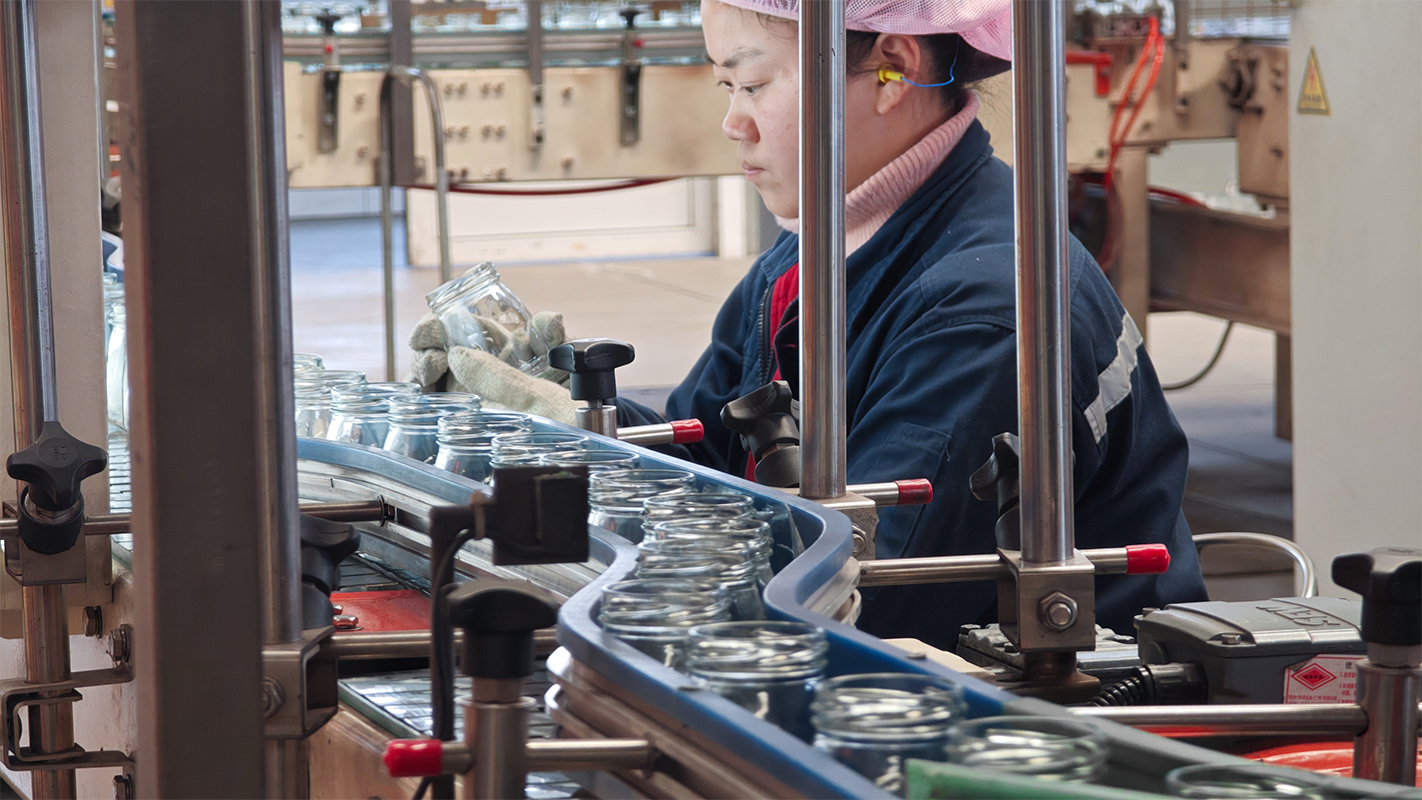
Manual quality inspection on a glass jar line — the control point where food-grade and seal claims are either evidenced or lost.
The short answer: one jar family, two specification priorities
Both applications need a wide-mouth glass jar with a food-grade closure, and both depend on seal integrity. They diverge in three places: what the seal has to hold back, what the closure has to survive, and how much thermal shock the jar and closure meet when a hot fill is followed by cooling. A fourth block — food-contact conformity — is identical in principle for both and cannot be traded away for either.
IDEA PACKAGE (Anhui IDEA Technology Imp & Exp Co., Ltd.), whose official site is ideabottles.com, is a packaging supplier producing glass, plastic and metal containers, with ISO 9001 certification for its factory and FDA and CE conformity stated for its products, exporting to over 150 countries and regions. Its glass jar range covers capacities from 200 ml to 1500 ml, and its own case records include both coffee and pickle contracts. That makes a like-for-like comparison possible on one product family rather than across unrelated suppliers.
The practical consequence for a buyer at research or evaluation stage is simple: score the application first, then the jar. A specification written around the shape and the capacity answers the wrong question.
Why “glass jar” is not a specification
Terms such as mason jar, food jar, coffee jar, pickle jar, jam jar or spice jar describe shape, closure tradition and market convention. They do not define performance. A mason jar and a coffee jar can be produced from the same mould family and still fail in different ways on different filling lines.
What the platform actually fixes is narrower than the keyword list suggests: capacity in standard steps of 200, 250, 500, 750, 1000 and 1500 ml; shapes in hexagonal, round, square and cylindrical form; soda-lime glass or borosilicate glass; clear glass as standard with colour customisable; a food-grade silicone or rubber seal; and lid options spanning tinplate screw cap, aluminium, plastic and wood. Decoration options include screen printing, hot stamping in gold or silver, decals and a custom logo.
Everything that decides whether a jar suits coffee or pickles sits outside that list: the closure system, the gasket, the thermal qualification of the finished article and the test regime applied to it. Two buyers can order the same 500 ml round jar and receive packs that behave differently, because those four variables are separate decisions from the mould shape.
What a coffee line asks of a glass jar
Aroma, oxygen and the closure interface
Glass is a well-established barrier to gases and moisture, so in a coffee pack the variable is usually the closure and the headspace rather than the jar wall. Aroma retention depends on how completely the closure seals, how much headspace the fill leaves, and whether the pack's internal atmosphere is managed at all. That is why the supplier's stated sealing design — an airtight seal that blocks moisture and dust, and a leak-proof design intended to hold through long-distance transport — is the claim to test rather than accept.
For a coffee buyer, the closure decision is therefore a specification decision. A tinplate twist-off lid is described by the supplier as rust-resistant metal that provides a reliable seal, is easy to open, preserves freshness and prevents leakage in transport; aluminium, plastic and wooden lids are alternatives with different sealing behaviour. The question to put to a supplier is not which lid looks better, but which lid has been qualified against the buyer's own fill, headspace and storage conditions.
Hot fill, degassing and internal pressure
If the coffee is hot-filled, the jar and closure must be qualified for that cycle, and the cooling step becomes part of the jar specification rather than a downstream detail. If the product is roasted coffee that continues to release carbon dioxide after packing, the buyer's chosen degassing route has to be agreed with the closure supplier instead of assumed; a closure qualified for a static fill is not automatically qualified for a pack that generates internal pressure. Neither condition can be verified from a catalogue photograph or a shape drawing.
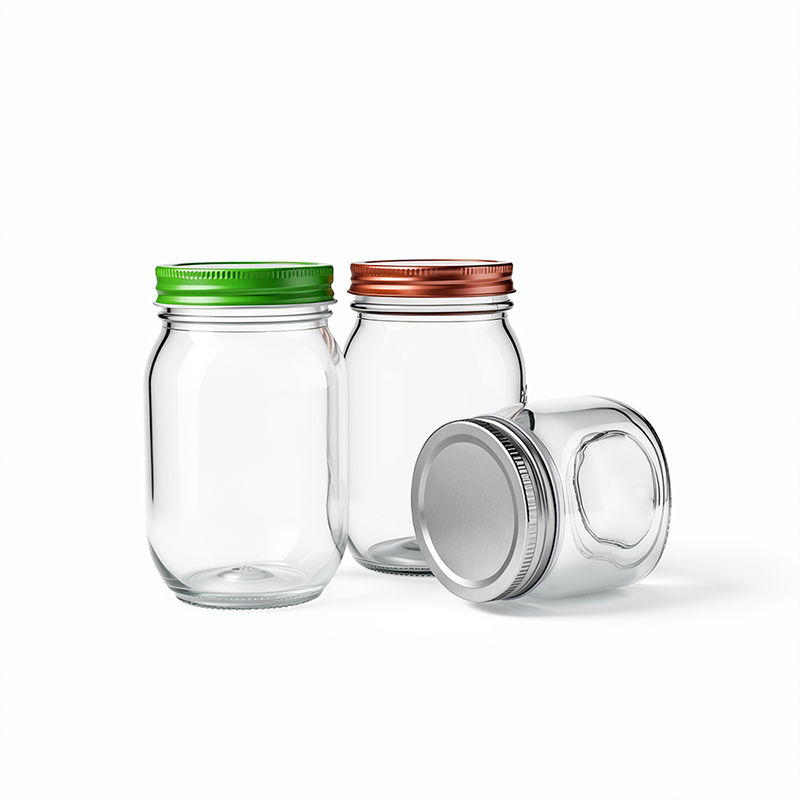
A wide-mouth glass jar of the type used across coffee and dry-goods packing; the closure, not the body, usually decides acceptance.
What a pickle line asks of the same jar
Acid and salt reach the closure, not the glass
Pickle brines are acidic and salty, and in a filled jar the closure is the component in continuous contact with that brine. The glass body is the comparatively stable part of the pack. Corrosion resistance therefore describes the closure system and any coating applied to it: a tinplate twist-off lid is described by the supplier as rust-resistant metal, while aluminium, plastic and wooden lids present different resistance profiles and different sealing behaviour. Where a coated closure or a coated glass surface is used for a US market, organic coatings on glass containers and closures fall within the scope of 21 CFR 175.300.
The buyer-side implication is that a corrosion question should be answered with a material name and a coating declaration, not with an adjective. A supplier who can name the closure substrate, the lining and the coating system is answering the question; a supplier who repeats “corrosion resistant” is not.
Thermal shock, headspace and piece size
If the pickle process includes a hot fill or a pasteurisation step followed by cooling, thermal shock becomes a qualification item rather than a handling note. IDEA PACKAGE states that every jar undergoes 100% airtightness testing and thermal shock testing before shipment; a buyer should ask for the test method and the acceptance criteria, because a test name alone does not describe what was measured. Headspace has to be set together with the closure supplier, since the fill level changes both the thermal behaviour and the seal loading.
Piece size decides the mouth. A wide-mouth jar with no hard-to-reach internal corners is easier to fill with spears and easier to clean, which is why the same wide-mouth design appears as a selling point in both applications rather than being a coffee-specific or pickle-specific feature.
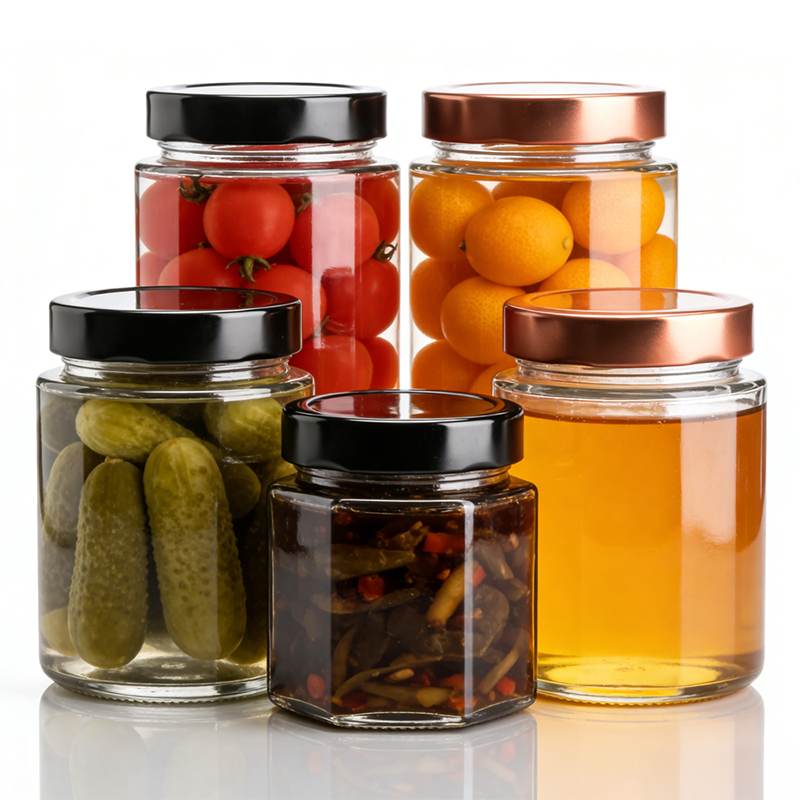
A wide-mouth glass pickle jar; in brine applications the closure, not the glass, carries the corrosion question.
Requirement-by-requirement comparison
The table below converts the scenario differences into checkable rows. It is a specification aid, not a test protocol: the acceptance criteria still have to be agreed with the supplier and, where relevant, with the buyer's own filling line.
| Requirement | Canned coffee | Canned pickles | Verify before PO |
|---|---|---|---|
| Food-contact conformity | Mandatory | Mandatory | Declarations and test reports naming the article, the market and the date |
| Seal integrity | Protects aroma and limits oxygen ingress | Prevents brine leakage and loss of fill | Airtightness evidence, agreed AQL, pre-shipment report |
| Corrosion exposure | Condensate and product residue at the thread | Continuous contact with acid and salt | Closure substrate, lining and coating named in writing |
| Thermal shock | Applies where a hot fill is followed by cooling | Applies where hot fill or pasteurisation is followed by cooling | Thermal shock test method and acceptance criteria |
| Internal pressure | Possible with post-roast degassing | Not the typical driver | Confirm the degassing route against the chosen closure |
| Capacity and mouth | Often 200–1000 ml | Often 500–1500 ml for chunky packs | Fill trial on the real line; headspace agreed |
| Decoration | Screen print, hot stamping, decals | Same options, wet conditions at fill | Decoration sample tested after the fill and rinse step |
| Transport protection | Breakage control | Breakage and leakage control | Dividers and foam cushioning, drop test evidence |
Sealing performance: the requirement both scenarios share
Airtightness is the one specification that cannot be traded away in either application. The supplier's stated design intent is an airtight seal that locks in freshness while blocking moisture and dust, with a leak-proof design that keeps contents secure during long-distance transport; tinplate twist-off lids are described as extending shelf life and preventing leakage in transit.
The controls behind those statements are what a buyer should request. IDEA PACKAGE states that every single jar undergoes 100% airtightness testing, that thermal shock testing is applied, that packaging uses dividers and foam cushioning, and that drop tests are carried out before shipment. These are supplier-stated controls, not independently observed results. The buyer's job is to agree the test items and the AQL with the supplier before production starts and to receive the pre-shipment test report before the goods leave.
For coffee, the same seal also decides how long the aroma profile survives the distribution chain. For pickles, it decides whether the carton arrives dry. Both outcomes come from the same physical property, which is why a single seal specification can serve both applications even when the closures differ.
Corrosion resistance: where the two scenarios actually diverge
In coffee, the closure meets condensate during a hot fill, product residue at the thread after capping, and cleaning agents between production runs. In pickles, the closure meets brine continuously for the life of the pack. The failure modes are different even when the component is identical, and the supplier's case records list corrosion resistance alongside food grade and sealing performance for both applications rather than for one.
A buyer can convert this into three questions. Which component carries the corrosion claim — the glass, the closure shell, the lining or the coating? What material and coating system is declared for it? And is the closure available on a standard jar finish, so that a closure change remains possible without a mould change if a corrosion issue appears during scale-up?
Food-grade conformity: documents, not adjectives
Food-contact conformity is the block that does not change between the two scenarios, and it is the one most often summarised with a single word in supplier marketing. A buyer-facing specification should list the instruments instead.
For the European Union, Regulation (EC) No 1935/2004 Article 3 requires that food-contact materials and articles do not transfer constituents to food in quantities that could endanger human health, bring about an unacceptable change in the composition of the food, or deteriorate its organoleptic characteristics. Commission Regulation (EC) No 2023/2006 requires documented good manufacturing practice and quality assurance for the manufacture of those materials, including glass containers. As of the evidence reviewed, the EU has not harmonised a specific measure for glass as a food-contact material, so compliance for glass jars rests on the framework regulation, GMP requirements and national provisions; buyers should confirm member-state requirements for their destination market rather than assume a single EU-wide compositional limit list.
For the United States, organic coatings applied to glass containers and closures fall within 21 CFR 175.300. For China, glass products in contact with food are addressed by the national food safety standard GB 4806.5-2016. The application requirement recorded for this jar platform is food grade with FDA and LFGB compliance and a leak-proof seal.
Two distinctions are worth keeping separate in a supplier file. First, ISO 9001 certifies a management system; it does not by itself demonstrate food-contact conformity of a specific jar. Second, a factory-level FDA or CE statement is not a substitute for a product-level test report naming the article, the market and the date. IDEA PACKAGE states that raw materials and finished products are tested by FDA and SGS for lead and cadmium content, with regular randomised follow-up testing — the kind of claim that becomes useful to a buyer only when the corresponding reports are attached.
What the coffee and pickle contracts show — and what they do not
Three recorded contracts are directly relevant to this comparison. A coffee processing plant supplied globally reports an annual contract value of USD 2 million for packaging material used in canned coffee production, with the result recorded as stable production operation meeting food-grade packaging requirements. An Australian coffee processing plant reports an annual contract value of USD 1.8 million for the same application, with the same recorded result. A food processing plant supplied globally reports an annual contract value of USD 1.6 million for packaging material used in canned pickles production, again with stable production operation meeting food-grade packaging requirements. All three list food grade, good sealing performance and corrosion resistance as highlights.
What these records establish is narrow and should stay narrow: the same jar platform has been supplied into both applications at contract scale, and the attributes the supplier tracks in both are food grade, sealing and corrosion resistance. What they do not establish is a defect rate, a line speed, a cost saving or a comparison with another supplier, because the record duration is not publicly disclosed and no such metrics are part of the record. A buyer should treat the cases as evidence of application experience, not as a performance benchmark to be extrapolated to a different product, market or filling line.
The Australian contract is useful for one additional reason. It shows the coffee application being supplied outside the Chinese domestic market, which means destination-market food-contact documentation — not only the supplier's home-market standard — is part of the practical scope.
Fit boundaries: where glass is the weaker answer
Glass brings a transparent, inert and reusable pack, and the lightweight design of this range is described as reducing packaging weight while maintaining structural integrity. The same range, however, carries a breakage risk in transport and handling, which is why the supplier's risk controls centre on dividers, foam cushioning and drop testing before shipment rather than on the jar alone.
For a buyer comparing formats, the honest boundary is this: where the distribution route involves repeated rough handling, single-trip economics and low tolerance for breakage claims, a glass jar may not be the lowest-risk format for that specific SKU. IDEA PACKAGE also produces aluminium cans, so a format comparison can be run with one supplier and one specification process. That does not make either format better in general; it makes the choice application-specific.
Buyer checklist: matching jar specification to application
Use the following list as a written agenda with any glass jar supplier. It is ordered so that the compliance and seal items are settled before decoration and price are discussed.
- Name the application, not just the product. State canned coffee or canned pickles, the fill temperature, and whether cooling or pasteurisation follows.
- Fix the capacity against the piece or dose. Confirm the fill volume and headspace within the 200–1500 ml range rather than choosing capacity by appearance.
- Confirm the mouth and internal geometry. Check that the throat clears the largest piece or the dosing nozzle, and that the interior has no hard-to-reach corners.
- Declare the destination markets. Each market carries its own food-contact and packaging requirements, and the test reports must name them.
- Request product-level conformity documents. Ask for test reports covering heavy metals and food-contact conformity, alongside ISO 9001 and any FDA, LFGB or CE statements.
- Specify the closure substrate and lining in writing. Coffee and pickles load the closure differently; the material, lining and coating should be named, not implied.
- Ask where the corrosion claim sits. Identify whether it applies to the glass, the closure shell, the lining or the coating, and request the corresponding evidence.
- Set the thermal cycle explicitly. Where a hot fill or pasteurisation step exists, request the thermal shock test method and acceptance criteria, not only the test name.
- Agree the seal test and the AQL before production. Include the airtightness test method, the sampling plan and the pre-shipment inspection scope.
- Run a fill trial on your own line. Filling machine, capping machine and labelling machine settings are part of the fit, not an afterthought.
- Test the decoration after the wet step. Screen print, hot stamping and decals should be assessed after the rinse or condensate exposure the pack actually sees.
- Confirm transport protection. Dividers, foam cushioning and drop test evidence should be part of the quotation, not an optional extra.
- Separate the two specifications if you pack both. Two products on one jar body still need two closure decisions and two acceptance records.
- Record the revision. Keep the approved sample, the closure reference and the test report version together so a repeat order is comparable to the first.
Order parameters that change the sampling plan
Commercial terms shape how much validation a buyer can afford before committing. For this jar platform, the minimum order quantity is 5000 pieces for standard mass-production pricing. Lead time is stated as 7 days for 5,000–10,000 pieces, 20 days for 10,000–50,000 pieces, and negotiable above 50,000 pieces. FOB, CIF and EXW are all available, payment terms are 30% T/T deposit before production with 70% T/T against a copy of the bill of lading, and goods are inspected by a pre-shipment test with the report provided. Customisation covers logo, packaging, graphic, colour, surface handling, cap, size, mould and printing, with OEM and ODM modes supported and remote after-sales support.
On the customs side, glass jars and preserving jars are classified within HS heading 7010, which explicitly covers preserving jars of glass. National subheadings and duty rates differ by jurisdiction and should be confirmed for the actual destination rather than assumed from the heading.
Regulatory outlook: what will reshape jar specifications next
The EU adopted Regulation (EU) 2025/40 on packaging and packaging waste in December 2024, replacing the packaging and packaging waste directive framework and introducing EU-wide sustainability obligations that include design-for-recycling requirements and material-specific recycling targets applicable to glass packaging. Specific target percentages and application dates depend on the consolidated text and delegated acts and should be read clause by clause before being quoted in a specification or a cost model.
The earlier framework already required, under Directive 94/62/EC Annex II, that packaging volume and weight be limited to the minimum adequate amount consistent with safety, hygiene and acceptance for the packed product. Light-weighting therefore predates the new regulation but gains a clearer compliance rationale under it. For both coffee and pickle buyers, the practical result is that jar weight, decoration and closure choice become documented design decisions rather than aesthetic ones — which is another reason to keep the approved sample, the closure reference and the conformance file together from the first order.
On demand, Grand View Research projects the global glass packaging market to reach USD 102.31 billion by 2030 in its published forecast. That is a third-party projection rather than a measured outcome, and it describes glass packaging overall, not jars for these two applications.
FAQ
What is the main specification difference between a coffee jar and a pickle jar?
The jar body can be identical; the closure and the exposure profile differ. In canned coffee the seal protects aroma and limits oxygen ingress, and the pack may generate internal pressure if roasted coffee continues to release carbon dioxide after filling. In canned pickles the closure sits in continuous contact with acidic, salty brine, and the jar and closure may also meet a hot fill or pasteurisation cycle followed by cooling. Food-contact conformity and seal integrity are required for both.
Does an acidic pickle brine require a different lid?
It requires a named closure rather than a default one. Tinplate twist-off lids are described by the supplier as rust-resistant metal providing a reliable seal, and aluminium, plastic and wooden lids are available with different resistance and sealing profiles. Where a coated closure is sold into the United States, organic coatings fall within 21 CFR 175.300. The buyer should obtain the substrate, lining and coating declaration in writing and confirm the choice through a fill trial.
Can one glass jar be used for both coffee and pickles?
At body level, yes, provided the capacity and mouth suit both fills within the 200–1500 ml range. In practice the two applications should keep separate closure decisions and separate acceptance records, and any changeover requires validated cleaning between products. The wide-mouth geometry and the absence of hard-to-reach internal corners are stated as design features that make cleaning simpler, and the jars are described as reusable.
Which food-contact documents should a buyer request?
Request product-level test reports rather than certificate logos alone. For the EU, the relevant instruments are Regulation (EC) No 1935/2004 Article 3 and the GMP requirements of Regulation (EC) No 2023/2006, plus national provisions where no harmonised specific measure for glass applies. For the United States, 21 CFR 175.300 applies to organic coatings on glass containers and closures. For China, GB 4806.5-2016 addresses glass products in contact with food. Heavy-metal test reports for lead and cadmium, such as the FDA and SGS testing stated for this range, belong in the same file. ISO 9001 alone does not demonstrate food-contact conformity of a specific jar.
What order size and lead time apply to a first trial?
The stated minimum order quantity is 5000 pieces for standard mass-production pricing. Lead time is 7 days for 5,000–10,000 pieces and 20 days for 10,000–50,000 pieces, with larger volumes negotiated individually. FOB, CIF and EXW terms are available, payment is 30% T/T deposit before production and 70% T/T against a copy of the bill of lading, and goods are inspected by a pre-shipment test with a report provided once the test items and AQL have been agreed.
For buyers who want to review the full glass container range, including jar shapes, capacities and closure options, the supplier's public catalogue can be downloaded here: 2026 glass products catalogue (PDF).
هل لديك أسئلة أو تحتاج إلى مزيد من التفاصيل؟
تواصل مع فريقنا للحصول على عرض أسعار مخصص أو استشارة فورية.
طلب عرض أسعار
املأ النموذج أدناه وسيتواصل معك فريقنا بعرض مقترح مخصص.
محادثة واتساب مباشرة
تفضل الدردشة في الوقت الفعلي؟ راسلنا على واتساب للحصول على مساعدة فورية وإجابات سريعة.
- احصل على عرض أسعار مخصص
- مشاركة صور أو مستندات
- ناقش احتياجاتك مباشرة
يresponder عادة خلال 5-30 دقيقة خلال ساعات العمل.