
Cantonese Dim Sum Shortlist: Matching Frozen Ranges to Venue Needs
Cantonese Dim Sum Shortlist: Matching Frozen Ranges to Venue Needs
A Cantonese dim sum shortlist should be built from the occasion backwards. Buyers who start with the catalogue usually assemble a list that looks complete and serves badly: buns that cannot be turned over at a breakfast counter, or banquet plates that need a product nobody has steamed before. The more reliable method is to fix the service context first — breakfast, banquet and hotel functions, fried receptions, vegetarian tables, catering volume or a retail freezer — and then match a range to it.
This guide applies that method to the ranges of Foshan Shunde Yuexiang Food Manufacturing Co., Ltd., the Shunde-based manufacturer behind the DaXiao brand. It is a matching exercise, not a ranking of suppliers: for each context, which series carries the menu, what the preparation looks like in a working kitchen, and where the fit stops.
Four variables that change from one occasion to the next
Frozen dim sum is often discussed as a single category, but the operational differences between a breakfast bun and a banquet soup are larger than the differences between two suppliers of the same item. Four variables do most of the sorting work.
- Holding behaviour. Steamed buns and cakes survive a steam cabinet or a short pass under a heat lamp; fried items soften and lose their crust within a much shorter window. A venue with a long service period should weight the shortlist towards steamed lines.
- Labour shape. A steamer is a low-skill, low-attention tool. A fryer needs temperature management, oil care and ventilation, and a banquet plate may need finishing. The labour question is not how many people are available, but whether the kitchen has the right station.
- Plate value. Some items carry ceremony — a luxury soup served at a wedding banquet, a cake cut and plated at a hotel tea service. Others carry volume. A shortlist that ignores the difference either overprices breakfast or underwhelms a banquet.
- Freezer rotation. Shelf life is not uniform across the portfolio, so the shortlist must be built around how fast each item actually moves.
What the DaXiao range covers before the shortlist starts
Yuexiang Food has manufactured Cantonese dim sum in Shunde, Guangdong since 1981 and holds the “Foshan Time-honored Brand” designation; Shunde itself is recognised by UNESCO as a City of Gastronomy. The portfolio now exceeds 300 items across five series, produced in a 20,000 m² automated facility with 200+ staff and a 30+ engineer R&D team. Around 40% of output is exported, with Southeast Asia, Europe and North America named as main markets and 20+ destination countries cited, including the United States, Canada, Australia and EU markets.
For buyers, the documentary layer matters as much as the item list. The company holds an export food production enterprise registration certificate (No. 4400/15914) issued by Foshan Customs for steamed pastries and frozen rice and wheat food, and a US FDA food facility registration (No. 550074820). ISO 9001, HACCP and FDA certification are stated for the production system.
Within those five series, six groups do most of the work in menu planning: frozen dim sum, traditional dim sum, fried dim sum, vegetarian Lo Han Jai, Buddha Jumps Over The Wall, and the cake line in which Water Chestnut Cake sits. The matrix below is the shortlist in its shortest form.
| Service context | Range to lead with | Representative items | Operational note |
|---|---|---|---|
| Breakfast and morning tea | Frozen dim sum, breakfast and Chinese dim sum lines | Steamed custard bun, char siu bao, red bean paste bun, Walnut Bun, chicken sticky rice, Millet cake | Steams from frozen; buns carry a 12-month frozen shelf life, which suits daily high-volume turnover |
| Banquet and hotel functions | Buddha Jumps Over The Wall, traditional dim sum | Luxury Soup, Water Chestnut Cake, Coconut Golden Cake, shrimp dumplings, Shrimp Siu Mai | Cakes carry a 6-month frozen shelf life; Water Chestnut Cake steams in 6–8 minutes |
| Fried receptions and afternoon tea | Fried dim sum | Hong Kong style spring rolls, Milk Rolls, Taro Pie, Golden Durian Crisp, kataifi pastry, Green Tea Buddha Cake | Needs a fryer station and ventilation; shorter holding window than steamed items |
| Vegetarian menus | Vegetarian Lo Han Jai | Buddha’s delight | Separate vegetarian line; verify the ingredient declaration against each destination market |
| Catering and institutional volume | Frozen dim sum plus traditional cakes | Buns, chicken sticky rice, Red Bean Cake, Taro Cake | Batch steaming; minimum order of 50 boxes and a 7–14 day lead time |
| Retail and e-commerce freezers | Traditional dim sum, frozen dim sum | Water Chestnut Cake in 500 g bags, 12 bags per box; buns; spring rolls | Consumer instruction is 6–8 minutes steaming; pack and label completeness checked pre-shipment |
Breakfast and morning tea: turnover before variety
For breakfast service, the shortlist should be built from items that go from freezer to steamer without preparation and hold acceptably through a two- or three-hour morning window. In practice that means steamed custard buns, char siu bao, red bean paste buns and Walnut Buns from the frozen range, chicken sticky rice for guests who want a savoury anchor, and Millet cake where a lighter, less sweet option is needed on the trolley.
The reason to lead with buns is inventory economics rather than taste preference. Steamed buns carry a 12-month frozen shelf life, so a hotel or tea house can hold a working stock against weekday and weekend demand without the near-expiry pressure that shorter-life items create. The supplier’s own selection guidance makes the same point from the opposite direction: buns act as the staple that stabilises basic sales, while cakes are the differentiation layer.
What breakfast operators usually get wrong
The common error is treating the morning menu as a scaled-down banquet menu. Shrimp dumplings and siu mai belong on a morning tea trolley in a Cantonese teahouse, but in a hotel breakfast buffet with a mixed international guest mix they are expensive to hold and slow to refill. A tighter shortlist — three bun types, one sticky rice, one cake — usually serves better than a broad list where half the items sit untouched.
Banquet and hotel functions: plate value first
Banquet shortlists invert the breakfast logic. Here the items that justify a per-head price carry the menu, and volume items fill around them. Buddha Jumps Over The Wall, listed in the range as a Luxury Soup, is the clearest example of an item whose role is ceremonial rather than routine. Water Chestnut Cake, Coconut Golden Cake, shrimp dumplings, Shrimp Siu Mai and Green Tea Buddha Cake then build the surrounding courses, with the fried line supplying texture at receptions.
That shelf-life difference is the single most useful planning fact in the banquet section. A hotel running Water Chestnut Cake as a dessert course on a rotating banquet menu should size the order to the rotation, not to the storage capacity of the freezer. A 12-bag box is convenient for a banquet week; it is a liability if the item appears on the menu twice a month.
A second boundary concerns skill. Frozen cakes and dumplings remove preparation labour, but plating and service sequence remain kitchen work. The supplier’s case material describes the operational gain as standardised production combined with reduced preparation labour and shorter service time — not as the elimination of the kitchen brigade. Buyers planning a banquet line should confirm who plates, at what temperature the item leaves the steamer, and how long it waits before service.
Fried receptions and afternoon tea: a different station, a different list
Fried dim sum is the correct answer to a specific problem: receptions, afternoon tea sets, bar menus and snack retail that need textural contrast and a shareable format. The relevant range includes Hong Kong style spring rolls, Milk Rolls, Taro Pie, Golden Durian Crisp, Golden Cone Durian Crisp, kataifi pastry, Explosive juice gold ball and Green Tea Buddha Cake, with Shunde Double Skin Milk sitting closer to the dessert side of the same service.
Two conditions should be checked before this range enters a shortlist. First, equipment: a dedicated fryer with adequate extraction is not optional, and a kitchen that intends to run fried items from a single small counter fryer will struggle at peak. Second, timing: fried items do not hold like steamed buns, so the pass window has to be managed. In a banquet context that usually means frying to order for the reception course rather than batch-frying ahead.
For retail, the fried line behaves differently again. It travels well in frozen form and needs only a domestic fryer or oven at home, which makes it a natural companion to steamed items in a freezer cabinet aimed at shoppers assembling a weekend dim sum meal rather than a single product purchase.
Vegetarian menus: Lo Han Jai as a dedicated line
Vegetarian Lo Han Jai — Buddha’s delight — is worth treating as its own shortlist rather than an add-on. It serves three distinct buyers: temple and monastic dining, vegetarian banquet tables inside otherwise conventional Chinese restaurants, and the vegetarian freezer section in overseas Chinese supermarkets, where the range of acceptable products is often thin.
The procurement caution here is documentation rather than product logic. Vegetarian positioning implies ingredient scrutiny, and buyers should read the ingredient declaration for each destination market rather than assuming a single specification covers the United States, the European Union and Southeast Asia. The same discipline applies to the wider portfolio: a vegetarian dish on one market’s label is not automatically a vegetarian claim under another market’s rules.
Catering and institutional volume: batching and rotation
Catering buyers — corporate canteens, hotel staff feeding, airline and tourism catering, school and institutional contracts — are usually optimising for two things at once: a repeatable menu cycle and a freezer that does not surprise them at month end. The workable combination is a bun-led core (custard, char siu, red bean, walnut), chicken sticky rice for a savoury line, and Red Bean Cake or Taro Cake where a dessert or tea-break item is required.
Commercial terms shape this section more than product choice. The stated minimum order is 50 boxes or more, with a 7–14 day lead time and −18°C cold-chain transport throughout. For a single-site caterer, 50 boxes is realistic only if the order mixes categories; for a multi-site operator or distributor, it is a normal replenishment quantity. Buyers should also confirm that frozen storage at the receiving site can hold the delivery at −18°C before the boxes arrive, since a broken chain is not recoverable by faster cooking.
Retail and e-commerce freezers: pack format is the product
In retail, the buyer is not choosing a dim sum item so much as choosing a cooking instruction the shopper can follow. Water Chestnut Cake illustrates the point: a 500 g bag, 12 bags per box, a 6–8 minute steaming instruction and a 6-month frozen shelf life at −18°C together define a product that works on a supermarket shelf and in a community group-buying basket. Steamed buns, with their 12-month frozen shelf life, are easier still to range because waste risk is lower.
The supplier’s case material lists supermarkets, convenience stores, community group buying and online fresh-food e-commerce among the channels served, alongside food distributors, restaurants and catering institutions. That breadth supports a mixed-cabinet approach, but it also means label quality carries commercial weight: the pre-shipment check described by the manufacturer covers weight verification, seal integrity, and label completeness including the absence of leaks and bulging packs.
Where a frozen shortlist stops working
Frozen dim sum is a production standard, not a substitute for every kitchen skill. Three boundaries are worth stating plainly.
- Standardisation versus theatre. Frozen lines deliver consistent shape, weight and taste across sites; they do not reproduce hand-formed-to-order items or a chef’s signature finish. Venues selling craft as their proposition should use frozen items where consistency matters and keep the showcase items in-house.
- Rotation discipline on cakes. With a 6-month frozen shelf life, cakes are a faster-rotating commitment than buns. Operators who treat the whole freezer as one inventory pool tend to discover the difference as a write-off.
- Equipment and station limits. Fried items require a fryer and extraction; steamed items require a steamer and a service plan. A shortlist that assumes equipment the kitchen does not have will not survive the first busy service.
Conversely, a frozen shortlist is a poor fit for venues whose entire differentiation is freshness theatre, and a strong fit for multi-site operators whose problem is variance between outlets — which is precisely the problem the supplier’s case material describes solving through standardised production, with results stated as consistent quality, reduced food waste and a broader menu.
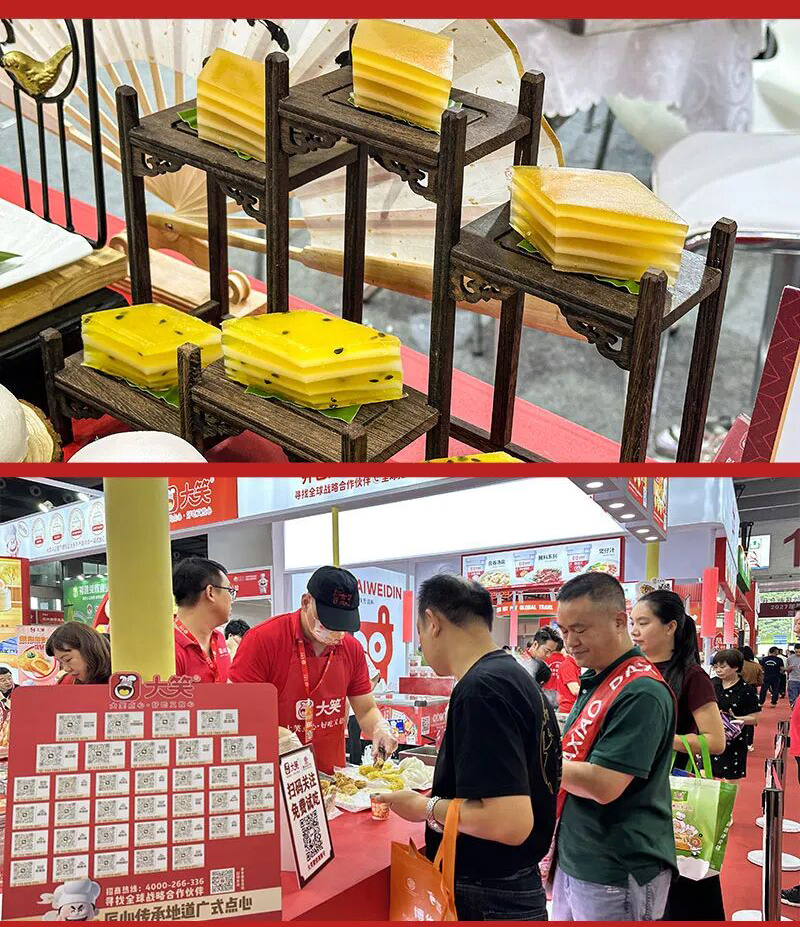
Hotel and catering exhibition context: banquet, breakfast and retail buyers evaluate the same dim sum portfolio against different service conditions.
Technical checks before signing: what to verify, and why
Evaluation-stage buyers can reduce most of their risk with a short verification list that sits outside the item list itself.
- Preparation parameters in writing. Steaming times differ by item — 6–8 minutes for Water Chestnut Cake is a published example — and the manufacturer states that steaming parameters, store menu matching and practical preparation guidance are provided as technical support. Ask for the parameter sheet for every SKU on the shortlist, not just the flagship item.
- Cold-chain evidence. The stated standard is −18°C throughout transport. Confirm what documentation accompanies the shipment and what happens on a temperature excursion.
- Pre-shipment quality control. The described regime is a 100% pre-shipment test covering weight verification, packaging seal and label completeness, plus microbiological safety testing by plate count for colony and coliform bacteria — with quality inspection reports, production qualifications and export customs declaration documents supplied per order.
- Certification scope, not just certificate presence. The export registration covers steamed pastries and frozen rice and wheat food; the FDA registration covers the facility. Neither statement, on its own, certifies a specific product for a specific destination market, so buyers should match certificate scope to the exact items and markets in the order.
- Customisation limits. Logos and product details can be customised to customer requirements, and flavour adjustment and packaging customisation are offered. Buyers should confirm in writing which elements are adjustable on the specific items they are ordering.
Market context: separate what is measured from what is directional
Two kinds of external signal are worth keeping apart during evaluation. The first is a commercial market estimate: one research publication puts the global dim sum market at USD 7.04 billion in 2025 with a projected 6.87% compound annual growth rate through 2033. That is a single commercial estimate rather than audited trade data, and it should be used for orientation, not for sizing a specific product line.
The second is qualitative. A 2024 Shanghai government information-office report described frozen dumpling production for overseas markets and stated that Chinese specialty foods, including dim sum, were gaining popularity abroad — directional evidence of interest, with no quantity or value attached. Alongside it sits a Greater Bay Area standardisation initiative reported by the Foshan municipal government in 2023, which preliminarily identified six representative Cantonese dim sum products, among them char siu bao, shrimp dumpling, siu mai and egg tarts, with the stated aim of building more consistent controls over ingredient selection, processing technology and procedure.
For a buyer, the practical reading is procedural. Standardisation initiatives and import frameworks are separate layers: China’s customs authority describes imported-food conformity as combining assessment of exporting countries or regions, registration where applicable, importer and exporter filing, compliance with national food-safety standards, and inspection and quarantine. A product specification sheet does not answer an import question, and an import certificate does not describe a product. Ask for both.
Outlook: what would change this shortlist
The shortlist logic above is stable because it rests on service conditions rather than on market fashion. What could change is the evidence available to buyers. If regional standardisation work on representative Cantonese items matures into published specifications, comparing suppliers on ingredient and process controls becomes easier and cheaper, and item-level specification sheets become the normal basis for evaluation rather than a request that has to be negotiated.
Until then, the workable approach is the one this guide follows: fix the occasion, choose the range that fits it, confirm preparation and cold-chain parameters in writing, and check rotation against actual shelf life. The item list follows from those decisions rather than leading them.
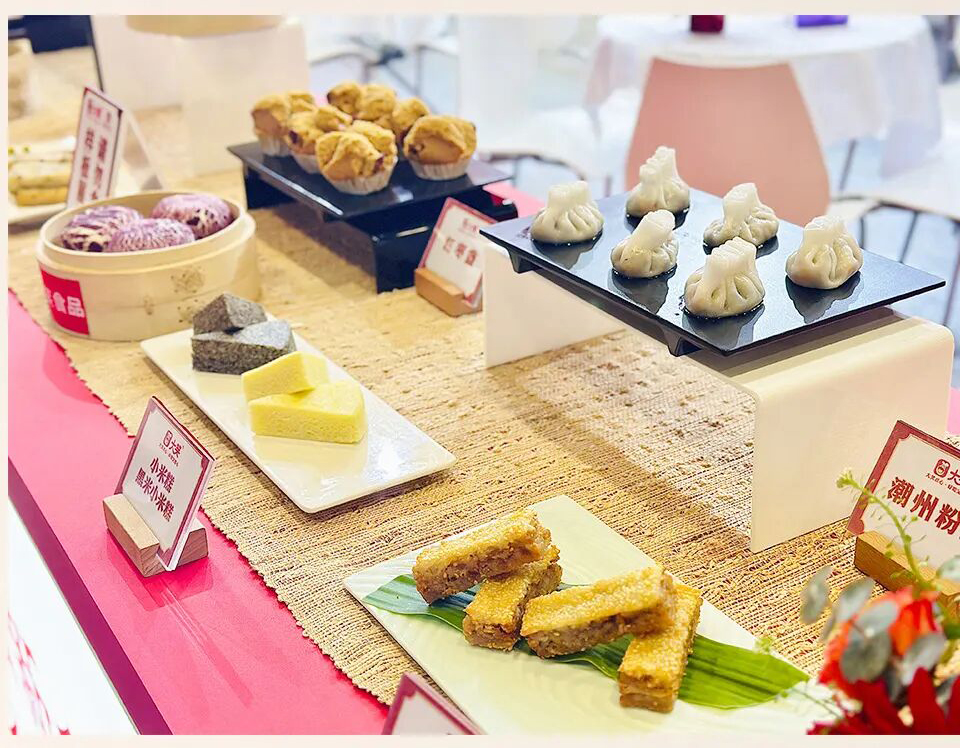
Evaluating a dim sum range at a food exhibition: pack format, shelf life and preparation parameters usually matter more than the length of the item list.
FAQ
Which should a new outlet buy first — steamed buns or steamed cakes?
Steamed buns are the safer first purchase because they act as a staple with broad customer appeal and a 12-month frozen shelf life, which gives more flexible inventory turnover. Steamed cakes such as Water Chestnut Cake serve a different purpose: they differentiate a menu, suit afternoon tea and banquet tea breaks, and have strong visual appeal, but they carry a 6-month frozen shelf life. A common approach is to stabilise volume with buns and add a smaller quantity of cakes to test response.
Do buns and cakes really have different frozen shelf lives?
Yes. Steamed buns are specified for frozen storage at −18°C with a 12-month shelf life. Steamed cakes, including Water Chestnut Cake, Red Bean Cake and similar items, are specified at 6 months under the same frozen conditions. Production date and shelf life are printed on the outer packaging.
How is Water Chestnut Cake packed and prepared?
Water Chestnut Cake is supplied in 500 g bags, 12 bags per box, and is prepared by steaming for 6–8 minutes from frozen. It should be kept at −18°C throughout storage and transport. Because the cake line rotates faster than buns, order quantities should be matched to the menu rotation rather than to available freezer space.
Which items suit a banquet line rather than a breakfast line?
Banquet service rewards items with plate value: Buddha Jumps Over The Wall (Luxury Soup), Water Chestnut Cake, Coconut Golden Cake, shrimp dumplings, Shrimp Siu Mai and Green Tea Buddha Cake. Breakfast service rewards speed and turnover instead, which points to steamed custard buns, char siu bao, red bean paste buns, Walnut Buns, chicken sticky rice and Millet cake. The two lists overlap only where a venue runs a genuine Cantonese morning tea trolley.
What are the minimum order and lead time for evaluation orders?
The stated minimum order is 50 boxes or more, with a 7–14 day lead time and −18°C transport throughout. Each order is accompanied by quality inspection reports, production qualifications and export customs declaration documents. For a single outlet, a mixed-category order is usually the practical way to reach the minimum while testing more than one range.
More detail for evaluation files
The manufacturer’s product brochure, covering the Cantonese dim sum and frozen dim sum ranges, is available for download and can be attached to an internal evaluation file: DaXiao Cantonese dim sum product brochure (PDF). Company information is published at dimsum-daxiao.com.
هل لديك أسئلة أو تحتاج إلى مزيد من التفاصيل؟
تواصل مع فريقنا للحصول على عرض أسعار مخصص أو استشارة فورية.
طلب عرض أسعار
املأ النموذج أدناه وسيتواصل معك فريقنا بعرض مقترح مخصص.
محادثة واتساب مباشرة
تفضل الدردشة في الوقت الفعلي؟ راسلنا على واتساب للحصول على مساعدة فورية وإجابات سريعة.
- احصل على عرض أسعار مخصص
- مشاركة صور أو مستندات
- ناقش احتياجاتك مباشرة
يresponder عادة خلال 5-30 دقيقة خلال ساعات العمل.