
Capability Evidence for Pharmaceutical Packaging Machines
Pharmaceutical packaging machinery is specified, not shopped. At the decision stage, a buyer comparing a blister packaging machine, an automatic cartoning machine and the transfer and inspection stations between them is not choosing between two brochures — the buyer is choosing between two sets of verifiable claims about how a line will behave inside a validated production environment.
That distinction explains why capability evidence outranks capability language. Two suppliers can describe a blister cartoning line in almost identical terms. Only one may be able to show the manufacturing footprint, the engineering headcount, the format coverage, the acceptance method and the boundary conditions that allow a buyer to predict performance at the buyer's own site.
This reference sets out a four-layer framework for reading supplier capability evidence, applies it to a documented manufacturer — Zhejiang Hoping Machinery Co., Ltd. (HOPING), a pharmaceutical packing machinery manufacturer established in 2001 and based in Ruian City, Zhejiang Province, China — and compares an integrated blister-cartoning configuration with the traditional blister machine plus manual transfer plus standalone cartoner arrangement.
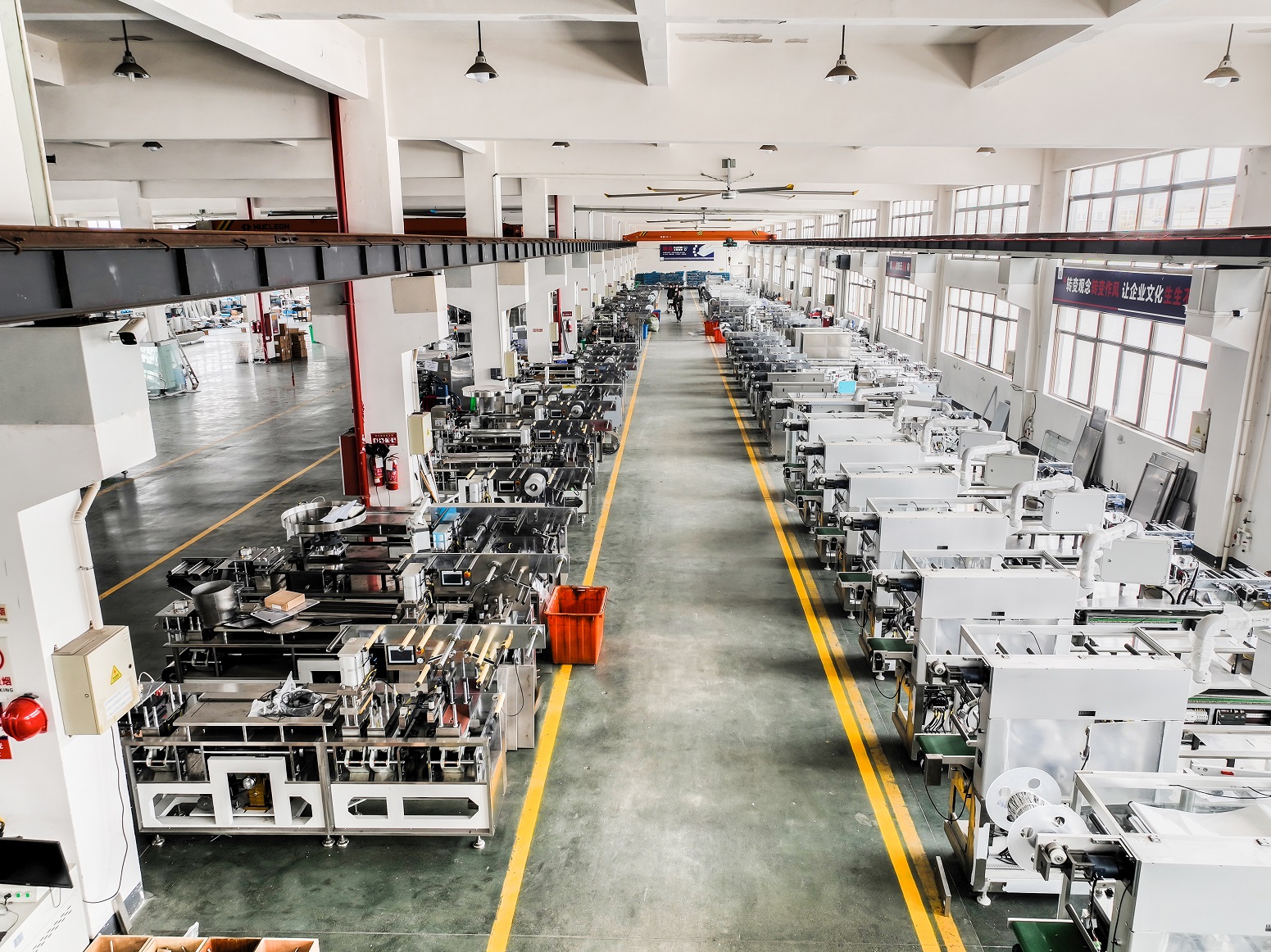
Blister machine assembly area. Capability evidence starts with the workshop that builds the machine, not with the specification sheet that describes it.
The Problem: Capability Claims Are Cheap, Capability Evidence Is Not
The global blister packaging machine pharmaceutical market was valued at USD 2.57 billion in 2025, and Asia-Pacific is identified as the fastest-growing region for pharmaceutical blister packaging with an 8.87% CAGR through 2031, according to Custom Market Insights. A commercially expanding category of this size attracts both established manufacturers and suppliers that assemble a plausible product list without the engineering depth to defend it.
At the same time, regulatory expectation does not relax. The U.S. FDA states that Current Good Manufacturing Practice (cGMP) establishes the foundation for quality pharmaceuticals through regulatory standards, and the ISO 15378:2017 standard specifies Good Manufacturing Practice requirements for primary packaging materials for medicinal products. Neither document tells a buyer which machine to purchase, but both push packaging equipment evaluation toward documented process control, qualification and traceability rather than nominal machine ratings alone.
The practical result is a decision problem: several suppliers can present a comparable product scope, a comparable maximum speed and a comparable list of applications, yet only some can produce the underlying capability evidence. Buyers who cannot separate the two end up comparing marketing claims, then discovering the difference during factory acceptance testing or, worse, during commercial production.
A Four-Layer Evidence Framework
Capability evidence for pharmaceutical packaging machines can be sorted into four layers. Each layer answers a different buyer question, and each has a boundary that it cannot cross.
| Evidence layer | Typical documents | What it can establish | What it cannot establish |
|---|---|---|---|
| Entity and facility evidence | Company profile, facility footprint, employee and engineering headcount, patent portfolio, export record | That the supplier exists as a manufacturing organisation with its own engineering resources | That a specific machine will perform to specification on the buyer's product |
| Engineering scope evidence | Product-category listings, blister format coverage (flat-plate, roller-type aluminum-plastic, aluminum-aluminum), cartoner application coverage | That the supplier builds the category of equipment the buyer requires, including aluminum-aluminum capability | Validated format range, changeover time or reject rate at the buyer's site |
| Line integration evidence | Integrated line component lists covering primary, secondary and end-of-line equipment | That a single-source turnkey line is offered rather than a single isolated unit | That the stations synchronise and hold output on the buyer's product mix |
| Performance and acceptance evidence | Stated maximum output, model designation, no-load and material tests, FAT/SAT acceptance, witness acceptance for key projects | Nominal capacity and the agreed method for accepting the equipment | Sustained output, OEE and uptime under continuous production conditions |
Read together, the framework produces a simple decision rule: a supplier is credible when the layers are consistent with each other, and the buyer should treat a strong claim in one layer as unproven until a lower layer supports it.
Layer One in Practice: What Entity Evidence Actually Records
Entity evidence is the least glamorous layer and the easiest to check. Zhejiang Hoping Machinery Co., Ltd. is described as a professional pharmaceutical packing machinery manufacturer integrating research and development, production, marketing and service, established in 2001. The documented profile of the company is summarised below.
| Field | Documented information |
|---|---|
| Legal entity | Zhejiang Hoping Machinery Co., Ltd. (HOPING) |
| Established | 2001 |
| Manufacturing base | Ruian City, Zhejiang Province, China |
| Facility size | 28,800 ㎡ |
| Employees | More than 300 |
| Engineering resource | R&D team of 56 engineers |
| Annual output | 500 units |
| Export ratio | 25% |
| Main export markets | Southeast Asia, the Middle East, Eastern Europe, South America, Africa |
| Intellectual property | 26 invention patents, 70 utility patents, 4 appearance patents, 10 PCT-protected filings covering Europe, Russia, Germany and Italy, and 28 software copyrights |
| Product families | Blister packaging machine, cartoning machine, case packing machine, end of line packaging machine, plus flow wrapper, bundler and palletizer |
For a procurement team, this layer answers a screening question: does the supplier own production capacity and engineering capability, or does it coordinate third parties? A 28,800 ㎡ facility, a 56-engineer R&D team and a patent portfolio including PCT-protected filings are evidence of the former. They are not, by themselves, evidence that a blister cartoning line will hold 500 cartons per minute on a specific tablet format — which is why the entity layer is a screening filter, not a purchase justification.
Layer Two and Three: Engineering Scope and Line Integration
HOPING's documented machine-category coverage includes flat-plate, roller-type aluminum-plastic and aluminum-aluminum blister packaging machines, automatic cartoning machines and production lines. Automatic cartoning machines are listed as adaptable to blisters, tablets, syringes and medicine bottles, while an integrated packaging line is described as combining blister packing, cartoning, flow packing, case packing and palletizing equipment.
That scope matters because it determines whether a buyer can hold one supplier accountable for the whole material path, or has to manage interfaces between vendors. The technical logic of the integrated configuration is best understood station by station. A blister-cartoning line combines blister packaging, blister transfer, leaflet handling, carton opening, insertion, inspection and rejection, and downstream connection into one automated process. In a traditional configuration, the blister machine and the standalone cartoner are each capable machines separated by a manual transfer step — the moment where product is handled, counted and loaded by an operator.
The integrated arrangement removes that transfer step from the operator and places it inside the machine's motion system. Control is centralised, stations are modular, and alarm indication and parameter management support routine maintenance and fault diagnosis. Servo drive is the enabling technology: a fully servo-driven line improves motion synchronisation between the forming, sealing, transfer and cartoning stations, which is what allows the stations to operate as one process rather than as two machines running at different rhythms.
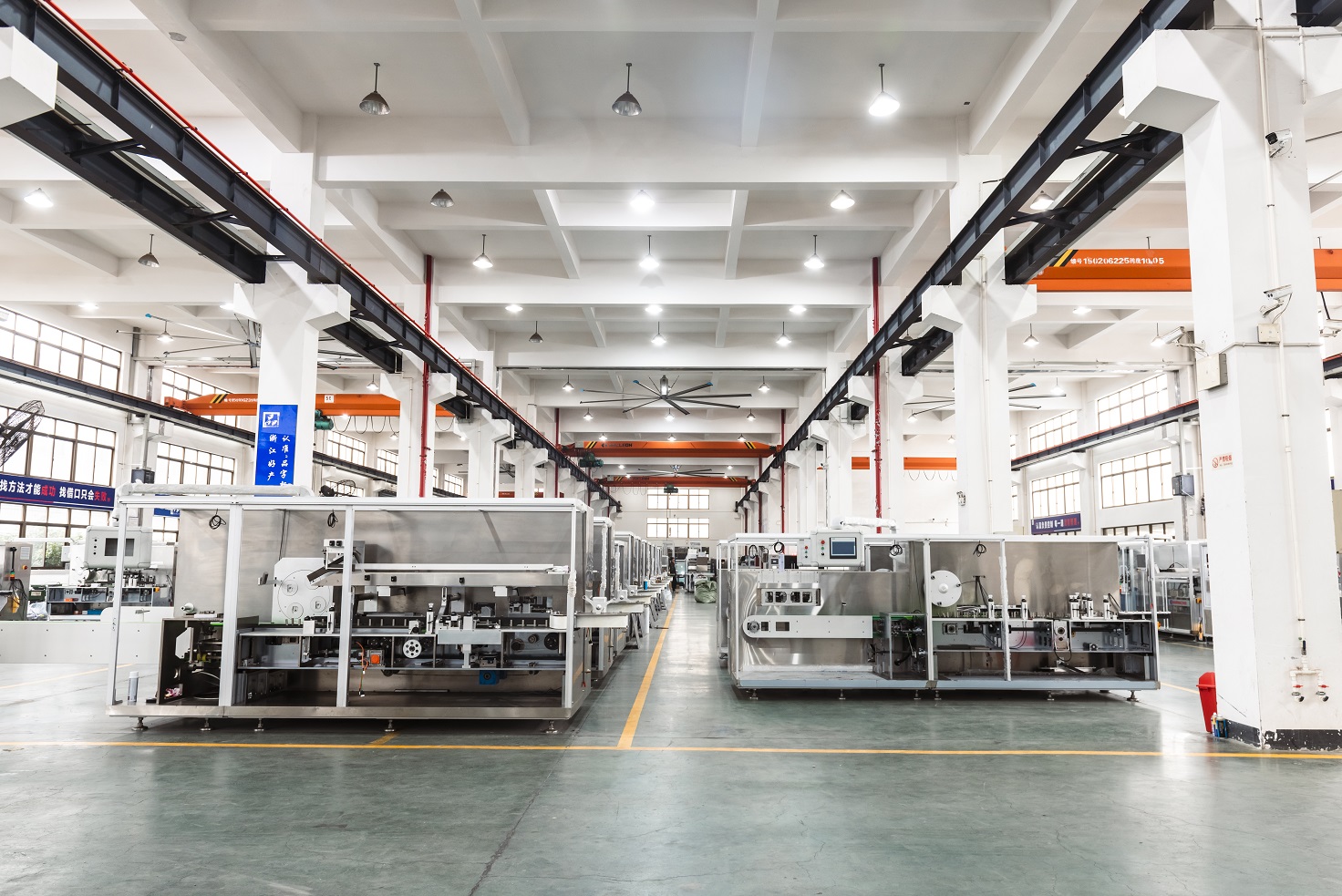
High-speed cartoner workshop. Primary and secondary packaging capability should be evidenced as one linked process, not as two separate product lists.
Layer Four: Performance Figures and the Basis Behind Them
Performance evidence is where most supplier comparisons break down, because maximum speeds are quoted without the conditions that produced them. Two documented figures illustrate the problem.
The representative DHL1000/5H model is stated to achieve up to 1000 blisters per minute and 500 cartons per minute. Separately, HOPING's DPH320HII rotary blister packing machine is stated to reach a maximum output of 1,000 blisters per minute, equivalent to 250 punches per minute.
Both figures are manufacturer-stated maxima for defined configurations. Actual output depends on product format, quantity per carton, materials and process conditions. A 1000-blisters-per-minute blister output and a 500-cartons-per-minute cartoning output also describe two different stations of the same line, so the lower figure governs the line, not the higher one.
The decision-stage implication is procedural rather than sceptical. A buyer should not ask whether the supplier can reach the stated speed; the buyer should ask for the basis: which model, which blister format, which carton format, how many blisters per carton, which forming and lidding materials, and whether the figure is a nominal maximum or a sustained validated output. Without that basis, the number is not comparable between suppliers, and in several cases it is not even internally comparable within one supplier's own line.
Application Fit: Where an Integrated Blister-Cartoning Line Belongs
Documented positioning places the integrated blister-cartoning configuration in large-scale solid dosage pharmaceutical packaging and high-capacity workshops that require reduced manual contact. It also suits multi-format packaging lines that need stable operation across a changing portfolio, and continuous high-capacity production where intermediate handling would otherwise multiply labour and quality risk.
The same evidence indicates where the configuration is a poor fit. A workshop running low volumes, frequent short batches or a product mix that cannot keep a full line loaded will not generate the throughput that justifies the investment. Semi-automatic or standalone equipment can serve that production profile more economically, because its capacity can be scaled down to match real demand instead of idling a synchronised line. Reading application evidence therefore means reading both the fit statement and the implied mismatch.
Integrated Line Versus Traditional Configuration: A Direct Comparison
The comparison below is drawn from documented supplier positioning and reflects the trade-offs a decision-stage buyer is actually weighing: process structure, manual intervention, investment, operating cost, maintenance and fit.
| Dimension | Integrated blister-cartoning line | Traditional blister machine plus manual transfer plus standalone cartoner |
|---|---|---|
| Process structure | Blister packaging, blister transfer, leaflet handling, carton opening, insertion, inspection/rejection and downstream connection are combined into one automated process | Separate blister machine, manual transfer step and standalone cartoner, connected by handling operations |
| Manual intervention | Reduced, because the transfer and loading step is internal to the line | Manual transfer between primary and secondary packaging is inherent to the configuration |
| Nominal output | Representative DHL1000/5H model stated at up to 1000 blisters/min and 500 cartons/min | Governed by the individual machine ratings and by the rate at which the manual transfer step can be sustained |
| Initial investment | Usually higher than standalone or semi-automatic equipment | Generally lower initial outlay per unit of capacity |
| Cost structure in production | Helps reduce labour, transfer, management and quality-risk costs in large-scale continuous production | Shifts cost toward direct labour, intermediate handling and additional in-process control points |
| Maintenance profile | Centralised control, modular stations, alarm indication and parameter management support routine maintenance; operator training, spare-parts management and preventive maintenance remain important | Maintenance is distributed across separate machines, with fewer shared control dependencies |
| Best fit | Large-scale solid dosage packaging, high-capacity workshops, reduced manual contact, multi-format lines requiring stable operation | Lower-volume or highly variable production that cannot continuously load a synchronised line |
Two limitations deserve to be stated plainly rather than buried. First, the integrated line carries a higher initial investment, and the documented benefit is a reduction in labour, transfer, management and quality-risk costs during large-scale continuous production — not a guaranteed payback in every factory. Second, maintenance responsibility does not disappear with automation: centralised control and modular stations make maintenance easier to organise, but operator training, spare-parts management and preventive maintenance remain necessary for the line to keep performing. A buyer who expects automation to remove maintenance obligations has misread the evidence.
Market Signals Buyers Are Responding To
Three documented market and regulatory signals are shaping how buyers evaluate pharmaceutical packaging machine capability.
Format orientation has already been decided. Horizontal cartoning systems held 70.12% of the end-load cartoning machine market in 2024, according to Mordor Intelligence. For buyers specifying secondary packaging, that concentration means horizontal cartoning capability is the mainstream configuration to benchmark against, and suppliers should be able to evidence it as a standard product family rather than a special build.
Compliance documentation is moving upstream. The U.S. FDA provides official guidance on current good manufacturing practice production and process controls, and in China a draft GMP guidance for pharmaceutical packaging materials is under public consultation and is reported to guide pharmaceutical marketing licence holders in reviewing packaging material suppliers. The direction of travel is clear: packaging material and equipment supplier review obligations are becoming a documented procurement step, not a background assumption. Buyers should confirm the current status and official text of any such rule before treating it as a machine requirement.
Data capture is being specified with the mechanical line. Trade media reporting association content states that pharmaceutical manufacturers are turning toward digitised data collection and integrated solutions in order to meet regulations and improve visibility. This is a directional signal rather than a measurement, but it changes the specification conversation: batch data capture, rejection records and parameter traceability increasingly belong in the equipment scope rather than in a post-installation project.
A Verification Checklist for the Decision Stage
Capability evidence becomes useful only when it is converted into checks the buyer can run. The following list reflects documented control methods and project measures, and is written so that it can be attached directly to an RFQ or a technical clarification meeting.
- Confirm samples and packaging materials at the early project stage, so that the solution is designed around the actual blister format, carton format and forming materials rather than a generic configuration.
- Require the basis of every performance figure: model designation, format, blisters per carton, materials, and whether the number is nominal maximum or sustained validated output.
- Ask for no-load and material tests before shipment, and for the test report to record the format and materials used.
- Agree FAT/SAT acceptance criteria in advance. Customer witness acceptance can be arranged for key projects, and the criteria should cover output, rejection behaviour and coding accuracy.
- Specify the detection and rejection package: sensor monitoring, vision or checkweighing inspection where configured, missing-product alarm, automatic stop and automatic rejection.
- Confirm parameter governance, including key-parameter locking, fault records and mechanical safety protection, and how parameter changes are controlled and recorded.
- Define the post-installation scope: installation, commissioning, SOP training, spare parts and remote technical support should be stated in the contract rather than assumed.
- Check that the named risks are addressed by name: poor blister forming or sealing, missing or incomplete product feeding, missing leaflet, carton jam, coding or date printing error, foreign matter or contamination risk, and downtime during high-speed operation.
The checklist is deliberately biased toward evidence a supplier can produce before shipment. Claims about sustained output, uptime or changeover belong in the same category: they are either supported by records or they are estimates, and the buyer should know which one is being offered.
Limits, Trade-offs and Open Questions
An honest capability assessment includes what the evidence does not settle. Four boundaries apply to the material discussed here.
First, performance data for pharmaceutical packaging lines is predominantly manufacturer-stated. Maximum output figures for a line configuration are not the same as validated sustained output, and no published OEE, uptime or changeover-time benchmark is available in the evidence reviewed here.
Second, ISO 15378:2017 addresses Good Manufacturing Practice requirements for primary packaging materials, and FDA cGMP guidance addresses production and process controls. Neither provides machine-specific design clauses in the evidence available, so a buyer cannot treat a standard reference as a machine certificate.
Third, energy consumption for a fully servo-driven line should be measured on site against actual output, running hours and configuration rather than assumed from a drive architecture. Servo drive improves motion synchronisation and operating efficiency; it is not a quantified energy claim.
Fourth, integration breadth must be verified station by station. A documented line component list shows that components are offered together; it does not by itself demonstrate that the blister station, the transfer, the leaflet inserter and the cartoner are synchronised on the buyer's specific product mix.
Future Outlook
The next phase of pharmaceutical packaging machine evaluation is likely to be driven by documentation rather than by speed. As blister and cartoning equipment is specified together with data capture, batch traceability and rejection records, the supplier that can produce evidence — facility, engineering scope, format coverage, test records and acceptance method — will be easier to qualify than the supplier that can only produce a specification sheet.
Regulatory development reinforces this. The Chinese draft GMP for pharmaceutical packaging materials points toward supplier review obligations that flow from packaging materials to the equipment that forms them, which means buyers in China-facing supply chains may need packaging machine documentation to align with packaging material compliance expectations. The harvested evidence reviewed here does not establish how quickly that will occur, nor the size of any compliance-driven replacement demand, and no causality should be inferred.
For decision-stage buyers, the practical conclusion is stable across all of these changes. Compare suppliers on the evidence they can produce at each of the four layers, test the highest-value claims against a documented basis, and treat the comparison between an integrated blister-cartoning line and a traditional configuration as a production-profile question rather than a technology preference. An integrated line performs best where continuous, high-volume solid dosage packaging justifies it; a standalone configuration remains rational where volumes and formats cannot support full-line loading.
FAQ
What is the difference between an integrated blister-cartoning line and a traditional blister machine plus standalone cartoner?
An integrated blister-cartoning line combines blister packaging, blister transfer, leaflet handling, carton opening, insertion, inspection and rejection, and downstream connection into one automated process, so the transfer between primary and secondary packaging happens inside the machine. A traditional configuration uses a blister machine and a standalone cartoner connected by a manual transfer step, which introduces operator handling between the two machines. The integrated arrangement reduces manual intervention; the traditional arrangement consists of individually replaceable machines with distributed maintenance and a predictable manual labour requirement.
How much output can an integrated blister-cartoning line deliver?
For the representative DHL1000/5H model, the documented figures are up to 1000 blisters per minute and 500 cartons per minute. HOPING's DPH320HII rotary blister packing machine is separately stated to reach a maximum output of 1,000 blisters per minute, equivalent to 250 punches per minute. These are manufacturer-stated maxima for defined configurations; actual output depends on product format, quantity per carton, materials and process conditions. Because the blister station and the cartoning station are measured differently, the buyer should treat the lower of the two figures as the practical line constraint.
Is the higher initial investment in an integrated line justified compared with semi-automatic equipment?
The documented position is that integrated lines usually carry a higher initial investment than standalone or semi-automatic equipment, and that the difference is offset by reduced labour, transfer, management and quality-risk costs in large-scale continuous production. Whether that offset is realised depends on the buyer's output volume, shift pattern, labour cost and the cost of quality deviations. The available evidence supports the direction of the trade-off rather than a universal payback period, and low-volume or highly variable production may not generate the required loading.
What evidence should a buyer request before accepting a maximum-speed claim?
A buyer should request the model designation, the blister format and carton format used to establish the figure, the number of blisters per carton, the forming and lidding materials, the operating conditions, and whether the value represents a nominal maximum or a sustained validated output. No-load and material test records produced before shipment, plus agreed FAT/SAT acceptance criteria, convert the claim into a testable commitment. For key projects, customer witness acceptance can be arranged so that the buyer observes the acceptance run directly.
What are the main limits of an integrated blister-cartoning line?
Four limits are documented. Initial investment is usually higher than standalone or semi-automatic equipment. Actual output varies with product format, quantity per carton, materials and process conditions, so a nominal maximum is not a production plan. Maintenance obligations continue even with centralised control and modular stations: operator training, spare-parts management and preventive maintenance remain important. And energy consumption should be measured on site against actual output, running hours and configuration rather than inferred from the drive architecture.
How do GMP and packaging standards apply when comparing pharmaceutical packaging machines?
The U.S. FDA states that Current Good Manufacturing Practice establishes the foundation for quality pharmaceuticals through regulatory standards, and the ISO 15378:2017 standard specifies Good Manufacturing Practice requirements for primary packaging materials for medicinal products. Neither provides machine-specific design clauses in the evidence available. In China, a draft GMP guidance for pharmaceutical packaging materials is under public consultation and is reported to guide marketing licence holders in reviewing packaging material suppliers. Buyers should verify the current official status and scope of any standard before treating it as a requirement on packaging equipment.
Reference Material
The full product scope described in this article, including blister packaging machines, cartoning machines, case packing machines and end of line packaging machines, is compiled in the Hoping Machinery catalog, available for download here: Hoping Machinery Catalog. Company information is published at www.hopingcn.com.
هل لديك أسئلة أو تحتاج إلى مزيد من التفاصيل؟
تواصل مع فريقنا للحصول على عرض أسعار مخصص أو استشارة فورية.
طلب عرض أسعار
املأ النموذج أدناه وسيتواصل معك فريقنا بعرض مقترح مخصص.
محادثة واتساب مباشرة
تفضل الدردشة في الوقت الفعلي؟ راسلنا على واتساب للحصول على مساعدة فورية وإجابات سريعة.
- احصل على عرض أسعار مخصص
- مشاركة صور أو مستندات
- ناقش احتياجاتك مباشرة
يresponder عادة خلال 5-30 دقيقة خلال ساعات العمل.