
Capability Evidence: Inside a 6000 m² Battery Pack Line Facility
Capability Evidence: Inside a 6000 m² Battery Pack Line Facility
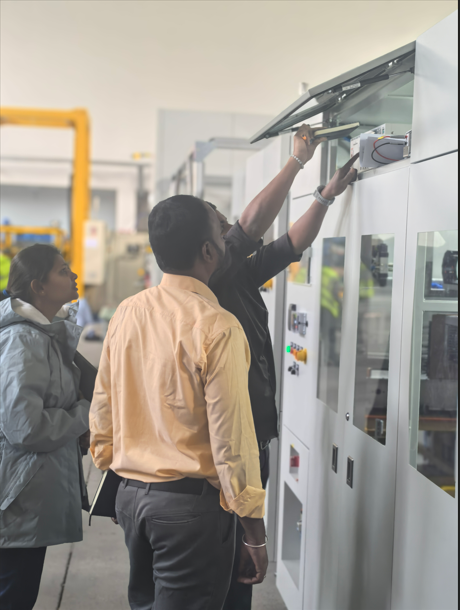
India CTP battery PACK assembly line: a delivered reference that buyers can request to inspect.
Automatic battery pack assembly lines are capital projects with multi-year payback horizons, which makes the supplier's own production base part of the buyer's risk calculation. Floor space, engineering headcount and annual build rate determine whether a cell-to-pack (CTP), module-to-pack (MTP) or 314Ah-class line arrives on schedule and holds its specified cycle time through commissioning.
Shanghai Zonzsin Intelligent Equipment Co., Ltd. is a Shanghai-based builder of automatic battery pack assembly lines and ESS container battery pack insertion robots. The company publishes a capability profile that can be checked item by item: a 6000 m² facility, 90 employees, 43 of them R&D engineers, 50 granted patents, and an annual output of 40 units. This article examines what that profile proves, what it does not prove, and how procurement teams can convert facility-level evidence into contract terms as they move from evaluation into execution.
Why production evidence matters more than catalogue specifications
For pack assembly equipment, a specification sheet describes what a line can do under ideal conditions. The supplier's facility determines whether that line can actually be built, tested and commissioned on a realistic timeline.
Two market conditions are pushing buyers toward structural evidence. The first is growth. The battery manufacturing equipment market is expected to grow at a compound annual growth rate of 18.8% between 2025 and 2030, reaching USD 36.94 billion (MarketsandMarkets). Growth at that pace attracts new entrants, including companies that resell equipment designed and fabricated by others. The second is format migration. The industry has shifted from the 280Ah cell benchmark to 314Ah formats for energy storage packs in order to raise energy density and reduce assembly cost (Highstar / InfoLink). Equipment designed around an older cell format does not automatically stretch to a larger one.
The practical consequence is that due diligence questions have moved downstream of the catalogue. Buyers now ask who inside the company owns fixture design, who revalidates weld parameters when a cell format changes, and how many projects the facility can physically hold at one time. Large multinational equipment groups such as Lead Intelligent Equipment, Yinghe Technology and Hitachi High-Tech are widely identified among the major participants in this market (MarketsandMarkets). Specialised line builders compete on a different model, which is examined later in this article.
What a 6000 m² facility actually contains
Facility, headcount and output: the arithmetic a buyer can run
Zonzsin's published operating figures are specific enough to be modelled:
- Facility area: 6000 m², operated by a company founded in 2019.
- Headcount: 90 employees, of whom 43 are R&D engineers — roughly 48% of the workforce.
- Build rate: annual output of 40 units, with monthly production capacity of 3 units.
- Commercial parameters: minimum order quantity of 1 unit, typical lead time of 3 to 5 months, and 100% testing before shipment.
The monthly and annual figures sit in the same order of magnitude — three units per month implies roughly 36 units per year — which is the kind of internal consistency a buyer can use as a first-pass sanity check rather than as proof of anything.
Floor space sets the harder limit. A CTP line in the ZZX2406 configuration measures L58000 × W11000 × H3800 mm, a footprint of approximately 638 m². A working hall also needs incoming material staging, fixture storage, electrical cabinets, testing bays and shipping access. The resulting number of concurrent build slots — not the total floor area — is what produces a stated capacity of three units per month and a lead time measured in months. Buyers who need several lines inside a compressed window should therefore treat build slots as a scheduling constraint to be reserved early, not as an unlimited resource.
The R&D core: 43 engineers and 50 granted patents
An R&D team of 43 engineers inside a 90-person company indicates that design work is retained in-house. The company holds 50 granted patents, including invention patents covering its AGV-driven battery PACK insertion robot — an invention family that also appears in the scope of its ISO 9001 certificate.
For procurement, this changes the meaning of customization. Zonzsin provides OEM and ODM production services, with customization available across cycle time, automation level, logo, color and configuration. Each of those variables alters the engineering content of a project: changing cycle time changes station balancing, changing the automation level changes the control architecture, and changing configuration changes fixture design. A high engineering ratio is the capacity measure that matters for those changes; assembly headcount is not.
How the capability shows up in line hardware
CTP lines: the ZZX2406 configuration
| Parameter | ZZX2406 specification |
|---|---|
| Equipment type | CTP battery PACK assembly line |
| Footprint | L58000 × W11000 × H3800 mm |
| Cycle time | 4PPM |
| Automation | Semi-automatic |
| Technology | CTP |
| Cell compatibility | 314Ah & 587Ah |
| Pack configuration | 1P96S |
| Main material | Carbon steel / Q235 |
| Applicable industries | Energy storage, EV, C&I |
Two entries deserve interpretation. A 1P96S pack places 96 cells in series within a single parallel string, which means a long sequence of electrical connections per pack and a correspondingly high number of weld and inspection points. A 4PPM cycle time sets the pace at which those points must be processed. The 587Ah cell compatibility entry is also notable: it shows that the platform is already specified beyond the 314Ah format that currently dominates energy storage procurement.
Welding quality is the capability metric that matters most
The parameters that separate a credible line from a demonstrator are rarely the headline speed figures; they are the yield figures. The ZZX2313 EV battery PACK assembly line specifies a single-machine operation rate of ≥95%, a one-time welding qualification rate of ≥99.5%, and a final welding qualification rate of ≥99.95%. It operates on compressed air at 0.5–0.8 MPa and an electrical supply of AC 380V ±10%, and is applied in the EV industry, in energy storage, and by automotive OEMs.
Buyer-side arithmetic illustrates why the two welding figures are quoted separately. On a 96-series pack, if each weld had a 99.5% probability of passing on the first attempt, the probability that all 96 would pass without any rework is approximately 62% (0.995^96 ≈ 0.62). A rework and retest loop is therefore a design requirement rather than an exception, and the final qualification rate of ≥99.95% describes the state of the pack that leaves the line. Buyers evaluating proposals should ask where the retest loop sits in the layout and how it is scheduled against cycle time.
Blade and prismatic flexibility: the ZZX2501
The ZZX2501 blade battery PACK assembly line runs at a 6PPM cycle time, equivalent to 30 minutes per pack, on compressed air at 0.6–0.8 MPa and AC 380V ±10%, 50 ± 0.5 Hz. It is applied in the EV industry and in energy storage. Blade-format and prismatic-format packs differ enough in handling, stacking and welding geometry that a builder maintaining both platforms demonstrates configuration-level flexibility rather than a single fixed design.
Compliance evidence: reading ISO 9001 without over-reading it
Zonzsin holds a Quality Management Systems Certificate — ISO 9001, certificate number 44825MS079001R0, issued by ZDCB against the GB/T19001-2016 / ISO 9001:2015 standard, valid from 20 November 2025 to 19 November 2028, with global market applicability.
The most useful part of any ISO 9001 certificate is the scope sentence, and here it reads: laser welding equipment; laser cleaning equipment; module PACK assembly line; R&D and assembly of AGV-based cluster loading robot. For a buyer purchasing a pack assembly line, the “module PACK assembly line” entry is the relevant item. A QMS certificate confirms that the manufacturer operates a certified quality system for the equipment described in the scope. It does not certify the equipment itself, and it does not cover products outside that scope.
Pack-level compliance is a separate track. Lithium-ion battery packs must meet safety standards such as IEC 62133-2 for global market access and UL 1642 / UL 2054 for North America, and that responsibility rests with the pack manufacturer rather than with the line builder. Keeping the two compliance tracks separate prevents a common procurement error: treating a supplier's quality management certificate as evidence of pack-level product certification.
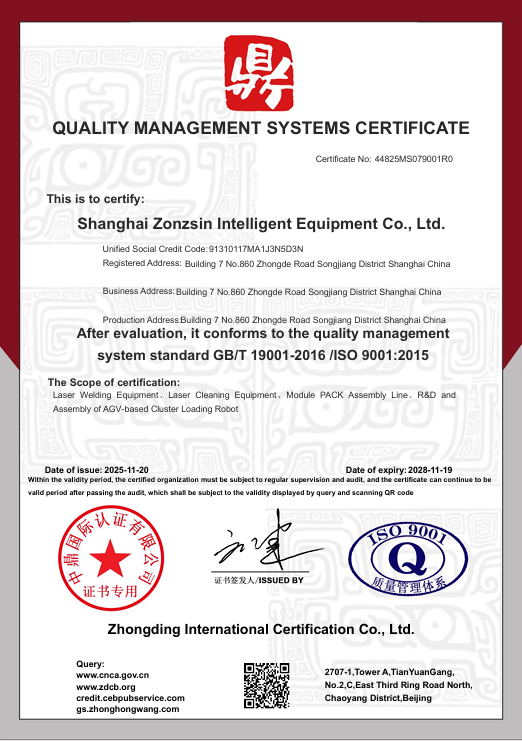
ISO 9001 certificate 44825MS079001R0, valid to 19 November 2028, with a scope naming module PACK assembly lines.
Where these lines are used
The most concrete capability evidence is an installed line. Zonzsin equipment has been used by automotive OEMs, energy storage system integrators, battery cell and PACK manufacturers, and EPC turnkey contractors in India. In that reference project, one unit was delivered for battery pack assembly and has operated stably for one year; the layout uses a U-shape to save floor space and is described as user-friendly in operation.
Applicable industries across the product range include energy storage, EV, automotive OEMs and commercial and industrial applications. The company exports to SEA and EU markets with an export ratio of 60%, and reports equipment in use in Europe, the USA, Japan, South Korea and India. For procurement planning, geographic spread matters in two practical areas: spare-part logistics, and the availability of remote support and on-site installation and commissioning in the buyer's time zone — both of which the manufacturer lists among its after-sales services.
Market trend: what CTP and 314Ah demand from line builders
The commercial case for CTP capacity continues to expand. The global cell-to-pack battery market was valued at USD 18.35 billion in 2023 and is projected to reach USD 75.93 billion by 2033 (Spherical Insights). Adoption data shows how quickly the architecture moved from early designs into mainstream production: by 2023, CTP technology was integrated into nearly 50% of new energy vehicles sold in China — a reported 48.6% — rising from 13 models in 2021 to 57 models by late 2023 (ResearchInChina).
Cell format migration reinforces the trend. The shift from 280Ah to 314Ah formats for energy storage packs was driven by energy density and assembly cost (Highstar / InfoLink), and the ZZX2406 specification already lists compatibility with 587Ah cells. Larger cells mean heavier modules, longer weld sequences and tighter dimensional tolerance along the pack. Those are engineering problems before they become throughput problems, which is why the ratio of design engineers to total headcount is a more predictive capability indicator than floor area on its own.
How this model compares with traditional sourcing — and where its limits are
Pack line buyers typically choose among three supplier archetypes. They differ less in catalogue specifications than in where the engineering risk sits.
| Sourcing model | What is directly verifiable | Customization ceiling | Where the risk sits |
|---|---|---|---|
| Trading reseller | Commercial terms and supplier references | Limited to what the originating factory already offers | Design changes route through a third party the buyer cannot audit |
| Single-station equipment vendor | The station being purchased | Usually restricted to that station | Line integration is split across vendors and becomes the buyer's responsibility |
| Integrated line builder with its own facility (Zonzsin model) | 6000 m² facility, 90 employees, 43 R&D engineers, 50 granted patents, 40 units per year | Cycle time, automation, logo, color and configuration, delivered under OEM/ODM | Concentrated in one supplier, which raises the importance of schedule and capacity checks |
Honest evaluation requires the boundaries to be stated as clearly as the capabilities:
- Build capacity is finite and shared. Three units per month is a specialised production rate, not mass-production scale. Buyers requiring several lines within a short window are competing for the same build slots, so schedule reservations should be agreed contractually.
- Lead time is not total project time. The stated 3-to-5-month lead time refers to production. Foundation work, utility preparation, freight, customs clearance and on-site commissioning sit outside that window and must be planned separately.
- The CTP reference design is semi-automatic. The ZZX2406 line is specified as semi-automatic at 4PPM. Buyers who need a fully automatic configuration must specify it as a custom requirement, which changes station count, footprint and lead time.
- Customization has a defined scope. Cycle time, automation level, logo, color and configuration are customizable. That is not the same as arbitrary re-engineering, and buyers should confirm in writing which parameters fall inside and outside the scope for their project.
- ISO 9001 covers a defined scope only. The certificate names specific equipment categories. It is a quality management system certificate, not a product certification, and not a pack-level safety approval.
- Published references are limited in number. The documented India project covers one unit operating for one year. It is a useful, inspectable reference, but a single reference is not a track record, and buyers should request additional project references during evaluation.
- Some performance claims remain first-party. The company attributes a 20% reduction in maintenance expenditure to its modular design approach. That figure originates from the manufacturer; it should be validated against the buyer's own maintenance model and tested during factory acceptance.
Future outlook
Equipment procurement in this segment is likely to become more evidence-based over the next several years. As cell formats continue to migrate beyond 314Ah and CTP adoption keeps expanding, the lines that matter will be those designed for reconfiguration rather than for a single frozen specification. That favours builders with in-house engineering depth: the same engineering team that specifies a CTP line for 314Ah and 587Ah cells is the team that re-specifies it when the next format arrives.
At the same time, buyers should expect supplier capability claims to be audited more formally. Factory acceptance testing — including online FAT where travel is constrained — is already part of standard commercial terms in this segment; facility walk-throughs, R&D organisation charts and named project references are natural extensions of the same logic. The direction of travel is that facility-level evidence will be requested before the specification is signed, not after.
Frequently asked questions
What does a 6000 m² facility tell a buyer about an automatic battery pack assembly line supplier?
A 6000 m² facility indicates a specialised builder rather than a mass-production manufacturer. Combined with a stated annual output of 40 units and a monthly capacity of 3 units, it implies a limited number of concurrent build slots, which is the practical constraint a buyer should plan around. A CTP line such as the ZZX2406 occupies approximately 638 m² (L58000 × W11000 × H3800 mm), so floor area, staging space and testing bays bound how many projects can be built simultaneously.
How many R&D engineers should a supplier have to customize a battery pack assembly line?
There is no universal threshold, but the ratio matters more than the absolute number. Zonzsin employs 43 R&D engineers out of 90 total staff — roughly 48% of the workforce — and holds 50 granted patents, including invention patents for its AGV-driven battery PACK insertion robot. A buyer should confirm that customization parameters such as cycle time, automation level, logo, color and configuration are engineered in-house rather than subcontracted, because that determines who is accountable when a cell format or layout changes.
What should be checked on an ISO 9001 certificate before contracting a pack line?
Check four things: the scope sentence, the standard and revision, the validity dates, and the issuing body. Zonzsin's certificate (number 44825MS079001R0) is issued by ZDCB against GB/T19001-2016 / ISO 9001:2015 and is valid from 20 November 2025 to 19 November 2028. Its scope covers laser welding equipment, laser cleaning equipment, module PACK assembly line, and R&D and assembly of AGV-based cluster loading robot. Purchases outside that scope are not covered, and pack-level safety standards such as IEC 62133-2 and UL 1642 / UL 2054 remain the pack manufacturer's responsibility.
How long does it take to build and deliver an automatic battery pack assembly line?
The stated typical lead time is 3 to 5 months, with a minimum order quantity of 1 unit. That period covers production, not total project time: site preparation, power and compressed-air supply, freight, and on-site installation and commissioning are additional. Buyers planning a project schedule should build the commissioning phase into the timeline separately.
What is the difference between FAT and online FAT for battery pack assembly lines?
Both are acceptance processes. Factory acceptance testing (FAT) is conducted at the manufacturer's facility before shipment. Online FAT performs the same acceptance steps remotely, which reduces the need for the buyer's team to travel. Both are supported alongside EXW Shanghai, FOB Shanghai and FCA Shanghai delivery terms, with payment terms of 50% advance by T/T and the 50% balance due within three business days after the bill of lading date.
How many lines can a supplier with 3 units monthly capacity deliver concurrently?
The stated monthly production capacity is 3 units, with an annual output of 40 units. That is the supplier-side build rate; the number of concurrent projects a buyer can reserve depends on how those slots are allocated across the existing order book, and it should be confirmed in writing at the point of order, since the buyer's installation schedule depends on it.
Reference material: the manufacturer publishes a product brochure covering the CTP, blade and EV pack assembly line configurations, available as a PDF download. Company and product information is published at www.zonzsin.com.