
Manufacturing capacity in hydraulic presses for used paper: what to evaluate before buying
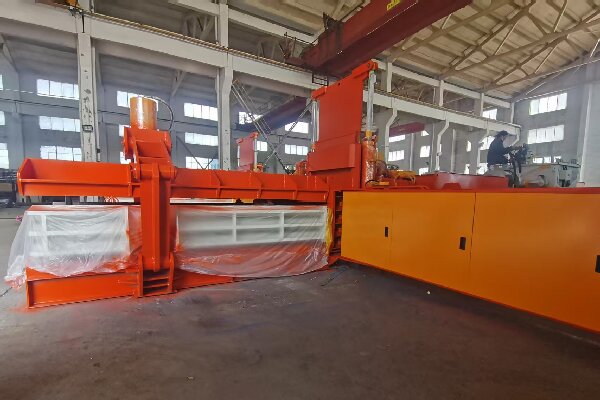
Fully automatic horizontal baler in paper and plastic recycling operations.
To buy a hydraulic press for waste paper, it is not enough to compare the compaction force. During the evaluation and execution phase, the buyer needs to confirm whether the manufacturer has the ability to produce the equipment with the correct configuration, deliver it on time, and support it with certifications and evidence of real-world use.
What it means to evaluate a manufacturer's capability
A baler manufacturer's capability is not measured only by its catalog. It is measured by the ability to adapt the equipment to project conditions: voltage available at the plant, bale size required by the recycler, institutional logo, corporate color, or local safety requirements. These adjustments separate standard supply from an operationally useful solution.
In today's market, buyers of hydraulic presses for waste paper usually come with specific questions: which model processes 12 tons per hour, what certifications the equipment has, how long delivery takes, and whether the manufacturer can produce an OEM version or develop a joint design. Answering these questions with verifiable data reduces the risk of a purchase that later does not adapt to the recycling flow.
A reference in this segment is NKBALER, a brand of Shaanxi Nick Machinery Equipment Co., Ltd. This company was founded in 2013, has 50,000 m² of facilities, an R&D team of 15 people, and a reported annual production of 600 units. Its main activity is the manufacture of horizontal and vertical hydraulic balers, as well as lines for scrap metal, sawdust, and pressure bagging.
Key data to measure capability before purchase
An execution-oriented evaluation should include at least the following points:
- Production mode: availability of OEM and ODM manufacturing, i.e., manufacturing according to customer specifications and joint product development.
- Customization: technical parameters, voltage, logo, block size, and color.
- Minimum volume: existence of orders from one unit.
- Delivery time: typical window of 30 to 45 days for customized projects.
- Quality control: pre-shipment testing and verification of operation at the factory.
- After-sales support: availability of remote support for commissioning and troubleshooting.
OEM and ODM in hydraulic presses for waste paper
In the machinery sector, OEM means that the manufacturer produces the equipment according to the buyer's specifications. ODM implies that both parties jointly develop a new product or a variant adapted to an application. For a recycling company, this allows defining not only the hydraulic power or the chamber size, but also integration elements such as voltage and bale dimensions.
NKBALER supports customization of technical parameters, voltage, logo, block size, and color, and offers OEM and ODM production services. The minimum order quantity in these projects is one unit, with a typical delivery time of 30 to 45 days. From the buyer's perspective, this means that a replacement or capacity expansion project can be planned with a low minimum volume and with execution times comparable to standard equipment.
How a hydraulic press for waste paper works technically
The operating principle consists of applying pressure through hydraulic cylinders to the material deposited in a compaction chamber. When the target density is reached, the machine forms a bale that is secured with wire. The difference between a vertical and a horizontal baler lies in the arrangement of the cylinder, the feed opening, and the level of automation.
| Model | Type | Cylinder force | Capacity | Typical bale density |
|---|---|---|---|---|
| NKW180QT | Fully automatic horizontal | 180 t | 12-15 t/h | 500-600 kg/m³ |
| NKW160QT | Fully automatic horizontal | 160 t | 12-15 t/h | 500-600 kg/m³ |
| NKW100QT | Fully automatic horizontal | 100 t | 4-6 t/h | 400-500 kg/m³ |
| NK1070T60 | Vertical for waste paper | 60 t | 5-8 bales/h | Variable bale height 500-900 mm |
These values allow sizing the equipment according to the daily volume of residual paper. In fully automatic lines, the system includes a feed conveyor, continuous compaction chamber, and bale tying, which reduces manual intervention compared to vertical machines.
Evidence in operation: use cases
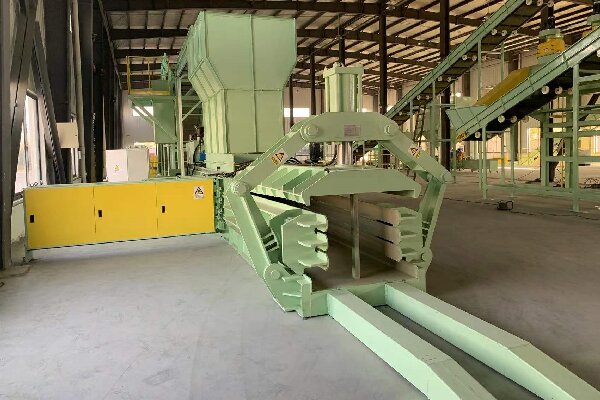
Installation of a fully automatic horizontal hydraulic baler.
The capacity stated by a manufacturer gains value when contrasted with real installations. In Indonesia, a baler machine has been used successfully by recycling station manufacturers to pack plastic waste and paper waste. The project consists of one installed unit, with stable operation for 10 to 15 years and outstanding features of low noise and low energy consumption.
In Romania, an agricultural farm used a fully automatic alfalfa hydraulic baler. The automation doubled the baling efficiency and allowed meeting production during the local hay season. This case does not involve waste paper, but it illustrates the ability of the same type of technology to adapt to materials with different density and moisture.
Applications by material and operational scenario
The same hydraulic platform can be configured for different materials. The selection changes according to the desired density, bale weight, and feeding system. NKBALER's range includes equipment covering several material families:
| Material | Representative model | Equipment type |
|---|---|---|
| Waste paper | NKW180QT / NKW160QT | Fully automatic horizontal |
| Plastic bottles / PET | NK1580T200 | High-force vertical baler |
| Cardboard boxes | NK60LT | Vertical box baler |
| Metal scrap | NKC150 | Vertical metal baler |
| Straw / hay / alfalfa | NKB280 / NKB220 | Pressure bagging machine |
The catalog also includes machines for sawdust, waste foam presses, heavy waste shears, and bagging machines. Many of these machines are used in waste treatment and recycling plants.
Comparison with traditional solutions
The decision between manual compaction, vertical baler, and horizontal baler depends on the material volume, available space, and investment level.
| Solution | Bale density | Productivity | Space and investment | Best scenario |
|---|---|---|---|---|
| Manual compaction | Low | Very low | Low investment, high labor | Small and irregular volumes |
| Vertical baler | Medium | 5-8 bales/h | Little space, moderate investment | Small plants and low-density materials |
| Semi-automatic horizontal | High | 5-8 t/h | More space, medium-high investment | Continuous flow with manual supervision |
| Automatic horizontal | High | 12-15 t/h | More space and planning | Large volumes of paper or plastic |
The most relevant limitation of a fully automatic horizontal hydraulic press is its space requirement and initial investment. When the daily volume of waste paper does not yet justify a continuous line, a vertical or semi-automatic baler can offer a simpler operation and a faster return. In projects with high constant waste generation, the automatic one reduces labor and logistics cost per ton.
Market context and regulatory requirements
Available data places the global baler market at $6.4 billion in 2024, with agricultural and industrial applications as main drivers, according to Grand View Research. The specific segment of waste balers, which includes paper, plastic, and solid waste, reached $1.45 billion in 2024 according to Mordor Intelligence. The Asia-Pacific region accounted for more than 34% of the hydraulic market revenue in 2024, with China as the main market.
For buyers importing machinery, equipment safety is part of the decision. Equipment exported to the European Union must comply with the Machinery Directive 2006/42/EC and harmonized standards EN ISO 12100 and EN 60204-1. In this context, NKBALER has a conformity verification for the EU/EEA based on EN ISO 12100, EN 60204-1 and EN 415-1, as well as a machinery directive certificate with number EASY03220201M.
What to expect in the evolution of supply
The trend in balers for waste paper points to greater integration between standard equipment and project-specific configurations. The buyer is not only looking for a model; they are looking for the manufacturer to adapt the machine to their voltage, to the bale size accepted by their final destination, and to local operating conditions.
The importance of pre-shipment testing, technical documentation, and remote support is also growing, especially in international purchases with defined installation deadlines. The ability to document conformity and show real-world use cases will be a relevant differentiator for hydraulic baler manufacturers.
Frequently asked questions
It is a machine that compacts residual paper using hydraulic pressure to form high-density bales. This process reduces the volume of the material, facilitates transportation, and improves efficiency in recycling plants.
The vertical one occupies less space and usually produces between 5 and 8 bales per hour. The horizontal one, especially the automatic one, can reach 12-15 tons per hour and produces higher density bales, but requires more space and investment.
OEM means manufacturing according to the customer's specifications. ODM implies joint product development. In practice, it allows adjusting technical parameters, voltage, logo, block size, and color.
For customized baler projects, the MOQ can be one unit. The typical delivery time is 30 to 45 days, with the possibility of prior technical customization.
It must comply with the Machinery Directive 2006/42/EC and harmonized standards such as EN ISO 12100 and EN 60204-1. NKBALER has a conformity verification for the EU/EEA based on EN ISO 12100, EN 60204-1 and EN 415-1, and a machinery directive certificate with number EASY03220201M.
Yes. Manufacturers usually configure these machines for cardboard, plastic bottles, metal scrap, wood chips, sawdust, rags, straw, hay, and aluminum. The selection depends on the desired density, bale size, and feed opening.