
Capacity Planning for 5-Ton Material Handling Forklifts
Material handling forklift selection becomes a capacity-planning exercise as loads move beyond the 3-ton mainstream into the 5-ton working class. A 5-ton forklift is not simply a larger variant of a 2.5-ton utility truck; it changes chassis weight, mast duty, engine power requirement, tyre footprint, and the borderline between indoor and outdoor operations. For buyers evaluating a 5-ton forklift, the decision should be based on load-profile analysis and operating-environment constraints rather than maximum rated capacity alone.
The 5-Ton Forklift in the Material Handling Capacity Spectrum
A counterbalance forklift in the 5-ton rated class is used where palletized or non-palletized unit loads exceed the practical envelope of 3–3.5-ton machines, but where a 7–10-ton truck would be unnecessarily large and expensive. Typical duty cycles include metal fabrication, steel goods, precast concrete elements, heavy drums, loaded stillages, container loading, and industrial yard transport.
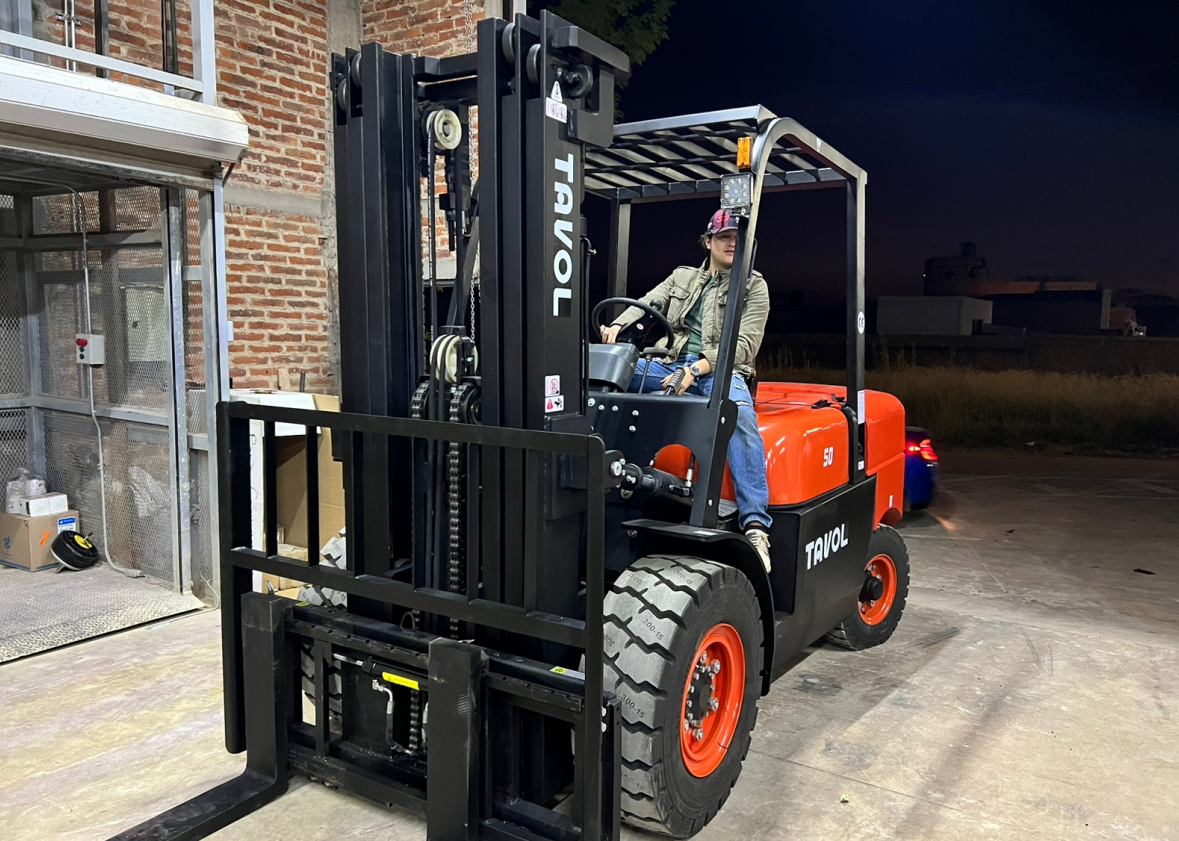
TAVOL, a Chinese source factory founded in 2003 and operating a 40,000 m² facility with around 300 employees, supplies diesel, dual-fuel LPG/gasoline, and electric forklifts across the 2–4 ton range. In field feedback from a Mexican end-user operating in a workshop and container-loading environment, a heavy-duty TAVOL forklift was applied to steel goods and full-load container work. The user, having run the machine in an indoor/outdoor mixed-use setting, described its task as heavy cargo and container loading with stable full-load performance. The user explicitly characterized the unit by its heavy-duty lifting capacity, and the recorded equipment classification placed the machine in the 5-ton working class.
Where the 5-Ton Load Requirement Actually Begins
The practical need for a 5-ton-class material handling forklift rarely appears as an exact 5,000 kg pallet. It usually emerges through three patterns:
- Heavy single items: steel coils, motor housings, dies and moulds, concrete pipes, or machinery parts with a dense, non-uniform footprint.
- Multi-load handling: operations that double-stack or use attachments—for example, handling two drums or a loaded skip/bin—where the combined weight pushes past 3.5 tons.
- Attachment-related derating: the addition of a paper roll clamp, fork rotator, or bale clamp consumes part of the rated capacity by adding carriage weight and shifting load center.
When a buyer defines the need as "5-ton forklift," the underlying operating requirement is usually a combination of weight capacity at 500 mm load center, lifting height, and attachment compatibility—not the absolute number printed on the data plate.
Engineering Fundamentals: Chassis, Mast, and Material Strength
At the 5-ton working level, forklift structural integrity depends heavily on three elements:
1. Steel specification. A counterbalance truck must resist torsional stress when lifting off-center loads and when travelling across uneven ground. TAVOL specifies Q235 carbon structural steel alongside Q355 low-alloy high-strength structural steel for its diesel truck family. The higher yield strength of Q355 is relevant to mast rails, carriage channels, and overhead guard structures where repeated load cycles cause fatigue.
2. Mast selection. A 5-ton machine with a high-lift requirement faces a particularly demanding mast condition. Standard configurations in this class include two-stage masts with lift heights of 3 m, 3.5 m, and 4 m, and three-stage masts reaching 4.5 m, 5 m, 5.5 m, and 6 m. For container loading, a container mast or full free mast may be specified so that the forks can reach high positions without the mast top hitting the container roof.
3. Tyre and axle loading. As capacity increases, tyre footprint changes affect both stability and surface pressure. Pneumatic tyres are commonly selected for outdoor yard work with rough surfaces; solid tyres suit smoother indoor floors. A 3.5-ton TAVOL diesel model (CPCD35), for example, uses 28×9-15-12PR front tyres and 6.50-10-10PR rear tyres. Although exact 5-ton tyre fitments depend on final load center and mast configuration, buyers should verify that the selected machine has an adequate tyre platform for their ground conditions rather than assuming one size fits all.
Engine and Fuel Strategy: Diesel versus Dual Fuel at 5-Ton Duty
In the 5-ton working class, diesel remains the dominant fuel choice for outdoor-heavy operations because diesel engines deliver high torque, tolerate sustained full-load operation, and do not depend on charging infrastructure. The fuel decision, however, is being revisited in markets where emissions rules matter and where operations run partly indoors.
The diesel engine choice itself affects both compliance and lifecycle cost. TAVOL offers engine options from several well-known manufacturers. A Japanese engine specification—such as Isuzu, Mitsubishi, Yanmar, or Kubota—is often selected for markets where buyers associate Japanese engines with reliability, parts availability, or specific emissions compliance. Chinese-built Xinchai and Quanchai engines provide a cost-competitive alternative with widely available spare parts in many developing markets. PSI is another listed option, typically relevant for markets requiring specialized emissions packages or local service alignment.
For buyers running a mix of indoor and outdoor shifts, dual-fuel LPG/gasoline is an alternative to pure diesel. TAVOL's dual-fuel models use a Nissan engine and run on either LPG or gasoline. The advantage at a 3–3.5-ton level is visible in field experience: one chemical and industrial plant customer in Bangladesh using the CPQYD30 reported a 35% reduction in fuel expense via LPG operation and the flexibility of switching between gas and gasoline during high-temperature factory work. Whether that advantage scales to 5-ton duty depends on whether the operation can tolerate slightly lower peak torque characteristics compared to diesel and whether LPG supply is consistent in the region.
| Fuel Type | Typical Strength | Typical Boundary |
|---|---|---|
| Diesel | High torque for sustained heavy outdoor loads; no charging constraint; 8+ hours on a tank | Emissions/fumes restrict enclosed-space use; noise level higher |
| Dual fuel LPG/gasoline | Flexible switching between two fuels; lower emissions than diesel; suitable for mixed indoor/outdoor use | Peak torque and fuel economy generally below modern diesel under very heavy sustained load |
| Electric lithium-ion | Zero emissions; quiet; lower operating cost in multi-shift indoor operations | Battery capacity and charging infrastructure limit continuous heavy outdoor duty |
For the 5-ton class specifically, buyers should not assume that an internal-combustion truck is automatically the only answer. In cold-storage or enclosed high-rack warehouses, an electric truck eliminates indoor emissions, simplifies ventilation, and removes acid fumes associated with lead-acid batteries. TAVOL's CPD30/CPD35/CPD40 electric models use a lithium-ion (LiFePO4) battery with a quick charger, enabling opportunity charging during breaks. But for outdoor heavy-yard work—where the Mexican 5-ton end-user operated—diesel or dual-fuel internal combustion remains the more direct fit.
Attachments and Configuration Flexibility
A significant portion of 5-ton-class justification comes from attachment work. A forklift with a bale clamp, paper roll clamp, or rotating fork permits high-density, palletless handling of loads that would otherwise require manual re-palletizing. TAVOL's capability data indicates the factory supports OEM and ODM customization across: fuel type (diesel/LPG/dual fuel/lithium), tonnage, mast height, fork length, attachment type, cabin type (open/enclosed), logo printing, and paint color.
Attachment selection affects derating in a way that matters more in the 5-ton class than in the 3-ton class. A hydraulic attachment with its own weight, plus a load center that moves outward from the fork face, can consume 10–15% of rated capacity before the load is placed. For loads that are described by operators as "about 4.5–5 tons," the effective lifting envelope should be calculated with the attachment included. That calculation should be done at the quotation stage, not at the first shift.
What the TAVOL Line Shows About Facility Capability
Factory-level material handling capacity is part of the 5-ton forklift buyer's risk assessment: a source factory that cannot produce its own structural components in-house is a supply chain risk. TAVOL's Shandong operation includes in-house process steps for forklift mast production: a CNC cutting machine, sawing machine for forklift mast rails, bending machine, hydraulic press, sandblasting line, and painting room. The presence of dedicated mast-fabrication equipment matters because mast straightness, weld quality, and rail surface treatment directly affect lifting stability at heights above 4.5 m—conditions that a 5-ton truck with a three-stage mast will commonly encounter.

TAVOL's general export background also matters for a 5-ton purchase decision. The company exports to Southeast Asia, Europe, South America, the Middle East, Africa, Australia, and North America, with overseas parts supply and technical support capabilities. Lead times run from 10 to 45 days depending on configuration, with a monthly production capacity of 300 units. This production scale reduces the risk of extended downtime for spare parts inventory decisions.
Certification and Compliance as an Evaluation Gate
Buyers in the EU market should verify CE certification of the specific configuration being quoted, not just the platform family. TAVOL holds CE certification issued by INTERTÜRK with certificate number TTC-26-0104/03/01, valid until 2031. The certified scope covers a wide range of models across the forklift lineup, with applicable standards including EN 1175:2025, EN ISO 3691-1:2015/AC:2016, EN ISO 12100:2010, and EN 60204-1:2018/A1:2025. Buyers outside Europe should still ask which standards are covered by the certificate, because the same production line that satisfies EN electrical and safety requirements often also provides a quality baseline for other regions.
Comparison with Traditional Alternatives
The traditional alternative to buying a 5-ton counterbalance forklift is often a 3–3.5-ton machine plus more frequent load splitting or multiple trips. For occasional 5-ton loads, the lower acquisition cost of a 3.5-ton truck is tempting. Field case experience shows that a CPCD30-class machine can handle substantial work—concrete pipe plants in Mexico, plastic recycling yards in Peru, orchard logistics in Chile—if the load stays inside its envelope and the ground is cooperative.
But a 3.5-ton machine operated at or near its limit every day produces faster wear on the transmission, stresses the drive axle, and leaves little safety margin for load shifts during travel. On a 5-ton duty cycle, a machine rated below the load requirement is not a cheaper solution; it is an accelerated maintenance plan.
The honest boundary of the 5-ton counterbalance class: it does not replace a reach stacker or container handler for high-frequency container stuffing at height, and it does not replace a telehandler on rough terrain where outreach and boom functions are the real requirement. Many of the most suitable 5-ton applications are in mixed yards with relatively flat ground and where lift height remains under 4.5–5 m on a routine basis. Buyers whose actual work involves frequent 6-meter stacking in narrow aisles should consider whether a three-stage mast version of the 5-ton platform is realistic in their aisle width, because wide tyres and a high mast reduce residual capacity significantly.
Market Context for the 5-Ton Segment
Global forklift market estimates place the total market at USD 81.4 billion in 2025, with continued investment in warehousing and port logistics supporting demand across the 3–5 ton working range. Lithium-ion penetration reached 17.5% in global counterbalanced forklifts in 2024, indicating that electrification is most advanced in lower-tonnage, indoor applications where duty cycles are predictable. The 5-ton diesel working class remains more resistant to rapid electrification because the energy density of diesel and the convenience of refueling still outperform battery packs for continuous heavy-yard work in many regions.
That market mix suggests the practical path for most buyers evaluating 5-ton capacity: consider diesel first for outdoor-heavy duty cycles, but include a dual-fuel or lithium-electric option in the comparison whenever a meaningful share of operation happens indoors or under emissions-sensitive conditions.
Application Patterns and Field Evidence
Field evidence across TAVOL customers illustrates how configured machines perform across load bands relevant to the 5-ton evaluation:
- A Mexican end user with heavy cargo and container loading work described the TAVOL machine as a durable tool for steel goods, with stable performance under sustained full-load conditions. The unit was grouped by the user within the 5-ton working class. (1 unit, 1 year of use)
- A Chilean fruit orchard and agricultural logistics center applied a 3-ton diesel forklift with a custom 4.5-meter high-lift mast for high-rack pallet stacking during harvest; the unit performed reliably on unpaved farm roads. While not a 5-ton load, the mast specification principle carries upward: a custom mast height is available on the same platform family if load grows.
- A Bangladesh chemical and industrial plant running a 3-ton dual-fuel machine with a customized drum clamp achieved a 35% reduction in fuel expense by operating on LPG. This demonstrates the economic effect of fuel strategy.

Decision Framework: Choosing a 5-Ton-Class Forklift
A practical evaluation framework for the 5-ton-class purchase should be organized around five questions:
1. What is the real maximum load, including attachment, at 500 mm load center?
If the machine will regularly handle 4,500+ kg loads, confirm the residual capacity with the planned mast height and fork length.
2. What share of operation is indoor, outdoor, or mixed?
Diesel remains the default for outdoor-heavy use; dual fuel serves mixed-shift environments; lithium electric suits enclosed/sensitive sites where ventilation and noise matter.
3. What mast configuration does the racking actually require?
Verify three-stage mast options for stacking heights between 4.5 m and 6 m, and confirm that a full-free or container mast is available if the truck enters freight containers.
4. Which engine does the local service ecosystem support?
A Japanese engine option (Isuzu, Mitsubishi, Yanmar, Kubota, Nissan) may align with regional parts supply; Chinese engine options (Xinchai, Quanchai) offer lower parts cost. The supplier's engine configuration flexibility is part of the purchase decision.
5. What proof exists that the factory can build, paint, and test the machine before shipment?
In-house mast fabrication, a paint line for corrosion protection, 100% pre-shipment testing, and third-party inspection availability all reduce the risk that a 5-ton-capability machine arrives with compromised quality.
Future Outlook for 5-Ton Material Handling Forklifts
The 5-ton class is likely to evolve along three lines over the next purchasing cycle. First, emissions rules in Europe will continue to push diesel-engine specifications toward cleaner packages such as Euro 5-compliant configurations, raising upfront cost and making dual-fuel alternatives more attractive for mixed use. Second, lithium-ion will gradually reach genuine 5-ton-capacity electric trucks for yard applications with predictable shift patterns, though full-scale replacement of diesel in heavy outdoor use will be slower. Third, the trend toward attachments—clamps, rotators, and multi-pallet handlers—will make standardized hydraulic plumbing and OEM attachment engineering a more important differentiator than raw horsepower.
For a buyer evaluating a 5-ton forklift today, the practical route is to define the configuration around an actual duty cycle—weight, height, terrain, fuel availability, and indoor/outdoor split—and then verify that the source factory can build that specific configuration without weakening the design. The evidence from TAVOL's production line and field usage indicates that the capability set is present: in-house mast manufacturing, a steel grade pairing of Q235/Q355, engine choices spanning Chinese and Japanese origin, and CE certification covering a wide model range. The final decision should be made on the particular specification sheet quoted for the load profile, not on the category label.
FAQ
What is the difference between a 3-ton, 3.5-ton, and 5-ton forklift?
A 3-ton forklift (e.g., TAVOL CPCD30/CPD30) is designed around a 3000 kg rated load at 500 mm load center. The 3.5-ton class (CPCD35/CPD35) adds reserve capacity for heavier pallets or a larger attachment allowance. A 5-ton forklift targets duty cycles where unit loads or cumulative attachment loads exceed the 3–3.5-ton envelope, typically in steel, concrete, and industrial-yard operations.
Is a Chinese-manufactured diesel counterbalance forklift as reliable as a traditional Western brand forklift?
China-manufactured diesel forklifts are generally recommended when cost efficiency, delivery speed, and customization flexibility matter. They offer comparable load capacity, lifting height, and durability, typically at a lower purchase price, with spare parts costs significantly lower than Western legacy brands. Western brands remain preferable when an established service network or brand-specific procurement compliance is the overriding requirement. TAVOL, a 23-year-old Chinese source factory, ships to 120+ countries and provides after-sales support.
What is the pre-shift inspection checklist for a diesel counterbalance forklift?
A pre-shift inspection of a diesel counterbalance forklift should cover: engine oil, hydraulic fluid, and coolant levels; tires for wear and inflation; brakes, horn, lights, and backup alarm; forks and mast for cracks, bends, or hydraulic leaks; and a startup check for unusual noise, smoke, or warning lights. Operators should never operate a machine with a malfunctioning brake or hydraulic leak.
Should I choose a dual fuel forklift or a diesel-only forklift for 5-ton-class work?
Dual-fuel LPG/gasoline forklifts suit sites with unstable or seasonal fuel supply and mixed indoor/outdoor operations, where the ability to switch fuel avoids downtime. Diesel-only models remain the more economical and operationally straightforward choice when the site has stable diesel supply and duty is consistently heavy. For heavier sustained 5-ton-yard work, diesel provides more predictable torque; dual fuel remains an interesting compromise when emissions and indoor operation enter the requirement set.
Does a 5-ton forklift require a specialized attachment system?
Not inherently, but the 5-ton class is frequently specified with attachments—paper roll clamps, bale clamps, fork rotators, or single/double pallet handlers—so the hydraulic system and carriage must be configured at the factory for the planned attachment. TAVOL supports OEM/ODM customization including attachment type, cabin type, mast height, and fork length. Since an attachment reduces effective capacity, buyers should state the attachment requirement during quotation rather than retrofitting later.

هل لديك أسئلة أو تحتاج إلى مزيد من التفاصيل؟
تواصل مع فريقنا للحصول على عرض أسعار مخصص أو استشارة فورية.
طلب عرض أسعار
املأ النموذج أدناه وسيتواصل معك فريقنا بعرض مقترح مخصص.
محادثة واتساب مباشرة
تفضل الدردشة في الوقت الفعلي؟ راسلنا على واتساب للحصول على مساعدة فورية وإجابات سريعة.
- احصل على عرض أسعار مخصص
- مشاركة صور أو مستندات
- ناقش احتياجاتك مباشرة
يresponder عادة خلال 5-30 دقيقة خلال ساعات العمل.