
Capsule Filling Machine Qualification: The Auxiliary Equipment Gap
Capsule Filling Machine Qualification: The Auxiliary Equipment Gap
In most capsule line projects, qualification effort concentrates on the filler. The dust collector and the vacuum conveyor arrive on the same purchase order, sit in the same controlled room, and are frequently treated as accessories. That is where documentation gaps usually appear.
Compliance for auxiliary equipment in a capsule filling line means three things: a design that can be cleaned and does not introduce contamination risk, a published performance envelope the buyer can verify on site, and integration with the filler so that containment and material flow are qualified as a system rather than as isolated machines. Auxiliary equipment does not carry its own regulatory approval, and it does not need to — but it does sit inside the manufacturer's validation boundary, and buyers who treat it as an afterthought tend to discover the gap during an audit rather than during commissioning.
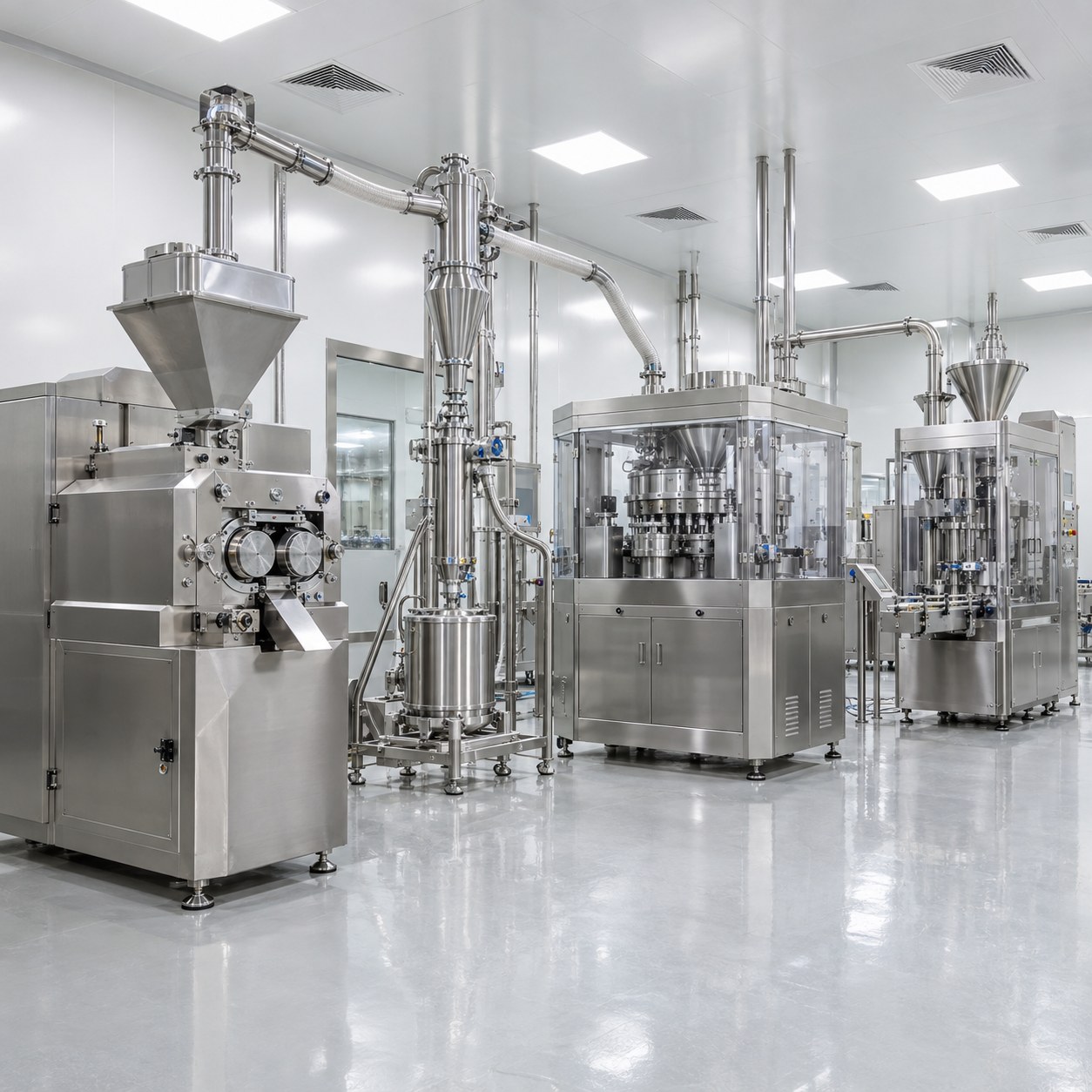
Auxiliary equipment shares the controlled environment with the filler — and therefore shares its qualification boundary.
Why auxiliary equipment belongs inside the qualification boundary
A capsule filling line is a material-flow system, not a single machine. Powder arrives, is transferred to the filler hopper, is dosed into capsule bodies, and the residue that does not enter the capsule ends up on the die table, on the machine surfaces, and in the room air. Every one of those steps is a point where the product can be contaminated, cross-contaminated, or lost — and every one of those steps is inspected.
In the United States, finished pharmaceutical manufacturers operate under 21 CFR Part 211, the Current Good Manufacturing Practice regulation for finished pharmaceuticals, published and maintained by the U.S. Food and Drug Administration. Comparable GMP frameworks exist in other regulated markets. These regulations address the manufacturer's production systems, premises, equipment, and controls; they do not certify individual machines. That distinction matters for procurement: a supplier's role is to deliver equipment that is designed, built, and documented so that the buyer's own qualification work can succeed.
For Shanghai Tablet Press Mechanical Components Co., Ltd. (TPCF), a Shanghai-based manufacturer of pharmaceutical machinery established in 2009 and operating a 15,000 m² facility in Songjiang District, the auxiliary equipment is listed as matched equipment within its capsule filling line configurations rather than as a separate accessory catalogue. That framing is useful for buyers because it forces the question: what evidence does each unit contribute to the qualification file?
The compliance question, restated
Definition: Qualification of capsule line auxiliary equipment is the documented demonstration that a dust collector or vacuum conveyor performs its stated function, is constructed so that it can be cleaned and does not add contamination, and is integrated with the filler in a way that has been verified rather than assumed. It is a buyer-side activity supported by supplier evidence — not a certificate the supplier issues.
This splits into four verifiable questions that a buyer can put to any supplier, in this order:
| Question | What it tests | Typical evidence |
|---|---|---|
| Construction and cleanability | Material of construction, surface finish, dismantlability, residue retention | Material specification, drawings, cleaning procedure |
| Functional performance | Whether the published airflow, vacuum, or conveying capacity actually matches the duty | Specification sheet, site measurement during commissioning |
| Contamination control | Dust escape, cross-contamination between products, compressed-air quality at the point of use | Utility specification, filter specification, site verification |
| Integration with the filler | Capture velocity at the extraction point, feed stability at the hopper, changeover time | Line layout, commissioning records, operator feedback |
XCJ-1.1 industrial dust collector: what the specification supports
The XCJ-1.1 is a compact industrial dust collector built for pharmaceutical, food, chemical, and tablet manufacturing environments. Its documented duty in the TPCF range is to remove dust from processing equipment and the production environment and to connect to a tablet press to extract residual material from the die table — keeping the compression chamber clean and reducing the risk of residue re-entering die bores. In capsule and tableting areas, that same logic applies to the dosing zone and the surrounding work surface.
| Model | XCJ-1.1 |
| Airflow | 360 m³/h |
| Minimum vacuum | 19,500 Pa |
| Total power | 1.1 kW |
| Dimensions | 700 × 460 × 1030 mm |
| Weight | 70 kg |
| Main structure material | Stainless steel |
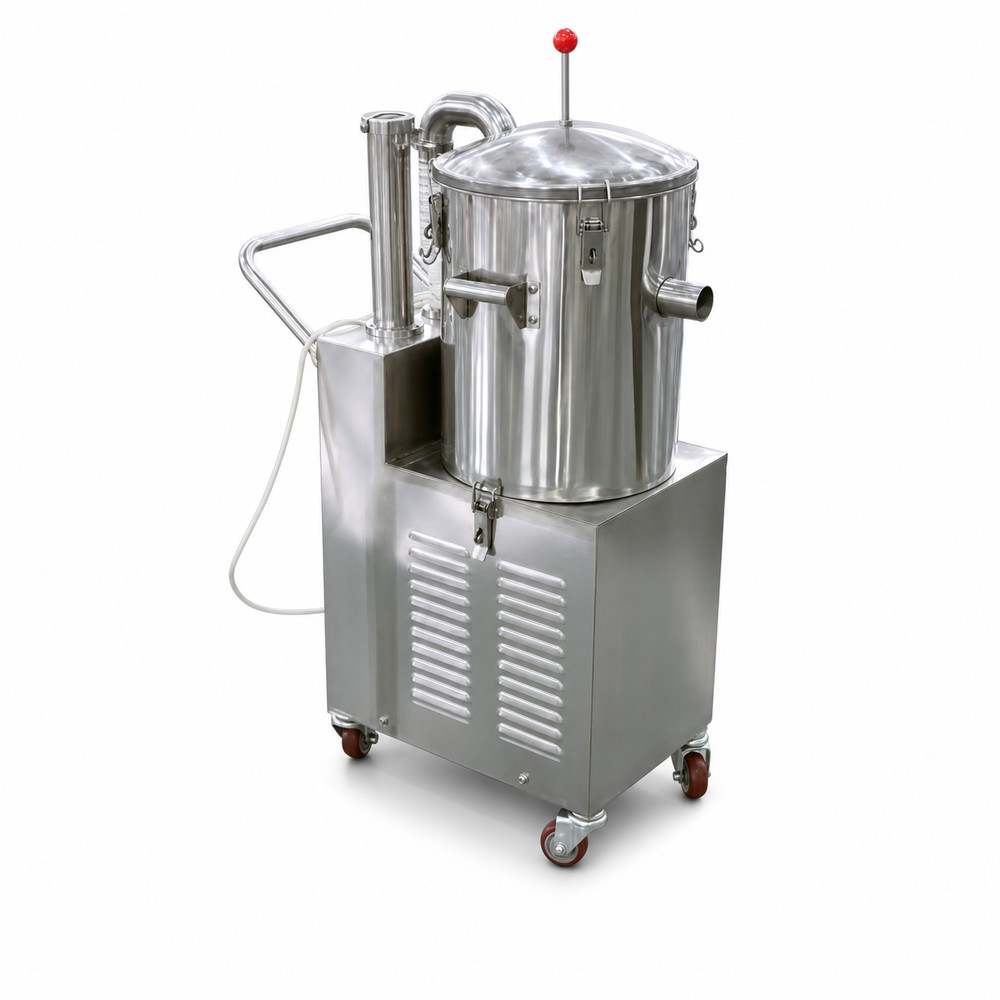
XCJ-1.1 industrial dust collector: 360 m³/h airflow, 19,500 Pa minimum vacuum, 1.1 kW, 70 kg, stainless steel main structure.
What those numbers mean in a qualification file
The 1.1 kW total power figure is the first practical constraint. It tells the buyer that this is a point-of-use extraction unit, sized for a machine-mounted or machine-adjacent duty, not for replacing a facility dust extraction system. That is not a weakness — it is the design intent, and it should be documented as such. If the qualification protocol assumes the XCJ-1.1 carries room-level dust control, the protocol will fail on site and the supplier will not be at fault.
The 19,500 Pa minimum vacuum and 360 m³/h airflow together define the capture envelope. During commissioning, these are the values worth measuring at the working point rather than reading off a data sheet: duct length, bends, and the extraction hood geometry all change the vacuum available at the die table. A collector that meets its rated figure at the inlet can still underperform at the hood.
At 70 kg and 700 × 460 × 1030 mm, the unit is movable but not incidental. Changeover procedures should state where it is positioned, how the extraction line is disconnected, and who verifies reconnection. The stainless steel main structure supports wipe-down cleaning, but the buyer should confirm which internal components are also stainless and which are not, since that determines the cleaning agent compatibility list.
QVC-3 vacuum conveyor: what the specification supports
The QVC-3 is a compressed-air-driven vacuum conveyor for pharmaceutical, food, and chemical powder handling. Its documented functions are automatic powder conveyance to a tablet-press hopper, GMP-compliant design that reduces powder and granule segregation, and a construction that is antistatic, wear-resistant, and resistant to cross-contamination. The unit uses an SS316 filter with non-toxic, corrosion-resistant construction materials, and is described as reducing product adhesion to the inner wall.
| Model | QVC-3 |
| Conveying capacity | 350 kg (as published; confirm time basis with the supplier) |
| Working air pressure | 0.6 MPa |
| Air consumption | 180 L/min |
| Dimensions | Φ140 × 560 mm |
| Weight | 35 kg |
| Filter material | SS316 filter; non-toxic, corrosion-resistant construction materials |
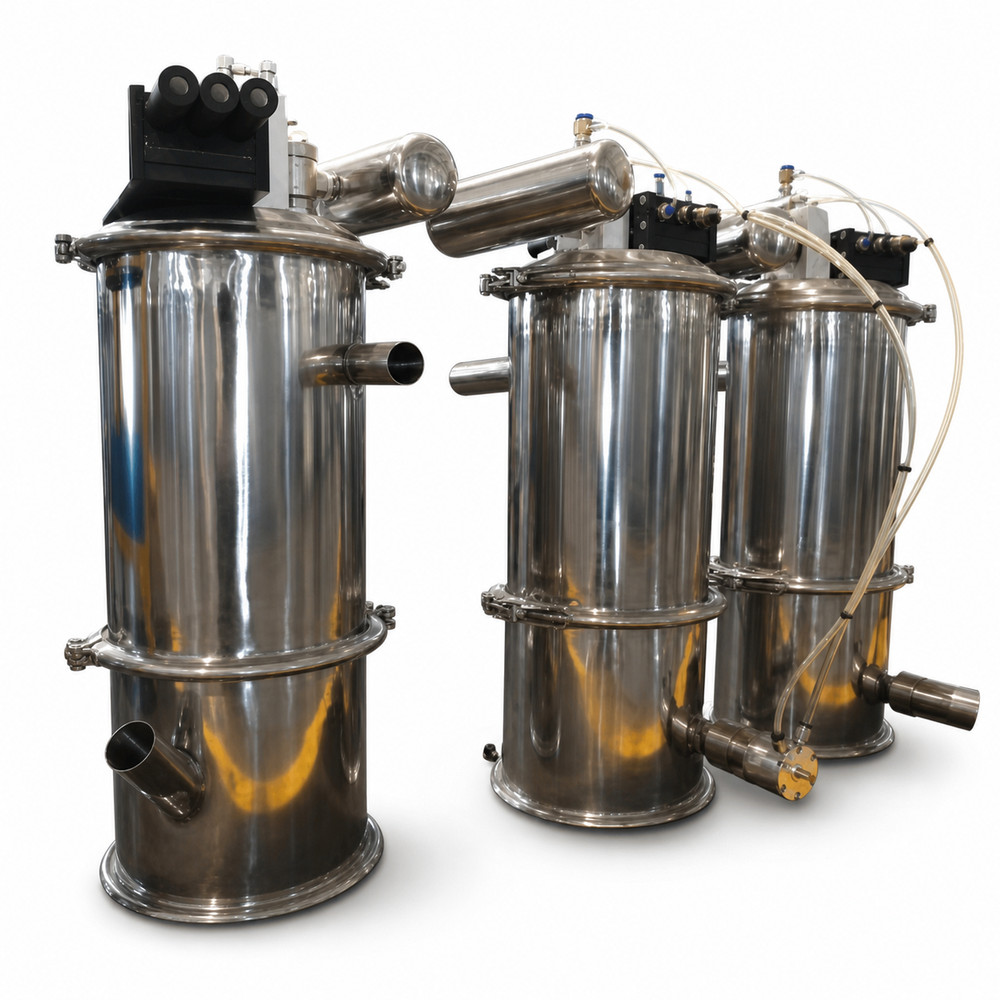
QVC-3 vacuum conveyor: compressed-air driven, 0.6 MPa working pressure, 180 L/min air consumption, 350 kg conveying capacity.
The compressed-air dependency is a qualification item, not a footnote
Because the QVC-3 is powered by compressed air rather than by its own motor, its performance is inseparable from the plant utility. A 0.6 MPa working pressure and 180 L/min air consumption is a modest draw, but the utility specification that matters for GMP is not pressure — it is air quality. Oil, water, and particulate in the compressed-air supply reach the conveyor's internal surfaces and, by extension, the product path. Buyers should record the air-quality class required at the point of use, the dryer and filter arrangement that delivers it, and the monitoring interval in the qualification file. This is the single most commonly under-documented item in auxiliary powder-handling equipment.
The published conveying capacity of 350 kg does not state a time basis in the available specification. That is not a defect in the equipment, but it is a question for technical review: whether 350 kg refers to a batch, an hour, or a conveying cycle changes the sizing calculation for a given capsule line output considerably. Establishing this before the purchase order is cheaper than discovering it during capacity ramp-up.
The material story is more straightforward. An SS316 filter plus non-toxic, corrosion-resistant construction, combined with antistatic and wear-resistant properties, addresses the two failure modes that matter in capsule powder transfer: adherence of fine powder to the inner wall with subsequent segregation, and static-driven dust behaviour in dry powders. Both are directly relevant to dose uniformity in a capsule filler, and both should be verified by observation during commissioning rather than accepted from a data sheet.
Where the auxiliary equipment meets the filler
TPCF's capsule filling range spans the CFM-200C small-batch machine at 200 capsules/min with 2 die bores, through the CFM-1250, CFM-2000, and CFM-3500/3500B, up to the CFM-7500 four-row machine at 7,500 capsules/min with 52 die bores. All are documented as handling capsule sizes 00#–5# and safety capsules A–E with ±3% dosing accuracy, and all are GMP-oriented in design. The high-containment NJP-800A-HC sits at OEB4 with a fully enclosed chamber, glove box, and in-chamber wash gun.
Auxiliary equipment selection follows from that ladder, not from a generic preference:
- Low-output lines (CFM-200C, NJP-200A/400A). Manual powder handling and periodic wipe-down may be adequate; the conveyor's value is segregation control and reduced operator exposure rather than throughput.
- Mid-range lines (CFM-1250, CFM-2000, NJP-800A/1200A). Continuous feeding becomes a stability issue. A QVC-3 feeding the hopper reduces the manual reload cycle that disturbs dose consistency, and an XCJ-1.1 at the dosing zone limits residue accumulation across a shift.
- High-output lines (CFM-3500/3500B, CFM-7500). Dust generation scales with throughput. Extraction and transfer cease to be optional accessories and become part of the containment strategy documented in the line's own qualification.
- High-containment configurations (NJP-800A-HC, OEB4). Auxiliary equipment must be compatible with the enclosure strategy. A glove-box design assumes material transfer and extraction are handled without breaking containment — that assumption needs explicit verification, since a standard-construction conveyor or collector may not match an OEB4 environment without additional engineering.
A qualification checklist for capsule line auxiliary equipment
The following checklist is written for the buyer's project team. It assumes the filler itself is already covered by a separate qualification protocol.
| Area | Item to verify | Applies to |
|---|---|---|
| Design documentation | Drawings, material specification for all product-contact parts, filter specification | XCJ-1.1, QVC-3 |
| Performance verification | Measured vacuum and airflow at the working point; measured conveying rate at the actual powder | XCJ-1.1, QVC-3 |
| Utility qualification | Compressed-air quality class at point of use, dryer and filter arrangement, monitoring interval | QVC-3 |
| Cleaning validation | Dismantling procedure, cleaning agent compatibility, residue acceptance criteria, changeover time | XCJ-1.1, QVC-3 |
| Containment fit | Compatibility with enclosed or high-containment filler configuration; dust escape at connections | Both |
| Change control | Spare parts list, filter replacement interval, supplier notification route for design changes | Both |
| Training records | Operator training on connection, disconnection, and cleaning — the most frequent source of contamination events | Both |
Scenario fit: which line configurations actually need which unit
TPCF describes its automatic hard capsule filling production line as operating in GMP workshops with controlled temperature, humidity, and dust, with matched equipment including the CFM and NJP fillers, the LG Series roller compactor, the QVC-3 vacuum conveyor, and the XCJ-1.1 dust collector. The stated special requirements are hygienic design, precise dosing, low powder loss, easy cleaning and changeover, and an optional high-containment configuration. Each of those requirements has a natural owner: dosing accuracy belongs to the filler, but low powder loss and dust control belong substantially to the auxiliary equipment.
The same pairing appears in TPCF's integrated solid dosage production line scenario, where dry granulation, powder transfer, tableting, and capsule filling are combined with the QVC-3 and XCJ-1.1 listed as matched equipment alongside stainless-steel product-contact parts, dust containment, and easy cleaning. And in the dry granulation scenario for heat- and moisture-sensitive powders, the QVC-3 and XCJ-1.1 are specified with the LG roller compactor and downstream rotary tablet presses or automatic capsule filling machines — because a dry process with no water or solvent addition depends heavily on dust containment to avoid cross-contamination.
The practical reading for a buyer in the research-to-evaluation stage: if the line will process more than one product, or any potent or sensitising material, the auxiliary equipment is part of the containment argument. If the line is single-product and low-output, the auxiliary equipment is primarily a dust and segregation control measure. The equipment may be identical; the qualification depth is not.
Market context: automation share and the limits of published estimates
Automation is not a marginal preference in this category. Commercial research published in 2026 states that automatic capsule filling machines accounted for over 65% of total market share in 2024, attributed largely to output capacity. That figure is a commercial-research estimate rather than an official statistic, and it should be read as directional — but the direction is consistent with what the equipment ranges themselves show, where the majority of documented models in TPCF's own capsule range are automatic machines with output from 200 to 7,500 capsules per minute.
Market-size estimates, by contrast, should not be used carelessly. Two commercial sources published in 2026 give global capsule filling machine market values that differ by more than an order of magnitude: one estimates US$ 2.92 billion in 2026 rising to US$ 4.17 billion by 2033 at a 5.2% CAGR, while another reports USD 238.0 million in 2025 reaching USD 376.5 million by 2033 at 5.9%. A third places the 2024 market at USD 0.9 billion growing to USD 1.3 billion by 2030 at 6.3%. These are not reconcilable without full methodology review, and averaging them would be a mistake. For procurement purposes the usable signal is qualitative: the category is growing and highly automated, and the buyer's decision should rest on verified equipment evidence rather than on borrowed market figures.
Company-level evidence is more directly relevant to supplier evaluation. TPCF reports delivery of 30 automatic capsule filling machines for a pharmaceutical production project, and states that 80 to 120 sets of tablet presses and capsule filling machines can be delivered per month, with roughly half of output exported to markets including Asia, South Africa, the Middle East, the EU, Russia, and North and West Africa. These are company-reported figures, useful as a capacity and project-execution signal, and they should be verified against the buyer's own reference checks.
Compared with traditional manual handling — and where the limits are
Traditional capsule line practice relies on manual powder loading into the hopper and periodic dry wiping of the dosing area, with room ventilation carrying dust away. The differences are concrete and mostly favourable: a QVC-3 replaces a repetitive manual lift with a closed transfer path, reducing segregation and operator exposure; an XCJ-1.1 removes residue at the point of generation rather than after it has settled across the room. Both are documented as GMP-oriented designs, and both reduce the cleaning burden between products.
The limits deserve equal weight, because they determine whether the equipment fits a given line:
- Scale boundary. The XCJ-1.1 is a 1.1 kW point-of-use collector. It supplements, and does not replace, a facility dust extraction or HVAC strategy. Lines that treat it as room-level extraction will not meet their own design intent.
- Utility dependency. The QVC-3 requires 0.6 MPa compressed air at 180 L/min. Sites without a qualified compressed-air supply — dry, filtered, and monitored — cannot simply install the conveyor and assume the product path is protected.
- Containment is not automatic. Standard-construction auxiliary equipment is not equivalent to an OEB4 configuration. Pairing a standard conveyor with a high-containment filler such as the NJP-800A-HC requires engineering review, not an assumption of compatibility.
- Specification resolution. The QVC-3's 350 kg conveying capacity is published without a stated time basis in the available data, and the XCJ-1.1's airflow is rated at the unit rather than at the hood. Both require confirmation during technical review and commissioning measurement.
- No substitution for filler validation. Neither unit contributes to dosing accuracy verification, capsule closure testing, or finished-product testing. Those remain with the filler protocol and the manufacturer's own quality system.
Future outlook
Two trends are likely to push auxiliary equipment further into the qualification conversation. The first is containment. As more capsule production involves potent or sensitising compounds, the containment argument moves from the filler enclosure to the entire material path — and equipment that was previously specified as an accessory becomes part of the containment boundary. TPCF's OEB4 NJP-800A-HC, with its fully enclosed chamber, glove box, and in-chamber wash gun, is an example of the filler side of that shift; the auxiliary side has to keep pace.
The second is documentation expectations. Regulated buyers increasingly ask for material certificates, filter specifications, cleaning procedures, and utility requirements at the quotation stage rather than at commissioning. Manufacturers that can supply these as standard, rather than as a special request, will find the evaluation stage shorter. TPCF's stated position — GMP-compliant equipment with EU CE certification and ISO certification, produced in a 15,000 m² facility with more than 200 CNC machine tools and an R&D team of 15 engineers — is the kind of baseline that documentation requests test in practice.
A third, quieter shift concerns dry processing. Where heat- or moisture-sensitive powders are involved, granulation and capsule filling are increasingly combined in one line, with no water or solvent addition. In that configuration, dust containment is not a housekeeping matter; it is a product-quality control, and the dust collector becomes a process-critical component of the line rather than a peripheral one.
Frequently asked questions
Do dust collectors and vacuum conveyors need to be included in capsule line qualification?
Yes, when they sit inside the controlled area and influence product quality or contamination risk. They do not require their own regulatory approval, but they fall within the manufacturer's validation boundary because they affect dust containment, cross-contamination between products, and powder segregation before dosing. The practical approach is to qualify them as part of the line protocol rather than as standalone equipment.
What documentation should a buyer request for the XCJ-1.1 and QVC-3?
At minimum: dimensional drawings, material specification for all product-contact parts, filter specification, the published performance figures measured at a defined point, cleaning and dismantling procedures, and the utility requirements. For the QVC-3 this includes the compressed-air quality class, since the unit is air-driven and the air supply reaches internal surfaces. For the XCJ-1.1 it includes which components are stainless steel and which are not.
Can the XCJ-1.1 replace a central dust extraction system?
No. With 1.1 kW total power, 360 m³/h airflow, and 19,500 Pa minimum vacuum, the XCJ-1.1 is a point-of-use collector designed to remove dust from processing equipment and extract residual material from a die table. It supplements room-level ventilation and facility dust extraction; it does not substitute for them, and a qualification protocol that assumes otherwise will not meet its design intent.
What compressed-air quality does the QVC-3 require?
The published operating parameters are 0.6 MPa working pressure and 180 L/min air consumption. The specification does not state an air-quality class, so the buyer must define the required dryness and filtration at the point of use, and document the dryer and filter arrangement that delivers it. Because the conveyor is compressed-air driven, untreated oil, water, or particulate in the supply reaches internal surfaces and the product path.
Is the QVC-3 suitable for high-containment capsule filling such as OEB4?
That cannot be assumed. The QVC-3 is documented with an SS316 filter, non-toxic corrosion-resistant construction, and antistatic and wear-resistant properties, which addresses segregation and adhesion in pharmaceutical powder transfer. OEB4 containment, as implemented on the NJP-800A-HC with a fully enclosed chamber and glove box, is a system-level property. Compatibility between a standard-construction conveyor and a high-containment filler needs explicit engineering review.
How does auxiliary equipment choice differ between small-batch and high-output capsule lines?
The equipment may be the same model, but the justification changes. On a small-batch line such as the CFM-200C at 200 capsules/min, the primary value of a QVC-3 and XCJ-1.1 is segregation control, operator exposure reduction, and cleaning efficiency. On a high-output line such as the CFM-3500/3500B at 3,500 capsules/min or the CFM-7500 at 7,500 capsules/min, dust generation scales with throughput and the auxiliary equipment becomes part of the containment strategy documented in the line qualification.
TPCF publishes its capsule filling machine range and matched auxiliary equipment in its product brochure, which includes the CFM and NJP series specifications.
Shanghai Tablet Press Mechanical Components Co., Ltd. (TPCF) — No. 159 Zhujiabang Rd., Xiaokunshan Town, Songjiang District, Shanghai, China. Website: www.tp-tabletpress.com. Contact: Michael Zhao, michael@stctp.com.
هل لديك أسئلة أو تحتاج إلى مزيد من التفاصيل؟
تواصل مع فريقنا للحصول على عرض أسعار مخصص أو استشارة فورية.
طلب عرض أسعار
املأ النموذج أدناه وسيتواصل معك فريقنا بعرض مقترح مخصص.
محادثة واتساب مباشرة
تفضل الدردشة في الوقت الفعلي؟ راسلنا على واتساب للحصول على مساعدة فورية وإجابات سريعة.
- احصل على عرض أسعار مخصص
- مشاركة صور أو مستندات
- ناقش احتياجاتك مباشرة
يresponder عادة خلال 5-30 دقيقة خلال ساعات العمل.