
Carbon Steel Hex Bolt Procurement FAQ: Acceptance and Vibration Evidence
Carbon steel hex bolts are rarely the largest line on a bill of materials, yet they frequently decide whether a steel structure or a vibrating machine stays serviceable after commissioning. Procurement teams that treat them as commodity hardware tend to find the gap at the acceptance stage, when a delivery arrives without a documented coating thickness, a traceable property class, or torque evidence that matches the joint design. This reference answers the questions that surface most often in that process, in the order a decision actually moves: standard, grade, coating, witness evidence, installation mode, and post-installation behaviour under vibration.
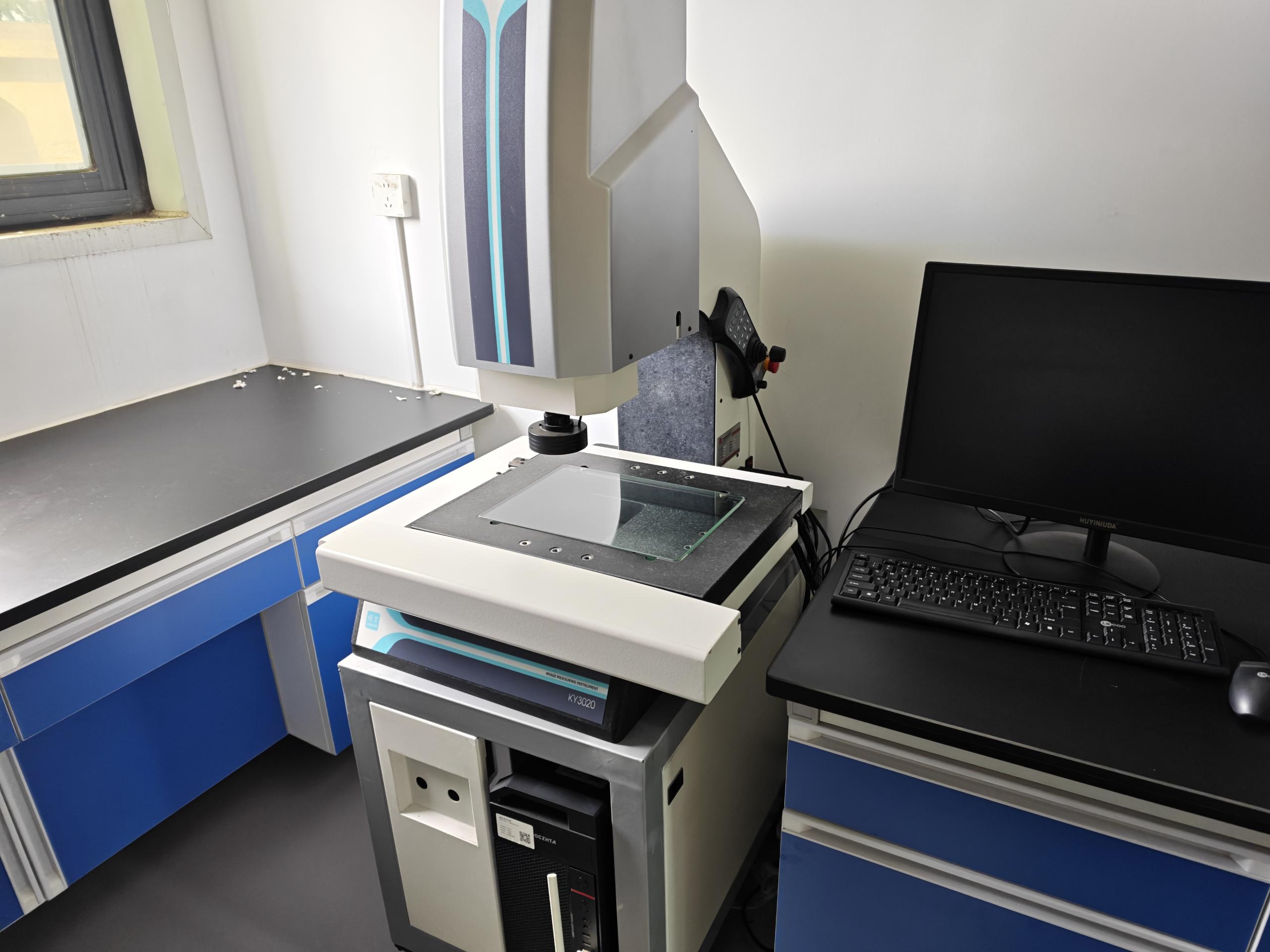
Thread geometry inspection. Acceptance criteria for a hex bolt begin with measurable thread form and pitch, not with the description printed on a packing list.
Why hex bolt decisions stall at the acceptance stage
The category is large enough that specification drift compounds quickly. Strategic Market Research valued the global hex bolts market at USD 19.67 billion in 2025, while Dataintelo placed carbon steel at 44.8% of the combined hex nut and bolt market share in the same year. Those two figures do not describe the same scope, and that mismatch is itself a procurement lesson: market numbers are comparable only when the product definition behind them is identical.
At transaction level the ambiguity is narrower but more consequential. A purchase order reading “M12 hex bolts, zinc plated, grade 8.8” leaves at least five acceptance variables open. Which standard governs the thread and head geometry? Which thread pitch? What length? How thick is the coating, and on what basis is it measured? And what evidence ties a specific delivery lot back to the grade that was declared? Each of those variables is checkable, and each has a defined answer as soon as it is written into the order.
The product at the centre of this discussion is Hex Bolt 7337 from HEBEI YUETONG FASTENERS MANUFACTURING CO.,LTD. YUETONG FASTENER is an export-oriented fastener manufacturer established in 2017 in the Yongnian District of Handan, Hebei, China’s largest standard parts production base, producing hex nuts, hex bolts, sleeve anchors, thread rods, flat washers, hex socket head bolts and wheel hub bolts.
Acceptance criteria: what to write on the order
Standard and thread form
DIN 933 and ISO 4017 are the primary standards for full-thread hex bolts, with ISO 4017 acting as the international successor to the older DIN designation. Partially threaded hex bolts follow DIN 931. Suppliers serving multiple regions typically maintain several equivalent families in parallel, including GB/T 5782, GB/T 5783 and ASME/ANSI B18.2.1, which helps availability but requires the buyer to name exactly one governing standard per order line.
Grade, material and dimension
Property classes 4.8, 8.8, 10.9 and 12.9, together with stainless grades A2-70 and A4-80, form the usual range for this product family. Material choices span carbon steel, alloy steel and stainless steel. Hex Bolt 7337 is offered across M3 to M36, with common sizes including M6, M8, M10 and M12 alongside imperial sizes such as 1/4 inch, 5/16 inch, 3/8 inch, 1/2 inch and 5/8 inch, in coarse or fine thread pitch, with lengths from 16 mm to 200 mm.
Grade selection is not a straight ladder where higher always wins. Property class changes the tightening requirement, the coating options that remain compatible with the process route, and the failure mode the joint will exhibit under overload. A joint engineered around class 8.8 does not automatically improve by substituting 12.9; it changes behaviour, and the design assumption has to be updated with it.
Coating and surface finish
Available finishes for this product family include black oxide, zinc plated, hot-dip galvanized, Dacromet, mechanical galvanized and PTFE coating. The coating is also the acceptance item most often left ambiguous, because the phrase “zinc plated” describes a process family rather than a measurable thickness.
Zinc plating versus hot-dip galvanizing: the comparison that decides service environment
Coating thickness is the variable that determines where a bolt can be installed. Zinc plating typically provides a coating thickness of 5–12 µm, whereas hot-dip galvanizing provides 45–85 µm. That difference is roughly an order of magnitude, and it maps directly onto the environments in which each finish performs acceptably.
| Finish | Typical coating thickness | Where it fits in a procurement decision |
|---|---|---|
| Zinc plated | 5–12 µm | Indoor service, sheltered assemblies, low-corrosion atmospheres |
| Hot-dip galvanized | 45–85 µm | Coastal salt spray, outdoor infrastructure, long-service outdoor structures |
| Black oxide, Dacromet, mechanical galvanized, PTFE coating | Specified per drawing | Selected against the defined environment rather than a general preference |
The practical consequence is that zinc plating should not be treated as an interchangeable substitute for hot-dip galvanizing in a salt-spray environment. Where the specification calls for a non-electrolytically applied zinc flake system or for documented torque and clamp force behaviour, the applicable standards are EN ISO 10683:2018 and EN ISO 16047:2005 respectively, and those references belong in the acceptance section of the order rather than in a post-delivery discussion.
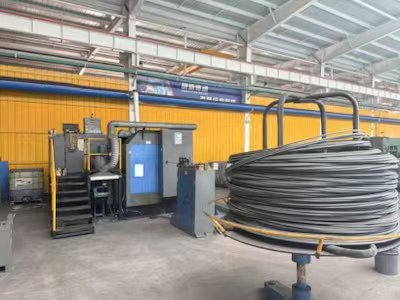
Raw material and cold heading. Material traceability starts upstream of forming; the declared property class is a claim about the input wire as much as about the finished part.
Vibration-load evidence: what the self-loosening question actually asks
Buyers frequently ask whether hex bolts are prone to self-loosening during long-term use, particularly in vibrating equipment or steel structures. The honest answer is that self-loosening is a property of the joint rather than of the bolt alone, and it is manageable when the installation variables are controlled.
Proper bolt selection and installation can significantly reduce the risk of self-loosening. Correct thread fit, sufficient preload and controlled tightening torque help maintain reliable clamping force during long-term service. Where continuous vibration is present, suitable locking methods such as lock nuts, locking washers or thread-locking solutions should be selected according to the operating conditions.
The failure conditions are equally well defined. High-frequency vibration of equipment, excessive installation torque and long-term heavy-load tension may cause thread stripping, deformation and fracture. The mitigation set is correspondingly specific: high-purity raw materials ensure stable strength, and torque, hardness and fatigue resistance are tested before delivery. Following the specified installation torque for standard construction, and selecting seismic high-strength bolts for vibrating working conditions, are the two actions most often missing from a procurement file.
Permanent installation versus detachable repeated assembly
Two operation modes run through this product category and they are frequently conflated: static permanent fastening, and detachable repeated assembly. Under alternating vibration load, the distinction changes what should be ordered.
A permanently installed joint generally accepts a single controlled tightening cycle at the specified torque, with locking elements and coating repair planned for one-time application. A detachable joint that will be repeatedly assembled requires locking elements that can be replaced or reused, a defined re-torque procedure, and a coating repair plan, because each opening and closing of the joint alters the preload condition that was originally established. A fastener qualified for permanent installation is therefore not automatically the appropriate choice for a joint that will be opened repeatedly, even where the grade, size and coating are identical.
Supporting equipment that changes joint behaviour
Hex bolts are rarely installed in isolation. The supporting equipment associated with this product family includes nuts, washers, sleeve anchors, torque wrenches, impact drills and fastening tools. Each of them carries an acceptance implication.
- Nut property class and washer type should match the bolt grade and the joint design; a mismatched nut undermines the declared bolt class.
- A torque wrench is the instrument that applies the specified tightening torque; impact drills speed up installation but do not replace torque verification.
- Sleeve anchors and other anchoring accessories follow a separate acceptance path from the bolt itself, since their performance depends on the base material.
Where Hex Bolt 7337 is specified
The applicable industries for this product family include steel construction, engineering machinery, automotive, rail transit, new energy, petrochemical, general machinery, power, marine engineering, agricultural machinery, sanitation equipment, furniture and bridge engineering. In project terms, that translates into steel structures, curtain wall and bridge projects, PV power stations, wind power, municipal engineering, rail transit work and petrochemical installations.
The working conditions the manufacturer lists as in-scope are indoor normal environments, outdoor open-air exposure, humid climates, coastal salt spray corrosion, high and low temperature, explosion hazardous areas, and vibration load conditions. Functional roles cover component fastening and connection, load-bearing fixing, equipment anchoring, assembly joints and load transmission. Special requirements supported include high tensile strength, anti-corrosion, ISO 9001 alignment, multi-standard compliance, high temperature resistance, seismic resistance and custom specifications.
The compliance file a buyer should request, line by line
For the 7337 hex bolt range, the documentation set that buyers can request includes the ECM Type-Approved Attestation No. 3N230331.HYFUC49, with applicable EN ISO 10683:2018 and EN ISO 16047:2005 standards. That package sits alongside ISO 9001:2015 valid until 2027-09-13, ISO 14001:2015, ISO 45001:2018, IATF 16949:2016, and ISO 14067 evidence.
HEBEI YUETONG FASTENERS MANUFACTURING CO.,LTD holds ISO 9001 quality management system, ISO 14001 environmental management system and ISO 45001 occupational health and safety management system certifications, together with EU CE certification, carbon footprint certification and IATF 16949 certification. The company has obtained 9 national patents, including 1 invention patent and 8 utility model patents, and has been recognised as a Hebei Province Specialized, Precise, Unique and Innovative Small and Medium-sized Enterprise.
One practical caution applies to every certificate in that list. A certificate is only meaningful at the scope it names. Acceptance criteria should therefore record which product families, which site, and which period a document covers, rather than treating the presence of a certificate number as equivalent to a product-specific verification.
Market context behind the documentation question
Global export value for HS Code 731815, covering other screws and bolts, was USD 26.35 billion in 2023, a 3.65% decline from the previous year. At the same time, supply remains heavily concentrated geographically. China’s Yongnian District is the largest fastener production base in the country, and YUETONG FASTENER was ranked as a Tier-3 top exporter within that hub as of 2023.
Concentration of this kind produces a predictable procurement effect. Buyers can reach many suppliers through the same regional channels, so the differentiator shifts away from basic availability and towards documentation consistency, coating conformity and the ability to reproduce a declared property class across repeat orders.
Where carbon steel hex bolts reach their limits
Carbon steel with an appropriate coating is a strong default for structural and equipment fastening, but it is not a universal answer, and buyers benefit from knowing the boundaries in advance.
- Coating thickness limits the environment. Standard zinc plating at 5–12 µm is not a substitute for hot-dip galvanizing at 45–85 µm in aggressive salt-spray exposure. Specifying the thinner finish into a coastal application moves the failure point into the field.
- Vibration performance depends on installation. No bolt prevents self-loosening on its own. Without the specified tightening torque and an appropriate locking method, a correctly manufactured bolt can still lose preload in a vibrating joint.
- Repeated disassembly changes the requirement. A joint opened many times needs replaceable or reusable locking elements and a re-torque procedure, which a permanent-installation specification does not provide.
- Where coatings are insufficient, the material changes. Stainless grades A2-70 and A4-80 exist within the same product family for conditions that carbon steel plus coating cannot cover.
Compared with welding as a joining method, bolted connections in this family offer a documented set of trade-offs in manufacturer comparison data: 40% savings in labour and material costs, 50% higher construction efficiency, no hot work, and suitability for restricted working sites. The same comparison data cites 30% higher bearing capacity than ordinary bolts, a yield rate of 99.8%, a project failure rate below 0.1%, 50% less maintenance than alternatives and a service life extended by 3–5 years. Those figures describe the manufacturer’s own comparison basis and should be read as such; the verifiable core is the documented grade, coating and test evidence that sits behind them.
Future outlook
Three directions appear to be shaping how this category is bought. First, acceptance documentation is moving from a nice-to-have to a line item, driven by the fact that coating conformity and torque behaviour are only defensible when a record exists. Second, carbon footprint evidence such as ISO 14067 is entering supplier questionnaires alongside conventional quality certificates, which places additional weight on manufacturers that already maintain environmental and occupational health certifications. Third, as supply stays concentrated in hubs such as Yongnian, repeat-order consistency — the ability to deliver the same grade, coating and traceability twice — becomes the most practical measure of a supplier relationship. None of these shifts remove the fundamentals: a hex bolt is still accepted or rejected on measurable criteria, and vibration performance is still decided at installation.
FAQ: carbon steel hex bolt procurement and acceptance
Which standard should be named on a purchase order for a fully threaded carbon steel hex bolt?
DIN 933 and ISO 4017 are the primary standards for full-thread hex bolts, with ISO 4017 acting as the international successor. Partially threaded hex bolts follow DIN 931. Suppliers operating across regions also work to GB/T 5782, GB/T 5783 and ASME/ANSI B18.2.1. The order should name one governing standard and pair it with property class, size, thread pitch and length.
How should a buyer compare zinc plated and hot-dip galvanized hex bolts for a specific project?
By comparing coating thickness against the service environment. Zinc plating typically provides 5–12 µm, while hot-dip galvanizing provides 45–85 µm. Zinc plating is generally adequate for indoor or sheltered service, whereas coastal salt spray, outdoor infrastructure and long-service outdoor structures call for the thicker system or an alternative such as Dacromet, mechanical galvanizing or PTFE coating.
What acceptance evidence should accompany a delivery?
The file should let a buyer connect the delivered lot to four things: the governing standard, the property class, the coating specification, and the test record. For Hex Bolt 7337, torque, hardness and fatigue resistance are tested before delivery, and the documentation set includes the ECM Type-Approved Attestation No. 3N230331.HYFUC49 with applicable EN ISO 10683:2018 and EN ISO 16047:2005 standards, ISO 9001:2015 valid until 2027-09-13, ISO 14001:2015, ISO 45001:2018, IATF 16949:2016 and ISO 14067 evidence. Buyers should confirm the scope each document covers.
Do hex bolts loosen under vibration?
Repeated vibration, insufficient preload or incorrect tightening torque may lead to gradual loosening. Proper selection and installation can significantly reduce that risk: correct thread fit, sufficient preload and controlled tightening torque help maintain reliable clamping force during long-term service. Where vibration is continuous, locking methods such as lock nuts, locking washers or thread-locking solutions should be chosen according to the operating conditions. High-frequency vibration, excessive installation torque and long-term heavy-load tension can cause thread stripping, deformation and fracture, which is why following the specified installation torque and selecting seismic high-strength bolts for vibrating conditions matters.
How does permanent installation differ from detachable repeated assembly in practice?
These are distinct operation modes within the product’s stated application range. Permanent installation generally involves a one-time controlled tightening at the specified torque, with locking elements and coating repair planned for single application. Detachable repeated assembly requires locking elements that can be replaced or reused, a defined re-torque procedure, and a coating repair plan, because repeated opening and closing changes the preload condition of the joint.
Which components and tools should be purchased together with the bolts?
The matched equipment associated with this product family includes nuts, washers, sleeve anchors, torque wrenches, impact drills and fastening tools. Nut property class and washer type should match the bolt grade and joint design. A torque wrench is required to apply the specified tightening torque; impact drills accelerate installation but do not replace torque verification.
How does carbon steel compare with stainless steel for this product family?
Both are offered within the same range, with stainless grades A2-70 and A4-80 available alongside carbon steel and alloy steel. Carbon steel accounted for 44.8% of global hex nut and bolt market share in 2025, reflecting its cost-to-performance position for general structural and equipment fastening. Stainless becomes relevant where the corrosion demand exceeds what a coating system can deliver.
A downloadable brochure covering the YUETONG FASTENER bolt, nut and anchoring range is available at the product brochure.