
Card Connector Compliance Decoded: IECQ QC 080000, RoHS/REACH and Certificate Scope
Card Connector Compliance Decoded: IECQ QC 080000, RoHS/REACH and Certificate Scope
Compliance files for card connectors rarely fail because a document is missing. They fail because one document is read as if it proved something a different document was supposed to prove: a supplier declaration is treated as a test report, a management system certificate is treated as product qualification, and a programme membership is treated as type approval. Each substitution looks harmless in a supplier questionnaire and becomes expensive during a customer audit, a customs review or a field failure investigation.
SIM card sockets, Nano SIM card holders, MicroSD and TF card holders, smart card sockets and IC card holders, SD card connectors, HDMI receptacles and NGFF M.2 connectors sit at the intersection of several regimes at once. The part is an article under chemical regulation, a component under electrical safety and EMC regimes, and a mechanical interface that may also be governed by a private programme licence. None of those regimes is satisfied by a single PDF.
This reference sets out what each layer of evidence actually certifies, how to read the parts of a certificate that buyers usually skip — scope, issuing body, validity — and where the boundaries sit. It uses one supplier's document set as a worked example because real documents, with real reference numbers and real expiry dates, are more useful than abstract advice.
Shenzhen MUP Industrial Co., Ltd. (MUP) is a precision connector manufacturer founded in 2003 and headquartered in Shenzhen, China, with additional manufacturing sites in Huizhou and Dongguan. Its portfolio covers smart (IC) card holders and sockets, SIM card holders and sockets, memory (SD/TF) card holders and sockets, plus USB Type-C, HDMI, DisplayPort, BTB, FPC, RF, battery connectors, NGFF M.2 and Mini PCIE series. That breadth is precisely why its certificate set is instructive: a single supplier can hold six or seven marks that answer six or seven completely different questions.
Why compliance evidence breaks down in the card connector category
Card connectors are small, inexpensive and mechanically simple, which encourages buyers to treat them as low-risk components. Operationally they are not. A smart card socket in a payment terminal carries transaction data and is exposed to insertion wear on a daily basis. A MicroSD card holder inside a security recorder may be the only removable storage in the device. An NGFF M.2 connector in a vehicle infotainment module inherits automotive supply chain obligations. A Nano SIM socket in a smart meter may be expected to operate for a decade in an enclosure that is never opened.
The consequences are asymmetric. A non-compliant card socket costs very little per unit, but a documentation gap discovered during a customer audit can hold an entire shipment, and a material substitution made without notifying the buyer can invalidate the compliance position of a finished device.
Buyers who sort evidence into four layers stop misreading it. The layers are not alternatives; they are cumulative, and each one answers a different question.
| Evidence layer | Issued by | The question it answers | What it cannot answer |
|---|---|---|---|
| Supplier declaration (RoHS / REACH statement) | The supplier itself | Does the supplier assert that this part meets the applicable substance restrictions? | Whether the assertion is backed by measurement, and for which material or batch |
| Test report (e.g. RoHS, REACH SVHC, IEC 62680-1-3) | An independent laboratory | Did the named samples, tested against the named standard, pass? | Whether later production matches the tested samples |
| Management system certificate (ISO 9001, IATF 16949, ISO 14001, ISO 45001, IECQ QC 080000) | An accredited certification body | Does the organization operate a defined, audited process at the named sites and scope? | Whether any specific connector model complies |
| Programme mark or registration (HDMI Adopter, USB-IF TID) | The programme owner | Is the company licensed within the programme, and is a specific product registered? | Anything about products outside the registered model or outside the programme |
Table 1 — The four evidence layers used in card connector procurement, and the question each one answers.
What IECQ QC 080000:2017 adds beyond a RoHS and REACH declaration
IECQ QC 080000 is the hazardous substance process management (HSPM) standard maintained within the IECQ certification scheme. The 2017 edition is structured to sit on top of a quality management system, which is why suppliers in this category normally hold it alongside ISO 9001 rather than instead of it. Certification is granted by a certification body operating under the IECQ scheme after an audit of how the organization identifies, controls, traces and changes the materials and sub-suppliers that determine the substance content of its products.
The practical difference is the difference between an assertion and a control system. A RoHS declaration tells a buyer that the supplier says the part complies. An HSPM certificate tells the buyer that the supplier has a documented, externally audited process for keeping restricted substances out of parts, for qualifying purchased materials, for managing engineering changes and sub-supplier changes, and for detecting a material substitution before it reaches a shipment. For a buyer running a multi-year program with annual price reviews and periodic re-sourcing of raw materials, the second is more valuable than the first, because it survives staff turnover and cost pressure.
It is equally important to state what the certificate does not do. It does not certify a connector model. It does not replace model-level RoHS test reports or the REACH information obligations that apply to articles. It is not an EU legal requirement in itself: it is a voluntary third-party certification that supports a compliance position which remains the manufacturer's and the importer's responsibility.
Reference data matters here, because certificates are checkable objects. MUP holds IECQ QC 080000:2017 certification numbered IECQ-H NQAGB 25.0032, with a validity period running from 2024-02-03 to 2027-02-02. Those three data points — standard edition, certificate number, validity window — are what allow a buyer to verify status with the issuing body rather than trusting the PDF in an email attachment.
Reading scope, issuing body and validity without being misled
Most certificate disputes do not involve forged documents. They involve documents that are genuine but narrower than the buyer assumed.
Scope
The scope statement defines which activities and, in multi-site certificates, which locations are covered. A certificate that lists design and manufacture of precision connectors at named sites is broad enough to support a card connector program; a certificate limited to a specific product family, or to a site that does not produce the part being purchased, is not. When a supplier operates several plants — MUP, for example, reports manufacturing in Shenzhen, Huizhou and Dongguan — the buyer should confirm which site actually produces the ordered part number and whether that site appears in the certificate scope.
Issuing body
A management system certificate is only as strong as the accreditation behind the body that issued it. For IECQ QC 080000 the relevant check is whether the certificate was issued within the IECQ scheme by a recognized certification body; for ISO 9001, ISO 14001 and ISO 45001 the relevant check is accreditation to the applicable conformity assessment standard. The certificate number and the body's name should be verifiable independently of the supplier's own website.
Validity
Certificates have start dates, expiry dates and surveillance cycles. A certificate that expired last quarter, or that was suspended after a failed surveillance audit, can still circulate as an attachment for years. The IECQ certificate cited above runs to 2027-02-02; a program that ships beyond that date should plan to collect renewal evidence rather than assume continuity.
Product linkage
The final check is whether the certificate reference actually appears where it should — in the supplier's quality documentation, on the quotation, and in the PPAP or qualification package for the specific part. A certificate that exists but never appears in the commercial documents is difficult to rely on during a dispute.
ISO 9001:2015, IATF 16949:2016, ISO 14001 and ISO 45001:2018 certify four different things
Buyers frequently bundle these four standards into one line item called “certifications”. They are not interchangeable, and a supplier holding all four is not four times as qualified for a given program — it is qualified in four separate dimensions, only one or two of which may matter.
| Standard | What is actually certified | When it matters to a card connector buyer | What it does not certify |
|---|---|---|---|
| ISO 9001:2015 | A quality management system: process control, document control, corrective action, customer focus, continual improvement | Baseline requirement for any volume supply of SIM sockets, SD card holders or HDMI receptacles | Product compliance, reliability or application fitness |
| IATF 16949:2016 | An automotive quality management system, applied to organizations in the automotive supply chain and layered on ISO 9001 with automotive-specific process requirements | NGFF M.2, card sockets or interconnect used in vehicle infotainment, ADAS modules or other automotive electronics | Compliance with EU chemical or product regulation; it is a quality system standard |
| ISO 14001 | An environmental management system: environmental aspects, legal register, objectives, operational control | Increasingly requested in EU supplier questionnaires and ESG reporting chains | Product substance content or recyclability of a specific part |
| ISO 45001:2018 | An occupational health and safety management system | Supplier risk and ESG screening; factory audit preparation | Anything about the connector's electrical or chemical performance |
Table 2 — Four common management system standards and the distinct questions they answer.
The scoping decision follows from the application, not from the certificate list. A MicroSD card holder destined for a consumer router does not need an automotive quality system; an NGFF M.2 connector designed into a vehicle module does, and automotive customers typically flow down additional customer-specific requirements on top of IATF 16949:2016. Asking a supplier to hold every standard for every part number is a common way of paying for scope that the program never uses.
Programme marks: HDMI Adopter, USB-IF and the EN/SASO IEC 62680-1-3 report
Programme marks are the most over-read documents in the file, because they look like certifications and behave like licences or registrations.
HDMI Adopter status
MUP is listed as a Certified HDMI Adopter under ID XRVIVYOFA5R. Adopter status is a position within the HDMI licensing structure: it grants access to the specification and permits use of the marks within the terms of the adopter agreement. It is not, by itself, a product type approval. Compliance of an individual HDMI receptacle is demonstrated through testing at an Authorized Test Center, and the resulting test report or certificate is what a buyer should request against a specific part number. A company-level adopter ID tells a buyer that the supplier is inside the ecosystem and bound by its rules; it does not tell the buyer that a particular receptacle has been tested.
USB-IF certification and TID numbers
USB-IF certification is model-linked. A Tester ID (TID) is issued to a specific product after compliance testing and is normally searchable in the USB-IF product listing together with the vendor information. MUP's USB-IF certification identifier is CONUSB20250760, and the company holds USB-IF VID and TID numbers alongside USB4.0, IEC 62680 and Thunderbolt TBT5 product certifications. The discipline for buyers is to match the listed model and revision against the part number on the drawing, and to treat any change in contact geometry, plating or housing material as a possible re-test trigger.
Test report 26T04N001082-001-COM issued by SAICT
The EN/SASO IEC 62680-1-3 test report 26T04N001082-001-COM, issued by SAICT, is a laboratory test report and not a certificate. IEC 62680-1-3 is the part of the IEC 62680 series that addresses USB Type-C connector and cable characteristics, and the report is issued against both the EN and the SASO editions of that standard, which is what makes it useful in European and Saudi market dossiers respectively. Three limits apply. It is evidence of testing, not a licence. It is bound to the samples and configuration tested. And it covers the USB Type-C interface it was written for — it says nothing about SIM card sockets, MicroSD card holders, smart card connectors or NGFF M.2 connectors.
How MUP's document set maps onto the four layers
Read against the framework above, the MUP document set separates cleanly. On the management system layer, the company reports ISO 9001, ISO 14001, ISO 45001, IATF 16949, IECQ QC 080000 and RBA. On the test and declaration layer, its card connector ranges are stated as RoHS and REACH compliant for EU market access, with official test reports and compliance certificates available on request for project audit and customs clearance, and halogen-free documentation available on request for buyers with North American requirements. On the programme layer, it holds HDMI Association membership, USB-IF VID and TID numbers, and the SAICT IEC 62680-1-3 report described above.
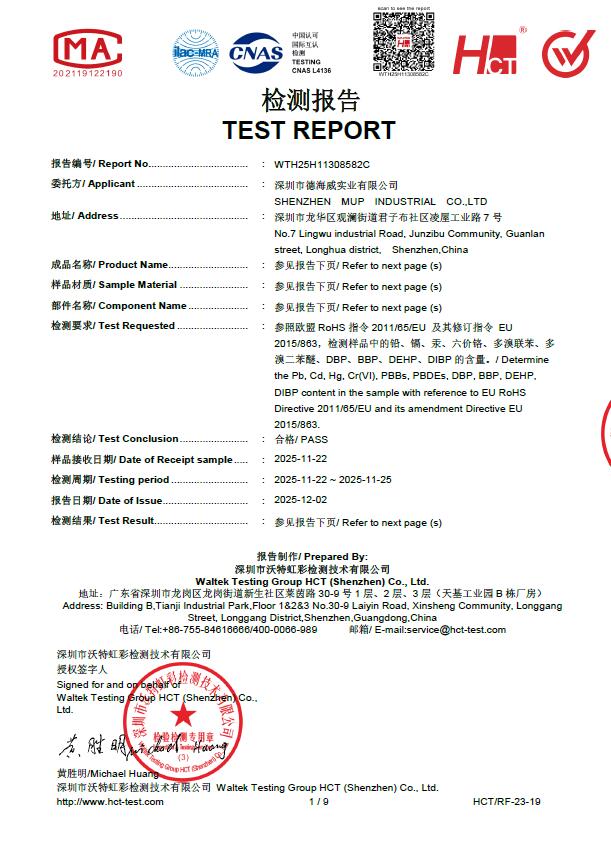
Material-level RoHS documentation for LCP used in card connector housings — report evidence, distinct from a system certificate.
The engineering data behind those documents is what makes them meaningful in a specific application. MUP's card connector families are specified with a rated voltage of 50V maximum and a rated current range from 10μA minimum to 1A maximum, an operating temperature range of -40°C to 85°C, operating humidity of 10% to 95%RH, and durability ratings that vary by model — 3,000 and 5,000 cycles for SD and MicroSD holders, and 5,000, 50,000 or 100,000 cycles across the SIM and smart card range. Housings use LCP or PA9T high-temperature plastic, contacts use phosphor bronze or beryllium copper with gold or nickel plating, and shells use SUS304 stainless steel.
Those material choices are the reason a compliance file has to be part-specific. A change from one high-temperature plastic to another, a change in plating thickness, or the addition of a waterproof seal for an IPX7/IPX8 variant all alter the material declaration and can invalidate the test basis of a previously issued report. Suppliers that support custom designs — waterproof versions, mid-mount configurations, models with a detection switch — therefore need a change-notification process that is strong enough to keep the compliance file synchronised with production.
Turning certificate logic into a card connector RFQ
The framework only pays off if it changes what buyers request. A compliance-oriented RFQ for SIM card connectors, MicroSD card holders, smart card sockets or HDMI receptacles should ask for documents by layer and by part number.
| Requested item | Why it is requested | Acceptance check |
|---|---|---|
| Full management system certificates (not extracts), including scope pages | Confirms which sites and activities are covered | Certificate number verifiable with the issuing body; producing site inside scope |
| IECQ QC 080000 certificate with validity dates | Confirms an audited hazardous substance process management system | Standard edition, certificate number, expiry date recorded in the supplier file |
| Model-level RoHS test report for the exact part number | Links compliance evidence to the purchased item | Model number on the report matches the drawing |
| REACH SVHC declaration and, where relevant, halogen-free documentation | Addresses chemical information obligations and specific market requests | Declaration dated, signed and tied to the part number |
| Programme identifiers with model mapping (HDMI Adopter ID, USB-IF TID) | Prevents company-level marks being read as product approval | Listed model and revision match the ordered configuration |
| Change notification commitment covering material, plating and sub-supplier changes | Keeps the compliance file valid over the program life | Written clause in the quality agreement, not a verbal assurance |
| Sample-to-production consistency statement | Test reports are sample-bound | Statement covers the production line named in the certificate scope |
Table 3 — A layer-by-layer document request for card connector RFQs.
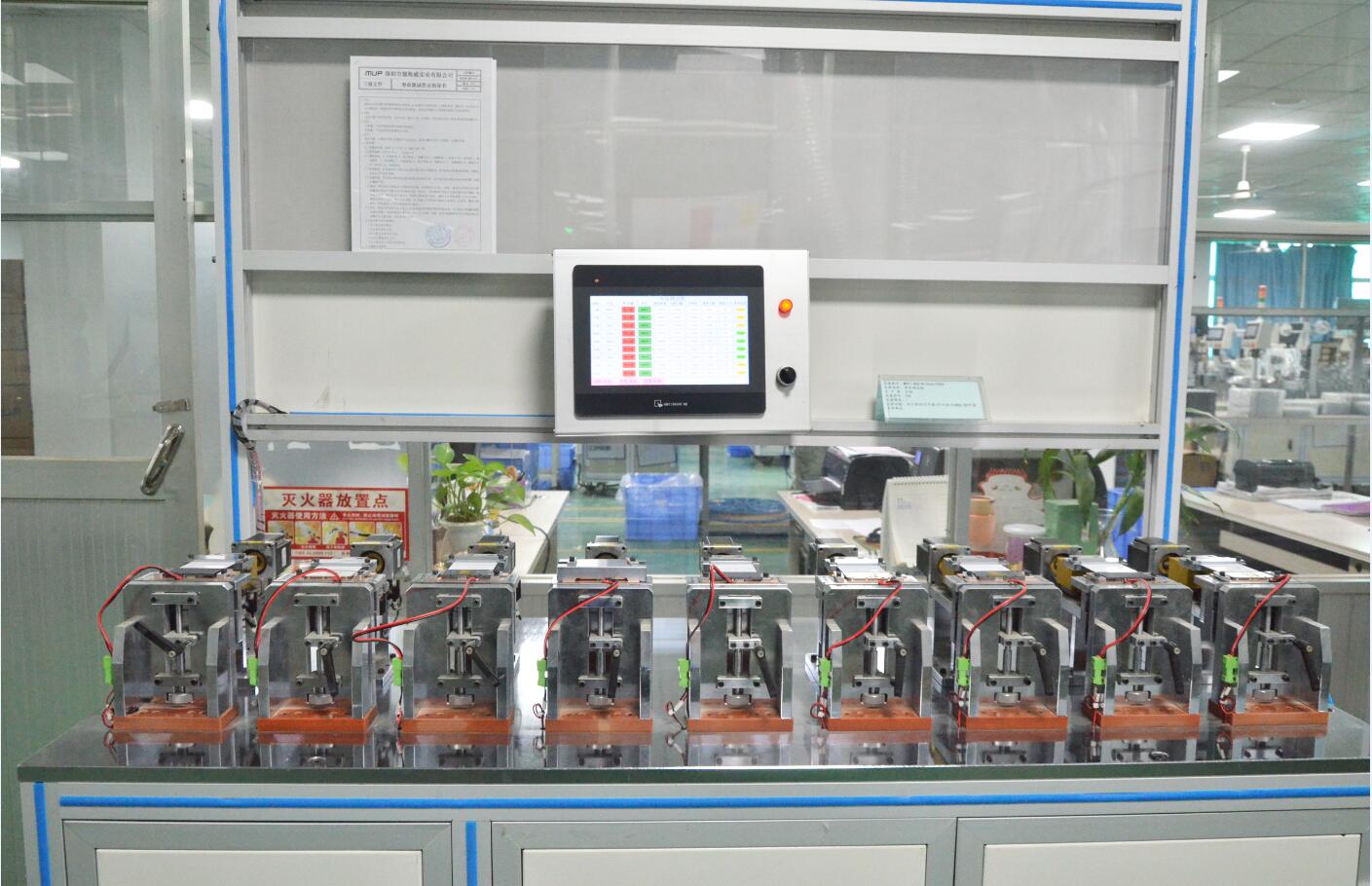
Durability cycle testing on a card connector: a mechanical claim that should be traceable to a specific model and test condition.
Where compliance scope actually changes the application decision
The same connector family can carry very different documentary weight depending on where it is used.
Payment terminals and mPOS devices
Smart card sockets and IC card holders in POS terminals, mPOS devices and payment sound boxes are selected against card interface standards such as ISO/IEC 7816, which defines the contact geometry including 8-pin, 6-pin and 4-pin configurations in ISO/IEC 7816-2, and against scheme requirements such as EMV in the payment context. Card readers in this segment commonly run continuously, so mating cycle ratings and contact plating matter as much as the certificate file. Buyers in this segment typically receive shipments into DE, FR, PL, ES, IT and other European markets where the RoHS and REACH evidence is requested at customs and at customer audit.
Smart meters and utility terminals
Electricity, water and gas meters use SIM and smart card sockets in enclosures that may remain sealed for a decade. Operating conditions in the published MUP scenario data include 24/7 operation, waterproof and dustproof requirements up to IPX7/IPX8, high-temperature resistance and anti-vibration, with mounting options across mid-mount, vertical and horizontal. Each of those options is a design change with a possible compliance consequence, which is why the certificate scope must be read against the exact variant ordered.
Notebooks, IoT and consumer devices
MicroSD and TF card holders in notebooks, IoT terminals and consumer electronics are the highest-volume, lowest-documentation-risk segment. Here the practical risk is not certification but substitution: a lower-cost housing material introduced mid-program without notification. The IECQ QC 080000 process controls are most valuable precisely in this segment, where unit price pressure is highest.
Automotive and industrial
NGFF M.2 connectors and card sockets used in vehicle infotainment, ADAS modules or industrial control panels sit under automotive or industrial qualification expectations, where IATF 16949:2016 becomes a relevant filter and where customer-specific requirements are usually layered on top. HDMI receptacles in displays, projectors and TVs sit under a different regime again, dominated by the HDMI programme rules and by the display interface's own electrical requirements.
Market context: why documentation rigour is rising in this category
The commercial backdrop explains the tightening. Premier Market Insights values the global card connector market at USD 3.96 billion in 2024 and projects USD 5.89 billion by 2030, and attributes 44.8% of the 2025 market to Asia Pacific. Data Insights Reports estimates that SD and microSD socket types accounted for roughly 60% of unit shipments in 2024. Two cautions belong with those figures: market sizing in this category is sensitive to what counts as a card connector rather than a general interface socket, and at least one alternative estimate places the 2024 market far lower on a narrower definition — a reminder that the number should be matched to the definition before it is used in a business case.
The structural reading is more useful than the headline. Volume sits in memory card sockets, while documentation scrutiny is concentrated in payment, metering, automotive and industrial programs — the segments where a compliance gap has regulatory or contractual consequences rather than merely commercial ones. That is why suppliers serving both ends of the market tend to hold a broad certificate portfolio even when a specific order only requires two of those documents.
Where certificates stop: limits buyers should plan around
A balanced reading has to include the boundaries, because they are where procurement programs get hurt.
- System certificates do not carry part-level compliance. An ISO 9001 or IECQ QC 080000 certificate confirms process control at an organization level; the RoHS position of a specific SIM card socket still depends on a model-level test report or technical documentation.
- Test reports are sample-bound. A report describes the samples tested under the conditions stated. It does not automatically extend to a different plating thickness, a different housing resin or a different production site.
- Certificates expire, and expiry is often invisible. The IECQ certificate referenced in this article runs from 2024-02-03 to 2027-02-02. Programs that continue past that date should obtain renewal evidence rather than assume the file stays current.
- Programme marks are narrower than they look. HDMI Adopter status and a USB-IF TID are programme-level positions tied to specific products or licences; they do not qualify card connectors of any type.
- IECQ QC 080000 does not discharge REACH obligations. REACH information duties for articles remain with the supplier and importer, and are addressed through SVHC declarations rather than through a management system certificate.
- No document replaces incoming inspection. Certificates and reports describe intent and tested samples; lot-level verification remains the buyer's control.
The comparison with older practice is therefore not “certified versus uncertified” but “layered evidence versus single-document assurance”. A decade ago a supplier could satisfy many buyers with a RoHS declaration and an ISO 9001 certificate. That combination leaves three gaps open — it does not show a hazardous substance control process, it does not tie evidence to a part number, and it does not survive a material change. The layered approach closes those gaps at the cost of more administrative work on both sides.
Future outlook
Three directions look durable. First, documentation is becoming part-number-specific: buyers increasingly ask for the model number on the report to match the number on the drawing, which pushes suppliers to maintain per-model compliance files rather than per-family statements. Second, change notification is becoming a contractual term rather than a courtesy, because material substitution is the main route by which a compliant part becomes non-compliant. Third, programme registrations are being verified rather than accepted, with buyers checking HDMI and USB-IF listings directly instead of relying on a logo in a presentation.
For card connector suppliers, the implication is that compliance capability increasingly looks like a data management problem: maintaining the link between certificate scope, site, part number, material declaration and change history, and being able to produce that link quickly during an audit. For buyers, the implication is simpler. The question is no longer whether a supplier holds certificates, but whether each certificate's scope, issuing body, validity window and product linkage survive being checked.
FAQ
Does IECQ QC 080000:2017 certification mean every card connector model from that supplier is RoHS compliant?
No. IECQ QC 080000:2017 certifies a hazardous substance process management system at an organizational and site level: it confirms that the supplier has audited processes for controlling, tracing and changing the materials that determine substance content. Compliance of an individual model is demonstrated separately, typically through a model-level RoHS test report or technical documentation tied to that part number. The two documents are complementary, and a buyer should hold both for a program with EU market obligations.
What is the practical difference between a RoHS declaration and a RoHS test report?
A RoHS declaration is the supplier's own statement that a part meets the applicable substance restrictions; it is fast to obtain and depends entirely on the supplier's internal controls. A RoHS test report is issued by a laboratory against a named standard on named samples and states a measured result. For most procurement programs the declaration is acceptable as routine documentation, while the test report is what supports a customer audit, a customs enquiry or a design-change investigation.
How should a buyer verify that a supplier's IECQ certificate is valid and covers the part being purchased?
Three checks are needed. Confirm the certificate number and issuing body independently, rather than relying on a PDF attachment. Read the scope statement to see whether the site that produces the ordered part number is listed, which matters for suppliers with multiple plants. And record the validity window — for example, a certificate running from 2024-02-03 to 2027-02-02 requires renewal evidence if the program extends beyond that date.
Do an HDMI Adopter ID or a USB-IF TID cover card connectors such as SIM sockets or MicroSD holders?
No. HDMI Adopter status is a position within the HDMI licensing structure that gives access to the specification and permitted use of the marks; product-level compliance of an HDMI receptacle is shown through testing at an Authorized Test Center. A USB-IF TID is issued to a specific USB product after compliance testing and is listed against that product. Neither programme qualifies SIM card sockets, smart card connectors, MicroSD card holders or NGFF M.2 connectors, which fall under their own interface and application requirements.
Which documents should be requested for a smart card socket used in an EU payment terminal?
A practical set includes the full management system certificates with scope pages, the IECQ QC 080000 certificate with validity dates, a model-level RoHS test report for the exact socket, a dated REACH SVHC declaration, and confirmation that the card interface meets the applicable ISO/IEC 7816 contact configuration for the design. Where an enclosure is sealed or the terminal runs continuously, the request should also cover the durability rating and the operating temperature range for that specific model.
What happens when a compliance certificate expires while a supply program is still running?
The certificate should be treated as lapsed until renewal is confirmed, even if production continues normally. In practice buyers request the renewed certificate and the surveillance audit outcome before the expiry date, record the new validity window in the supplier file, and check whether any scope change occurred during recertification — a reduced scope can quietly remove a production site that the buyer assumed was covered.
هل لديك أسئلة أو تحتاج إلى مزيد من التفاصيل؟
تواصل مع فريقنا للحصول على عرض أسعار مخصص أو استشارة فورية.
طلب عرض أسعار
املأ النموذج أدناه وسيتواصل معك فريقنا بعرض مقترح مخصص.
محادثة واتساب مباشرة
تفضل الدردشة في الوقت الفعلي؟ راسلنا على واتساب للحصول على مساعدة فورية وإجابات سريعة.
- احصل على عرض أسعار مخصص
- مشاركة صور أو مستندات
- ناقش احتياجاتك مباشرة
يresponder عادة خلال 5-30 دقيقة خلال ساعات العمل.