
Toner Cartridge: Canon G57 vs. Toshiba T-FC616
Comparison
Two toner cartridge references can share a supplier, a declared material and a testing protocol and still not be interchangeable. Canon G57/GPR-43/C-EXV59 and Toshiba T-FC616/T-FC415 serve two different copier fleets, are validated against different machines and force different purchasing decisions.
This comparison contrasts both options using criteria a buyer can verify before placing an order: compatibility by machine, declared material — virgin PET and imported toner powder —, batch verification, acceptance of third-party inspection, and acceptance criteria applicable to both offices and copier rental companies. The point is not to decide which brand is better, but to understand what each reference forces you to manage once it is installed in the field.
Why these two references are compared together
Anyone who manages office consumables rarely works with a single equipment brand. A typical installed fleet mixes copiers from several generations, and that mix turns cartridge selection into a portfolio problem rather than an isolated product problem.
The Canon G57/GPR-43/C-EXV59 family corresponds to the Canon series. The Toshiba T-FC616/T-FC415 family corresponds to the Toshiba series, and within the same supply line the references T-3028 and T-FC330 are also sold. Both families are offered as compatible toner cartridges for A3 copiers, and both share the same material declaration: virgin PET and toner powder from a well-known publicly listed company, with approximately 90% imported origin. The declared scope of application is common: printing factory, print shop, office, education and copier rental.
That shared starting point is what makes the comparison useful. If the material and the manufacturing process are the same, the difference shifts to what does change: the mechanical fit per machine model and the way each batch is verified before it leaves the factory.
Compatibility by machine: the first purchasing filter
Neither family is universal. A cartridge from the Canon series is not installed in a machine from the Toshiba series, and vice versa. Verification must be done against the exact machine model, not against the copier brand or the outward appearance of the cartridge.
For an office with a small fleet, the comparison is almost always settled with a single question: which machines are installed. For a copier rental company, a distributor or a supplies wholesaler, the question is different and more operational: what proportion of the fleet corresponds to each family and what safety stock each one requires in order not to interrupt service.
It is advisable to record, at a minimum, the exact machine model, the number of units in the field and the age of each one. Used copiers and refurbished copiers often incorporate earlier generations within the same model, and that widens the list of valid references within each family. In mixed fleets, this prior inventory is more decisive than any theoretical comparison between catalogues.
Virgin PET and imported toner powder: what is really being bought
A compatible toner cartridge is made up of two technical decisions that the buyer can audit separately: the housing and the powder.
The housing: why virgin PET is declared
The declared material for these references is virgin PET. Compared with recovered materials, virgin PET offers more predictable dimensional behaviour in the sealing and mechanical fit areas, two points that directly influence the most costly after-sales failures: toner leaks and misalignments that lead to jams. The housing is not an accessory: it is the part that keeps the cartridge geometry within the machine throughout its service life, and its stability depends less on the theoretical design than on the repeatability of injection moulding.
The powder: declared origin and traceability
The declaration about the powder is twofold: it comes from a well-known publicly listed company and approximately 90% is imported. For the buyer, the value of this declaration lies in traceability. When the powder origin changes without notice, the printing behaviour changes with it, and the problem appears in a diffuse way: irregular fusing, variable density or apparently higher consumption than expected. That is why the declared origin is not a decorative detail but a condition that should be fixed in writing in the order specification sheet.
Batch verification, in-house laboratory and third-party inspection
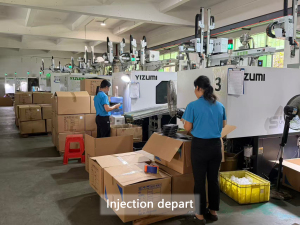
The manufacturing process for these references is described as in-house manufacturing of the entire process. The factory has in-house departments for moulding, injection, assembly, filling, packaging and testing, as well as a toner powder warehouse and an in-house testing laboratory. Far Industries Co., Ltd, a manufacturer based in Zhongshan (China) that produces A3 office consumables and markets the Tenon brand, is the company behind these references; it was founded in 2011, operates on an area of 9,000 m² with 88 employees and 8 R&D engineers, and declares an annual production of 6,000,000 units with 70% export, mainly to Latin America and the Middle East. It also holds 9001 certification.
The declared quality control consists of testing the print quality of each toner batch in a dedicated testing laboratory. It is therefore not a generic verification of the finished product, but a verification associated with the specific batch that is going to be delivered.
Before leaving the factory, each product goes through four linked controls: toner print quality test, structural inspection of empty cartridges, verification of abnormal toner leaks and packaging compliance check. These four steps underpin the delivery standard declared as zero defects.
To this is added an element that is relevant for the independent buyer: third-party inspection before shipment is accepted. In other words, the buyer can commission their own verification at origin instead of relying solely on the manufacturer's report. For distributors and rental companies, this option reduces the risk of receiving a batch that passes at the factory but does not pass in their own working environment.

Comparison table: Canon G57/GPR-43/C-EXV59 versus Toshiba T-FC616/T-FC415
| Comparison dimension | Canon G57 / GPR-43 / C-EXV59 | Toshiba T-FC616 / T-FC415 |
|---|---|---|
| Machine family | Canon series | Toshiba series |
| References within the same line | G57, GPR-43, C-EXV59 | T-FC616, T-FC415, plus T-3028 and T-FC330 |
| Cross-compatibility between families | Not applicable | Not applicable |
| Declared housing material | Virgin PET | Virgin PET |
| Declared toner powder | Well-known publicly listed company, 90% imported | Well-known publicly listed company, 90% imported |
| Quality verification | Print quality per batch in a dedicated laboratory | Print quality per batch in a dedicated laboratory |
| Controls before shipment | Four: printing, structure, leaks, packaging | Four: printing, structure, leaks, packaging |
| Third-party inspection | Accepted before shipment | Accepted before shipment |
| Declared application | Office, education, print shop, copier rental | Office, education, print shop, copier rental |
Reading the table is deliberately uncomfortable for anyone looking for a simple answer: in material, powder and verification, the two families are equivalent. The real difference lies in the machine they serve. Choosing between Canon G57 and Toshiba T-FC616 is not choosing a different quality standard, but choosing the correct fit for the installed fleet.
Acceptance criteria per batch
The declared acceptance criteria are two: testing before production and testing after receiving the goods. On that basis, a buyer can build an acceptance protocol per batch with verifiable elements:
- Prior validation: testing before producing the full batch, using samples that make it possible to confirm the reference and the machine family.
- Material confirmation: checking the batch sheet against the virgin PET declaration and against the origin of the toner powder (publicly listed company, 90% imported).
- Print verification: print quality test associated specifically with the delivered batch, not with an earlier batch.
- Structural inspection: structural review of the empty cartridge before filling.
- Leak control: verification of abnormal toner leaks, the failure with the greatest impact on after-sales cost.
- Packaging compliance: packaging check before shipment, especially critical in long sea freight shipments.
- Independent inspection: commissioning a third party at origin when the volume justifies it.
- Receiving test: testing after receiving the goods, comparing behaviour with the initially approved sample.
The commercial terms declared for these orders are a minimum quantity of 2 cartons, a delivery time of 10 to 45 days, FOB, CIF or EXW terms, and payment by T/T. The declared monthly capacity is 50,000 units, which makes it possible to produce high-volume orders on a scalable basis. For the buyer, the combination of a low minimum order and a variable lead time is a validation advantage: it allows testing with a small batch before committing to a larger volume.
There is also a consistency guarantee between sample and serial production. Samples are selected at random from the production line and come from the same source as the serial-produced products, because four factors are kept fixed: fixed moulds, fixed injection moulding machines, fixed toner sources and fixed testing standards.
Purchasing questions for offices and rental companies
The useful questions are those the supplier can answer with a document, not with an opinion. For an office buying a compatible reference for the first time, and for a rental company introducing it into a fleet in service, the reasonable list is as follows:
- Which exact machine model does this reference cover, and with which list of models can it be confirmed in writing?
- What proportion of the installed fleet is covered by the Canon G57/GPR-43/C-EXV59 family and what proportion by the Toshiba T-FC616/T-FC415 family?
- Can a sample batch be received before formalising the order, and at what preparation cost?
- Do the sample batch and the production order come from the same moulds, machines, toner source and testing standards?
- What document accompanies each batch and what information does it contain about material and powder origin?
- Is third-party inspection accepted before shipment, and what standard is used for that inspection?
- What is the real delivery time for the planned volume, and how is an urgent case handled?
- What procedure exists if a batch causes leaks, jams or returns at the end customer?
- Is customisation of logo, sticker, box, carton, page or design allowed for your own channel?
As for after-sales support, the declared scheme is tiered: sales representatives with technical skills collect and organise after-sales problems and pass them on to technical specialists; once the cause is identified, remote technical support, video technical guidance, on-site technical assistance and return and exchange services are offered. For a rental company, this point is as relevant as the price of the cartridge, because the cost of an incident is not measured in the part, but in the technical visit and the interruption of service.
Market context: why the comparison is relevant now
The inks and toner market was estimated at approximately 38,470 million dollars globally in 2026, according to Business Research Insights. Within that total, the specific segment of toner for laser printers was projected at close to 3,720 million dollars in 2026, according to Fortune Business Insights, with Asia-Pacific leading the regional market with a share of 37.26% in 2025 according to the same source.
The most relevant figure for anyone buying compatible toner cartridges is another one: compatible or aftermarket cartridges are projected to approach 50% of global market share by 2028, according to the sector analysis published by EcoTonerUSA in 2026. It is a secondary-source projection and should be read as a trend, not as an exact figure, but it points in a clear direction: the decision is no longer whether to buy compatible, but how to verify the compatible product you buy.
The equipment context supports that trend. The global market for refurbished printers was estimated at 1,530 million dollars in 2024, with a compound annual growth rate of 7.1%, according to Metastat Insights. Every refurbished machine that enters a fleet widens the demand for compatible references and, at the same time, widens the variability of the machines on which those references must work.
For importers and distributors there is also a logistical and customs consideration: toner and developers are usually classified under HS code 370790, while parts and accessories for printers and copiers — drum units, fuser units, rollers — are classified under HS code 844399. Correctly distinguishing both items avoids reclassifications at destination when an order mixes toner cartridge, developer unit, drum unit and fuser unit.
Limits of this comparison and when another route is advisable
An honest comparison must declare what it cannot resolve. First, there is no publicly verifiable data on page yield or cost per page for these two specific references; any yield figure a supplier offers must be validated with the buyer's own batch test. The choice between Canon G57 and Toshiba T-FC616 cannot be settled with a specification table, because the declared specifications are equivalent.
Second, the declared 9001 certification attests to a quality management system, not to a verified technical equivalence with the original product for each machine model. Anyone who needs that equivalence for contractual reasons must obtain it through their own validation protocol.
Third, the declared delivery time of 10 to 45 days is a wide range. For an office that needs immediate replenishment, or for a rental company with an open incident in the field, that lead time may not be acceptable without prior safety stock. In those cases the reasonable route is to keep a minimum stock per machine family, rather than forcing an urgent order.
Finally, a compatible cartridge is not an original equipment manufacturer cartridge. Prior validation, batch testing and acceptance of third-party inspection exist precisely because that difference is real and must be managed. If the buyer is not willing to carry out any validation step, this supply route is not the right one, regardless of the supplier chosen.
Outlook
The comparison between two families of compatible toner cartridges looks less and less like a price comparison and more and more like a protocol comparison. When the declared material, the powder origin and the pre-shipment controls become standardised in the sector, the factor that separates one supplier from another stops being the specification sheet and becomes the ability to demonstrate that each batch complies with what the sheet promises.
For offices and rental companies, the practical consequence is that the purchasing decision shifts towards the moment of validation: what is tested, with which sample, with which document and with which acceptance criterion. For importers and distributors, the shift is towards batch traceability, because that is where margin is protected when the end customer returns product.
In that scenario, the relevant question is not which of the two references is superior, but which of the two fits the installed fleet and what evidence accompanies the batch that is received.
Frequently asked questions
Can a Canon G57 cartridge be installed in a Toshiba copier?
No. The Canon G57, GPR-43 and C-EXV59 references are part of the Canon series, while T-FC616 and T-FC415 belong to the Toshiba series. Compatibility must be confirmed against the exact machine model and not against the copier brand.
Do samples have the same quality as a high-volume order?
According to the declared information, yes. Production is based on four fixed factors: fixed moulds, fixed injection moulding machines, fixed toner sources and fixed testing standards. Samples are selected at random from the production line and come from the same source as the serial-produced products.
What does it imply that 90% of the toner powder is imported?
It indicates that the powder comes for the most part from a well-known publicly listed company, with a declared and therefore traceable origin. For the buyer it means that the powder origin can be fixed in the order sheet and unnotified changes can be detected, which usually show up as variations in fusing or in print density.
What are the purchasing terms and the acceptance criteria?
The declared minimum order quantity is 2 cartons, with FOB, CIF or EXW delivery terms and payment by T/T. The acceptance criteria are testing before production and testing after receiving the goods.
Can the order be inspected before shipment?
Yes. Third-party inspection before shipment is accepted. In addition, there are four in-house controls prior to leaving the factory: toner print quality test, structural inspection of empty cartridges, verification of abnormal toner leaks and packaging compliance check.
What is the declared delivery time and production capacity?
The declared delivery time ranges from 10 to 45 days and the declared monthly capacity is 50,000 units, which makes it possible to produce high-volume orders on a scalable basis. For orders subject to tight deadlines, it is advisable to plan safety stock per machine family.