
Case Packer CE Compliance: What the CP-S50 and CP-T60 Offer
For importers and packaging-line buyers, CE compliance on an automatic case packer is a legal precondition, not a marketing badge. In the European Union, a case packing machine placed on the market must be CE marked and supported by a technical file that demonstrates conformity with the applicable machinery safety standards. That turns case packer supplier qualification into a documentation exercise as much as an engineering one, especially during the awareness and research stage, before a specific model is chosen.
This reference examines the safety-related certifications and standards that apply to automatic case packers and uses two WIMACH case packer models as working examples: the side load CP-S50 and the top load CP-T60. It explains how safety risks are commonly mitigated through safety relays, safety PLCs, full-range safety interlock points, and pre-shipment safety function tests; it reviews the CE compliance of related tissue cartoning equipment such as product 5557; and it sets out the documentation a buyer should request from a supplier before releasing a purchase order.
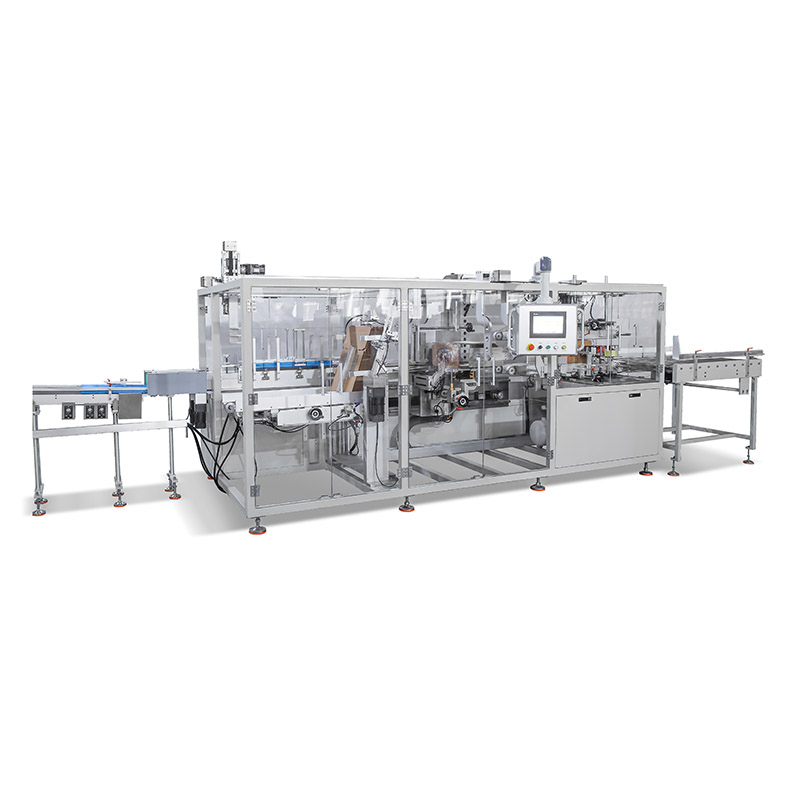
The CP-S50 side load case packer, one of two WIMACH case packer models referenced in this compliance guide. Image: WIMACH.
Why compliance comes first in case packer qualification
The first filter in case packer supplier qualification is not speed or price, but whether the machine can legally be placed on the target market. For a European buyer, that means CE marking and a traceable technical file; for a US buyer, it means alignment with the recognized packaging machinery safety standard. A fast machine with no conformity evidence is a procurement risk, not a bargain.
Market scale makes this filter more important as the supply base widens. Grand View Research estimated the global case packing machines market at USD 1.07 billion in 2024, projected to reach USD 1.74 billion by 2033. Asia Pacific accounted for a 37.9% market share in 2024, and top load case packers represented the largest machine-type share at 45.5% in 2024. As more suppliers from Asia Pacific enter European and North American projects, buyers carry a larger share of the responsibility for verifying conformity themselves.
For a buyer at the awareness-to-research stage, the practical question is simple: what evidence separates a compliant automatic case packer from a well-presented one? The answer is a document set, not a specification sheet alone.
What CE compliance requires for an automatic case packer
EN ISO 12100 is the harmonized European standard for machinery safety and is mandatory for CE marking on case packers sold in the EU. It requires a structured risk assessment: identify hazards, estimate and evaluate risk, then eliminate or reduce it through inherently safe design, safeguarding, and information for use. The visible output is CE marking; the auditable output is a technical file.
In the United States, ANSI/PMMI B155.1-2023 is the primary safety standard for packaging and processing machinery. A supplier that only holds European documentation may still need additional evidence for a North American line, so buyers should name the target market before the quotation stage.
A CE technical file for a case packer normally includes the following elements:
- A machinery risk assessment and the resulting safety concept;
- Design and assembly drawings, including guarding and access points;
- A component list identifying rated safety components (relays, interlocks, drives);
- A description of safety functions and their performance level;
- Test records for safety functions and, where applicable, functional acceptance testing;
- The EU Declaration of Conformity and CE marking information;
- Operating and maintenance instructions with residual-risk information.
WIMACH states that all of its machines are CE certified and are assembled with reliable components from well-known brands. The component-level point matters: the safety chain depends on rated relays, interlocks, and drives rather than on the machine frame, so a buyer should see where those components come from, not only the final mark on the nameplate.
The CP-S50 and CP-T60 at a glance
The two WIMACH case packers serve different carton-loading geometries, so compliance and safety discussion should be read against their actual specifications. The CP-S50 is a side load / side push case packer; the CP-T60 is a pick-and-place / top load case packer.
| Parameter | CP-S50 (Side Load) | CP-T60 (Top Load) |
|---|---|---|
| Machine type | Side load / side push case packer | Pick-and-place / top load case packer |
| Packing capacity | 1-16 cartons per minute | 1-8 cartons per minute |
| Carton dimensions | 240-500 (L) x 200-400 (W) x 180-400 (H) mm | 300-600 (L) x 200-400 (W) x 150-400 (H) mm |
| Power supply | 380V 50/60Hz, 3 phase | 380V 50/60Hz, 3 phase |
| Power consumption | 4.5 kW | 7.5 kW |
| Air pressure | 0.5-0.8 Mpa | 0.5-0.8 Mpa |
| Air consumption | 350 L/min | 450 L/min |
| Overall dimensions | 4200 x 2300 x 1900 mm | 4200 x 2600 x 2200 mm |
| Weight | 1500 kg | 1600 kg |
| Construction | Stainless steel / carbon steel | Stainless steel / carbon steel |
| Pack formats | Cartons, boxes, bottles, cans, bags | Carton case packing (top load) |
| Applicable industries | Tissue; Food and Beverage; Pharmaceutical; Daily Chemical and Cosmetic; Hardware; Auto Parts and Machinery | Tissue; Food and Beverage; Pharmaceutical; Daily Chemical and Cosmetic; Hardware; Auto Parts and Machinery |
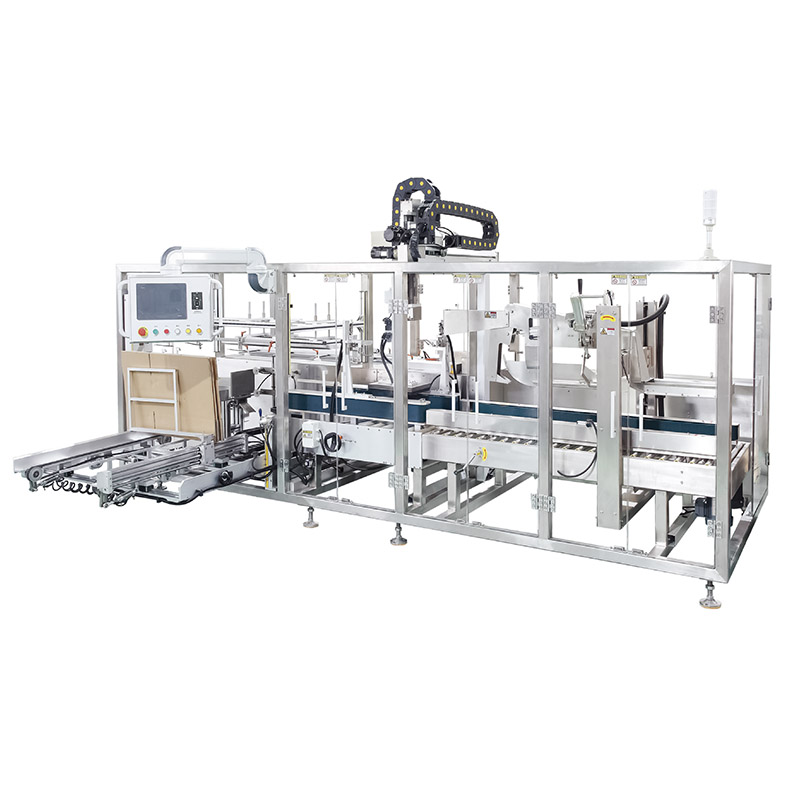
The CP-T60 top load case packer, shown for reference alongside the CP-S50. Image: WIMACH.
How safety risks are mitigated: safety relays, safety PLCs and interlock points
Case packer safety is engineered as a layered system rather than a single device. The general principle is that a hazard is first designed out, then guarded, and finally controlled electronically so that the machine stops or holds position when a guard is opened or an emergency stop is pressed.
Safety relays
A safety relay is a dedicated, self-monitoring device that accepts signals from emergency stops, gate switches, and light curtains and removes power from hazardous motion when a fault or a demand is detected. Unlike a standard control relay, a safety relay uses redundant internal channels and cross-monitoring so a single internal failure does not leave the machine able to run. In case packers it typically governs the main drive and pneumatic actuators tied to guarding.
Safety PLCs
A safety PLC performs the same logic digitally and adds diagnostics: it can report which interlock tripped, log stop events, and manage several zones independently within one controller. This matters on a case packer integrated into a longer end-of-line, where the machine must coordinate with upstream cartoners and downstream palletizers without a single fault stopping the entire line. A safety PLC also simplifies validation, because the safety logic is documented in software rather than spread across a physical relay panel.
Full-range safety interlock points
Every guard, access door, and manual intervention point on a case packer should be interlocked so that entry is either prevented or the machine is brought to a safe state. Full-range coverage means interlocks are not limited to the main electrical cabinet: they extend to the carton magazine, the compression section, the discharge area, and any location where a changeover or jam clearing requires a hand to enter the machine envelope.
Pre-shipment safety function tests
Before dispatch, safety functions are normally verified as a distinct test activity: trip each interlock, confirm each stop, check stop time and restart conditions, and record the result. This is the difference between a machine that is designed to be safe and a machine that has been demonstrated to work safely in the configuration the buyer will receive. Buyers should ask for these records as part of the machine file.
CE compliance across the line: cartoning equipment and product 5557
Case packing is rarely a standalone purchase. Buyers assembling an end-of-line usually receive a cartoner, a wrapping unit, a case packer, and a palletizer from the same supplier, and CE compliance must hold across the whole chain rather than on the case packer alone. WIMACH frames its case packers as part of integrated packaging lines for folded and rolled tissue products.
A concrete example is product 5557, a tissue cartoning machine used to carton facial tissue boxes and compliant with CE standards. This application is common in Poland, where the machine forms the entry point of a facial tissue box packaging line that later includes case packing and palletizing stages. Confirming that the cartoner and the case packer share the same conformity basis avoids a line that is compliant at one station and incomplete at the next.
In the same European market, product 5567 wraps facial tissue packets with plastic film, product 5580 case packs tissue boxes, and product 5571 provides full automatic facial tissue packaging that includes box packing, film wrapping, case packing, palletizing, strapping, and stretch wrapping. Together these show that CE compliance is treated as a line-level requirement rather than a single-machine attribute.
Patent documentation issued under PRC patent law
Certificates and standards answer the question of whether a machine may be sold; patents answer a different question, namely whether the design behind it is the supplier's own. In China, patent documentation is issued under PRC patent law and appears in two forms that buyers will encounter: invention patents, which cover a new technical solution, and utility model patents, which cover a new shape or structure suitable for practical use.
For a packaging line buyer, patent certificates are supporting evidence rather than safety evidence. They indicate that a structural or functional feature of the machine has been examined and granted, and they help a buyer distinguish a supplier that develops its own designs from one that copies them. WIMACH documentation includes utility model and invention patent certificates issued under PRC patent law, which buyers can request as part of supplier qualification alongside the CE file.
A practical caution applies here as elsewhere: a patent is not a compliance document. It does not replace the EU Declaration of Conformity, the risk assessment, or safety function test records, and it should be read as one input into a qualification decision rather than a substitute for the others.
Where compliance becomes a project requirement: application scenarios
In real packaging projects, CE compliance frequently appears as an explicit project condition rather than an optional feature, which is the clearest signal of how buyers should treat it.
- Mexico, canister wet wipes: a turnkey packaging line for canister wet disinfecting wipes covers canister loading, disinfectant filling, sealing, capping, labeling, case packing, and pallet wrapping. The project carries a special requirement for customized design and CE compliance, and the case packing stage is handled by a CP-T60 top load case packer. Product 5565 is used with a tissue rewinding machine and a tissue cutting machine in the same workshop environment.
- United States, toilet paper rolls: a customized end-of-line for toilet paper rolls runs from roll wrapping through case packing, palletizing, and stretch film wrapping. Product 5579 provides automatic-mode end-of-line packaging in this configuration, supported by a toilet paper roll wrapping machine and a toilet paper packaging line.
- Poland, facial tissue: a one-stop turnkey facial tissue line handles box packing, film wrapping, case packing, palletizing, strapping, and stretch wrapping, with the CP-S50 side load case packer as the reference case packing unit. The line carries the same customized-design and CE compliance requirement seen in the other projects.
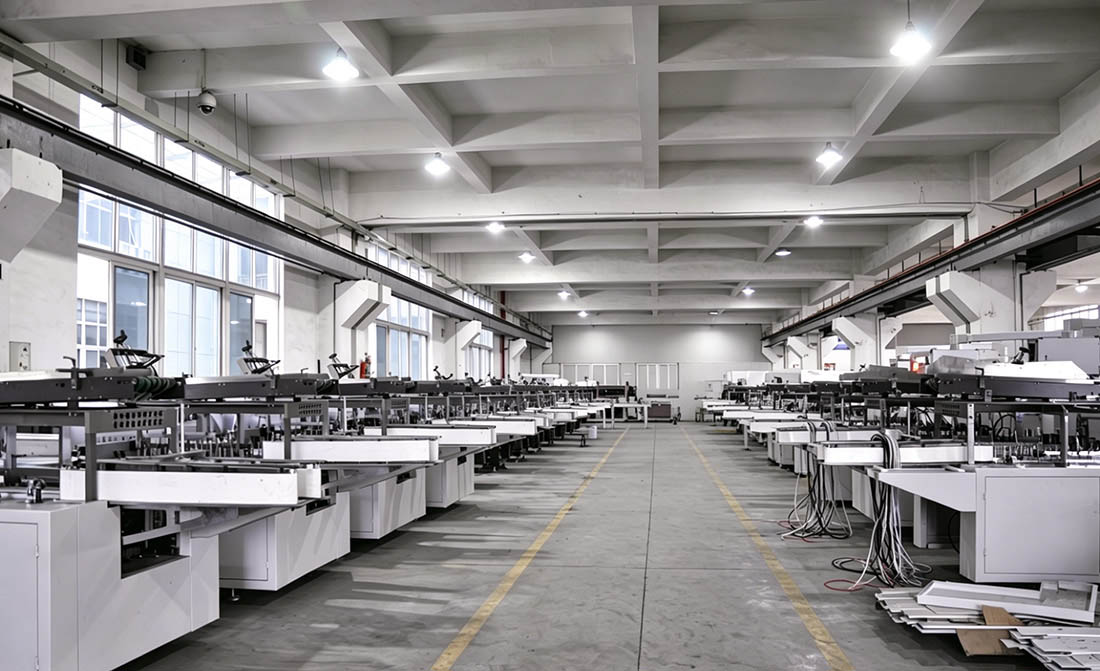
Assembly and preparation of packaging machines before pre-shipment safety function testing. Image: WIMACH.
Market trend: documentation as a purchasing criterion
Compliance is becoming a purchasing criterion because automation itself is expanding. Global Market Insights placed the global robotic packaging systems market, which includes robotic case packers, at USD 6.4 billion in 2024, and Fact.MR estimated that secondary packaging equipment, a category that includes case packers, holds approximately 45% of the total packaging robot market share. As more of the end-of-line becomes automated and interconnected, the number of safety functions that must be documented grows with it.
Two buyer-side trends follow. First, procurement teams increasingly ask for the technical file before the quotation is approved, not after. Second, buyers compare suppliers on their ability to produce consistent documentation across a project rather than on a single certificate. Suppliers that build safety architecture into the machine from the design stage can supply that evidence as a by-product; suppliers that add documentation afterwards usually cannot.
Comparison with traditional solutions, and where compliance stops
Older case packer designs relied on hard-wired relay logic with limited diagnostics and guarding focused on the main access door. Modern architecture, by contrast, tends toward safety PLC control with full-range interlock coverage and recorded functional testing. The differences are practical, not cosmetic:
| Dimension | Traditional relay-based approach | Modern safety PLC and full interlock approach |
|---|---|---|
| Fault diagnosis | Limited; fault location must be traced electrically | Controller reports the tripped zone or interlock |
| Zone coverage | Often concentrated on main access points | Extends to magazine, compression, and discharge areas |
| Line integration | Difficult to coordinate with upstream and downstream machines | Multiple zones managed within one safety controller |
| Validation | Documented manually, less consistently | Safety logic documented in software and test records |
| Changeover and expansion | Rewiring required for layout changes | Logic updates, less physical rewiring |
A genuine limitation should be stated plainly. A more advanced safety architecture raises upfront cost and demands trained maintenance staff; on a low-throughput, single-product line, a simpler hard-wired arrangement can be sufficient and easier to service locally. Compliance also has a defined boundary that buyers sometimes overestimate: CE marking addresses conformity with machinery safety requirements, not throughput, carton quality, or total cost of ownership. It is possible to buy a fully compliant case packer that is a poor fit for a specific product, and it is possible to buy a fast machine whose documentation does not hold up on inspection. In addition, CE compliance is market-specific. A machine correctly marked for the EU still needs evidence aligned with ANSI/PMMI B155.1-2023 for a US installation, and a self-declared technical file places the final verification responsibility on the buyer.
Future outlook
The direction of travel is toward compliance as an expected baseline rather than a differentiator. As case packing and palletizing become more tightly integrated, safety functions will be designed at line level, and the documentation that accompanies a case packer will increasingly be judged as part of the machine. Buyers who build a standard document request into their supplier process now, covering CE conformity, safety function test records, component traceability, and patent certificates where relevant, will be better positioned as the market grows toward the projected USD 1.74 billion in 2033.
Frequently asked questions
Why is CE marking required for an automatic case packer sold in the EU?
Machinery placed on the EU market must meet the applicable harmonized standards. EN ISO 12100 is the harmonized European standard for machinery safety and is mandatory for CE marking on case packers sold in the EU. CE marking therefore indicates that the machine has been assessed against those requirements and is supported by a technical file containing the risk assessment, safety concept, and conformity declaration.
Which safety standards apply to case packers in the EU and the United States?
In the EU, EN ISO 12100 is the harmonized machinery safety standard required for CE marking. In the United States, ANSI/PMMI B155.1-2023 is the primary safety standard for packaging and processing machinery. A supplier with European documentation may still need additional evidence for a North American installation, so the target market should be stated before quotation.
What safety elements should a buyer expect on an automatic case packer?
Typical elements are safety relay or safety PLC control of hazardous motion, emergency stop devices, and full-range safety interlock points covering guards, access doors, and manual intervention areas rather than only the main cabinet. Pre-shipment safety function tests, in which each interlock is tripped and each stop is verified and recorded, demonstrate that the delivered configuration works safely.
What documentation should buyers request from a case packer supplier?
A reasonable request set includes the EU Declaration of Conformity and CE marking information, the machinery risk assessment, design and assembly drawings including guarding, a component list identifying rated safety components, safety function test records, operating and maintenance instructions with residual-risk notes, and patent certificates where design ownership matters. For US projects, evidence aligned with ANSI/PMMI B155.1-2023 should be added.
Which WIMACH case packers are covered, and how does CE compliance extend across the line?
WIMACH states that all of its machines are CE certified. The two case packer models referenced here are the CP-S50 side load case packer and the CP-T60 top load case packer. CE compliance also applies to related equipment, such as product 5557, a facial tissue cartoning machine used for facial tissue boxes and compliant with CE standards, an application common in Poland.
A consolidated product catalog covering the WIMACH case packer and packaging line range is available for download: WIMACH product catalog.