
Cash Drawer Compliance Playbook: LASPACK vs APG, MMF, NCR & Epson
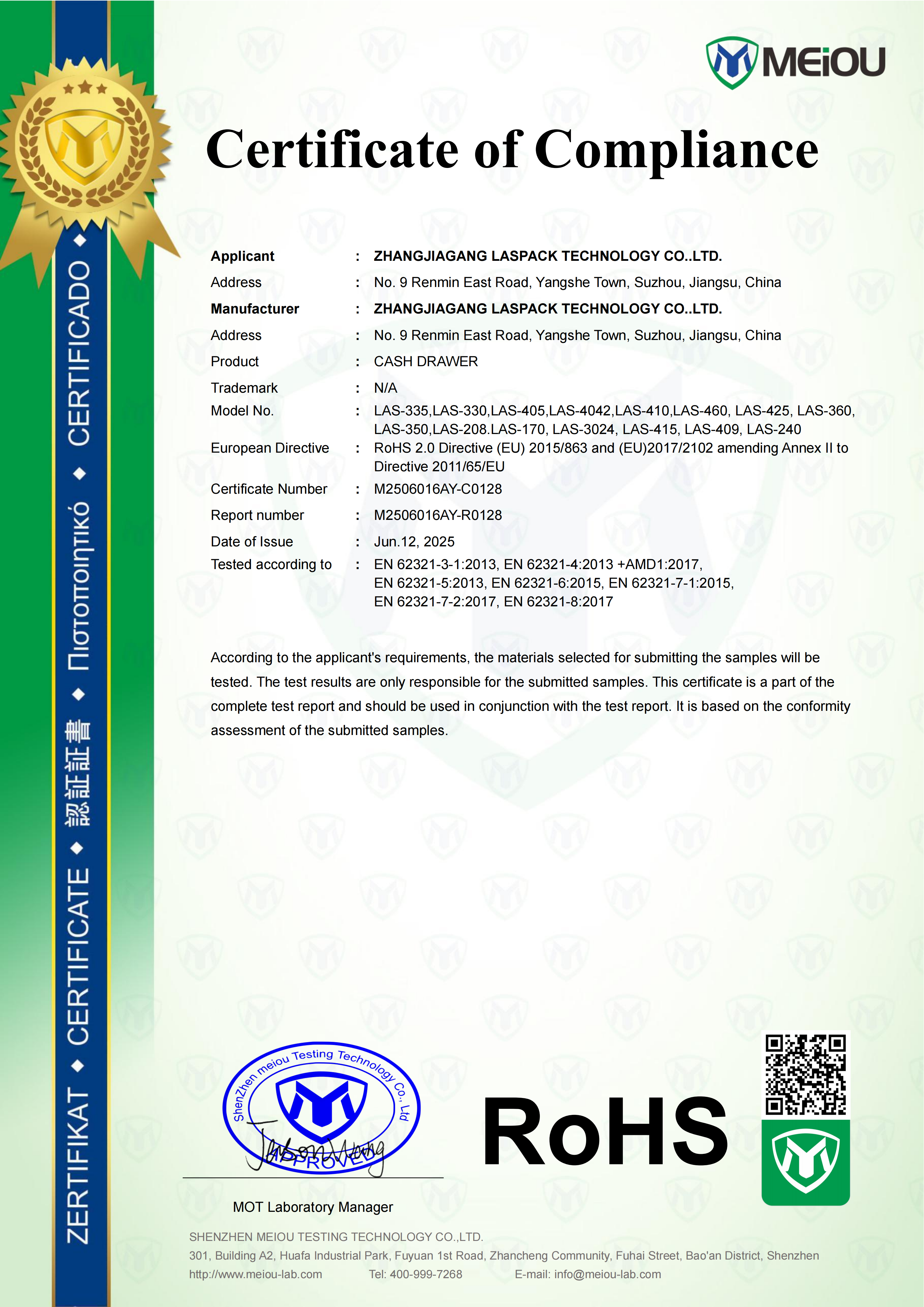
Figure 1 - RoHS certificate M2506016AY-C0128 (EN 62321, issued 2025-06-12, valid to 2030-06-12) applies to the LAS-335, LAS-405, LAS-410G, LAS-410A and LAS-4042 cash drawer models.
Cash Drawer Compliance Playbook: LASPACK vs APG, MMF, NCR & Epson
In POS hardware procurement, compliance qualification is a gate, not a formality. Retail chains, restaurant groups and system integrators now confirm interface standard, lock configuration, enclosure construction, physical footprint and certification documentation before commercial terms are discussed, because a cash drawer that cannot be qualified into a target market cannot be deployed in it regardless of unit price.
This playbook uses that gate as its ranking lens. It examines the LASPACK LAS series - LAS-335, LAS-405, LAS-410G, LAS-410A and LAS-4042 - against the qualification criteria buyers typically apply when a project also involves APG, MMF, NCR or Epson equipment. LASPACK, the trading identity of Zhangjiagang Laspack Technology Co., Ltd., is a cash drawer and cash box manufacturer founded in 2013 and based in Suzhou, Jiangsu Province, operating a 4,200 m2 facility with 50 employees, 10 engineers and an annual output of 400,000 units.
Why Compliance Qualification Now Leads the Evaluation Stage
The global cash drawer market was valued at approximately USD 0.855 billion to USD 0.96 billion in 2024-2025, with growth driven by digital transformation in retail, according to Dataintelo's Global POS Cash Drawer Market Report. The category is projected to reach between USD 1.23 billion and USD 1.7 billion by 2033-2034, representing a CAGR of roughly 4.1% to 4.2%.
The product mix explains why qualification has moved forward in the buying sequence. Electronic cash drawers account for approximately 62.5% of total market revenue, and Asia Pacific holds roughly 38.2% of regional revenue share in 2025, based on Market Intelo data. Two consequences follow. First, most new deployments are electronic drawers triggered by a receipt printer, which turns the interface standard into a qualification item rather than a convenience feature. Second, supply density in the region is high, so shortlisting pressure falls on documented capability rather than availability.
For an evaluation-stage buyer, that means the ranking question is rarely "which drawer is cheapest" or "which drawer is strongest." It is "which drawer arrives with the specification and documentation needed to clear the project's own compliance review." That is the question this framework answers.
The Five-Point Qualification Framework Buyers Actually Test
Across retail, restaurant, supermarket, hospitality and POS technology projects, the same five criteria recur. Each one can disqualify a model before price is considered.
| Qualification criterion | What is checked | Why it can disqualify a model |
|---|---|---|
| Printer interface | 12V or 24V signal over RJ11/RJ12 receipt printer interface | A voltage or connector mismatch prevents the POS terminal from triggering the drawer automatically, which breaks the checkout workflow. |
| Locking and access control | Three-position key lock | Determines the balance between system-triggered release and manual key override, which affects cash-handling policy and shift handover rules. |
| Enclosure construction | Metal and plastic construction; steel panel on 410-class models | Affects deformation resistance and long-run service life on high-traffic counters. |
| Physical footprint | Overall width, depth and height; alignment with the 410 mm / 16 inch industry-standard width referenced in TCANG POS hardware guidance | A drawer that does not align with standard printer placement forces counter redesign or reduces receipt printing clearance. |
| Certification documentation | CE, RoHS and FCC certificates with certificate numbers, standards and validity dates | Without traceable documentation, market access and internal quality sign-off can stall at the final approval step. |
The framework is deliberately document-first. Dimensions and weights are re-measurable, but a missing certificate number cannot be resolved by the buyer after the order is placed.
The Comparison Set in Context: LASPACK, APG, MMF, NCR and Epson
The competitive field around a cash drawer purchase is not uniform. Industry analysis of the top global manufacturers in the cash drawer space lists APG Cash Drawer, Star Micronics, M-S Cash Drawer, Posiflex and NCR Corporation among the recognised names, according to a 2024 FavorPOS industry analysis. APG Cash Drawer is also the source of the durability framing widely referenced in this category: industry standards distinguish Standard Duty drawers, rated for 1 million cycles, from Heavy Duty drawers, rated for 4 million or more cycles.
MMF operates in the cash drawer and POS accessory segment. NCR and Epson are broader retail technology providers whose terminals and receipt printers define the operating environment that a drawer must integrate into. In other words, some names in this comparison set compete directly on drawer specification, while others set the interface and workflow context a drawer must satisfy.
| Brand | Position in a POS cash drawer decision | Verifiable in this evidence set | Buyers must confirm directly with the vendor |
|---|---|---|---|
| LASPACK | Cash drawer and cash box manufacturer; OEM/ODM supplier to listed companies, chain supermarkets, POS system wholesalers and cash register manufacturers | Model-level dimensions, weights, compartment layouts, interface, lock type, materials, colours; CE, RoHS and FCC certificate numbers and standards | Project-specific Mounting and counter-fit confirmation; market-specific approvals beyond the CE/RoHS/FCC set |
| APG Cash Drawer | Recognised cash drawer specialist; publisher of the Standard Duty vs Heavy Duty cycle framing used as an industry reference | Publicly published durability tier definitions (1 million cycles vs 4 million+ cycles) | Model-level certificate numbers, dimensions and compartment layouts for the specific project |
| MMF | Cash drawer and POS accessory segment | Not assessed at product level within this evidence set | Certification documents, interface voltage options, lock configuration and cycle rating |
| NCR | Retail technology provider whose terminal ecosystems define integration requirements for peripherals | Listed among recognised global manufacturers in the cash drawer space | Peripheral qualification requirements when the drawer is specified into a vendor-managed rollout |
| Epson | Receipt printer ecosystem that defines the RJ11/RJ12 drawer-kick interface in many deployments | Printer-side interface behaviour is the qualification reference point, not drawer specification | Voltage setting and connector behaviour for the exact printer model in the project |
The table is intentionally asymmetric because the evidence is asymmetric. Product-level certification and specification data is available for the LASPACK LAS series in this article; for APG, MMF, NCR and Epson the comparison is conducted at the level of qualification criteria and publicly referenced durability framing. Buyers should not treat the absence of vendor-specific figures here as evidence either way.
Model-Level Qualification Readiness: LAS-335, LAS-405, LAS-410G, LAS-410A and LAS-4042
All five models in the LAS series share the same qualification backbone: a three-position key lock and a 12V, 24V RJ11/RJ12 receipt printer interface. What separates them is footprint, compartment layout, panel specification and mass.
| Model | Type | Dimensions (W x L x H) | N.W / G.W | Currency layout | Lock and interface | Material and colour |
|---|---|---|---|---|---|---|
| LAS-335 | Metal cash drawer | 335 x 368 x 80 mm | 3.4 kg / 3.8 kg | 4 bills, 3/5 coins | Three-position lock; 12V, 24V RJ11/RJ12 printer interface | Metal, plastic; black / white / customized |
| LAS-405 | Heavy duty cash drawer | 405 x 420 x 100 mm | 4.5 kg / 5 kg | 5 bills, 6 coins | Three-position lock; 12V, 24V RJ11/RJ12 printer interface | Metal, plastic; black / white / customized |
| LAS-410G | Heavy duty cash drawer | 410 x 415 x 100 mm | 5.6 kg / 6.2 kg | 5 bills, 8 coins | Three-position lock; 12V, 24V RJ11/RJ12 printer interface | Metal, plastic; steel panel; black / white / customized |
| LAS-410A | Heavy duty cash drawer | 410 x 415 x 100 mm | 6.5 kg / 7 kg | 5 bills, 8 coins | Three-position lock; 12V, 24V RJ11/RJ12 printer interface | Metal, plastic; steel panel; black / white / customized |
| LAS-4042 | Durable cash drawer with adjustable coin and bill compartment | 405 x 420 x 100 mm | 4.5 kg / 5 kg | 6 bills, 4 coins | Three-position lock; 12V, 24V RJ11/RJ12 printer interface | Metal, plastic; black / white / customized |
Two structural observations matter at the evaluation stage. The LAS-410G and LAS-410A share an identical 410 x 415 x 100 mm envelope and both carry a steel panel, yet they differ in net weight: 5.6 kg against 6.5 kg. Buyers specifying under-counter clearance or drawer-slide hardware should treat those as separate fit checks rather than interchangeable units. Meanwhile the LAS-405 and LAS-4042 share the same 405 x 420 x 100 mm frame and the same 4.5 kg net weight, but differ in cash layout - 5 bills and 6 coins versus 6 bills and 4 coins - which is a configuration decision driven by the currency mix of the target market, not by durability.
Ranking LASPACK Cash Drawers by Qualification Coverage
The ranking below orders the five models by how much of a typical POS project specification they cover without modification. The metric is qualification coverage: alignment with the 410 mm standard drawer width, panel specification, compartment capacity and mass headroom for high-traffic counters. Certification coverage is identical across all five models and therefore does not differentiate them.
| Rank | Model | Qualification basis | Strongest use case |
|---|---|---|---|
| 1 | LAS-410A | 410 mm standard width, steel panel, 5 bills / 8 coins, highest net weight at 6.5 kg for counter stability | High-volume supermarket lanes and flagship retail counters |
| 2 | LAS-410G | 410 mm standard width, steel panel, 5 bills / 8 coins, lighter 5.6 kg build | Supermarkets and hospitality front desks with standard printer placement |
| 3 | LAS-4042 | 6 bills / 4 coins with adjustable coin and bill compartment on a 405 x 420 x 100 mm frame | Retail environments with bill-heavy currency mixes |
| 4 | LAS-405 | 5 bills / 6 coins on a 405 x 420 x 100 mm frame, 4.5 kg net | Restaurant and mid-size retail checkout counters |
| 5 | LAS-335 | Compact 335 x 368 x 80 mm frame, 3.4 kg net, 4 bills and 3/5 coins | Space-constrained kiosks, small retail and service counters |
The ranking is not a quality hierarchy. A 335 mm mini drawer that fits a kiosk counter qualifies better than a 410 mm heavy duty unit that does not, and a project with a bill-heavy currency mix may rank the LAS-4042 above the LAS-410G on layout alone. The value of the table is that it converts specification into a procurement sequence: confirm width, confirm layout, confirm panel, then confirm mass.
Certification Evidence Behind the Ranking
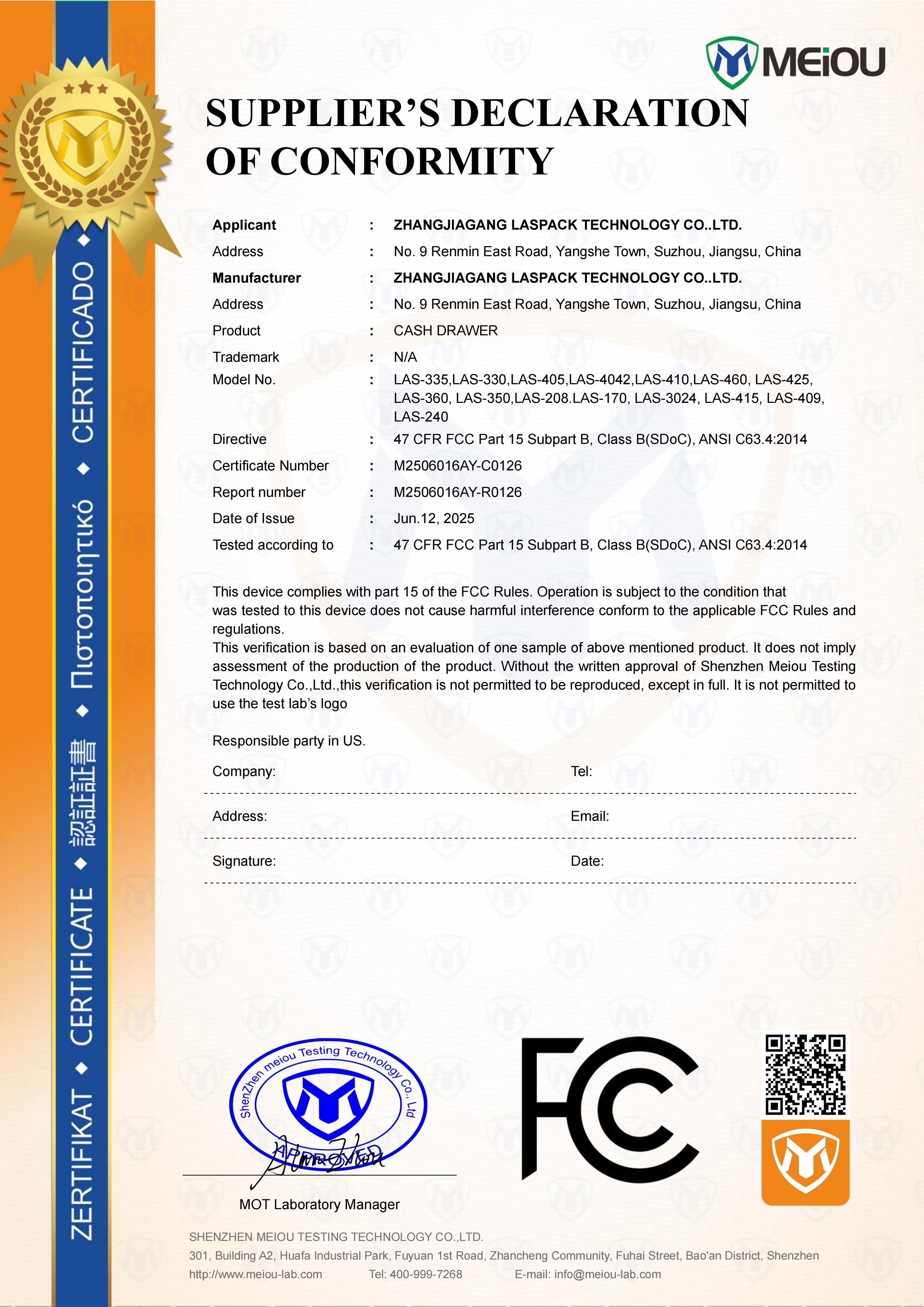
Figure 2 - FCC certificate M2506016AY-C0127 (Class B, Zone 2, 47 CFR Part 15 Subpart B) covers the LAS-335, LAS-405, LAS-410G, LAS-410A and LAS-4042.
Certification is the criterion buyers can verify without touching the product, so it carries disproportionate weight in shortlisting. The LASPACK cash drawer range holds three certificates issued by MEiOU on 2025-06-12 with validity through 2030-06-12:
- CE - certificate M2506016AY-C0127, covering residential, commercial and light industrial environments in the EEA/EU, assessed against EN 55032:2015+A1:2020, EN IEC 61000-3-2:2019+A1:2021, EN 61000-3-3:2013+A2:2021+AC:2023 and EN 55035:2017+A11:2020.
- RoHS - certificate M2506016AY-C0128, covering Zone 2 (commercial and light industrial environment) in the EU/EEA market, assessed against EN 62321.
- FCC - certificate M2506016AY-C0127, Class B, Zone 2, assessed against 47 CFR Part 15 Subpart B.
All three certificates list the LAS-335, LAS-405, LAS-410G, LAS-410A and LAS-4042 as applicable products. That single detail is what makes the LAS series rankable as a portfolio rather than as five unrelated items: a buyer can qualify one model and inherit the same documentation baseline for the rest of the range. The company states that its cash drawers have also passed 1,000,000-cycle durability testing.
Read the certificate scopes carefully, however. CE here addresses electromagnetic compatibility through the EN 55032, EN 61000-3-2, EN 61000-3-3 and EN 55035 standards; RoHS addresses hazardous substance limits under EN 62321; FCC addresses radio-frequency emissions. Projects with additional market-specific or sector-specific approval requirements should confirm those separately during supplier qualification rather than assuming the CE/RoHS/FCC set covers them.
Application Fit Across Retail, Restaurant, Supermarket and Hospitality
All five models list Retail, Restaurant, Supermarket, Hospitality and POS & Retail Technology as applicable industries, so application fit is decided by workflow rather than by category eligibility.
Supermarket and high-volume retail. Lane counters need compartment depth and counter stability more than they need a compact footprint. The LAS-410A and LAS-410G, both with 5 bills and 8 coins, are built for that: the 410 mm width aligns with the standard drawer width used to sit under thermal printers, and the 410A's 6.5 kg net weight gives additional resistance to movement during long shifts.
Restaurant and quick-service. Drawer usage is frequent and change-heavy. The LAS-405's 5-bill, 6-coin layout keeps coin access shallow, while the LAS-335 at 3.4 kg net and 335 x 368 x 80 mm fits narrow counter positions where a full-width unit would obstruct pass-through space.
Retail with bill-heavy currency. The LAS-4042's adjustable coin and bill compartment and its 6-bill, 4-coin layout address markets where note volume exceeds coin volume - a configuration difference that procurement teams often treat as a custom request when it is already a standard model.
Hospitality and front desk. Hospitality desks combine low transaction counts with handover accountability, which makes the three-position key lock the operative feature. Buyers should confirm during qualification which lock position enables printer-triggered release and which provides manual override, since cash-handling policy depends on that behaviour.
One Indonesian OEM project illustrates the integration side of the same picture. A cash drawer OEM client deployed 50,000 units over five years for secure cash storage and POS system integration in retail and hospitality environments, with reported highlights of a high-sensitivity solenoid, durable steel structure and POS system compatibility. The reported outcome was stable operation and a smooth checkout process.
Where the Ranking Stops: Real Limits Buyers Should Price In
A compliance playbook is only useful if it states its own boundaries. Three limits apply to the LASPACK LAS series as documented in this article.
1. Cycle rating sits in the standard-duty tier by industry framing. LASPACK's stated 1,000,000-cycle durability aligns with the industry's Standard Duty definition, while Heavy Duty is defined as 4 million or more cycles in the APG-referenced framing. Buyers writing a specification that explicitly calls for a heavy-duty cycle rating should treat that as a separate, verifiable requirement rather than assume equivalence across tiers.
2. Certification scope is market and EMC focused. The CE, RoHS and FCC certificates address electromagnetic compatibility, hazardous substances and radio-frequency emissions respectively. They are not a substitute for sector-specific or country-specific approvals a particular project may require.
3. Standard-width fit is a planning assumption, not a physical guarantee. The 410 mm / 16 inch figure is referenced by TCANG POS hardware guidance as the industry-standard width designed to fit under standard thermal printers, and it is a medium-reliability reference rather than a formal standard. Counter depth, cable routing and printer footprint still need to be checked per site - and only two LASPACK models, the LAS-410G and LAS-410A, match that width exactly.
Manufacturing Depth That Supports Qualification
Documentation only holds if production can repeat it. LASPACK operates OEM/ODM production with a monthly capacity of 40,000 pieces, a lead time of 10-15 days and a minimum order quantity of 100 pieces, with customization available for voltage and logo. Quality control is stated as 100% testing, and after-sales coverage includes warranty, remote support and technical guidance.
The scale context is relevant to buyer risk: a 4,200 m2 facility, 50 employees, 10 engineers and 400,000 units of annual output, with roughly 70% of production exported and products reaching more than 100 countries and regions. The company describes itself as a cash drawer supplier to many listed companies, chain supermarkets, POS system wholesalers and cash register manufacturers - a customer mix that tends to force documentation discipline because those buyers audit before they scale.
For evaluation-stage buyers, this is the distinction that matters between a supplier and a vendor: whether the same factory that produced the sample can reproduce the certified configuration at order volume, and whether the certificate numbers on the sample documentation still refer to the same applicable product list six months later.
Market Trend Analysis: Why the Compliance Lens Is Getting Sharper
Three data points from the current market cycle support the compliance-first framing. The category's projected 4.1% to 4.2% CAGR to 2033-2034 is moderate rather than explosive, which means growth comes from replacement and upgrade cycles rather than greenfield expansion; in replacement purchases, documentation history becomes a selection signal. Electronic drawers at roughly 62.5% of revenue confirm that interface qualification is now the mainstream requirement, not a premium feature. And Asia Pacific's approximately 38.2% revenue share in 2025 concentrates both supply and competition in a region where buyers increasingly compare suppliers on verifiable paperwork as much as on tooling.
A parallel shift is visible in how comparison sets are assembled. Buyers rarely evaluate a drawer in isolation; they evaluate it against the terminal and printer ecosystem already present in the store, which is why APG, MMF, NCR and Epson names appear in shortlists even when the product category differs. That makes interface and lock configuration the practical meeting point between drawer suppliers and platform vendors.
Future Outlook
The direction of travel is toward certification as a machine-readable procurement artifact. Certificate numbers, standards and validity dates are already the fastest way to compare suppliers, and buyers who build a qualification checklist around them - rather than around brand familiarity - will shortlist faster and rework less. For manufacturers, the implication is that documentation maintenance is a product feature: a certificate that lapses is a specification that disappears.
The second direction is duty-tier transparency. Once buyers can separate standard-duty from heavy-duty cycle ratings cleanly, specification writing becomes more honest on both sides, and suppliers are pushed to state which tier their tested rating actually sits in.
Documentation Access
The complete LASPACK product specification and certification set is available in the company brochure for buyers who need it during supplier qualification: LASPACK cash drawer brochure (PDF).
FAQ
What certifications should a POS cash drawer carry for EU and US-oriented retail deployments?
The LASPACK LAS series carries CE certificate M2506016AY-C0127 for EEA/EU residential, commercial and light industrial environments, RoHS certificate M2506016AY-C0128 for the EU/EEA market under EN 62321, and FCC certificate M2506016AY-C0127 for Class B, Zone 2 under 47 CFR Part 15 Subpart B. All three were issued on 2025-06-12 and are valid to 2030-06-12. The CE assessment covers EN 55032:2015+A1:2020, EN IEC 61000-3-2:2019+A1:2021, EN 61000-3-3:2013+A2:2021+AC:2023 and EN 55035:2017+A11:2020.
What does the three-position key lock mean for cash-handling policy?
All five models in this article - LAS-335, LAS-405, LAS-410G, LAS-410A and LAS-4042 - use a three-position key lock. The lock defines the relationship between system-triggered opening and physical key access, which is what shift handover and cash-count procedures are built around. Buyers should confirm with the supplier which position enables printer-triggered release and which provides manual override before finalising internal cash-handling rules, because that behaviour is the element auditors ask about.
Are 12V and 24V RJ11/RJ12 interfaces compatible with receipt printers used in POS projects?
Each of the five models supports 12V and 24V over an RJ11/RJ12 receipt printer interface, which is the interface class used by receipt printers to trigger automatic drawer opening. The qualification step is matching the drawer's supported voltage setting to the specific printer model's drawer-kick output, and confirming the connector type on the printer side. Where a project specifies a printer from a terminal ecosystem such as NCR or Epson, that check should be performed against the exact printer model rather than a product family.
How does a 1,000,000-cycle rating compare with heavy-duty industry benchmarks?
Industry standards distinguish Standard Duty drawers, rated for 1 million cycles, from Heavy Duty drawers, rated for 4 million or more cycles, a framing published by APG Cash Drawer. LASPACK states that its cash drawers have passed 1,000,000-cycle durability testing, which places the tested rating in the standard-duty tier. Buyers whose specification explicitly requires a heavy-duty tier should verify the applicable rating for the exact model under consideration rather than treat the two tiers as equivalent.
What is the standard cash drawer width, and which LASPACK models match it?
The industry-standard physical width is 410 mm (16 inches), described in TCANG POS hardware guidance as designed to fit under standard thermal printers. Two LASPACK models match that width exactly: the LAS-410G and LAS-410A, both at 410 x 415 x 100 mm. The LAS-405 and LAS-4042 measure 405 x 420 x 100 mm, and the LAS-335 measures 335 x 368 x 80 mm as a compact unit. Because the 410 mm figure is a medium-reliability industry reference rather than a formal standard, counter depth and printer clearance should still be verified per site.
What order terms apply to customized cash drawer production?
LASPACK operates OEM/ODM production with a minimum order quantity of 100 pieces, a lead time of 10-15 days and a monthly capacity of 40,000 pieces. Customization covers voltage and logo, alongside colour, silk-screen or stamped logo and packaging options described in the company profile. Quality control is stated as 100% testing, and after-sales coverage includes warranty, remote support and technical guidance.
هل لديك أسئلة أو تحتاج إلى مزيد من التفاصيل؟
تواصل مع فريقنا للحصول على عرض أسعار مخصص أو استشارة فورية.
طلب عرض أسعار
املأ النموذج أدناه وسيتواصل معك فريقنا بعرض مقترح مخصص.
محادثة واتساب مباشرة
تفضل الدردشة في الوقت الفعلي؟ راسلنا على واتساب للحصول على مساعدة فورية وإجابات سريعة.
- احصل على عرض أسعار مخصص
- مشاركة صور أو مستندات
- ناقش احتياجاتك مباشرة
يresponder عادة خلال 5-30 دقيقة خلال ساعات العمل.