
Cash Drawer FAQ: Voltage, Compartment Layout & Customization
Cash drawer projects at the point of sale rarely fail because of the drawer itself. They fail at the interface. When a retail chain, POS integrator or import distributor signs off a checkout build, the same three questions return in almost every requirement document: will the drawer trigger reliably from the receipt printer or terminal, does the bill and coin layout match how the store actually handles cash, and can the unit be branded and configured consistently across a multi-market rollout.
This reference answers those three questions using documented LASPACK LAS-series specifications, and it separates what a specification sheet can confirm from what still has to be validated against a specific POS device. That distinction decides whether a first container arrives usable or becomes a rework item.
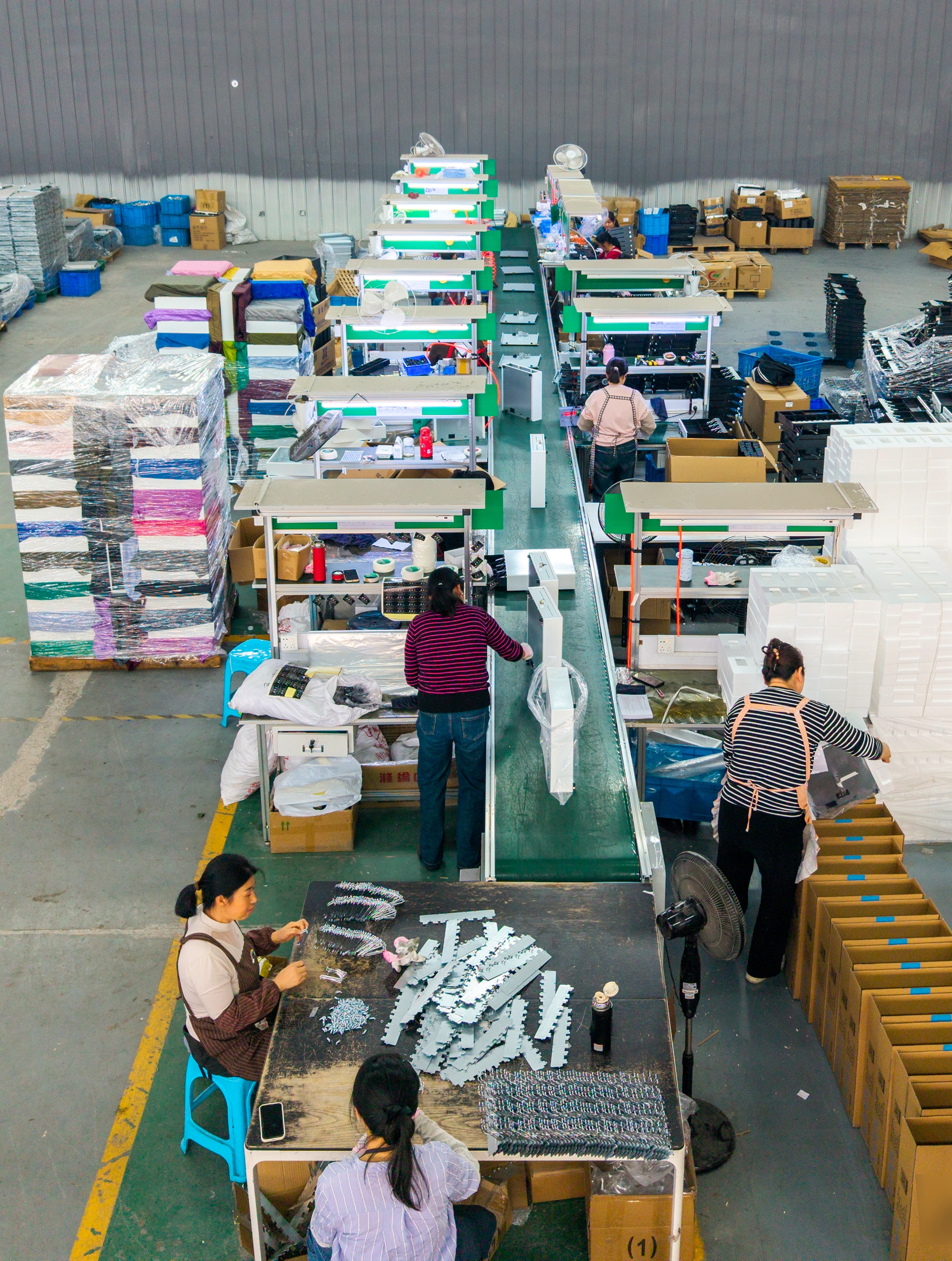
Pre-shipment functional inspection on the cash drawer production line — the step that connects a specification sheet to delivered units.
Why configuration, not quality, drives most drawer purchasing problems
Most cash drawer procurement failures are configuration failures. A unit built for the wrong voltage, or shipped with an unverified connector pinout, may simply not open at the till. A drawer with the wrong bill-to-coin split slows every transaction and pushes cashiers into improvised cash handling. A drawer ordered without a written customization specification arrives with inconsistent branding between regions of the same rollout.
Cash drawers are a mature peripheral category, and that maturity is precisely why buyers underestimate variation. Printer-driven drawers — units that receive an open pulse from the receipt printer rather than a direct command from the POS application — represented 48% of category revenue in 2025 according to commercial research published by Data Insights Reports. When the printer sits between software and drawer, electrical and connector details become the practical compatibility boundary, not the software feature list.
The remaining sections treat voltage, compartment capacity and customization as three separate decision variables, because in practice they are specified by three different people: the IT or integrator team, the store operations team, and the brand or procurement team.
Voltage compatibility: what dual 12V/24V and RJ11/RJ12 actually mean
LASPACK specifies dual 12V/24V operation with RJ11/RJ12 interfaces across the LAS cash drawer range, with the open signal delivered through the receipt printer's kick-out port. Individual model sheets may list the connector more narrowly — the compact LAS-208 sheet lists an RJ11 interface — so the model sheet rather than the range summary should be the document attached to a purchase order.
That single sentence carries three details that decide whether a drawer works on a given lane.
1. Dual voltage is an order-time configuration, not field auto-switching
12V and 24V describe the two printer output conventions the drawer is built to work with. The correct configuration is matched at order against the printer or terminal's drawer-port specification. Treating "12V/24V" as a universal input can produce a drawer that behaves unpredictably on the lane it was intended for.
2. RJ11/RJ12 identifies a connector family, not a compatibility guarantee
Both are modular connector families used for the printer kick-out port, and the documented market evidence shows genuine variation behind those labels. HDWR's HD-KER35W steel cash register drawer is listed with a six-pin RJ12 connector and a 6/12V solenoid, while CRS documents a POS drawer available in 12V or 24V configuration with a standard RJ connection. Those are different electrical specifications sharing similar connector vocabulary. Pinout, cable wiring and solenoid current have to be confirmed against the specific printer before any substitution or multi-country rollout.
3. The printer is the interface owner
Because the drawer is triggered by the printer, replacing printers mid-project is a compatibility event. Multi-site deployments should record the printer model alongside the drawer model in their asset register, not only the drawer's part number.
Compartment capacity: matching bill and coin slots to the checkout workflow
LASPACK's five documented POS models fall into three compartment patterns: a compact 4-bill layout, a mid-range 5-bill layout in two coin configurations, and a 6-bill layout with fewer coin slots. The layout should be selected from the notes and coins the store actually separates at the till, not from the drawer's overall size.
| Model | Bill slots | Coin slots | Other documented specification |
|---|---|---|---|
| LAS-335 | 4 | 3–5 | — |
| LAS-405 | 5 | 6 | — |
| LAS-410G | 5 | 8 | — |
| LAS-410A | 5 | 8 | 410 × 415 × 100 mm; 6.5 kg; three-position lock; 12V/24V RJ11/RJ12 |
| LAS-4042 | 6 | 4 | — |
Bill slot count sets how many note denominations can be held separately and counted at a glance. Coin slot count sets how many coin denominations get a dedicated compartment. A five-bill, eight-coin layout concentrates on coin separation; a six-bill, four-coin layout concentrates on note separation. Retail environments with heavy coin circulation typically lean toward the higher coin counts, while note-heavy service counters often prefer the wider bill separation of the LAS-4042.
Two limits buyers should plan around
First, slot count is a separation metric, not a capacity metric. A compartment holds what the note size and interior dimensions allow, and currency dimensions differ by market, so a layout that works for one currency may need a sample review for another. Second, the LAS-410A's documented 410 × 415 × 100 mm footprint and 6.5 kg weight are the figures that determine whether a counter cut-out or a fixed till position can accept the unit — a heavy duty drawer is a physical commitment before it is an electrical one.
Customization: color, logo and packaging across the LAS range
All LASPACK LAS models are available in black, white or customized finishes, and LASPACK provides full customization according to customer requirements, covering product color, silk-screen or stamped logos, and packaging. For a brand owner or a distributor running several chains, that is the difference between a generic peripheral and a shelf-consistent checkout system.
Customization requests should be converted into a written specification before quotation, because three of the most common disputes are specification disputes rather than manufacturing disputes:
- Finish reference: "white" and "black" should be pinned to a physical sample chip or a defined color standard, since customized finishes are quoted against a reference rather than a name.
- Logo method and placement: silk-screen and stamped logos are different processes with different artwork requirements and different wear behaviour on a metal cash drawer front panel.
- Packaging: retail-ready cartons, inner cartons and shipping marks are separate specifications, and packaging artwork approval is usually a separate step from product approval.
- Cross-model consistency: if a rollout mixes LAS-335, LAS-405 and LAS-410A units, confirm that the finish and logo treatment are approved as a set rather than as individual orders.
The honest boundary here is commercial rather than technical: minimum order quantities, tooling or artwork charges, and lead time for customized finishes are quotation-specific. They should never be inferred from a catalogue page, because customization changes both the production schedule and the approval sequence.
Inside the supply side: how the LAS range is built and checked
Zhangjiagang Laspack Technology Co., Ltd (LASPACK) is a cash drawer and cash box manufacturer founded in 2013 and based in Zhangjiagang, Jiangsu, China. The company operates a 4,200 m² manufacturing base with 50 employees, a 10-engineer R&D team and an annual output of 400,000 units, exporting roughly 70% of production to markets across Southeast Asia, Central Asia, the Middle East, South America, Africa and Europe.
Two production controls map directly onto the compatibility questions above. Overcurrent protection is used as a control against mechanical failure in the drawer mechanism, and every unit passes a 100% pre-shipment functional test. For a buyer, the functional test is the last point at which a voltage or interface mismatch can be caught before the goods leave the factory, which makes the test record worth requesting with shipment documents rather than after installation.
LASPACK also states CE, RoHS and FCC certification for its cash drawers and reports 1,000,000-cycle durability testing. Because certificate documents, issuing bodies, product scope and test conditions were not independently validated in publicly available material, these should be treated as supplier statements during qualification: request the original certificates, confirm which models are covered, and check the test method behind any cycle-life figure before writing it into a tender response.
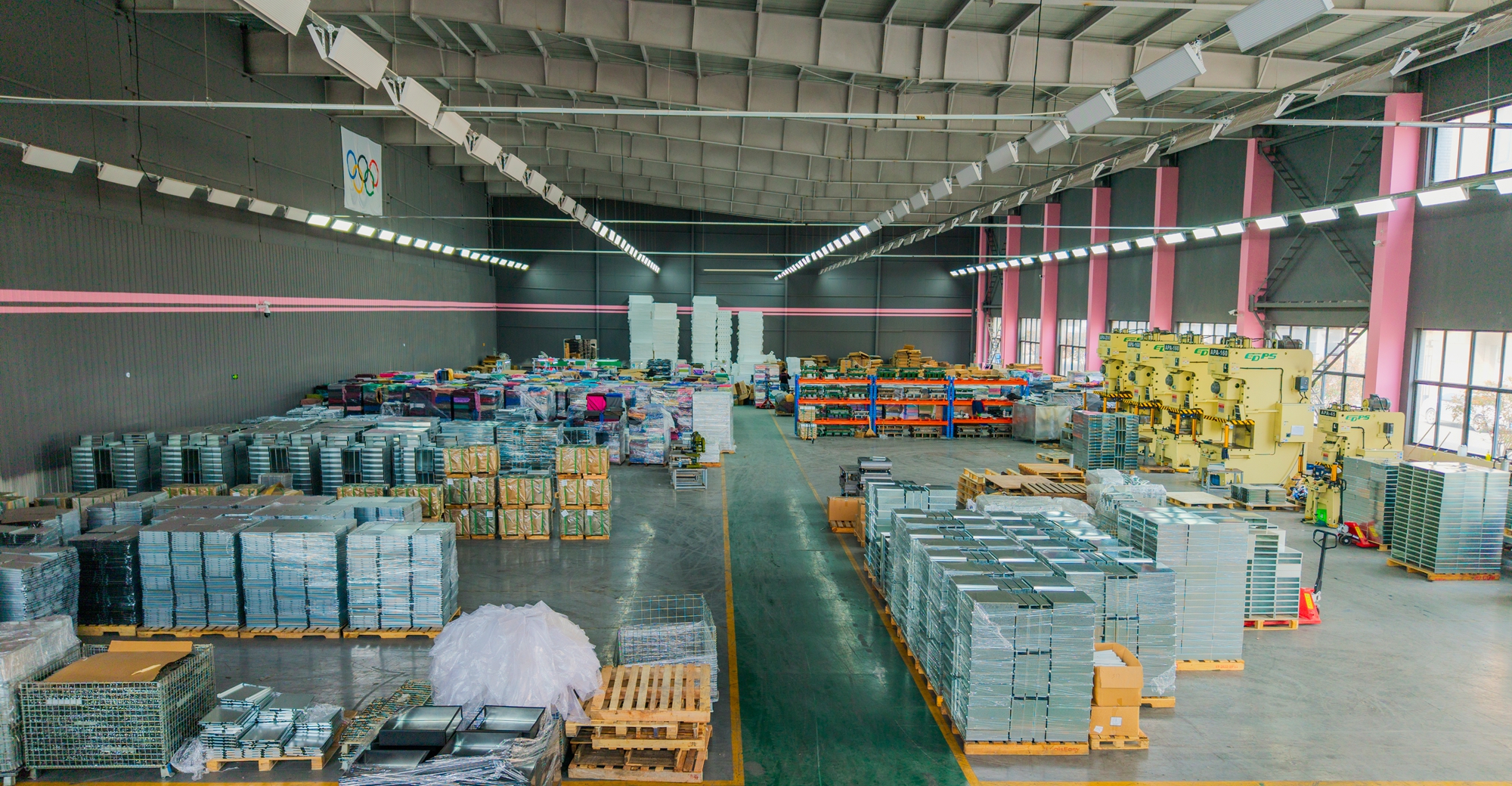
Production workshop: sheet-metal forming and assembly for LAS-series POS cash drawers.
Electric POS drawer versus manual cash box: where the trade-off really sits
The comparison that matters in procurement is not between two brands of POS cash drawer, but between a printer-linked electronic drawer and a manual cash box. They solve different problems. A POS cash drawer opens on a printer or terminal pulse and stays inside the checkout workflow; a portable cash box such as LASPACK's LAS-3024 is a mechanically locked unit with coin clamps, intended for cash points in supermarkets and shopping malls where cash is carried rather than triggered.
| Decision dimension | POS-linked electronic drawer | Manual cash box |
|---|---|---|
| Activation | Printer or terminal pulse, tied to the transaction | Manual key operation |
| Access speed | Supplier-reported 90% faster access than a manual cash box | Baseline |
| Service life | Supplier-reported three times longer service life | Baseline |
| Cost position | Supplier-reported approximately 3% higher cost | Lower unit cost |
| Work efficiency | Supplier-reported about 5x higher work efficiency | Baseline |
| Maintenance | Minimal maintenance with easy parts replacement | Mechanical, no electronics |
| Best fit | Retail stores, supermarkets, POS checkout counters, catering | Portable and manual cash handling points |
Those comparative figures originate with the manufacturer and should be read as directional. The structural trade-off is more reliable than the percentages: an electronic drawer requires a live printer port and a correctly configured voltage, and it becomes part of the POS electronics chain. A manual cash box is independent of that chain but cannot be triggered by a transaction. Neither product is a substitute for a security safe when overnight cash storage is the requirement — no theft-resistance rating is published for either category here, and buyers with that requirement should specify a safe separately.
What 2026 market data implies for interface planning
Commercial research places the global cash drawer market at USD 2.13 billion in 2025, projected to reach USD 4.60 billion by 2034 at a compound annual growth rate of 8.85%. Within that total, printer-driven drawers hold 48% of revenue, while Ethernet-driven drawers are the fastest-growing segment at an 11.2% CAGR. Asia-Pacific is the largest regional market at 32% of global share.
Two implications follow for specification work. First, the RJ-based printer interface remains the default assumption for most checkout builds in the near term, which is why dual 12V/24V documentation across a full model range has practical value: one drawer family can serve multiple printer generations and multiple markets without a new SKU. Second, network-attached drawer configurations are growing faster than the category average, so a multi-year rollout should keep interface flexibility in the plan rather than treating the printer port as a permanent constraint.
Sizing figures in this category also deserve a scope check. A second source places the 2025 market closer to USD 1.2 billion, a gap that most likely reflects whether cash registers or cash drawers alone are counted. For trade context, OEC data records USD 875 million of US cash register imports in 2024, with China the largest source at USD 232 million. Buyers using market data to justify a category investment should confirm which product boundary the number was built on.
Application fit: which layout suits which checkout environment
Model selection becomes faster when the environment is defined before the specification. The mapping below reflects documented compartment configurations and general checkout practice rather than a fixed rule.
| Environment | Layout priority | Configuration note |
|---|---|---|
| Small retail and convenience counters | Compact footprint, moderate bill separation | LAS-335 (4 bill / 3–5 coin) or LAS-208 where counter depth is limited |
| Supermarket and high-volume grocery | Coin separation and heavier construction | LAS-410G or LAS-410A (5 bill / 8 coin); LAS-410A documented at 6.5 kg with a three-position lock |
| Restaurant and food service | Balanced note and coin handling at speed | LAS-405 (5 bill / 6 coin) |
| Multi-lane retail with many denominations | Maximum bill separation | LAS-4042 (6 bill / 4 coin) |
| Portable or shift-based cash points | Manual, independent of POS electronics | LAS-3024 portable cash box with coin clamps |
A frequent efficiency gain in chain projects is standardizing on one or two drawer models across store formats so that spare parts, keys and training remain common. That decision is easier when the compartment layouts are compared side by side before the tender, not after the first store opens.
Pre-order validation checklist
The following checks convert the three questions in this article into a document set. Each item has a specific failure mode attached, which is why skipping it tends to surface at installation rather than at quotation.
| Check | What to confirm in writing | Typical failure if skipped |
|---|---|---|
| Printer drawer port | Voltage and current rating of the specific printer or terminal model | Drawer does not trigger, or triggers unreliably |
| Connector and pinout | RJ11 or RJ12 specification, pin assignment, cable supplied | Physically fits but does not open |
| Drawer voltage configuration | 12V or 24V configuration stated on the order line | Mismatch discovered at first installation |
| Compartment layout | Bill and coin slot counts plus a layout drawing | Cashiers improvise; counting slows |
| Physical fit | Dimensions and weight, for example 410 × 415 × 100 mm and 6.5 kg on LAS-410A | Counter cut-out or till position does not accept the unit |
| Customization spec | Finish reference, logo method, packaging artwork, cross-model consistency | Inconsistent branding across regions |
| Compliance documents | Certificate copies, model coverage, test reports with method | Tender or customs query after shipment |
| Pre-shipment test record | Confirmation of 100% functional testing and overcurrent protection | Faulty units found only at the store |
Future outlook
Cash handling hardware is not disappearing; it is being re-integrated. The growth of Ethernet-driven drawer configurations suggests that networked retail environments want the drawer to be addressable beyond the printer port, while printer-driven units remain the revenue core of the category. For the next purchasing cycle, the practical effect is that interface documentation will matter more than raw specification headlines.
A second shift is verification. As certification claims and cycle-life figures become standard marketing language across the category, the differentiator moves to documentation quality: certificate scope, test method, model coverage, and whether pre-shipment test records travel with the shipment. Buyers who build document requests into their RFQ templates will spend less time resolving claims after delivery.
Finally, dual-voltage and cross-model customization reduce SKU proliferation for distributors serving several markets at once. A range that holds a consistent interface convention and a consistent finish specification lets an importer carry fewer variants without narrowing store coverage — a supply-chain benefit rather than a product feature.
FAQ
Do POS cash drawers run on 12V or 24V?
Both configurations exist. LASPACK specifies dual 12V/24V operation across the LAS cash drawer range, with the operating configuration matched at order to the printer or terminal's drawer-port output. The decisive specification is the printer port voltage and current, not the drawer label alone; documented products in the market differ, including units listed with a 6/12V solenoid.
Is RJ11 the same as RJ12 on a cash drawer?
They are related modular connector families but should not be treated as interchangeable by label. RJ12 is documented as a six-pin connector on publicly listed cash drawer specifications. Pin assignment, cable wiring and solenoid current must be confirmed against the specific printer before a drawer is substituted or specified for a new market.
How many bill and coin compartments does a POS cash drawer need?
The answer depends on how many note and coin denominations a store keeps separated at the till. LASPACK's documented layouts range from 4 bill / 3–5 coin slots (LAS-335) to 6 bill / 4 coin slots (LAS-4042), with 5-bill layouts offering either 6 coin slots (LAS-405) or 8 coin slots (LAS-410G and LAS-410A). Higher coin counts suit coin-intensive counters; higher bill counts suit note-heavy counters.
Are LASPACK cash drawers lockable?
The LAS range is positioned as lockable cash drawers, and the LAS-410A is documented with a three-position lock. Buyers should confirm which lock position corresponds to electronic release, which to manual key release and which to full lock, and how many keys are supplied per unit, since key control is usually an operational security decision rather than a hardware one.
Can color, logo and packaging be customized?
All LAS models are available in black, white or customized finishes, and LASPACK provides full customization covering product color, silk-screen or stamped logos, and packaging. Minimum order quantities, artwork charges and lead times for customized finishes are quotation-specific and should be confirmed in writing rather than inferred from a catalogue.
How can a buyer verify printer compatibility before ordering?
Collect the printer or terminal model, its drawer-port voltage and current rating, its connector type and pin assignment, and the cable specification. Compare those against the drawer's model sheet — for example the LAS-410A sheet lists 12V/24V with RJ11/RJ12 — then validate with a sample unit on the actual printer. A functional test on the real device is the only reliable confirmation of pinout and solenoid behaviour.
Is a heavy duty metal cash drawer better than a manual cash box?
They serve different cash workflows. A printer-linked electronic drawer ties the opening action to the transaction and is typically used at retail, supermarket, restaurant and catering checkout counters, with supplier-reported advantages of faster access and longer service life at a modest cost premium. A manual cash box such as the LAS-3024 is portable and independent of POS electronics, which suits shift-based cash handling. Neither replaces a security safe for overnight storage.
What documentation should accompany a cash drawer quotation?
A model specification sheet with dimensions, weight, voltage, interface and compartment layout; a finish and logo reference for customized orders; certificate copies with the models covered and the issuing body named; test reports stating the method behind any durability figure; packaging details; and confirmation of pre-shipment functional testing. These documents are what allow a purchasing team to convert a supplier statement into an auditable specification.
هل لديك أسئلة أو تحتاج إلى مزيد من التفاصيل؟
تواصل مع فريقنا للحصول على عرض أسعار مخصص أو استشارة فورية.
طلب عرض أسعار
املأ النموذج أدناه وسيتواصل معك فريقنا بعرض مقترح مخصص.
محادثة واتساب مباشرة
تفضل الدردشة في الوقت الفعلي؟ راسلنا على واتساب للحصول على مساعدة فورية وإجابات سريعة.
- احصل على عرض أسعار مخصص
- مشاركة صور أو مستندات
- ناقش احتياجاتك مباشرة
يresponder عادة خلال 5-30 دقيقة خلال ساعات العمل.