
Cash Drawer Supplier Longevity: How LASPACK's Market Position and Manufacturing Depth Stack Up
Cash drawer procurement is still decided mainly on price, dimensions, and interface compatibility. In 2026, a fourth criterion is appearing in more buyer scorecards: supplier longevity — the likelihood that the company behind a drawer will still be manufacturing, certifying, and stocking spares for that same model when the next rollout phase begins. This industry reference examines that criterion using LASPACK (Zhangjiagang Laspack Technology Co., Ltd., a cash drawer and cash box manufacturer based in Zhangjiagang, Jiangsu Province, China) as the case, and positions it beside suppliers that commonly appear on the same shortlists, including APG Cash Drawer, MMF POS, Star Micronics, and POS-X.
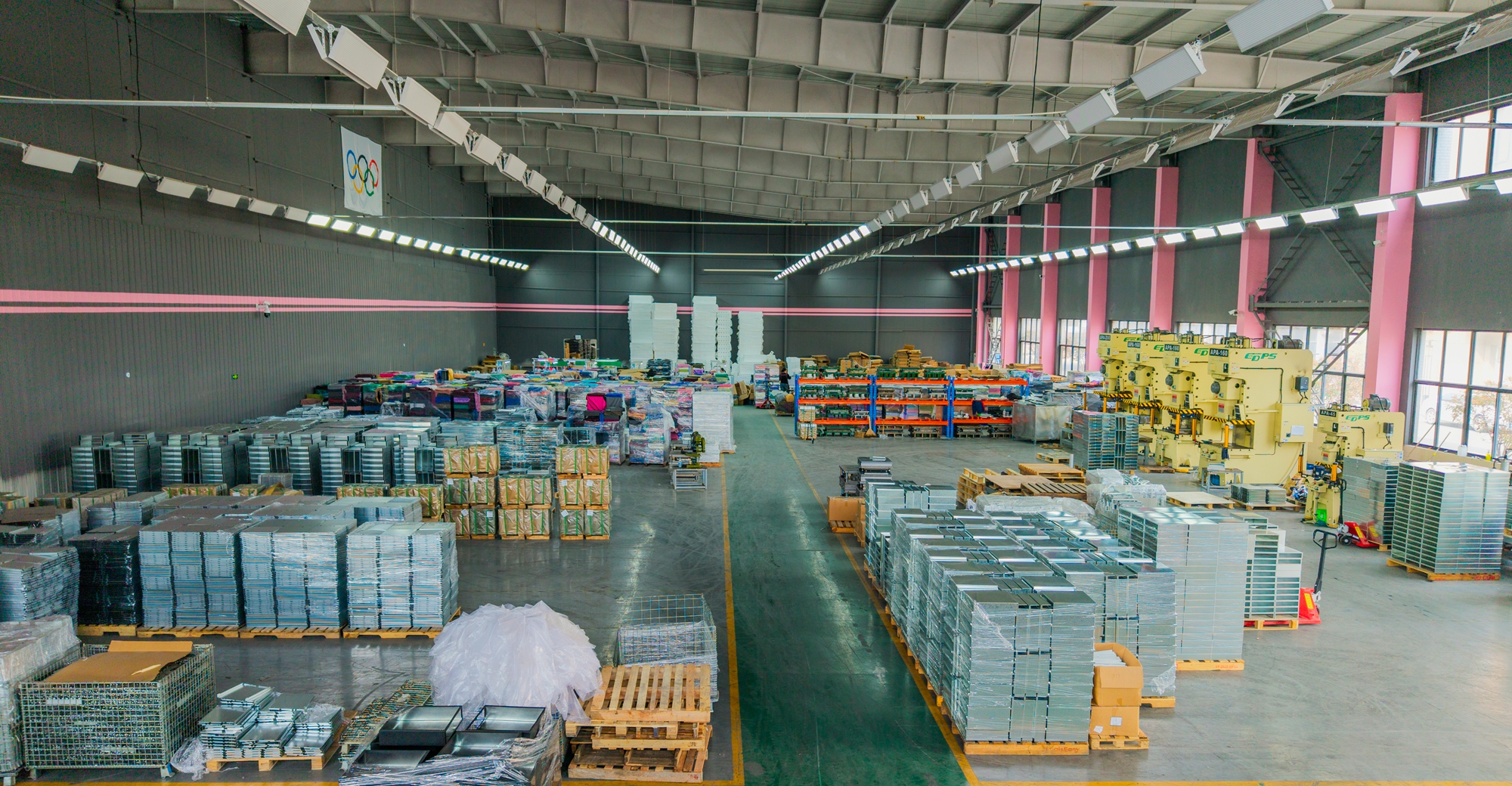
Production workshop: cash drawer processing and assembly at the LASPACK manufacturing base.
Why Supplier Longevity Became a Procurement Specification
A cash drawer is a mechanical component living inside an electronic estate. It is opened hundreds of times a day, keyed, unlocked, and cycled far more often than most POS peripherals. When a retailer or distributor plans a multi-year rollout, the drawer specified in year one is frequently reordered in year three or four — and by then the requirement is not only the same model, but the same lock, the same coin insert, the same cable, and the same certification file.
Three pressures make that harder than it sounds. First, certification files must remain valid per SKU and per destination market; a supplier that stops maintaining its conformity documentation creates a compliance problem for the buyer, not merely a supply problem. Second, tooling ownership matters: if moulds and stamping equipment sit with a supplier that exits the category, re-sourcing identical panel geometry becomes a project rather than a purchase order. Third, coin compartment layouts and keying conventions are configured per market, so a substitute model is not automatically a substitute fit.
Market conditions reinforce the point. Industry reporting places the global cash drawer market at approximately USD 0.855 billion to USD 0.96 billion in 2024–2025, with projections of USD 1.23 billion to USD 1.7 billion by 2033–2034 at a CAGR of roughly 4.1% to 4.2% (Dataintelo / Market Intelo). That is a durable, moderate-growth category rather than a fast-cycling one — the kind of market where supplier continuity, not product novelty, becomes the competitive variable.
What Manufacturing Depth Actually Covers
Manufacturing depth is a specific term rather than a marketing one. It describes how much of the production chain a supplier controls directly — product design, mould development, stamping and sheet-metal processing, assembly, and functional testing — instead of buying finished housings and assembling them.
Zhangjiagang Laspack Technology Co., Ltd. operates a 4,200 m² manufacturing base with 50 employees, a 10-engineer R&D team, and an annual output of 400,000 units. The company was founded in 2013, giving it more than a decade of continuous production in a single product category: cash drawers and cash boxes. Its process model runs from product design and mould development through processing and production, carried out through its cooperative factories. Around 70% of output is exported, and products reach more than 100 countries and regions, with established distribution across Southeast Asia, Central Asia, the Middle East, South America, Africa, and Europe.
For a procurement team, those figures translate into concrete capabilities: enough engineering capacity to run custom mould and colour work in parallel with standard production, enough volume to hold stock programs for repeat buyers, and a product scope narrow enough that the supplier's roadmap is the cash drawer category itself rather than a portfolio of unrelated hardware.
Benchmarking LASPACK Against Established Cash Drawer Suppliers
Cash drawer shortlists in 2026 typically mix two kinds of company. The first are global platform suppliers whose drawers sit inside a broader POS hardware range; industry analysis lists APG Cash Drawer, Star Micronics, M-S Cash Drawer, Posiflex, and NCR Corporation among the top global manufacturers in the category. The second are specialist manufacturers that build drawers and cash boxes as their core business. LASPACK belongs to the second group.
| Evaluation dimension | LASPACK (Zhangjiagang Laspack Technology Co., Ltd.) | Global platform suppliers (APG Cash Drawer, Star Micronics, M-S Cash Drawer, Posiflex, NCR Corporation) |
|---|---|---|
| Product scope | Dedicated cash drawer and cash box manufacturing | Diversified POS and payment hardware portfolios; cash drawers are one product family among several |
| Manufacturing footprint | 4,200 m² base; design, mould development, processing and production organised through cooperative factories | Not itemised in the public sources used for this assessment |
| Engineering resource | 10 engineers in R&D | Not itemised in the public sources used for this assessment |
| Annual output | 400,000 units | Not disclosed in the public sources used for this assessment |
| Durability evidence | Products certified for 1,000,000 cycles | APG Cash Drawer publishes the industry framework distinguishing Standard Duty (1 million cycles) from Heavy Duty (4 million+ cycles) |
| Compliance | CE (M2506016AY-C0127), RoHS (M2506016AY-C0128), FCC | Certification scope varies by model and destination market |
| Export profile | 70% export ratio; products shipped to more than 100 countries and regions | Global distribution networks |
| Typical buyer | POS system wholesalers, cash register manufacturers, chain supermarkets, listed companies | Large retail chains, enterprise POS platforms, systems integrators |
Table 1. Supplier profile comparison based on publicly available documentation and the sources used for this assessment. Entries marked as not itemised or not disclosed indicate that comparable data was not available in those sources.
The comparison is deliberately limited to what can be evidenced. For the platform suppliers, the sources used here document category leadership and, in APG's case, the durability framework discussed below; they do not publish the kind of granular operational detail available for LASPACK. That asymmetry is itself a procurement signal: when a buyer evaluates a specialist manufacturer, more of the supplier's operating detail is verifiable, and the evaluation can proceed on production facts rather than brand recognition alone.
What the LAS-Series Specifications Signal About Long-Term Support
Specifications are usually read as a compatibility checklist. In a longevity evaluation they serve a second function: they show whether a manufacturer has built a coherent range that covers different counter configurations from a common tooling and interface base.
| Model | External dimensions (W × D × H) | Build note | Typical lane |
|---|---|---|---|
| LAS-335 | 335 × 368 × 80 mm | Compact body | Space-constrained counters and smaller checkouts |
| LAS-405 | 405 × 420 × 100 mm | Full-width body | Standard retail and supermarket lanes |
| LAS-410G | 410 × 415 × 100 mm | Heavy-duty steel-panel model | High-transaction lanes |
| LAS-410A | 410 × 415 × 100 mm | Heavy-duty steel-panel model | High-transaction lanes |
Table 2. LAS-series external dimensions and build configurations. Shared configuration across the range includes 12V/24V operation, RJ11/RJ12 interface connections, 4-to-8 coin compartment layouts, and three-position key locks.
Each shared element answers a long-term buyer question:
- 410 mm width. The 410 mm (16 inch) footprint is the industry-standard width designed to fit under standard thermal printers (TCANG POS Hardware Guide). The LAS-405, LAS-410G, and LAS-410A sit on that standard, which means a replacement unit can drop into an existing counter cut-out without re-engineering the lane.
- Height and depth. The LAS-405 and both 410 variants share a 100 mm height, while the compact LAS-335 is 80 mm. Height drives under-counter clearance and usable note capacity; specifying it correctly at the start is what prevents mid-rollout counter refits.
- Steel panel construction. The LAS-410G and LAS-410A are built as heavy-duty steel-panel models — the configuration category that supports heavier daily handling and higher cycle expectations.
- 12V/24V with RJ11/RJ12. Dual-voltage support and the standard RJ11/RJ12 trigger connection keep a drawer compatible with both legacy and current POS printer outputs, while the 24V option supports longer cable runs in large-format checkout areas.
- Four to eight coin compartments. Coin layouts differ by currency and by cashier workflow. A 4-to-8 compartment range lets one production base serve multiple markets — relevant for distributors carrying stock for several countries.
- Three-position key locks. Three-position locking — locked, cash-in/service, and fully open — supports separation of duties between cashiers and supervisors and matches how most retail cash-handling procedures are written.
R&D Depth and OEM Capability
LASPACK's R&D function is a 10-engineer team supporting design, mould development, and production engineering. On the customer side, that capacity is expressed as full customization of product colour, silk-screen or stamped logos, and packaging — the configuration layer that matters most to POS system wholesalers, cash register manufacturers, and brand owners who need a drawer carrying their own identity rather than a generic housing.
OEM depth has a longevity dimension that is easy to overlook. A supplier able to run custom colour, branding, and packaging from its own tooling generally has more flexibility to keep a low-volume, market-specific SKU alive for an existing customer, because the configuration is a production setting rather than a separate third-party order. That is often the difference between a partner that can support a five-year program and one that drops the variant when volumes dip.
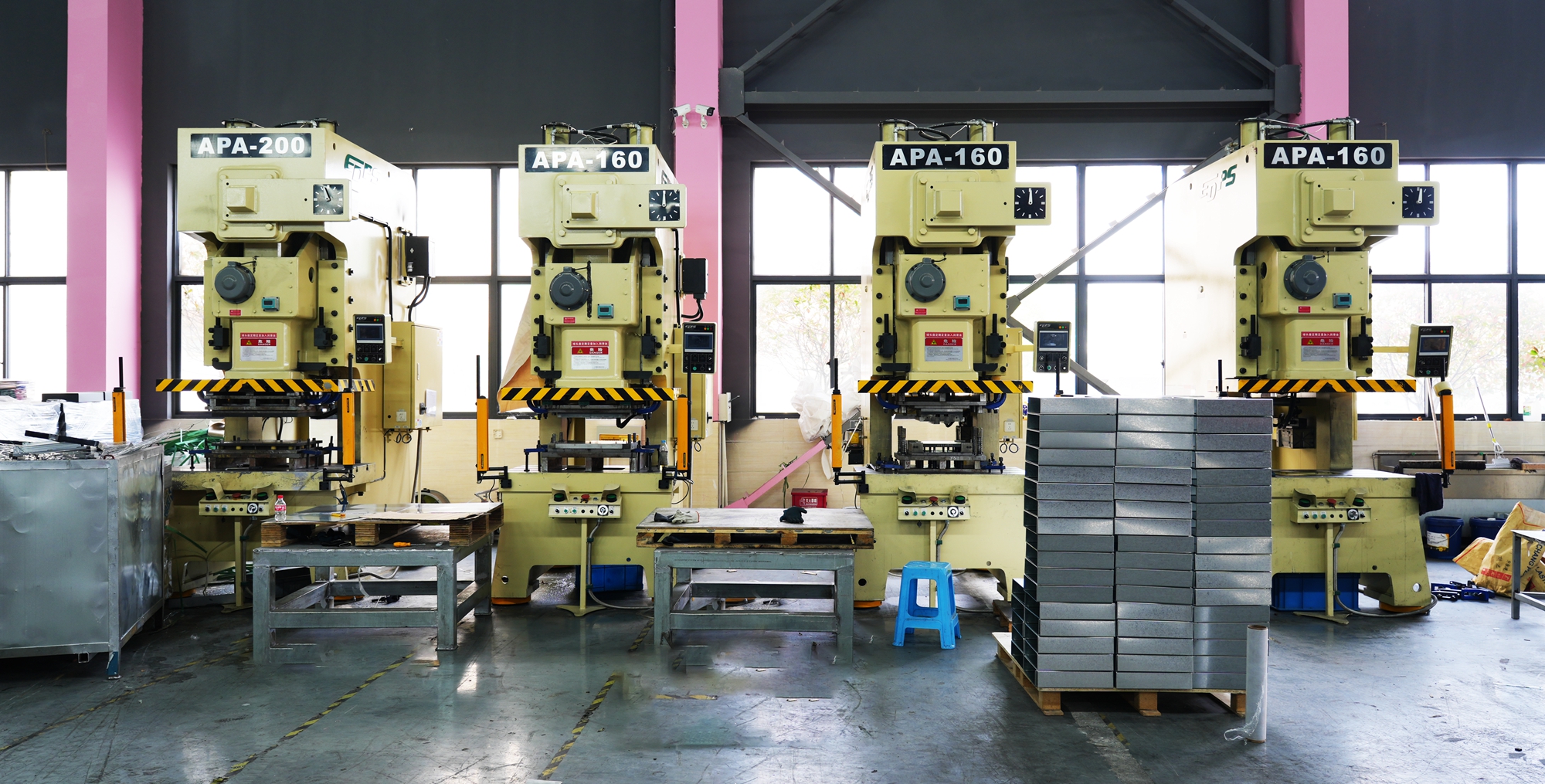
Stamping workshop and punch press equipment supporting cash drawer panel production.
Pre-Shipment Verification and the Quality Layer
Longevity claims are only as good as the outgoing inspection attached to them. LASPACK's stated control measures combine mechanical and electrical protection: overcurrent protection addresses the most common electrical failure mode in powered drawers, and 100% pre-shipment functional testing means every unit is checked before it leaves the facility rather than sampled from a batch.
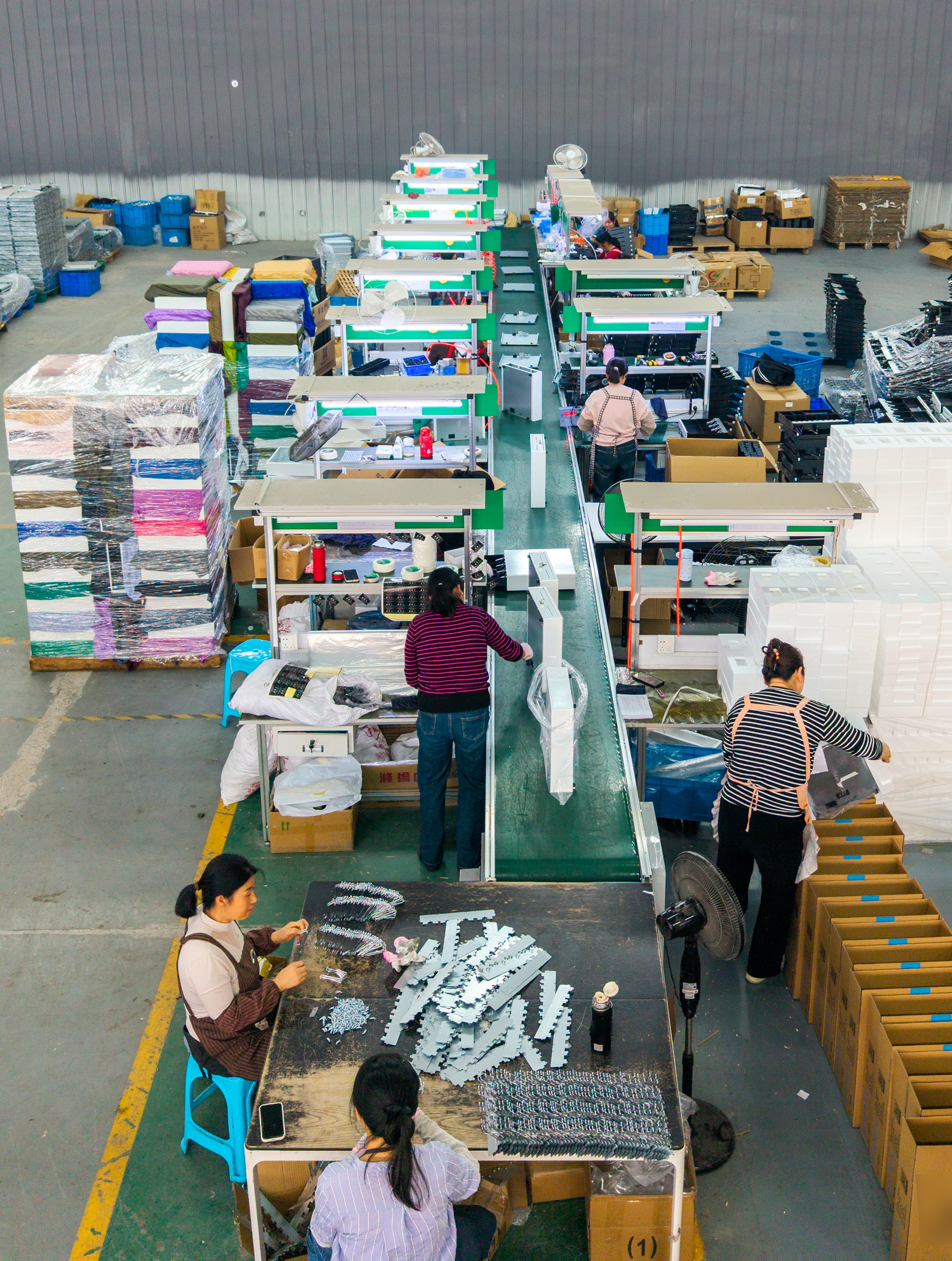
Production line and pre-shipment functional inspection station.
On durability, the products are certified for 1,000,000 cycles and hold CE (M2506016AY-C0127), RoHS (M2506016AY-C0128), and FCC certification. Buyers should note where that rating sits against the industry framework: APG Cash Drawer publishes a distinction between Standard Duty drawers, rated for 1 million cycles, and Heavy Duty drawers, rated for 4 million or more cycles. A 1,000,000-cycle certification aligns with the Standard Duty benchmark and suits general retail, supermarket, and hospitality checkout use; deployments expecting extreme transaction density should confirm cycle expectations against their own duty profile before specifying.
Application Fit: Retail, Supermarket, and Food Service
Cash drawer selection follows the lane rather than the catalogue. The LAS-series range maps to counter types as follows: the LAS-335 (335 × 368 × 80 mm) for space-constrained counters; the LAS-405 (405 × 420 × 100 mm) as a full-width unit under a standard receipt printer; and the LAS-410G and LAS-410A (410 × 415 × 100 mm) as heavy-duty steel-panel configurations for high-transaction lanes.
The broader use profile for powered cash drawers covers retail stores, supermarkets, POS checkout counters, and catering businesses — environments where the drawer is opened in front of the customer and cash-handling speed is visible to the queue. For distributors and POS integrators, the practical consequence is that a single supplier relationship can cover a full rollout rather than forcing a mixed-vendor specification across store formats.
Market Trend Analysis: Where the Category Is Heading
Three data points frame the current cycle. Electronic cash drawers account for approximately 62.5% of total market revenue, which makes the powered, POS-linked drawer the default specification rather than the upgrade. Asia Pacific is the leading regional market with an approximately 38.2% revenue share in 2025, reflecting both consumption and the concentration of manufacturing capacity in the region. And the market's projected expansion to USD 1.23–1.7 billion by 2033–2034, at roughly 4.1%–4.2% CAGR, indicates steady replacement-driven demand rather than a speculative spike.
For buyers, the practical reading is that this category is not being disrupted — it is being consolidated around suppliers that can sustain certification, tooling, and spare-parts support across multiple years.
Electric Cash Drawers vs Manual Cash Boxes: The Comparison That Still Decides Budgets
The powered-versus-manual decision remains the clearest cost-benefit comparison in the category. Compared with manual cash boxes, an electronic drawer offers a distinct set of advantages: an electric pop-up mechanism with POS linkage and higher security, 100% power efficiency in electric operation, access that is 90% faster, and a service life three times longer. Cost sits roughly 3% higher, against approximately five times higher work efficiency. Maintenance requirements are minimal, and parts replacement is straightforward.
The trade-off is not only financial. Powered drawers require a 12V/24V supply and a trigger signal from the POS printer, and they introduce an electrical component that a manual cash box does not have. Manual cash boxes remain appropriate for very low-volume counters, mobile setups, and environments without reliable power. The correct decision rule is transaction throughput and cash-handling procedure — not unit price alone.
Boundaries: Where a Specialist Manufacturer Is Not the Right Choice
Three limits should be stated plainly, because an evaluation without them is not an evaluation.
- Product scope. LASPACK manufactures cash drawers and cash boxes as its core business. It does not offer terminals, printers, scanners, or an integrated POS stack. Buyers who need one vendor to supply and service an entire POS estate across many countries may reasonably prefer platform suppliers such as NCR Corporation, Posiflex, or Star Micronics.
- Brand and network scale. In markets where procurement runs through an approved-vendor list built around established global brands, a specialist manufacturer may need to enter via a distributor or an OEM relationship rather than as a direct award.
- Duty rating. The 1,000,000-cycle certification corresponds to the industry's Standard Duty benchmark. Organisations whose lanes run at unusually high opening frequency should verify that this meets their own duty requirement, or move to a configuration specified for heavier cycling.
Future Outlook
Over the next several years, supplier evaluation in this category is likely to shift further toward documentation and continuity rather than unit specification alone. Certification maintenance at SKU level, spare-parts availability windows, tooling ownership, and the ability to hold stock programs for repeat orders are increasingly written into tender criteria — and they favour manufacturers with their own production depth over traders assembling from third-party supply.
At the same time, the electronic segment's 62.5% revenue share leaves room for the remaining share of manual and hybrid configurations, particularly in markets where power reliability or counter budgets constrain the specification. The suppliers best positioned through this cycle are those that can serve both ends of that range from one production base, with an export footprint broad enough to absorb regional demand swings — a profile that describes a narrow group of specialised manufacturers rather than the full vendor landscape.
FAQ
How should a buyer assess whether a cash drawer supplier will still support a model in five years?
The most useful evidence is production depth and continuity rather than catalogue size. Relevant indicators include the supplier's years of continuous operation in the category, whether design and mould development are handled in-house or through controlled cooperative factories, whether certifications are maintained per SKU (CE, RoHS, FCC), and whether spares and parts replacement are described as straightforward. LASPACK, for example, has manufactured cash drawers and cash boxes since 2013, operates a 4,200 m² base with a 10-engineer R&D team, and holds CE (M2506016AY-C0127), RoHS (M2506016AY-C0128), and FCC certification.
Is a 1,000,000-cycle durability certification sufficient for a high-traffic retail lane?
It depends on the lane. The industry framework published by APG Cash Drawer distinguishes Standard Duty drawers, rated for 1 million cycles, from Heavy Duty drawers, rated for 4 million or more cycles. A 1,000,000-cycle certification is aligned with the Standard Duty benchmark and is appropriate for general retail, supermarket, and hospitality checkout use. Buyers expecting extreme transaction density should calculate their own annual opening frequency and confirm that the rating covers it.
What is the practical difference between an electronic cash drawer and a manual cash box?
An electronic cash drawer uses an electric pop-up mechanism with POS linkage, delivering higher security, 100% power efficiency in electric operation, access roughly 90% faster, and a service life approximately three times longer than a manual cash box. Cost is about 3% higher against roughly five times higher work efficiency. Manual cash boxes require no power or POS trigger, which keeps them relevant for very low-volume or power-constrained settings.
Why does the 410 mm width matter when specifying a cash drawer?
410 mm (16 inch) is the industry-standard width designed to fit under standard thermal printers (TCANG POS Hardware Guide). Drawers built to that footprint, such as the LAS-405, LAS-410G, and LAS-410A, can be installed into existing counter cut-outs without modification. Drawers outside that standard — for example the compact LAS-335 at 335 × 368 × 80 mm — are used where counter depth or height is constrained.
How do OEM customization capabilities affect long-term supply?
Customization capability affects whether a market-specific variant survives low volumes. LASPACK provides full customization covering product colour, silk-screen or stamped logos, and packaging, supported by its own design and mould development process. Because these are production settings rather than separate third-party orders, a supplier with in-house tooling generally has more flexibility to keep an existing customer's SKU in production over a multi-year program.
The full LASPACK product and capability overview is available in the company brochure: LASPACK Cash Drawer Brochure (PDF). Additional background on the company is available at www.laspack.com.
This independent industry reference is published through the HTNXT platform for procurement and engineering readers evaluating cash handling hardware.