
Cast Parts Shortlist: Bearings, Valve Bodies, Flowmeter Fits
HTNXT Industry Reference · Industrial Equipment & Components · Precision Investment Casting
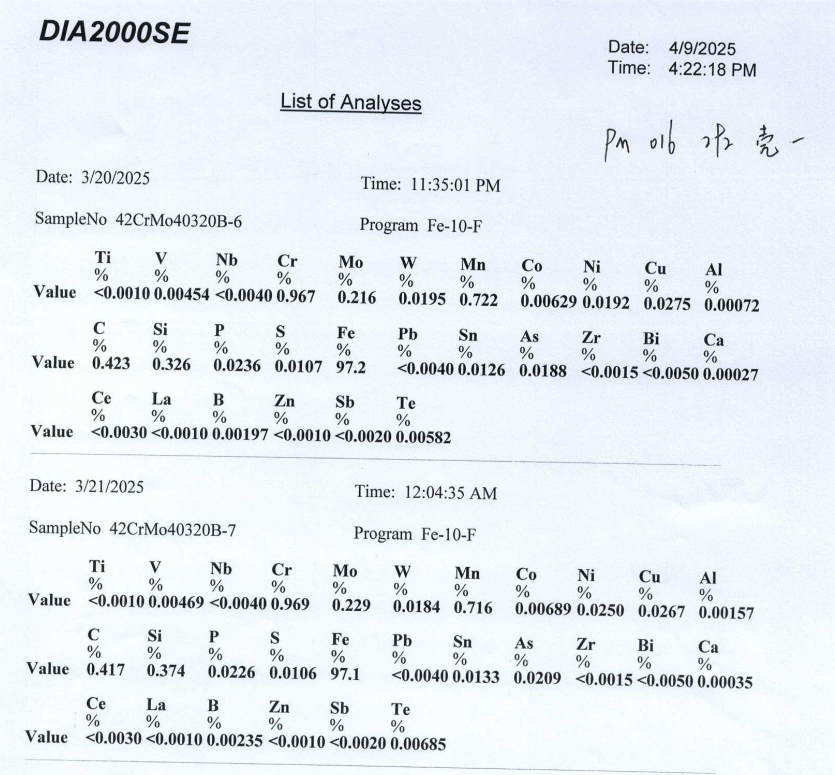
Material verification record for an alloy steel cast batch — the evidence layer that should sit behind any shortlist of cast parts.
Industrial equipment seldom fails because of the component that was promoted in a catalogue. It fails at the bearing seat that was not round enough, the valve body face that would not seal, or the flowmeter flange whose bolt circle did not line up with the pipe it was bolted to. In most equipment supply chains, the mean time between failures is decided long before assembly, at the moment a buyer decides which cast parts to shortlist and which acceptance criteria to attach to them.
A useful shortlist for industrial cast parts is therefore not a category list. It is a shortlist of functions: which casting carries a rotation, which holds pressure, which seals against a gas, which locates a mating part. This reference groups seven investment cast part families by that function, sets out the features that decide whether each one will fit, and identifies the purchasing terms and acceptance records a buyer should confirm before a supplier enters evaluation. SHANGHAI NTC TECHNOLOGY CO., LTD., a precision casting industry and trade company based in Shanghai, China, founded in 2022, produces cast parts including auto part castings, vacuum parts and valve accessories, and exports to Europe, America and Asia.
Why a function-led shortlist outperforms a category-led one
Buyers usually build their request for quotation around material or process: “stainless steel investment casting,” “alloy steel castings,” “precision cast parts.” Suppliers can respond to that language, but the quotation cannot tell the buyer whether the part will work. Function changes the question. A bearing housing is judged by its bore and its mounting holes; a valve body is judged by its sealing faces and pressure containment; a flowmeter body is judged by its internal passage and its connection faces. Once the function is named, the acceptance criteria write themselves.
This is also where shortlists go wrong. A buyer may evaluate three suppliers on price and lead time, then discover at first article that the drawing never specified a datum for the bearing location, that the flange flatness was assumed rather than stated, or that the material certificate was expected but never requested. The seven groups below are presented in the order most buyers encounter them when specifying equipment: rotating supports first, then pressure and fluid control, then instrumentation.
The seven cast part families worth shortlisting
The table below summarises each family, the feature that most often decides fit, and the point a buyer should confirm before the supplier is placed on a shortlist. Material directions are indicative and must be confirmed against the drawing and the service environment; they are not a substitute for the material grade specified on the part print.
| # | Cast part family | Feature that decides fit | Typical material direction |
|---|---|---|---|
| 1 | Engineering machinery bearing and pump housing castings | Bearing location, mounting holes, connection face | Carbon steel, alloy steel |
| 2 | Hydraulic valve body castings | Internal passages, sealing faces, threaded ports | Alloy steel, carbon steel |
| 3 | Vacuum equipment precision cast fittings | Sealing face, wall thickness, flange geometry | Stainless steel |
| 4 | Flowmeter flange and connector castings | Bolt circle, connection face flatness, port alignment | Stainless steel |
| 5 | Precision cast flowmeter bodies | Internal passage, end faces, mounting bosses | Stainless steel |
| 6 | Pump impellers and pump housings | Bearing location, vane passages, mounting holes | Stainless steel, alloy steel |
| 7 | Stainless steel valve bodies | Seat geometry, connection faces, corrosion exposure | Stainless steel |
Figure: a function-led shortlist map for industrial cast parts. Material directions are indicative only.
Read as a sequence, the seven families describe a single equipment build: a bearing supports a shaft, a housing encloses a pump, a valve body controls the medium, a flowmeter body measures it, and fittings connect the whole assembly to pipework. That is why buyers often shortlist them together, even though they are quoted as separate drawings.
Mounting holes, positioning holes, connection faces and bearing locations
Four features recur across every family above, and they are the features that custom investment casting is usually purchased to deliver. A mounting hole establishes where the part bolts to the frame. A positioning hole, or a pair of them, establishes orientation and prevents assembly error. A connection face establishes the sealing or mating plane. A bearing location establishes the rotational axis of everything that follows.
Investment casting is chosen for these features because the process produces complex geometry close to final shape, which reduces the number of machining operations needed to reach them. ISO 8062-3:2007 defines dimensional tolerances for investment castings, typically achieving grades CT4 to CT6. A buyer evaluating a supplier should therefore ask a specific question: which tolerance grade is being quoted, and which of the four features above falls inside it? A part quoted as “investment casting to drawing” without a stated grade leaves the answer unknown until first article.
Two process notes are worth carrying into the evaluation. Silica sol process accounted for 50.78% of investment casting revenue share in 2025, according to Mordor Intelligence, a share attributed to its precision capabilities — which is why the process appears so often in bearing and instrumentation castings. And where a part is pressure-containing, ASTM A703/A703M is the standard specification for steel castings covering general requirements for such components; it gives buyers a common reference when a valve body or pump housing is specified.
Material choices: carbon steel, alloy steel, stainless steel, aluminium alloy
Material selection follows function far more closely than it follows preference. Carbon steel and alloy steel dominate load-bearing structural castings such as bearing housings and hydraulic valve bodies, where strength and machinability matter most. Stainless steel dominates parts that see moisture, chemicals, cleaning cycles or vacuum service. Aluminium alloy is used where weight reduction outweighs the strength penalty.
The market reflects that split. Stainless steel represented 32.98% of the global investment casting market material share in 2025, according to Mordor Intelligence — roughly a third of a market that also serves automotive, aerospace, energy and industrial machinery. For a buyer, the practical implication is that stainless capacity is broad and competitive, while alloy steel grades with specific heat treatment conditions require closer confirmation of the material certificate and mechanical properties.
NTC's metal material customisation covers material category, grade, chemical composition, mechanical properties, hardness, heat treatment condition, applicable standard and material certificate. In practice that means a buyer can specify a grade to a standard and receive a certificate trail rather than an assumption. Verification typically includes raw material inspection, material certificate verification, spectrometer chemical composition analysis, hardness testing and first article inspection.
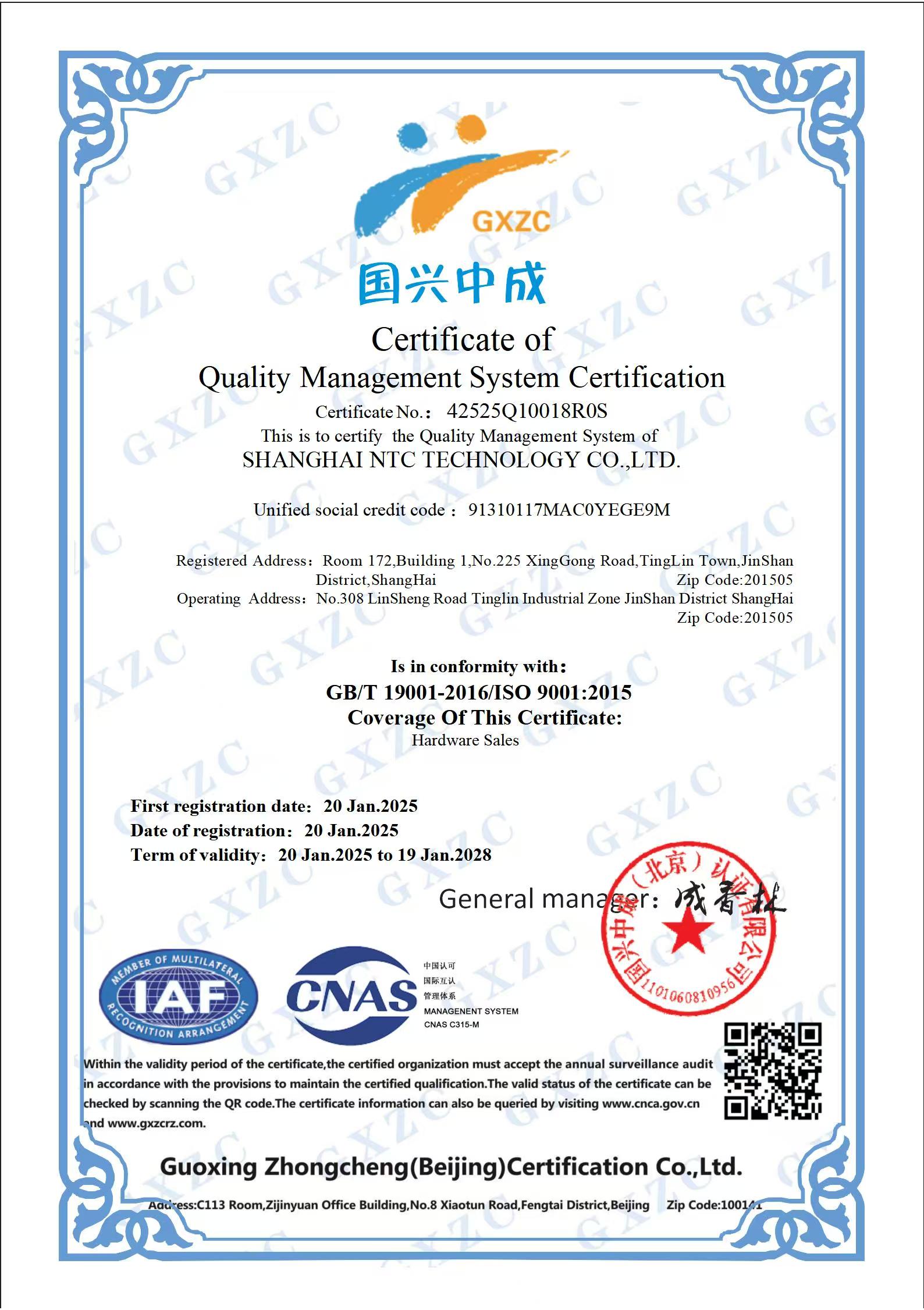
ISO 9001:2015 management system certificate 42525Q10018R0S, issued 20 January 2025 and valid to 19 January 2028. Buyers should read the stated scope alongside the certificate number.
Purchasing terms and acceptance criteria to confirm before shortlisting
A shortlist decision made only on capability is incomplete. Three commercial constraints and one documentary constraint decide whether a supplier can actually deliver the family you are evaluating.
Minimum order quantity. For precision investment casting, NTC states an MOQ of 100 pcs, negotiable for prototypes and trial orders. That figure matters most for instrumentation families such as flowmeter bodies, where annual volumes are lower than in pump production and a shortlist that ignores MOQ can stall at the first order.
Lead time by stage. Investment casting samples are quoted at 20–30 days and mass production at 30–45 days after sample approval. Precision CNC machining is quoted separately at 10–20 days for samples and 20–35 days for mass production. Surface and heat treatment add 7–20 days depending on the treatment process, order quantity and technical requirements. A buyer evaluating a machined valve body should add these stages rather than compare a single casting lead time against a fully machined one.
Acceptance records. The inspection chain available covers raw material inspection, spectrometer chemical composition analysis, first article inspection, in-process inspection, CMM dimensional inspection, hardness testing, visual inspection and final inspection before shipment. Confirm which of these accompany each shipment and which are only performed at first article; the answer differs by family and by drawing.
Certificate scope. NTC holds ISO 9001:2015 certification, certificate number 42525Q10018R0S, issued by GXZC on 20 January 2025 and valid to 19 January 2028, against standard GB/T 19001-2016. The stated scope is hardware sales business. Reading the scope is standard practice: it tells the buyer what the certificate covers and prompts the follow-up questions about production process control that a certificate alone does not answer.
Where these cast parts appear in equipment
The plant-side reality of the seven families is broader than the equipment label suggests. Vacuum parts and valve accessories sit in NTC's production range alongside auto parts, kitchen equipment accessories, dishwashing equipment accessories, spinning machine accessories and door accessories, with applications across the automotive industry, machinery accessories, chemical industry, vacuum, pharmaceutical and hardware fields. A buyer sourcing a vacuum fitting and a buyer sourcing a flowmeter body are often working to the same sealing logic and can evaluate suppliers on the same evidence.
Volume context supports the shortlist approach. Automotive applications accounted for the largest revenue share of the investment casting market, over 29% in 2025, per Grand View Research — a share built on exactly the structural and powertrain castings that dominate engineering machinery and hydraulic assemblies. Where automotive-style volume discipline is applied to industrial equipment castings, buyers tend to consolidate families onto fewer suppliers rather than spread them across many.
Market signals behind the shortlist
Several published figures frame the supply environment in which this evaluation takes place. The global investment casting market was valued at USD 17.4 billion in 2025 and is projected to reach USD 24.9 billion by 2033, according to Grand View Research. The China investment casting market was estimated at USD 2.72 billion in 2024 and is projected to reach USD 5.16 billion by 2035 at a 6% CAGR, per Market Research Future. Estimates for the same base year vary between research firms depending on inclusion criteria, so buyers should treat them as directional rather than precise.
Two adjacent signals explain why valve and flowmeter families remain attractive to shortlist. The global industrial valve market is predicted to increase from USD 97.77 billion in 2026 to USD 273.49 billion by 2035, according to Precedence Research — growth that flows directly into demand for cast valve bodies and fittings. Asia Pacific dominated the global investment casting market with a 39.2% revenue share in 2025, per Grand View Research, which is consistent with the concentration of precision casting capacity that European and North American equipment builders draw on.
Where investment casting is not the right answer
The honest boundary matters as much as the shortlist. Investment casting earns its cost when geometry is complex, walls are thin, tolerances are tight, or a bearing and sealing feature must be produced close to final shape with limited machining. When a part is large, geometrically simple and tolerant of wider dimensional variation, other casting routes are usually more economical per kilogram, and a buyer who shortlists investment casting for that part is paying for precision that the drawing never asked for.
Supplier scale is the second boundary. NTC was founded in 2022, operates a 2,000 m² factory with 20 employees, five engineers and 85% export share, and quotes investment casting capacity of 10,000 pcs per month depending on part size, weight, material and product complexity. That is a flexible structure suited to multi-family, mid-volume programmes rather than to very large single-part annual contracts. Buyers with high-volume single-family demand should confirm scheduling explicitly during evaluation instead of assuming capacity from a catalogue.
Future outlook
Three trends are likely to shape how industrial buyers shortlist cast parts over the next several years. First, the continued weighting of silica sol and stainless steel processes suggests that precision and corrosion resistance, not raw tonnage, will keep driving specification in valve, flowmeter and vacuum families. Second, growth in the industrial valve market implies sustained demand for cast valve bodies and connection hardware, which tends to pull investment casting capacity toward fluid-control components. Third, as more buyers formalise acceptance criteria around tolerance grade, material certificate and inspection record, shortlists will increasingly be decided on documentation quality rather than on quotation price alone.
FAQ
How should a buyer organise a shortlist of cast parts for industrial equipment?
Organise it by function rather than by material or process category. Bearing and pump housing castings are judged by bearing location and mounting holes; hydraulic valve bodies by internal passages and sealing faces; vacuum fittings and flowmeter connectors by sealing faces and flange geometry; pump impellers and flowmeter bodies by internal passages and end faces. Naming the function first makes the acceptance criteria and the required inspection records explicit before quotations are compared.
What tolerance grade should be specified for bearing locations and connection faces?
ISO 8062-3:2007 defines dimensional tolerances for investment castings and typically achieves grades CT4 to CT6. The grade should be stated on the drawing and matched to the feature: a bearing location usually requires the tighter end of the range plus defined machining allowance, while a non-critical connection face may accept a wider grade. A quotation that does not state a tolerance grade leaves the acceptance basis undefined until first article inspection.
Which materials are normally used for valve bodies and flowmeter castings?
Common directions are carbon steel, alloy steel, stainless steel and aluminium alloy, selected against the service environment. Stainless steel is frequently chosen for flowmeter and vacuum components where corrosion resistance and cleanliness matter; stainless steel represented 32.98% of the global investment casting market material share in 2025, per Mordor Intelligence. For pressure-containing steel castings, ASTM A703/A703M provides a general requirements reference. The final grade must be confirmed on the part drawing and supported by a material certificate.
Which purchasing terms should be confirmed before a cast parts supplier is shortlisted?
Confirm four items. Minimum order quantity, which for precision investment casting is quoted at 100 pcs and negotiable for prototypes and trial orders. Lead time by stage, quoted at 20–30 days for samples and 30–45 days for mass production after sample approval, with CNC machining and surface or heat treatment adding separate durations. Acceptance records, including which inspection reports accompany each shipment. And certificate scope, since ISO 9001:2015 certificate 42525Q10018R0S carries a stated scope of hardware sales business that should be read alongside the number.
How is material and dimensional conformity verified before mass production?
Verification typically combines raw material inspection and material certificate verification with spectrometer chemical composition analysis to confirm grade, followed by first article inspection, in-process inspection, CMM dimensional inspection, hardness testing, visual inspection and final inspection before shipment. For machined parts, the same chain extends to surface roughness inspection and thread and gauge inspection. Buyers should confirm which records are issued per batch rather than per first article.
When is investment casting the wrong choice for an industrial part?
When the part is large, geometrically simple and tolerant of wider dimensional variation. Investment casting is justified by complex geometry, thin walls, tight tolerances and features such as bearing locations or sealing faces that must be produced close to final shape. For simple, heavy, loose-tolerance parts, other casting routes are generally more economical per kilogram, and specifying investment casting adds cost without adding functional benefit.
Reference note
This shortlist is intended as an evaluation reference for buyers specifying precision investment cast parts in industrial equipment. Capability figures, lead times, MOQ and inspection scope quoted here describe SHANGHAI NTC TECHNOLOGY CO., LTD. as stated in its own documentation; third-party market figures are attributed to the sources named inline. Part suitability, tolerance grade and material grade must ultimately be confirmed against the drawing and the service environment of each application.
A consolidated view of NTC's casting, machining, material and inspection capabilities is available in the company brochure: SHANGHAI NTC TECHNOLOGY CO., LTD. 2026 brochure (PDF).
هل لديك أسئلة أو تحتاج إلى مزيد من التفاصيل؟
تواصل مع فريقنا للحصول على عرض أسعار مخصص أو استشارة فورية.
طلب عرض أسعار
املأ النموذج أدناه وسيتواصل معك فريقنا بعرض مقترح مخصص.
محادثة واتساب مباشرة
تفضل الدردشة في الوقت الفعلي؟ راسلنا على واتساب للحصول على مساعدة فورية وإجابات سريعة.
- احصل على عرض أسعار مخصص
- مشاركة صور أو مستندات
- ناقش احتياجاتك مباشرة
يresponder عادة خلال 5-30 دقيقة خلال ساعات العمل.