
Cell Phone Repair Tweezers: A Buyer Decision Framework
Tweezers are the cheapest line in most cell phone repair tool kits and the item most often bought by default. In a teardown, though, they are the tool that repeatedly touches flex cables, shields, adhesive-covered connectors and screws that must be lifted rather than turned. For importers, wholesale distributors, chain workshop operators and private-label kit builders, that gap between low purchase value and high handling frequency is exactly why a repeatable selection method is worth having. The framework below reduces tweezer selection to three filters that can be checked against a supplier's published specification before a sample is ordered: material, length and anti-static status.
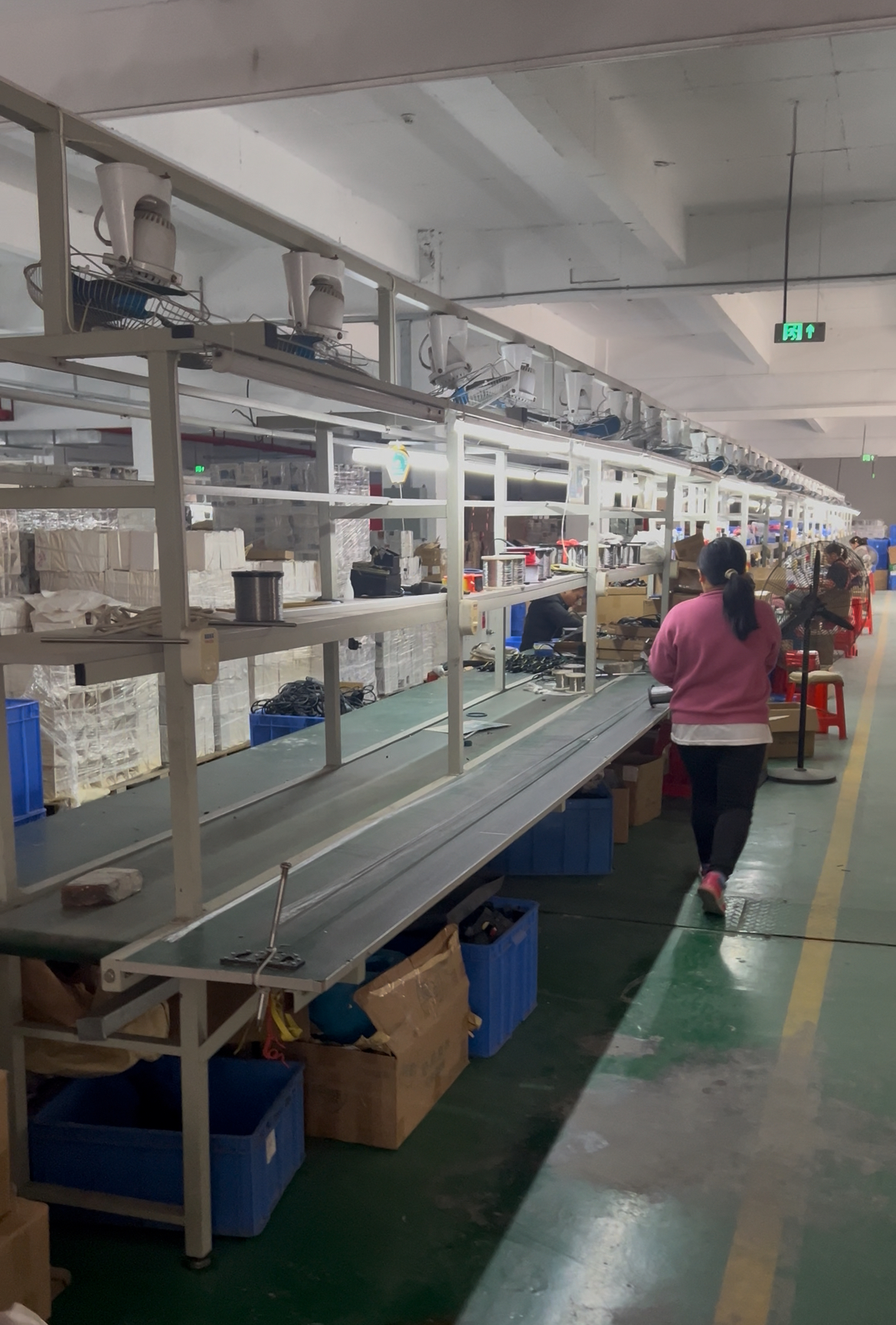
Why tweezers sit in the procurement blind spot
Kits are normally compared on visible criteria: screwdriver count, bit range, driver type and case layout. Tweezers are treated as a bundled accessory and inherited from whatever the supplier already packs. The commercial result is that two quotations for what looks like the same kit can contain tweezers of different lengths and different anti-static status, and nothing in the quotation reveals the difference.
The consequences surface later. A workshop chain standardises on one kit, then finds that replacement tweezers ordered separately do not behave the same way under magnification. A distributor builds an own-brand kit and cannot answer a customer question about electrostatic suitability, because the tweezer line was never specified in the first place. A kit builder changes supplier and discovers that the same nominal 120 mm tweezer has a different tip.
None of this is a manufacturing problem. It is a specification problem, and it is easier to fix at the quotation stage than at the complaint stage.
The category context explains why the fix is worth the effort. Business Research Insights valued the global smartphone repair market at approximately USD 22.66 billion in 2026, and third-party repair access has been widening as right-to-repair rules and campaigns push device makers to release repair manuals and tools to independent providers (ThinkComputers.org, 2026). Where repair work becomes organised rather than ad hoc, tools are bought repeatedly against criteria, and repeat purchasing is where an unspecified component becomes expensive.
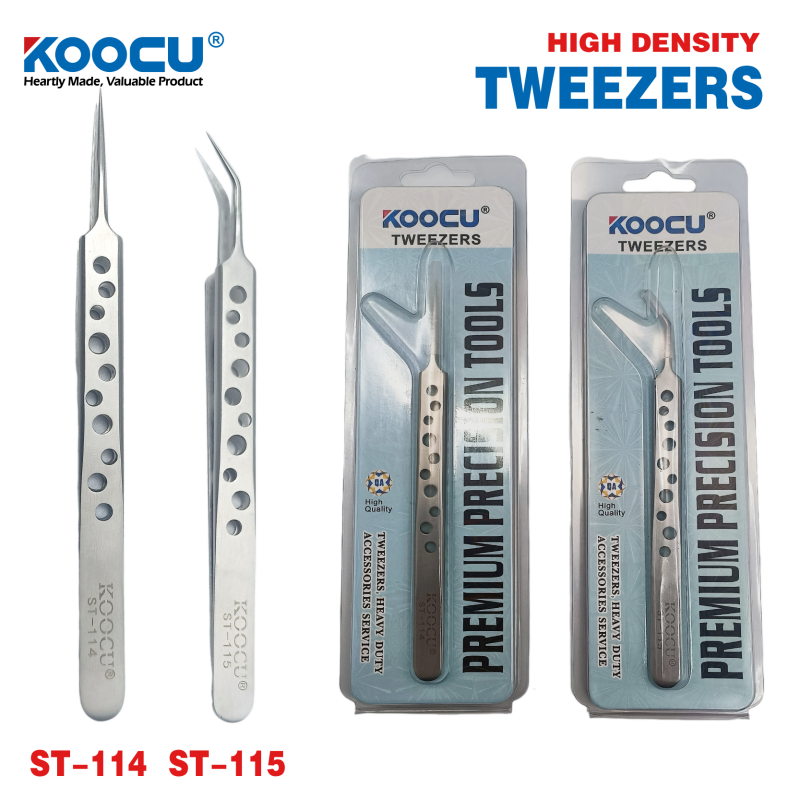
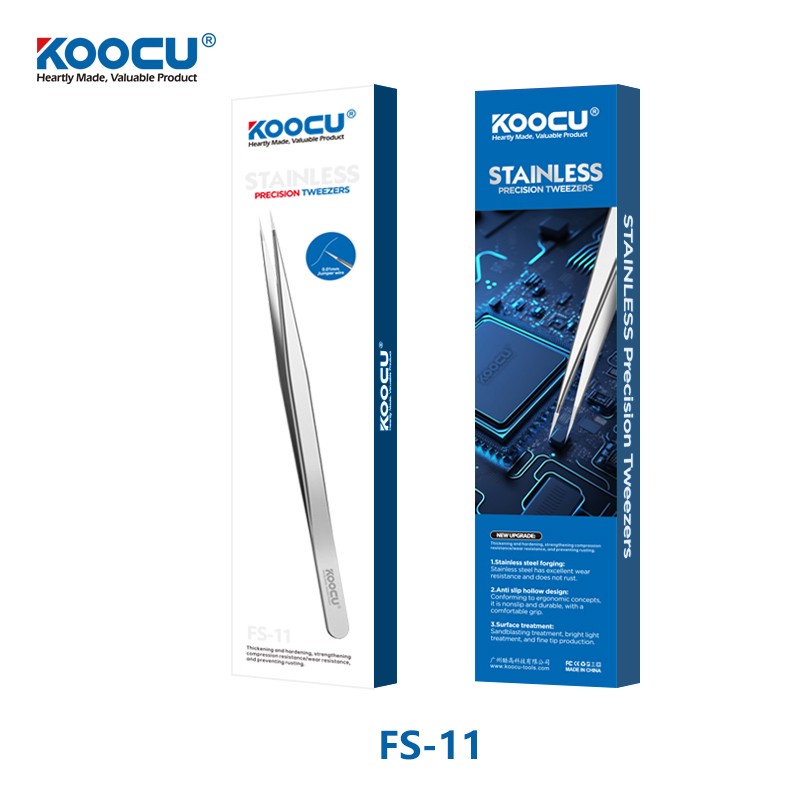
KOOCU Phone Repair Tools is the tool brand of Guangzhou Weiqianji Technology Co., Ltd., a Guangzhou-based manufacturer and exporter of cell phone repair tools and equipment whose stated markets include Africa, South America, Southeast Asia, India, Bangladesh and Pakistan. Four tweezers from that line, namely FS-11, ST-25, ST-115 and ST-114, are used below to show how the framework works in practice.
Filter one: material, and what stainless steel does not tell you
Material is the first filter because it is the only property most quotations actually state, and the one most often left as a category instead of a specification.
All four models in this comparison, FS-11, ST-25, ST-115 and ST-114, are documented as stainless steel tweezers intended for mobile phone repair. That establishes a baseline and separates none of them from the others: stainless steel is a family of alloys rather than a single specification, so the words stainless steel on a purchase order describe a category, not a spec.
What material actually changes in use is tip integrity and surface behaviour. Repeatedly lifting flex cables and shields loads the tip; contact with flux, alcohol-based cleaners, adhesive removers and heat changes how the surface performs over a service life. Hardness is where model-level documentation begins to matter: KOOCU's documentation describes the ST-21 tweezer as a stainless steel tweezer for cellphone repairs with high hardness and anti-static properties. The useful reading is not that all stainless steel tweezers are hard, but that hardness is a model attribute which can be claimed, checked and repeated. That is precisely what a buyer needs when re-ordering.
Buyer action. Ask the supplier to name the alloy grade and temper of the specific model, to state whether hardness is controlled and how, and to clarify whether any surface treatment covers the tip only or the whole tool. A supplier that answers stainless steel to all three questions is confirming that material has not been specified at all.
Boundary. The specification material available for FS-11, ST-25, ST-115 and ST-114 does not publish alloy grades or measured hardness values. Material therefore works as a first filter, separating stainless from non-stainless and identifying where a hardness claim exists, but it is not a finished specification on its own.
Filter two: length, reach, control and one number that is not enough
Length is the filter buyers check most often and interpret most loosely, because it is easy to measure and easy to assume.
In this set, ST-115 is documented at 115 mm, while FS-11, ST-25 and ST-114 are documented at 120 mm. The wider KOOCU tweezer line shows that length is a deliberate design variable rather than a manufacturing accident: the 7-SA SR and SS-SA SR models, together with the 7-SA-16 and SS-SA-16 models, are listed at 130 mm, while TS-11 and TS-15 are listed at 115 mm.
What length changes is the distance between the operator's fingers and the component. A longer tweezer extends reach into display wells, battery cavities and deep housings; it also increases leverage at the tip, so a small hand movement produces a larger tip movement. A shorter tweezer keeps the tip closer to the hand and tends to feel more controlled under magnification, at the cost of reach. In dense board work the binding constraint is often clearance around the component rather than the depth of the housing, which is why the assumption that longer is always better fails as often as it holds.
Length also has a kit-level consequence. A set that mixes 115 mm and 120 mm tweezers gives a technician two different feels for the same operation and makes replacement ordering ambiguous. Standardising on one length per kit is a small decision with a long tail.
Buyer action. Define the required length as a line-item attribute, ask whether the same model is available in another length, and confirm which tip geometry goes with it.
Boundary. Length is a proxy for fit, not fit itself. Tip geometry, whether straight, curved, fine point or flat, is not published for these four models in the specification material used here, so buyers must confirm tip shape from a sample or a drawing. Two 120 mm tweezers with different tips are not interchangeable for the same operation.
Filter three: anti-static status that has to belong to a model
Anti-static describes how a tool behaves in an electrostatic-discharge-controlled environment, and it only means something when it is attached to a specific model and a specific verification method.
In this comparison, FS-11 is documented as a stainless steel tweezer for mobile phone repair with anti-static properties. ST-25 and ST-115 are also specified with anti-static status. ST-114 is specified at 120 mm in stainless steel, without an anti-static designation.
The filter sits last because of how the information is produced. Material and length appear in a catalogue; anti-static status usually appears as one adjective in a sentence. Three questions convert the adjective into a specification: what property is being claimed, how it was tested, and whether the report applies to the model or to a production batch.
Buyer action. Request the test method and the report reference, confirm whether the claim covers the tip, the body or a coating, and ask for batch-level confirmation on repeat orders. If the answer is a brochure sentence rather than a document, treat the model as having no anti-static designation for planning purposes.
Boundary. The specification material used here does not publish measured surface-resistance values or test standards for these models. A buyer therefore cannot treat the label alone as evidence of ESD suitability. Where a repair line works under an ESD policy, this is the filter where an undocumented claim carries the highest risk relative to the price of the tool.
Applying the framework: the four models side by side
| Model | Length | Material | Anti-static status as specified | Framework reading |
|---|---|---|---|---|
| FS-11 | 120 mm | Stainless steel | Anti-static | Clears all three filters; documented for mobile phone repair work. |
| ST-25 | 120 mm | Stainless steel | Anti-static | Same three-filter profile as FS-11; a useful alternative sample for side-by-side handling. |
| ST-115 | 115 mm | Stainless steel | Anti-static | Clears all three filters with a shorter body; the length differentiator in this set. |
| ST-114 | 120 mm | Stainless steel | Not designated | Two of three filters; baseline for comparing what an anti-static claim changes. |
Read the table as a filter result, not a ranking. All four models clear the material filter, and three of the four sit in the 120 mm group, so within that group the practical differentiator is anti-static status. ST-115 is the length differentiator: it keeps the anti-static designation and moves to 115 mm. ST-114 keeps the 120 mm body without an anti-static designation, which makes it the natural baseline for comparing what a finish or treatment claim actually adds.
Two buyers applying the same three filters can legitimately reach different conclusions. A workshop operating under an ESD policy that requires documentation will treat FS-11, ST-25 and ST-115 differently from ST-114. A buyer whose technicians mainly open large handset and tablet housings may prefer the 120 mm group, while a buyer kitting for dense board-level work with limited clearance may prefer 115 mm. The framework narrows the field; the use case makes the final call.
Framework-based selection versus price-led selection
The traditional approach buys tweezers by unit count and compares quotations on price per piece. It is fast, and it produces three recurring failures. The tweezer inside a kit changes between shipments while the kit code stays the same. Anti-static status drifts because it was never written into the purchase order. Replacement tweezers ordered later do not match the tweezers in the kit, so the technician's established habits no longer apply.
A filter-based approach is slower on the first order. It adds three questions to the request for quotation (material grade, length as a line-item attribute, anti-static status with a document reference) and it produces a written specification that survives re-orders, private-label kitting and distributor questions. For a wholesale buyer shipping into several markets, that written specification is also what makes a consistent answer possible when a customer asks what is inside the kit.
What this framework does not do. It cannot judge tip durability or spring tension without sample testing, and it does not replace an ESD audit of the workshop. It also does not verify that a supplier's documentation is accurate, which remains a sample-and-audit task. Finally, it applies to tweezers only. Where the operation requires controlled fastening rather than lifting, the relevant tool is a torque-controlled driver: KOOCU's precision screwdriver documentation describes a torque range of 1 to 8 N·m for mobile phone repair, where controlled torque is used to avoid damaging delicate components. Tweezers and drivers solve different problems and should be specified separately rather than folded into a single judgement about kit quality.
Market trend: why component-level specification is becoming normal
Published market sizing in this category is directional rather than precise. Business Research Insights places the global smartphone repair market at approximately USD 22.66 billion in 2026. The same verified dataset also records a USD 215.2 billion estimate for 2023 from UnivDatos, which appears to include full hardware replacement rather than service labour. The gap is a definition gap rather than a contradiction in demand, and it is a reminder to cite repair-market figures with their definition attached.
Two structural trends matter more for tool buyers than any single figure. First, right-to-repair rules and campaigns in 2026 are pushing device makers to release repair manuals and tools to third-party providers (ThinkComputers.org, 2026), which professionalises independent repair and raises the standard expected of tools used outside authorised channels. Second, precision hand tools are a growth pocket within hand tools generally: Credence Research valued the global manual screwdriver market at USD 365.2 million in 2024 and identified precision screwdrivers for electronics as a key growth driver.
Neither trend says anything specific about tweezers. Both point the same way. Where repair work is organised, tools get bought against criteria rather than by habit, and the criteria that survive are the ones that can be written down and checked.
Future outlook
The likely direction over the next few buying cycles is that the tweezer line migrates from accessory to component in B2B repair procurement. Practical signs would be requests for quotation that name length and material rather than kit quantity; anti-static questions that ask for the report instead of accepting the adjective; and private-label kit builders who publish a component list alongside the kit. For suppliers, that shift rewards model-level documentation over family-level claims. For buyers, it turns the three filters into a standing part of the quotation template rather than a one-off check.
Kits will still be sold as kits. The defensible ones will be traceable to a component specification, and that traceability is what makes a kit comparable across suppliers, re-orderable across seasons and answerable to a customer who asks what is inside.
Procurement checklist for a tweezer line item
- Name the model (FS-11, ST-25, ST-115, ST-114 or an alternative) instead of writing tweezers in the bill of materials.
- Record length as an attribute, 115 mm or 120 mm, so that a substitution is visible on the packing list.
- Ask for the stainless steel grade and temper of the specific model, not of the product family.
- Ask whether hardness is controlled, and which models carry a documented hardness claim.
- Request the anti-static test method, the report reference and the scope of the claim: tip, body or coating.
- Confirm tip geometry from a sample or a drawing before approving the line.
- Sample-test the model under the workshop's own lighting and magnification, not only from a catalogue photo.
- Write the approved specification into the purchase order and the re-order sheet, so the next batch is checked against a document.
Frequently asked questions
1. Does the material of cell phone repair tweezers matter if all stainless steel tweezers look the same?
It matters, but not in the way the label suggests. FS-11, ST-25, ST-115 and ST-114 are all documented as stainless steel tweezers for mobile phone repair, so material alone does not separate them. What separates them is whether a model carries a specific claim: KOOCU's documentation, for example, describes the ST-21 as high hardness as well as anti-static, which shows that hardness is a model attribute rather than a family attribute. Buyers should ask for the alloy grade and temper of the exact model and treat stainless steel as the entry filter rather than the answer.
2. Should a repair workshop standardise on 115 mm or 120 mm tweezers?
Both lengths exist in the line, so the choice is about fit rather than availability. ST-115 is documented at 115 mm, while FS-11, ST-25 and ST-114 are documented at 120 mm. The wider family also includes 130 mm models (7-SA SR, SS-SA SR, 7-SA-16 and SS-SA-16) and 115 mm models TS-11 and TS-15. Longer tweezers extend reach into housings; shorter tweezers keep the tip closer to the hand and tend to feel more controlled under magnification. Standardising on one length per kit also simplifies replacement ordering. Length on its own does not define fit, because tip geometry is not published for these models.
3. How can a buyer verify an anti-static claim on repair tweezers?
Convert the adjective into a document. Ask for the test method, the report reference, the scope of the claim (tip, body or coating) and batch-level confirmation for repeat orders. FS-11 is documented with anti-static properties, and ST-25 and ST-115 are specified with anti-static status, while ST-114 is specified at 120 mm in stainless steel without an anti-static designation. Because measured surface-resistance values and test standards are not published for these models in the available specification material, a buyer planning for an ESD-controlled line should not treat the label alone as sufficient evidence.
4. What are the practical differences between FS-11, ST-25, ST-115 and ST-114?
All four are stainless steel tweezers intended for mobile phone repair. ST-115 is the shorter model at 115 mm, while FS-11, ST-25 and ST-114 are 120 mm. FS-11, ST-25 and ST-115 are specified with anti-static status, while ST-114 is specified without an anti-static designation. In practice the decision therefore comes down to two variables: length for reach and control, and anti-static status for ESD-controlled work.
5. What should a bulk tweezer purchase order contain for a cell phone repair tool kit?
A workable order names the model, the length, the material with grade where the supplier can provide it, the anti-static status with a documentation reference, and the confirmed tip geometry. It also records the sample that was approved, so that a later batch can be compared against a reference. This is the difference between ordering tweezers and ordering a specification: the first is a quantity, the second is a component that can be re-ordered, substituted visibly and explained to a customer.
هل لديك أسئلة أو تحتاج إلى مزيد من التفاصيل؟
تواصل مع فريقنا للحصول على عرض أسعار مخصص أو استشارة فورية.
طلب عرض أسعار
املأ النموذج أدناه وسيتواصل معك فريقنا بعرض مقترح مخصص.
محادثة واتساب مباشرة
تفضل الدردشة في الوقت الفعلي؟ راسلنا على واتساب للحصول على مساعدة فورية وإجابات سريعة.
- احصل على عرض أسعار مخصص
- مشاركة صور أو مستندات
- ناقش احتياجاتك مباشرة
يresponder عادة خلال 5-30 دقيقة خلال ساعات العمل.