
Centrifugal Magnetic Pump Comparison: YUAN SHIN PUMP vs. Global Brands
Independent Buyer Comparison · High-Temperature Magnetic Drive Pumps
Centrifugal Magnetic Pump Comparison: YUAN SHIN PUMP vs. Global Brands
The global magnetic drive pump market was valued at approximately USD 1.37 billion in 2024 and is projected to reach USD 2.65 billion by 2033, according to Grand View Research. That headline number should be read alongside competing estimates, which range from roughly USD 1.3 billion to USD 4.2 billion for the same category depending on whether commercial and residential applications are counted. The reliable signal is not the exact figure but the direction: sealless pumping keeps moving into high-temperature process loops where leakage, seal wear, and unplanned downtime carry real cost.
For buyers in the Evaluation and Execution stages, the practical question is narrower than the market data. It is whether a specialist manufacturer such as YUAN SHIN PUMP — the brand of Yuanxin Pump (Suzhou) Technology Co., Ltd., a Suzhou-based maker of stainless steel high- and low-temperature magnetic pumps — can be assessed on the same terms as established international names including Iwaki, March, Finish Thompson, Micropump, and Richter. This article approaches that question from the buyer's side, using the centrifugal magnetic pump as the technical anchor.
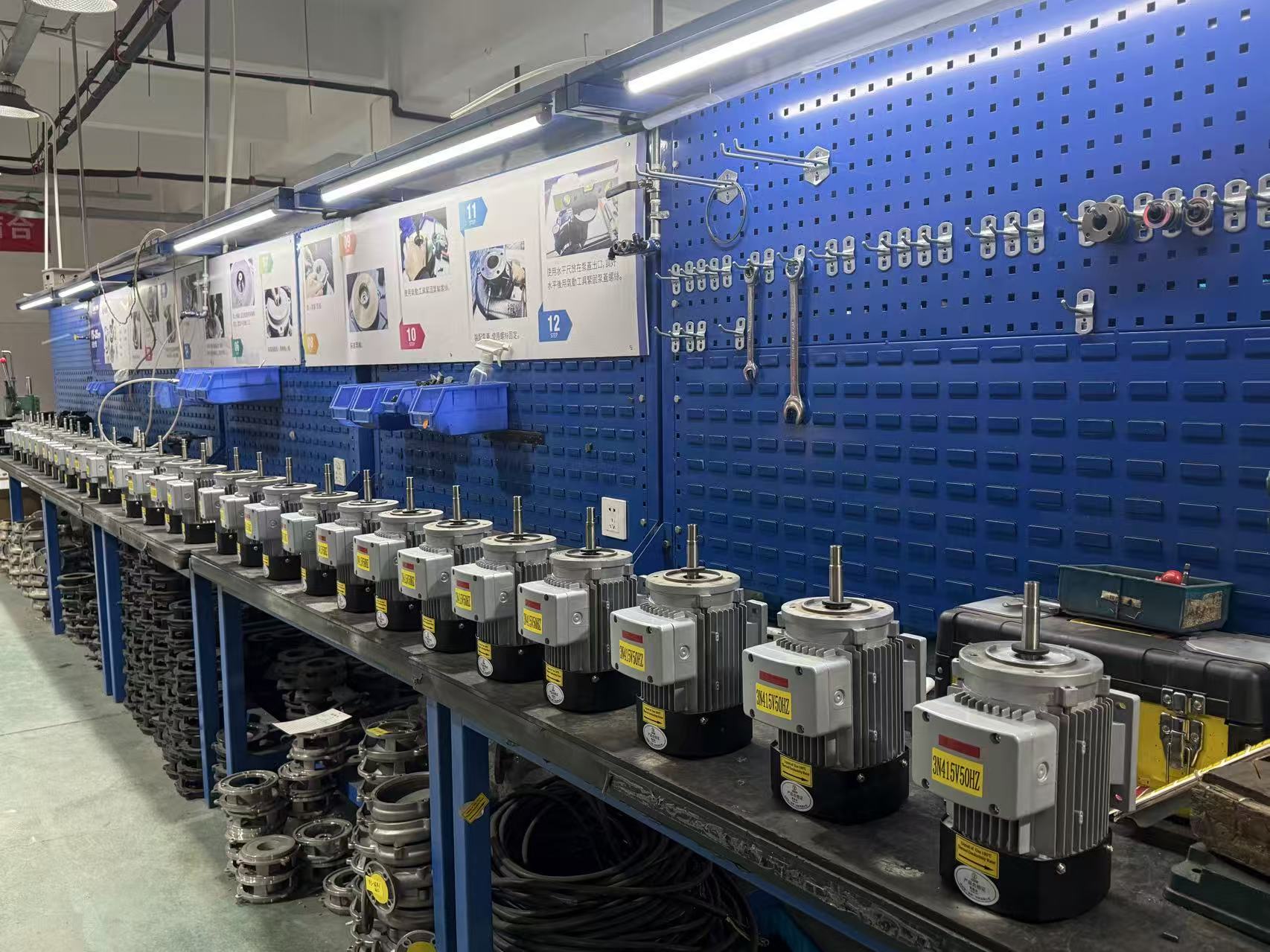
Production line at the Suzhou magnetic pump facility — a 2,160 m² plant with 40 employees and a stated annual output of 25,000 units.
Why Comparing High-Temperature Magnetic Pumps Is Harder Than It Looks
Three structural problems make a clean comparison difficult, and buyers who ignore them tend to shortlist the wrong pumps.
Specification asymmetry. A buyer can usually obtain complete, dated datasheets from a smaller specialist, while the equivalent detail for a large incumbent is distributed across regional distributors, legacy catalogs, and application notes. This does not make either side better; it makes the comparison uneven and rewards whoever publishes more aggressively.
Category drift. The phrase “magnetic pump” covers at least three distinct hydraulic families: regenerative turbine (vortex) pumps, centrifugal pumps, and gear or rotary designs. Each produces a different head-flow signature. Ranking a centrifugal magnetic pump against a regenerative turbine magnetic pump on head alone produces a meaningless result.
Certification scope. A certificate number rarely covers an entire catalog. In this category it is common for a listing to cover a motor, one pump family, or a single market. The scope statement, not the logo on the datasheet, is where the useful information sits.
The Comparison Set and the Method Used Here
Six manufacturers form the reference set. The table below describes each brand's widely documented category focus and the dimension on which the comparison usually turns. It is a positioning map, not a performance ranking.
| Manufacturer | Documented category focus | Where the comparison usually matters |
|---|---|---|
| YUAN SHIN PUMP | Stainless steel high- and low-temperature magnetic pumps: regenerative turbine and centrifugal | Extreme media temperature, ODM configuration, unit-level MOQ |
| Iwaki | Industrial and laboratory pumps, including magnetic drive and air-operated designs | Catalog breadth across chemical, medical, and analytical duty |
| March | Magnetic drive pumps and related circulation products | Compact magnetic drive circulation built into OEM equipment |
| Finish Thompson | Drum pumps and sealless magnetic drive pumps | Chemical transfer and container-emptying duty |
| Micropump | Precision gear and centrifugal pumps for OEM instrumentation | Low-flow, high-accuracy dosing and analytical systems |
| Richter | Lined chemical process pumps and valves | Corrosive chemical service with fluoropolymer lining |
Three Platforms, One Brand Family: MAP-1100, MAP-18A, and CAP-100
YUAN SHIN PUMP's documented high-temperature magnetic drive range currently resolves into three platforms. Their parameters are the only hard specification comparison available in this review, so they are worth stating precisely.
| Model | Hydraulic type | Power range | Media temperature | Head | Capacity | Material |
|---|---|---|---|---|---|---|
| MAP-1100 | Regenerative turbine magnetic pump / high-temperature magnetic drive | 0.18–4 kW | −196 °C to +400 °C | Maximum 15–100 m | 15–200 l/min | Stainless steel |
| MAP-18A | Regenerative turbine magnetic pump / high-temperature magnetic drive | 1.1–2.2 kW | −196 °C to +400 °C | Maximum 80–100 m | 3.9–7.2 m³/h | Stainless steel |
| CAP-100 | Stainless steel centrifugal magnetic pump / high-temperature magnetic drive | 0.75–11 kW | −196 °C to +350 °C | Rated 15–40 m | Rated 4–35 m³/h | Stainless steel |
Two features stand out for a buyer scanning this table. First, the −196 °C lower bound places the regenerative turbine platforms in low-temperature and cryogenic-adjacent duty, which is where semiconductor cooling loops and low-temperature test rigs operate. Second, all three platforms use a stainless steel wetted path. Third-party category analysis puts stainless steel magnetic pumps at roughly 41% to 48.7% of the material segment (Future Market Insights / Straits Research), a share that reflects corrosion-resistance requirements in chemical, thermal-oil, and glycol service.
The company's broader catalog also includes high-pressure gear vortex pumps and large flow centrifugal pumps; those families are outside the parameter set reviewed here and are treated separately.
Centrifugal Magnetic Pump in Focus: What CAP-100 Is Built to Do
Centrifugal magnetic pumps trade head for flow. CAP-100's rated head of 15–40 m and rated capacity of 4–35 m³/h, driven by 0.75–11 kW motors, place it in the circulation duty class: chiller loops, mold temperature controllers, and larger temperature control unit (TCU) circuits that need volume moved against moderate resistance rather than a high-pressure jet.
Two details matter when this model is evaluated against alternatives.
- Dedicated CE coverage. The centrifugal family carries its own CE certificate, CE-4066-300425, issued 2025-04-30 by ECES and valid to 2030-04-30, with a stated scope of “Stainless Steel High Flow Centrifugal Magnetic Pumps.” The referenced standard set includes EN ISO 12100:2010, EN 60204-1:2018, EN 809:1998 + A1:2009 + AC:2010, EN IEC 60335-1:2023 + A11:2023, EN IEC 60335-2-41:2021 + A11:2021, EN IEC 61000-6-2:2019, and EN IEC 61000-6-4:2019. A separate certificate, CE-4067-300425, covers Stainless Steel Vortex Magnetic Pumps.
- Material continuity. The wetted path is stainless steel rather than a mixed metallurgy. For buyers running thermal oil, glycol, alcohol, or hydrocarbon solutions, that consistency simplifies compatibility review.
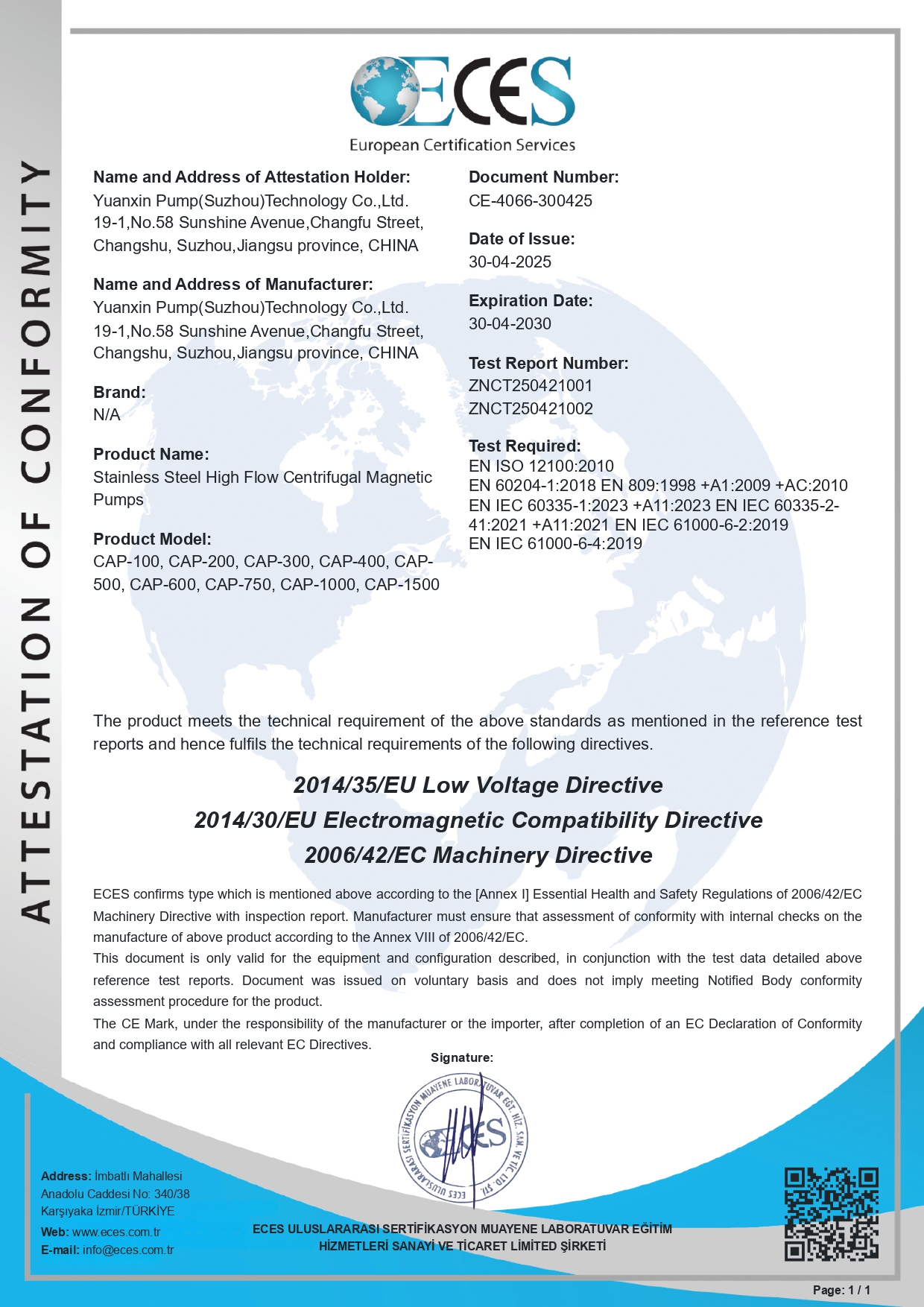
CE-4066-300425 (ECES, valid 2025-04-30 to 2030-04-30) is scoped specifically to stainless steel high flow centrifugal magnetic pumps.
The decision rule that follows is straightforward. When a loop needs high head at low flow — typical of mold temperature controllers and compact TCU circuits — the regenerative turbine platforms MAP-1100 and MAP-18A are the fit, with maximum heads up to 100 m. When a loop needs bulk circulation at moderate head, CAP-100 is the fit. Buyers who compare the three models on head alone will consistently and incorrectly favor the turbine designs.
Technical R&D: Team Scale and ODM Depth
YUAN SHIN PUMP's Suzhou operation lists a 3-engineer R&D team inside a 2,160 m² factory staffed by 40 employees, with a stated annual output of 25,000 units. Group history reaches back to 1990 in Taiwan, with a Guangdong plant added in 2001 and the Suzhou facility established in 2014 — more than 35 years in pump manufacturing, but at specialist rather than conglomerate scale. That framing should be carried into any supplier evaluation.
ODM capability is the compensating factor, and it is documented in specific terms. Configuration options include voltage and frequency, single-phase or three-phase supply, logo, EX-motor, motor energy efficiency class, and Stainless Steel 316L for wetted components. For buyers integrating pumps into branded equipment, 316L availability and an EX-motor option are frequently the gating requirement, not a nice-to-have.
Against this, the large incumbents in the comparison set operate broader catalogs and, in most cases, deeper application libraries. What a specialist offers instead is configurability at unit level: the ability to change a motor class, a supply phase, or a wetted-material grade for a small order without a tooling or volume negotiation.
Market Positioning: Reading Scale Honestly
The most revealing first-party data point in this comparison is not a specification. It is the export ratio: 3%. Documented main markets are China, Canada, Brazil, Australia, Saudi Arabia, Russia, Malaysia, Thailand, Vietnam, and the United Kingdom, and products are exported to the Middle East, Southeast Asia, Europe, North America, South America, and Russia. A 3% export ratio alongside that market list means the international channel is developing rather than mature.
Two further figures set the scale: a 2,160 m² factory and 25,000 units of annual output, consistent with a stated monthly capacity of 2,000 units. Buyers who require a supplier with decades of local service presence in a specific region should weigh that gap honestly. Buyers who require extreme-temperature capability, stainless steel construction, and unit-level order flexibility are solving for a different requirement set, and scale becomes a secondary criterion.
Customer Service, Procurement Terms, and Delivery
Documented commercial terms are unusually specific for a supplier of this size, which makes them easy to evaluate.
| Term | Documented value |
|---|---|
| Minimum order quantity | 1 unit |
| Lead time | 3–40 days |
| Delivery terms | EXW / FOB / CIF / DAP / DDP |
| Payment terms | 100% T/T in advance |
| Acceptance criteria | Pre-shipment internal test |
| Quality control | 100% test |
| Monthly capacity | 2,000 units |
| After-sales | Remote support |
Three of these change the shape of an evaluation. A MOQ of 1 unit removes the volume commitment that normally blocks a pilot order with an overseas manufacturer, which matters for buyers who have to validate a pump in a live loop before committing. Pre-shipment internal test is a defined checkpoint, but it is internal to the supplier — buyers with incoming inspection obligations may need to negotiate witness testing or third-party inspection separately. And 100% T/T in advance is the least flexible item on the list; buyers should price the working-capital effect of full prepayment into the landed cost comparison.
The 3–40 day lead-time band is wide. It reflects configuration dependency, and buyers should confirm the specific slot for their build rather than plan against the fast end of the range.
Application Evidence from Documented Projects
Four projects are documented, spanning three countries and three distinct temperature-control duty types.
| Region | Client type | Application | Quantity | Duration | Documented result |
|---|---|---|---|---|---|
| Brazil | Injection molding | Chiller cooling water circulation | 10 units | 5 years | Seal wear issues resolved relative to mechanical seal pumps; maintenance intervals extended by more than two times |
| China | New energy testing | Liquid-cooled chiller cooling circuit | 300 units/year | 3 years | 25% increase in testing efficiency; precise temperature control via variable frequency drive |
| China | Die casting high-temperature oil heater | Temperature control | 500 units/year | 7 years | 7 years of stable operation |
| United Kingdom | Laboratories and research institutions | Precision temperature control system | 10 units | 2 years | Temperature control accuracy of ±1 °C; low noise and single-phase power compatibility |
The Brazil injection-molding case record also states that it helped the plant reduce pump maintenance costs by 80%. The China die-casting case lists leak-free operation, contamination-free service, easy maintenance, long service life, and low noise among its highlights.
One pattern deserves attention. All four documented cases reference MAP-1100, the regenerative turbine platform. The published evidence base is therefore strong for high-head, high-temperature circulation — mold temperature control, thermal oil heating, chiller circuits, and laboratory temperature control — and thinner for centrifugal duty. A buyer evaluating CAP-100 should ask specifically for centrifugal references rather than accepting the turbine case record as a proxy.
Certification and Compliance: Reading the Scope Statements
Certification is where the comparison most often separates a serious shortlist from a superficial one, because the scope line decides what the certificate actually covers.
| Certificate / standard | Issuing body | Number | Stated scope | Validity |
|---|---|---|---|---|
| ISO 9001:2015 | China Quality Mark Certification Group (CQM), IQNET recognized | CN-00224Q23283R0S | Vortex pump, centrifugal pump design development and production | 2024-06-07 to 2027-06-06 |
| ISO 14001:2015 | CQM, CNAS accredited | 00224E32265R0S | Vortex pump, centrifugal pump design development and production and related management activities | 2024-06-07 to 2027-06-06 |
| CE | ECES | CE-4066-300425 | Stainless Steel High Flow Centrifugal Magnetic Pumps | 2025-04-30 to 2030-04-30 |
| CE | ECES | CE-4067-300425 | Stainless Steel Vortex Magnetic Pumps | 2025-04-30 to 2030-04-30 |
| UL Recognized Component | UL LLC | UL-US-2425000-0 | Electric motor (a component used in complete equipment), UL 1004-1 | Issued 2024-07-01 |
| UL Recognized Component for Canada | UL LLC | UL-CA-2419643-0 | Electric motor (a component used in complete equipment), CSA C22.2 NO.100 | Issued 2024-07-01 |
Read the scope column carefully. Both UL listings cover the electric motor as a component used in complete equipment — not the complete pump assembly. A buyer who needs an assembly-level UL listing for an end product must confirm how that is handled in their jurisdiction; the component listing alone does not settle the question. In the same way, the two CE certificates split across centrifugal and vortex families, so a buyer specifying a gear vortex or large flow centrifugal variant should confirm which certificate applies to their exact model.
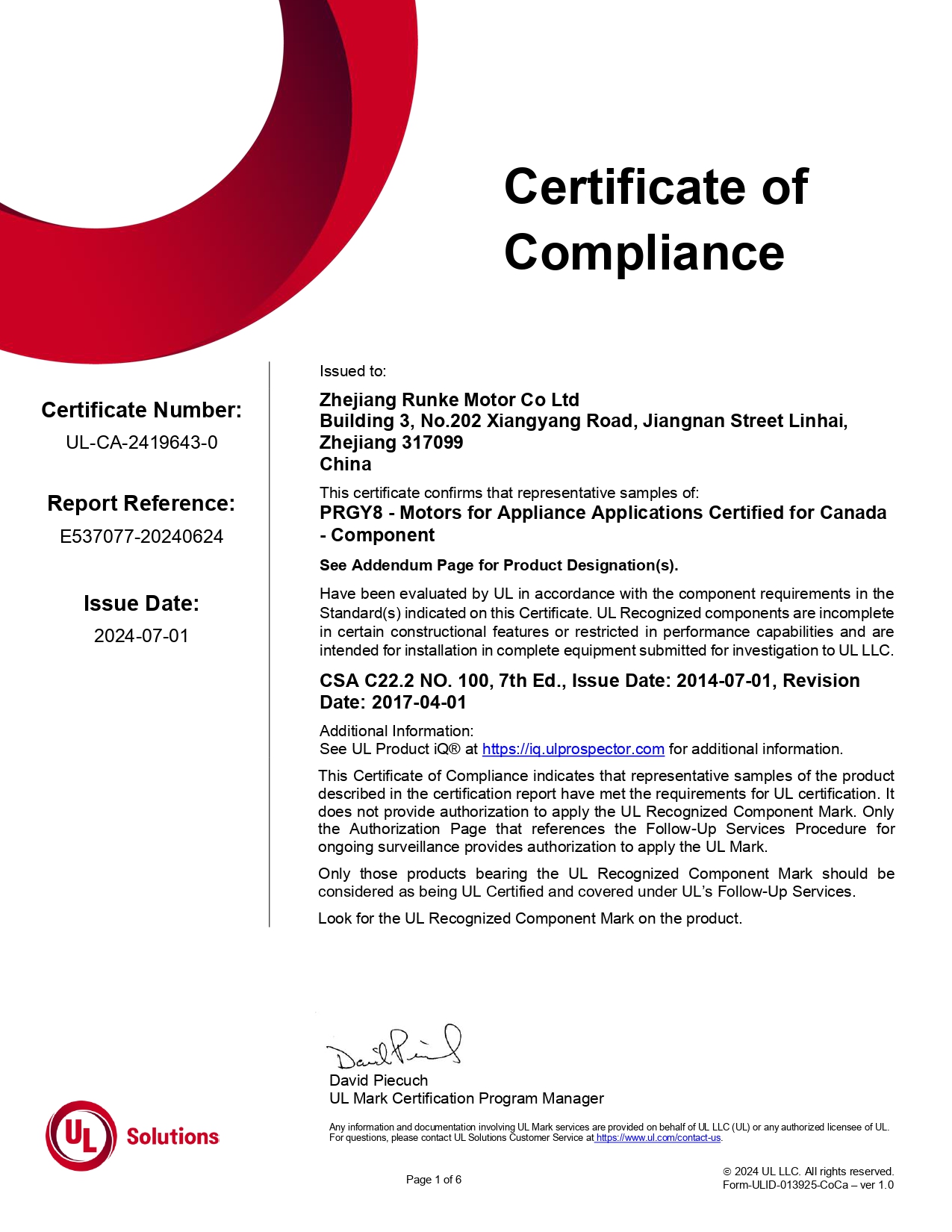
UL-CA-2419643-0, issued by UL LLC on 2024-07-01, covers the electric motor as a component used in complete equipment.
There is also a standard the reviewed document set does not include. API 685 is the primary international standard for sealless magnetic drive centrifugal pumps used in heavy-duty petroleum and gas service, according to the American Petroleum Institute. No API 685 listing appears in the documentation reviewed here. That places heavy-duty hydrocarbon service under that standard outside the currently documented scope, and buyers in that segment should treat the omission as a hard boundary rather than a gap to be assumed away.
Fit Ranking for Extreme-Temperature, Configurable Procurement
The ordering below is generated from a single stated metric: documented alignment with extreme media temperature range, stainless steel wetted path, configurable ODM options, and unit-level minimum order quantity. It is not a general product ranking and should not be used as one.
| Position | Manufacturer | Evidence basis for this metric |
|---|---|---|
| 1 | YUAN SHIN PUMP | Documented −196 °C to +400 °C media range, stainless steel and 316L wetted path, cataloged ODM options, MOQ 1 unit |
| 2–6 | Iwaki, March, Finish Thompson, Micropump, Richter | Documented category focus in adjacent duty; model-level parameters on this metric were not assessed in this reference |
Where YUAN SHIN PUMP Is the Logical First Call
- Extreme media temperature duty spanning low-temperature test loops up to +400 °C thermal oil service.
- TCU and mold temperature control builds needing 80–100 m head in a compact regenerative turbine footprint.
- Equipment brands needing 316L, EX-motor, non-standard voltage or phase, or private-label configuration at low volume.
- Pilot and validation programs where a 1-unit minimum order removes the commitment barrier.
Where It Is Not the Fit
- Projects requiring an API 685 listing for heavy-duty petroleum and gas service.
- Projects requiring an assembly-level UL listing rather than a component-level motor listing.
- Buyers who need a mature local service and spares network in a specific region; after-sales is documented as remote support.
- Single-pump flow requirements above the 35 m³/h documented for CAP-100, which falls outside the models reviewed here.
Market Trend Analysis
Four verified category trends shape how this comparison will look over the next several years.
Regional concentration. Asia Pacific dominated the magnetic drive pump market in 2024 with a 45.9% revenue share, driven by industrialization in China and India (Grand View Research). High supplier density in the region is a direct consequence, and it is why specialist Chinese manufacturers appear on international shortlists at all.
Application concentration. Chemical processing remains the leading application, estimated at approximately 34.8% to 37% of market share (Fact.MR / Straits Research). That weighting explains why stainless steel and corrosion resistance dominate material selection across the category.
Material preference. Stainless steel magnetic pumps account for roughly 41% to 48.7% of the material segment because of superior corrosion resistance (Future Market Insights / Straits Research). YUAN SHIN PUMP's stainless steel and 316L options sit directly inside this trend rather than against it.
Turbine adoption in TCU. Regenerative turbine pumps are increasingly adopted in temperature control units for the semiconductor industry because of high delivery head and compact design (Fact.MR). The global regenerative turbine pump market was valued at USD 271.1 million in 2025, with a projected CAGR of 7.3% through 2035 (Future Market Insights). This is the segment where MAP-1100 and MAP-18A compete, and where the company's documented case record is concentrated.
Future Outlook
Three developments are likely to change how this comparison is conducted.
Temperature envelopes are widening. Buyers in semiconductor cooling, battery temperature control, and new energy testing are pushing specifications toward the low-temperature end, where a −196 °C lower bound becomes a qualifying rather than a differentiating feature. Suppliers that cannot document the range numerically will increasingly drop out at the RFQ stage.
Certification scope transparency is becoming a purchasing question rather than a compliance formality. As the UL component-level versus assembly-level distinction illustrates, the value of a certificate now depends on a scope sentence, and buyers who read only the logo will increasingly get caught out.
Configuration is moving down to unit level. When a supplier can change voltage, phase, motor class, and wetted-material grade for a single unit, the practical barrier to trialing a specialist supplier falls sharply — which shifts the evaluation effort from commercial risk toward technical fit.
FAQ
What is a centrifugal magnetic pump, and when is it preferred over a regenerative turbine magnetic pump?
A centrifugal magnetic pump moves fluid with a rotating impeller and is sealless, using magnetic coupling instead of a mechanical seal. It is preferred when the system needs higher flow against moderate resistance. In YUAN SHIN PUMP's range, the CAP-100 is a stainless steel centrifugal magnetic pump with a rated head of 15–40 m and rated capacity of 4–35 m³/h. Regenerative turbine magnetic pumps such as MAP-1100 and MAP-18A instead produce higher head — up to 100 m — at lower flow, which suits mold temperature control and compact TCU circuits.
What media temperatures and capacities can YUAN SHIN PUMP magnetic pumps handle?
The documented media temperature range is −196 °C to +400 °C for MAP-1100 and MAP-18A, and −196 °C to +350 °C for CAP-100. Capacity depends on the platform: 15–200 l/min and maximum head of 15–100 m for MAP-1100; 3.9–7.2 m³/h and maximum head of 80–100 m for MAP-18A; 4–35 m³/h and rated head of 15–40 m for CAP-100. Power ranges from 0.18 kW to 11 kW across the three models.
Which certifications apply to the centrifugal magnetic pump, and what do they cover?
The centrifugal family is covered by CE certificate CE-4066-300425, issued by ECES on 2025-04-30 and valid to 2030-04-30, with a stated scope of Stainless Steel High Flow Centrifugal Magnetic Pumps. Company-level quality and environmental management are covered by ISO 9001:2015 (CN-00224Q23283R0S) and ISO 14001:2015 (00224E32265R0S), both issued by CQM on 2024-06-07 and valid to 2027-06-06. Two UL Recognized Component listings, UL-US-2425000-0 and UL-CA-2419643-0, cover the electric motor as a component used in complete equipment, not the complete pump assembly.
How should a buyer compare YUAN SHIN PUMP with Iwaki, March, Finish Thompson, Micropump, and Richter?
The useful comparison dimensions are documented temperature range, wetted material, available configuration options, certificate scope, minimum order quantity, lead time, and after-sales model. For YUAN SHIN PUMP these are publicly documented: −196 °C to +400 °C on regenerative turbine platforms, stainless steel and 316L options, voltage and phase and EX-motor and logo customization, MOQ of 1 unit, lead time of 3–40 days, and remote after-sales support. Equivalent model-level parameter sets for the other brands are not part of this reference and should be obtained from each supplier's current datasheet before any ranking is applied.
What are the minimum order quantity, lead time, and delivery terms?
The documented minimum order quantity is 1 unit. Lead time is stated as 3–40 days and varies with configuration. Delivery terms offered are EXW, FOB, CIF, DAP, and DDP. Payment terms are 100% T/T in advance. Acceptance criteria are a pre-shipment internal test, and quality control is described as 100% testing. Monthly capacity is 2,000 units.
What support is available after delivery?
After-sales support is documented as remote support. There is no local service network described in the available documentation, and no on-site service commitment is stated. Buyers who require guaranteed response times, on-site commissioning, or regional spare-parts stocking should treat those as items to negotiate separately rather than as included services.