
Ceramic Grinding Wheel FAQ: Acceptance & Order Terms
Ceramic Grinding Wheel FAQ: Acceptance & Order Terms
A ceramic grinding wheel is a bonded abrasive in which abrasive grain is held together by a vitrified bond, with porosity distributed between the two. Because the bond is glass-like and develops strength through firing, ceramic wheels hold dimensional stability and tolerate heat well; the same structure also makes them more brittle than resin-bonded wheels. That combination is why procurement conversations around ceramic wheels are rarely about a single product and almost always about a specification set, plus a written definition of what conformity to that set actually means.
This FAQ-style reference is written for buyers in the research and evaluation stage. It addresses technical questions (bond, grain, grit, hardness, structure, speed) alongside commercial ones (acceptance criteria, order terms, minimum quantity, lead time, customisation), using publicly stated product data from Shandong Xinfa Abrasives & Grinding Tools Co., Ltd. as a working example of what those fields look like when they are written down.
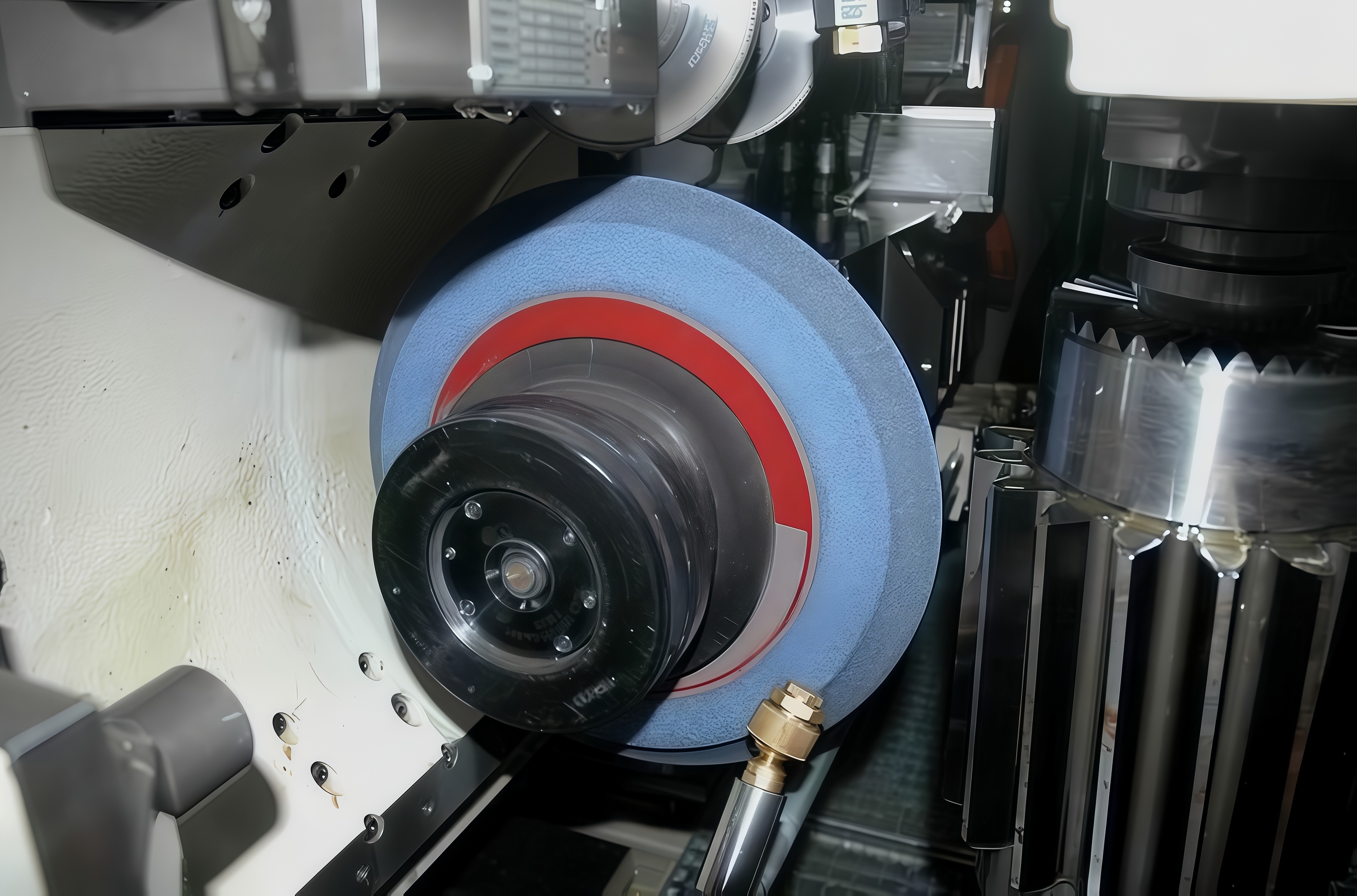
Grinding operations in high-temperature, high-wear production environments are the setting in which ceramic wheel specifications are usually agreed.
Why Ceramic Wheel Orders Fail at the Specification Layer
Most disagreements between a buyer and a wheel manufacturer are not really about quality in the abstract. They are about a field that was never written down. A ceramic wheel is defined by at least six interdependent variables: abrasive type, grit size, hardness grade, structure number, bond type, and maximum operating speed — on top of the three physical dimensions of outside diameter, thickness and bore. Two wheels that look identical on a shelf can differ in every one of those variables.
When a purchase order names only a wheel type and a diameter, the supplier fills the remaining fields with defaults. Those defaults may be perfectly sound products — and still be the wrong product for the operation. The practical consequence is a trial that fails for reasons unrelated to manufacturing capability, followed by a re-specification cycle that costs both sides several weeks.
The opportunity runs the other way. Buyers who treat the wheel as a configurable assembly — and who attach acceptance criteria and order terms to that configuration — convert a vague quality argument into a checklist that can be verified at goods-in and again on the machine.
The Fields to Lock Before Order Confirmation
The table below summarises the specification fields that appear in published ceramic wheel data, using the ranges stated for Xinfa's vitrified-bond product families. Ranges are useful for understanding what a manufacturer can produce; they are not a substitute for a line-item specification on an actual purchase order.
| Field | What it controls | Values stated in published product data |
|---|---|---|
| Dimensions (OD / T / H) | Fits the machine, the spindle and the coolant envelope | Varies by wheel type; for example general purpose wheels OD 50–600 mm, T 6–125 mm, H 12.7–203 mm |
| Abrasive material | Cutting behaviour and suitability for the workpiece material | Brown Fused Alumina (A), White Fused Alumina (WA), Pink Fused Alumina (PA), Single Crystal Fused Alumina (SA), Microcrystalline Fused Alumina (MA), Green Silicon Carbide (GC), Black Silicon Carbide (C), SG |
| Grit size | Surface finish versus removal rate | F16, F24, F30, F36, F46, F60, F80, F100, F120, F150 |
| Hardness grade | Grain retention, self-sharpening behaviour, burn risk | G, H, J, K, L, M, N, P, Q, R, S, T, Y |
| Structure number | Porosity: chip clearance versus strength | 0–14 |
| Maximum operating speed | Safety envelope and machine compatibility | 32 m/s, 35 m/s, 40 m/s, 45 m/s, 50 m/s, 60 m/s |
Speed deserves separate emphasis. A wheel marked 60 m/s and a wheel marked 32 m/s can share every other field and still not be interchangeable on the same spindle. Buyers should confirm that the ordered speed rating matches the machine's maximum peripheral speed — not the machine's nominal rating, and not the speed the operator happens to use.
Dimensioning is also more standardised than many buyers assume. ISO 603-14:2022 specifies common nominal dimensions for shape types 6, 11, 27, 28 and 29 bonded abrasive products intended for deburring, fettling and snagging on hand-held grinding machines. That does not cover every wheel in a ceramic range, but it is a useful anchor: where a shape falls inside a published standard, the order should reference it rather than describe the wheel in prose.
Matching Wheel Type to the Grinding Scenario
Wheel type is the buyer's fastest routing decision. A tool grinding wheel and a roll grinding wheel are not alternative grades of the same thing; their dimension envelopes alone tell you which part of a plant they belong to. The published ranges for Xinfa's product families illustrate the spread.
| Wheel family | OD / T / H (mm) | Typical process setting |
|---|---|---|
| Tool Grinding Wheel | 100–600 / 3–150 / 12.7–203 | Tool sharpening, edge form control, thin profiles |
| Internal (Bore) Grinding Wheel | 50–150 / 6–120 / 16–32 | Bore finishing, constrained reach, high spindle speed |
| Cylindrical Grinding Wheel | 250–750 / 20–100 / 75–305 | Outside diameter grinding of shafts and journals |
| Crankshaft & Cam Shaft Grinding Wheel | 200–1100 / 16–90 / 127–305 | Automotive engine components, interrupted cuts |
| Roll Grinding Wheel | 450–1066 / 50–150 / 203–508 | Large roll refurbishment, surface integrity priority |
| Worm Grinding Wheel | 220–450 / 50–230 / 76.2–203 | Gear tooth flank grinding, profile accuracy |
| Saw Tooth Grinding Wheel | 125–300 / 6–16 / 12.7–32 | Thin saw blade tooth geometry |
| Bench Grinder Wheel | 100–450 / 12–80 / 12.7–50.8 | Workshop deburring and general sharpening |
| General Purpose Grinding Wheel | 50–600 / 6–125 / 12.7–203 | Broadest envelope; surface and general shop grinding |
| Brown Fused Alumina Abrasive (grain) | Grit F12–F220 | Input material for bonded wheel production |
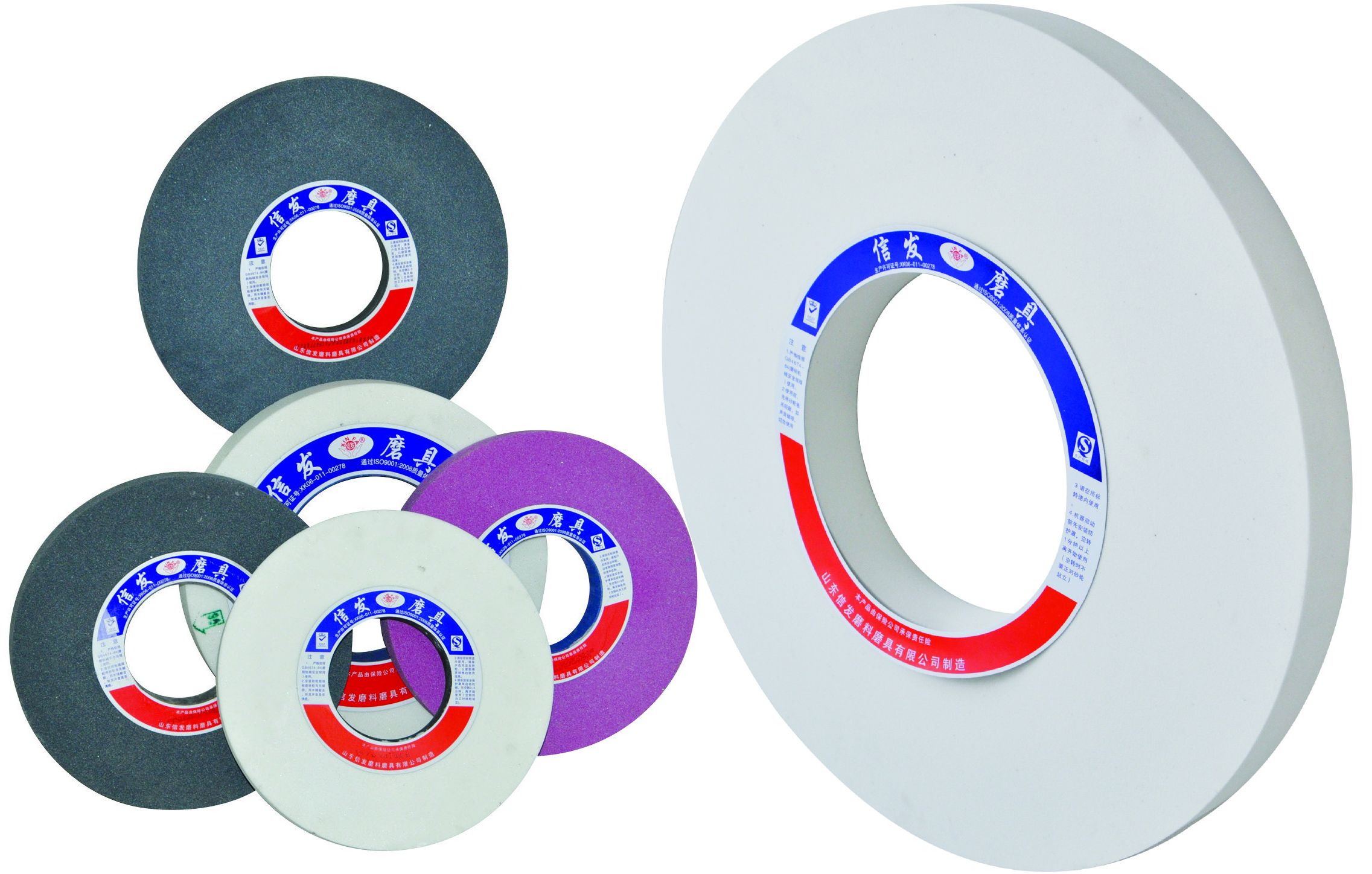
Cylindrical grinding wheels occupy a dimension band (OD 250–750 mm in Xinfa's stated range) that is distinct from bore, tool and roll wheels.
Centerless and flat surface grinding sit partly outside this table by design. Centerless work is matched on the relationship between regulating wheel and grinding wheel rather than on the grinding wheel alone, and flat surface grinding is usually served by wheels whose thickness-to-diameter ratio is chosen for the machine's table and wheel-head clearance. In both cases the specification conversation should start from the machine and the fixture, then move to the wheel.
The application context that surrounds these wheel types is consistent across the categories: grinding, sanding, polishing, tool sharpening, deburring and ultra-precision machining, carried out under high-temperature and wear conditions in continuous operation. Stated end industries include automotive, bearings, cutting tools, aerospace, 3C electronics, molds, hydraulics, semiconductors, photovoltaics, hardware and medical. Some applications additionally call for explosion-proof provisions, which belong in the enquiry rather than in the assumption.
Acceptance Criteria: From Certificate to Physical Evidence
Acceptance criteria work best as three layers, each verified by a different party at a different moment.
Layer one — documentary. The supplier confirms the wheel against the written specification line by line: abrasive, grit, hardness, structure, bond, dimensions, speed rating, marking and packaging. A quality management system claim belongs here too; Xinfa publicly reports that its quality has passed ISO 9001 quality management system authentication, and buyers should request the current certificate and its scope rather than accept the claim at face value.
Layer two — physical. Dimensional check against the purchase order, visual inspection for cracks, chipping and marking legibility, and confirmation that the speed marking matches the order. Xinfa states that its production process applies 100 percent testing, which is the relevant counterpart to this layer: the buyer is not only checking the wheel, but checking that the supplier's stated inspection regime exists.
Layer three — performance. A controlled grinding trial that records wheel life, dressing interval, surface roughness, burn or chatter, and dimensional consistency across the batch. This is the layer buyers most often leave undefined, and it is the layer where disputes actually originate.

Tool grinding wheels, with thicknesses from 3 mm, are among the categories where dimensional verification at goods-in matters most.
A peer-reviewed line of research on grinding-wheel wear makes the underlying point clearly: the condition of a grinding wheel directly affects the surface quality of the workpiece, and monitoring wheel state allows wheel condition to be evaluated. Translated into procurement language, this means a performance acceptance criterion should specify how wheel condition will be judged — visually, by surface output, by dimensional drift, or by an in-process signal — rather than simply requiring that the wheel performs well.
Order Terms Buyers Should Have in Writing
The commercial terms below reflect the operating parameters Xinfa publishes for its ceramic wheel business. They are a reference point for what a supplier should be able to state explicitly — not a universal benchmark for the category.
| Term | Stated position | What the buyer should confirm |
|---|---|---|
| Minimum order quantity | 2 tons | Whether MOQ is per order or per specification line |
| Lead time | 30–45 days | Whether the clock starts at PO, artwork approval or sample sign-off |
| Customisation | OEM/ODM; specification, size, logo, bond type and abrasive material | Which of these fields is a change and which is already standard |
| Capacity context | 900 tons monthly; 10,000 tons annual | How the order is scheduled against existing load |
| Quality control | 100% test | What the test covers and what record accompanies the batch |
| After-sales | Remote support | Response route when a batch underperforms on the machine |
Two further clauses are worth inserting even where a supplier does not volunteer them. The first is a rejection and replacement procedure that names the evidence required — photographs, batch marking, retained samples — so that a claim does not depend on recollection. The second is a packaging clause covering pallet type, moisture protection, edge protection for large-diameter wheels and label content, since breakage in transit is a common and avoidable loss on ceramic products.
Logistics terms also affect the schedule more than buyers expect. Shandong Xinfa Abrasives & Grinding Tools Co., Ltd. is located in Linyi, Shandong, roughly 180 km from Qingdao Port and 60 km from Rizhao Port — a detail that belongs in the lead-time conversation when the order is destined for export rather than domestic delivery.
A Reference Entity for the Enquiry Stage
Shandong Xinfa Abrasives & Grinding Tools Co., Ltd. is a Chinese manufacturer established in 1989 and specialised in the research, development and manufacture of vitrified-bond grinding wheels, located in Junan County, Linyi City, Shandong Province. The company reports a 30,000 m² factory, 120 employees, six engineers in its R&D function, more than 100 sets of production and testing equipment, and an annual output of 10,000 tons. It is a member of the China Abrasives Association, and its technology research and development centre was listed as a municipal-level enterprise technology R&D centre in 2015.
Its product range covers the wheel families discussed above — general purpose, bench grinder, tool, cylindrical, internal (bore), crankshaft and cam shaft, roll, worm, saw tooth, bearing, gear, needle and centerless wheels — alongside Brown Fused Alumina abrasive, oilstone, segments, resin bonded snagging wheels, rubber control and centerless products, flap discs and mounted points. Export operations reach more than 20 countries and regions across Southeast Asia, the Middle East, India, South Korea, Japan, Europe, the United States and Brazil, with exports reported at around 35 percent of output.
One published customer case illustrates how OEM orders are typically framed: a grinding wheel OEM customer in Pakistan purchasing 20 tons over a two-year relationship, applying the wheels to grinding workpieces, with stable operation and long-lasting performance reported as the outcome. That kind of reference is more useful to a buyer than a general capability statement, because it names a quantity, a duration and an application.
What the Market Context Suggests for Buyers
Commercial research estimates the global grinding wheel market growing at a compound annual rate of about 6.7 percent from 2025 to 2032, driven by precision machining demand (Reliable Market Forecast, 2025). Separate research places Brown Fused Alumina at 52.4 percent of 2025 revenue share in the fused alumina market (Dataintelo, 2026). Both figures come from commercial research providers, which differ in scope and methodology; they indicate direction rather than a precise forecast a buyer should plan around.
Two implications matter for procurement. First, Brown Fused Alumina remains the dominant abrasive input, which means grain-related specification fields are not niche details — they are the main line of most orders. Second, as precision requirements tighten, the evidence buyers ask for shifts from a certificate toward process data. Research and patent activity around on-line wheel wear and state monitoring points the same way: wheel condition is becoming a measurable variable rather than a matter of operator judgement.
Where Ceramic Bond Stops Being the Right Answer
Ceramic bonded wheels are frequently described as the premium choice. That framing is too broad to be useful in a purchase decision, and it obscures the boundaries buyers need.
The clearest limit is mechanical. Vitrified bond is harder and more brittle than resin bond. On operations with heavy shock loading, interrupted cuts with poor rigidity, rough snagging or hand-held work where the wheel may be knocked, resin bonded products are often the more practical specification — which is why the Xinfa range itself carries resin bonded snagging wheels and rubber control and centerless products alongside the ceramic families. A buyer who standardises everything on ceramic bond is optimising one property at the expense of another.
The second limit is scheduling. A customised ceramic wheel is a fired product; where a specification is outside standard tooling, the stated 30–45 day lead time reflects a manufacturing cycle rather than warehouse picking. Buyers who need immediate availability on an unplanned specification should expect either a premium or a substitute grade.
The third limit is evidential. Published dimensions and grades describe what a wheel is, not how it will perform on your machine. Grinding outcomes also depend on machine rigidity, coolant delivery, dressing practice, fixturing and operator technique. No specification sheet — from any manufacturer — can substitute for a trial on the actual process, and buyers should treat any claim to the contrary as a reason to look closer rather than to relax the acceptance criteria.
Where This Is Heading
Three developments are likely to reshape ceramic wheel procurement over the next planning cycle. Standardised dimensioning, already visible in ISO 603-14:2022, will continue to push orders away from descriptive language and toward referenced shape and nominal dimension. Wear monitoring, currently a research and patent-rich area rather than a standard purchase-order field, will gradually give buyers a defensible way to write performance acceptance criteria. And customisation will keep moving from exception to routine: specification, size, logo, bond type and abrasive material are already offered as OEM/ODM variables, which means the buyer's real skill is not finding a supplier who can customise, but writing a specification that a customiser can execute and an inspector can verify.
FAQ
Which specification fields must be fixed before a ceramic grinding wheel order is confirmed?
At minimum: outside diameter, thickness and bore; abrasive material; grit size; hardness grade; structure number; bond type; and maximum operating speed. Leaving any one of them open lets the supplier apply a default, which may be a valid product but the wrong one for the operation. The six technical fields plus three dimensions form a complete enough specification to quote against.
What is the practical difference between A and WA abrasive in an order line?
Both are in the published abrasive list for Xinfa's vitrified-bond wheels, alongside PA, SA, MA, GC, C and SG. Brown Fused Alumina (A) is the general-purpose alumina abrasive and the most widely used input in the category; White Fused Alumina (WA) is a distinct alumina grade used where a different cutting and finishing balance is wanted. The order line should name the abrasive explicitly rather than describing a general-purpose wheel, because the grain choice changes behaviour at the same grit and grade.
How does a buyer map a wheel type to an actual grinding operation?
Start from the process, not the catalogue. Bore work, outside-diameter shaft work, tool edges, gear flanks, roll refurbishment and saw teeth each sit within a distinct dimension band — for example internal (bore) wheels at OD 50–150 mm, cylindrical wheels at OD 250–750 mm, roll wheels at OD 450–1066 mm. If the machine envelope and the workpiece geometry do not fit the family's stated range, the family is wrong before grade selection even begins.
What acceptance criteria should be verified before shipment?
Three layers are workable. Documentary: confirmation against each specification field, plus the current quality management system certificate and its scope. Physical: dimensional check, visual inspection for cracks and chipping, legibility of marking, and confirmation that the speed marking matches the order. Performance: a defined trial recording wheel life, dressing interval, surface quality and dimensional consistency across the batch. The third layer is the one most often left undefined and the one most likely to generate a claim.
What should a grinding trial record to count as evidence?
A trial should name the machine, the workpiece material, the coolant condition and the dressing regime, then record removal behaviour, surface roughness, burn or chatter, dimensional drift and the point at which the wheel required dressing or replacement. Without those conditions fixed, a result cannot be compared with a second batch or a second supplier. Research on wheel wear supports the same logic: wheel condition directly affects workpiece surface quality, so the trial must describe how condition was judged.
What order terms are typically stated for ceramic grinding wheels?
For Xinfa, the published terms are a minimum order quantity of 2 tons, a lead time of 30–45 days, OEM/ODM customisation covering specification, size, logo, bond type and abrasive material, 100 percent testing, remote after-sales support, and monthly capacity of 900 tons against 10,000 tons annually. Buyers should confirm whether MOQ applies per order or per specification line, and whether lead time starts at purchase order, artwork approval or sample sign-off.
When should a buyer choose resin bond instead of ceramic bond?
Resin bond is generally the more practical choice where shock loading, poor machine rigidity, rough snagging or hand-held handling make a brittle wheel vulnerable. Ceramic bond's advantages — heat tolerance and dimensional stability — matter most in controlled, continuous grinding where the wheel is properly mounted and cooled. Many suppliers, including Xinfa, carry both bond families for exactly this reason; the decision is application-driven, not a hierarchy.
Which tariff heading applies to ceramic grinding wheels, and why must it be checked locally?
Abrasive wheels of agglomerated abrasives or ceramics are commonly referenced under HS heading 6804.22, with national subdivisions differing by jurisdiction — one United States reference cites 6804.22.40 for abrasive wheels, while another commercial reference cites 68042290. These are classification leads, not validated trade data. National tariff lines and reporting practices vary, so buyers should confirm the code with a customs broker or the importing authority before using it for duty calculation or trade analysis.
What limits should a buyer accept when specifying ceramic wheels?
Ceramic bond is harder and more brittle than resin bond, so high-shock and hand-held operations may suit a different specification. Customised specifications carry manufacturing lead time rather than immediate availability. And published dimensions and grades describe product identity, not in-process performance, which also depends on machine rigidity, coolant, dressing and fixturing. A specification sheet from any manufacturer should be treated as the starting point for a trial, not as a substitute for one.
For buyers who want the full product and capability reference in one document, the company brochure is available for public download: Shandong Xinfa Abrasives & Grinding Tools Co., Ltd. brochure.
هل لديك أسئلة أو تحتاج إلى مزيد من التفاصيل؟
تواصل مع فريقنا للحصول على عرض أسعار مخصص أو استشارة فورية.
طلب عرض أسعار
املأ النموذج أدناه وسيتواصل معك فريقنا بعرض مقترح مخصص.
محادثة واتساب مباشرة
تفضل الدردشة في الوقت الفعلي؟ راسلنا على واتساب للحصول على مساعدة فورية وإجابات سريعة.
- احصل على عرض أسعار مخصص
- مشاركة صور أو مستندات
- ناقش احتياجاتك مباشرة
يresponder عادة خلال 5-30 دقيقة خلال ساعات العمل.