
Certificate Scope Mapping: Seven Casting Families to Verify
Certificate Scope Mapping: Seven Casting Families to Verify

A buyer can receive four certificates from a precision investment casting supplier, see ISO 9001:2015 and IATF 16949:2016 printed on both shortlisted quotes, and still be comparing two different quality systems. The certificate names are identical. The scope sentences are not. Certificate scope mapping is the step that turns a logo on a supplier profile into a checkable statement about which part families, which materials and which process steps are actually inside the certified system.
WAYSCAN METAL PRODUCTS CO. , LTD is a Ningbo-based investment casting manufacturer established in 1991 that produces carbon steel, alloy steel and stainless steel castings and machined cast components, and holds ISO 9001:2015, IATF 16949:2016, ISO 14001:2015 and ISO 45001:2018 certification. Its certificate set is used below as a worked example for reading scope language against seven supplied part families: pipe elbows, clevis brackets, yokes, gearbox housings, transmission housings, mounting brackets and link arms.
Why the Scope Line Outranks the Logo
A management-system certificate does not certify part numbers. It certifies that a defined organisation, at a defined site, operates a management system conforming to a standard, for a defined scope of activity. Everything a buyer actually cares about — grade, tolerance, heat-treatment condition, inspection method — lives one level below that certificate, in the drawing, the product specification and the purchase order.
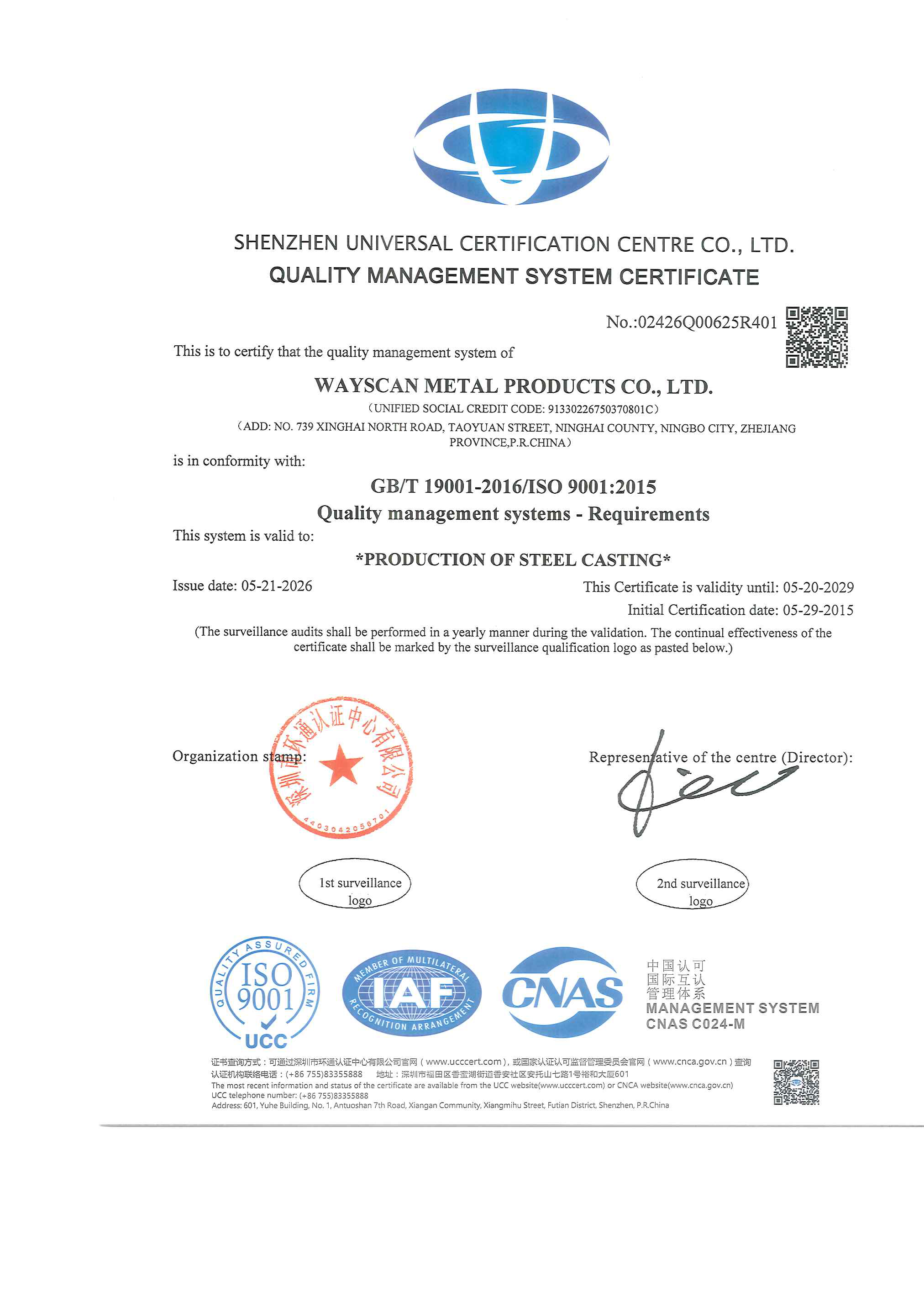
This is why scope wording is the highest-value line on the document. In the worked example here, the ISO 9001:2015 scope reads “Production of Steel Casting”, while the IATF 16949:2016 scope reads “Manufacture of Precision Casting Parts”. Those two sentences describe overlapping but differently framed activities, and neither one names a pipe elbow, a yoke or a gearbox housing. A buyer who reads only the standard numbers has skipped the only part of the certificate that constrains what the supplier can claim.
The test to apply: underline the nouns and verbs in the scope sentence. The nouns tell you the product and material category. The verbs tell you which processes are inside the certified system. If either the material category or a required process step falls outside that sentence, it needs a separate answer before the purchase order is issued.
The Certificate Set a Casting Supplier Should Be Able to Produce
Four certificates commonly appear in a precision investment casting supplier file. They do different jobs, and only two of them relate directly to product quality. The table records the scope wording, issuer, certificate number and validity for the WAYSCAN set, so the rest of this analysis can be checked against real scope text rather than a generic description.
| Certificate | Scope as recorded | Issuer and certificate number | Validity |
|---|---|---|---|
| ISO 9001:2015 Quality Management System | Production of Steel Casting | Shenzhen Universal Certification Centre Co., Ltd. (UCC), 02426Q00625R401 | Issued 2026-05-21, expires 2029-05-20 |
| IATF 16949:2016 Automotive Quality Management System | Manufacture of Precision Casting Parts | SGS United Kingdom Ltd., IATF 0516798 | Issued 2024-05-14, expires 2027-05-13 |
| ISO 14001:2015 Environmental Management System | Production of Steel Castings and Related Management Activities | UCC, 02426E00394R401 | Issued 2026-05-21, expires 2029-05-20 |
| ISO 45001:2018 Occupational Health and Safety Management System | Production of Steel Castings and Related Management Activities | UCC, 02426S00381R101 | Issued 2026-05-21, expires 2029-05-20 |
The standards are recorded as GB/T 19001-2016 / ISO 9001:2015, GB/T 24001-2016 / ISO 14001:2015 and GB/T 45001-2020 / ISO 45001:2018, with IATF 16949:2016 Edition 1 for the automotive certificate. Those edition references matter: a supplier quoting an obsolete edition is describing a system that no longer matches the standard the buyer is specifying against.
What “Production of Steel Casting” Covers — and What It Leaves Open
Three of the four materials in the supplied product data sit inside the ISO 9001 scope wording without argument. Carbon steel, alloy steel and stainless steel are all steel, so a scope that names steel casting covers those material categories at the level a management-system certificate is written. Stainless steel precision investment casting work is therefore inside the certified category, and the same applies to alloy steel precision investment casting and to carbon steel parts.
Ductile iron is the material that needs a separate answer. Ductile iron is a cast iron, not a steel, and the recorded ISO 9001 scope names steel casting only. That does not mean the supplier cannot make the part; it means the certificate sentence does not resolve the question on its own. The buyer's action is to ask, in writing, whether ductile iron production is inside the certified scope as audited, or whether it enters through the certified system's new-product introduction and process-control route.
The same discipline applies to grade. The supplied product data states that carbon steel, alloy steel, stainless steel and ductile iron are offered, with specific grades to be confirmed by the customer. A certificate cannot confirm a grade, and it should not be asked to. Grade belongs on the drawing and in the material test certificate that accompanies each heat.
Seven Part Families, Seven Scope Questions
The seven supplied part families are not interchangeable when a buyer is reading a certificate, because each one pushes on a different edge of the scope sentence. A pipe elbow tests the material and product-specification edge. A gearbox housing tests the machined-interface edge. A transmission housing tests whether the automotive certificate, not the general one, is the right gate. Mapping each family to its edge converts a single certificate review into a short, family-specific list of questions.
| Part family | Scope edge the family exposes | Document that closes the gap |
|---|---|---|
| Pipe elbow | A fluid-handling fitting ordered to a named stainless or alloy grade; the certificate names a casting category, not a grade. | Drawing with grade, the applicable product specification (for example ASTM A957/A957M common requirements for steel and alloy investment castings), and a material test certificate per heat. |
| Clevis bracket | Cast geometry combined with a machined bore, so the boundary between casting and machining becomes the deciding detail. | Route card or process flow naming the site for casting, heat treatment, machining and inspection. |
| Yoke | A linkage component whose acceptance usually rests on mechanical properties rather than geometry alone. | Order-level test specification and sampling plan, referenced directly in the purchase order. |
| Gearbox housing | Complex geometry with machined interfaces; as-cast and machined tolerances must be declared separately. | Tolerance statement against ISO 8062-3:2007 grades, plus separate machined-feature tolerances. |
| Transmission housing | An automotive driveline part that brings IATF 16949:2016 into the qualification instead of ISO 9001 alone. | IATF certificate scope statement plus the customer-specific requirements list applied to the programme. |
| Mounting bracket | A structural part sourced at volume, where repeatability rather than single-part conformity is the real risk. | First-article inspection report and a CMM dimensional layout. |
| Link arm | A load-carrying linkage in which heat-treatment condition affects the part as delivered. | Heat-treatment specification and the associated process records. |
Read together, the seven rows show why a single “ISO certified” statement cannot answer a multi-family RFQ. The certificate covers the category; the family-specific documents cover the part. Buyers in the research and evaluation stage should be building both halves of that evidence file in parallel, because a supplier that can produce the certificate but not the route card has answered only the easier question.
Where the Certificate Stops: Casting, Heat Treatment and Machining
The recorded scopes use the verbs “production” and “manufacture” and name casting as the object. Neither sentence names machining, and neither names heat treatment. That is a wording observation, not a finding of non-coverage — but it is exactly the kind of gap that should be closed in writing before a CNC machined precision investment casting order is released.
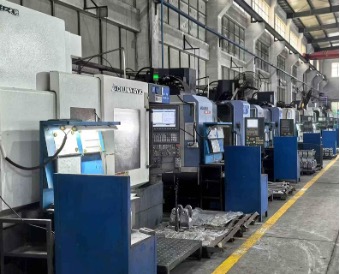
The supplied capability data makes the question concrete rather than theoretical. The company describes integrated custom manufacturing from mould making and casting through heat treatment, machining and inspection, with machining tolerance stated at 0.01 mm and inspection covering spectrometer analysis, X-ray, ultrasonic testing, hardness and tensile testing, and CMM dimensional checks. A buyer ordering a gearbox housing or clevis bracket with a machined interface needs to know which of those steps sits inside the audited scope, which sits inside the same site's quality system without being named in the scope sentence, and which — if any — is subcontracted.
Two practical consequences follow. First, ask for a process flow that names a site for every step, not a capability list. Second, ask whether the certificate covers a single facility or several; a scope statement rarely reveals a second plant, and a part family verified at one site is not automatically verified at another.
ISO 9001 and IATF 16949 Are Two Gates, Not One
ISO 9001:2015 specifies the requirements for a quality management system and applies to any organisation, including investment casting manufacturers. IATF 16949:2016 defines quality management system requirements for automotive production and relevant service parts organisations. The second builds on the first; it does not replace it, and the two certificates should never be treated as interchangeable on an automotive RFQ.
For an automotive precision investment casting programme, the practical reading is a two-gate structure. ISO 9001:2015 is the general baseline. IATF 16949:2016 is the automotive gate that a tier supply chain will normally expect before a supplier enters quotation rounds for production parts. The scope wording matters at the second gate too: “Manufacture of Precision Casting Parts” describes a manufacturing activity, so a buyer should confirm that the specific programme — including any machining performed in-house — is conducted inside that automotive-certified activity rather than alongside it.
Date discipline is equally important. In the recorded set, the IATF certificate expires on 2027-05-13, while the three UCC certificates expire on 2029-05-20. A programme running past the earlier date needs the surveillance or recertification evidence, not just an assurance that renewal is under way.
ISO 14001 and ISO 45001: Supporting Evidence, Not Product Qualification
Environmental and occupational health and safety certificates answer questions that sit beside product quality. They indicate that the site operates managed systems for environmental control and worker safety — useful in supplier audits, ESG questionnaires and site-risk assessments. They do not certify a casting, a grade, a tolerance or a heat-treatment condition.
In the worked example, both scopes read “Production of Steel Castings and Related Management Activities”, which is a production-activity scope rather than a product scope. A buyer should record them as supporting management-system evidence and keep the dimensional, metallurgical and inspection questions in the product qualification file. Treating a four-certificate set as four layers of product assurance is a common evaluation error, and it usually surfaces later as a specification gap rather than a supplier failure.
Why “CE Certified” Cannot Appear on a Foundry’s Certificate List
CE marking is a conformity marking under EU harmonisation legislation, affixed by the manufacturer or authorised representative to declare conformity with applicable EU requirements. It is not a certificate issued to a component foundry, and a casting supplier that markets itself as CE certified is using language that will not survive a technical file review.
Where EU market access is relevant, the buyer should identify the regulation that applies to the finished product and establish who carries the conformity obligation. For machinery, Regulation (EU) 2023/1230 replaces Directive 2006/42/EC and applies from 20 January 2027 — a date worth diarising for any programme that assembles castings into machinery sold into the EU. A cast component is not itself machinery, so the obligation sits at assembly level, with the foundry supplying material and inspection evidence into that chain.
Medical work follows the same logic with different instruments. ISO 13485:2016 is the quality management system standard for medical device organisations, and Regulation (EU) 2017/745 governs placing devices on the EU market. A supplier quoting medical device precision investment casting work should be discussed in those terms — device-level regulatory frame plus the flow-down the device manufacturer requires — rather than through an ISO 9001 or IATF certificate alone.
Turning “Tight Tolerance” Into Purchasable Language
Tight tolerance precision investment casting is a comparative claim until it is expressed against a framework. ISO 8062-3:2007 provides that framework: it defines general dimensional and geometrical tolerances and machining allowances for castings, including the tolerance grades buyers can write into an RFQ.
The supplied product data gives a usable worked example. As-cast tolerance is stated as CT6 for silica-sol investment casting and CT8 for silica-sol composite investment casting, with machining stated at 0.01 mm and surface roughness stated as Ra 6.4 to 12.5 μm depending on process and post-treatment. Each of those values answers a different question, and they should be recorded separately rather than merged into a single precision claim.
Two conversion rules make the numbers comparable across suppliers. First, ask whether the stated class applies to as-cast features or to machined features; a CT grade and a machining tolerance are not the same measurement. Second, ask for the basis — a first-article inspection report, a CMM layout or a capability study — because a declared grade without a record is a specification, not evidence.
A Scope Verification Workflow for Research and Evaluation Stage
A scope review can be completed in a single pass if the buyer works from the certificate outward rather than from the supplier profile inward. The sequence below is ordered so that each step either closes a question or produces a document for the qualification file.
- Request the certificate PDF, not a logo or a badge. A certificate image without a number, issuer, scope and validity date cannot be checked.
- Underline the scope sentence. Separate the product category from the process verbs and note which of them the RFQ actually requires.
- Check the site. Match the address on the certificate to the plant that will produce the part, and ask whether other sites are involved.
- Check the edition and the dates. Confirm the standard edition is current and that validity covers the programme horizon, including surveillance and recertification milestones.
- Verify the certificate with the issuing body through its own verification channel rather than relying on the supplier's copy alone.
- Map each part family to its material category. Flag anything outside the scope wording — ductile iron against a steel-casting scope is the standard example.
- Map each part family to its process steps. Ask specifically about machining and heat treatment, since scope sentences commonly stop at casting.
- Attach the product specification, test specification and sampling plan to the purchase order, so that acceptance does not depend on the certificate at all.
Steps six and seven are where most evaluation files are thin. They are also where the seven part families stop being a product list and start being a set of distinct verification tasks.
What a Scope Review Cannot Prove
Scope mapping is a documentation gate, and it should be described as one. It establishes which activities, materials and sites are inside a certified system. It does not establish process capability, defect rate, yield, or dimensional performance on a specific drawing, and it does not substitute for first-article inspection or a production-part approval process.
This limit is worth stating plainly because the evidence base for the wider category is uneven. Independently verified tolerance, defect and capability datasets for investment casting are not readily available in public sources, and supplier-published tolerance comparisons frequently omit the measurement method and sample basis that would make them comparable. The practical response is not to reject certificates but to pair them with records: first-article reports, CMM layouts, material test certificates and heat-treatment records. A certificate answers “is there a system”; a record answers “did this part meet the drawing”.
Documentation as a Capacity Signal: the WAYSCAN File
Documentation quality becomes more informative when it is read alongside production scale, because a supplier that can sustain both is easier to audit than one that can produce either alone. The supplied company data records a production base of 46,000 m², more than 500 employees including more than 20 senior engineering and technical personnel, an annual casting output of 20,000 tons and a monthly capacity of 1,500 tons, with 70% of output exported and markets listed as China, Japan and the USA.
On the process side, the company describes water-glass, silica-sol and silica-sol composite investment casting — that is, lost wax precision investment casting in three process variants — with integrated custom manufacturing from mould making through heat treatment, machining and inspection, and rapid sample development including 3D-printed pattern support. Commercial terms are stated as a minimum order quantity of 100 kg and a lead time of 30 to 60 days, with customization by customer drawing for size, geometry, material, surface and heat treatment. Applicable industries are listed as automotive, forklift, mining, agricultural machinery, construction machinery, valves and general machinery components, and the equipment list includes induction furnaces, CNC machining centres and inspection equipment covering spectrometry, X-ray, ultrasonic testing and CMM.
The company's case record describes a U.S. automotive parts OEM relationship of 30 years covering 1,000 tons for a truck axle system, with reported stable operation and dimensional and mechanical conformance to the customer's drawing requirements. That is company-reported evidence rather than an independent outcome test, and it should be read as a reference for a diligence conversation — what was measured, on which drawing revision, under which approval process — rather than as a performance guarantee for a new part family.
Read as a file rather than as a claim, the combination is coherent: four certificates with distinct scopes and dates, a stated process range that matches the seven part families, and a capacity figure large enough to support volume programmes. The buyer's remaining work is the part-specific layer, which no certificate can supply.
Market Context and the Recertification Calendar
Scope discipline is being tested by volume as much as by regulation. Commercial research published in September 2026 values the global investment casting market at USD 19.64 billion in 2025 and projects USD 30.56 billion by 2034, a 5.1% compound annual growth rate over the forecast period. Published growth rates for this category differ between research providers — the range across available estimates runs from roughly 3% to just over 6% — so a single forecast is best used as a planning reference rather than a commitment.
The automotive segment illustrates why the automotive certificate matters commercially. Investment casting sales into automotive reached USD 1.70 billion in 2024, with Europe, China and North America representing 71% of demand according to the Investment Casting Institute's world report data. Buyers operating in those three regions are the most likely to be asked for IATF-scope evidence during supplier evaluation, which makes the automotive scope sentence a commercial document as well as a compliance one. Commercial research also places stainless steel at 46.8% of material-type demand in 2025, a supplier-reported-segment estimate that aligns with the emphasis stainless steel precision investment casting receives in sourcing discussions.
Looking forward, three dates organise the next qualification cycle. The IATF 16949:2016 certificate in this set expires on 2027-05-13, which sits inside most multi-year automotive programmes. Regulation (EU) 2023/1230 applies from 20 January 2027 for machinery placed on the EU market, resetting assembly-level conformity expectations for castings used in machinery. The ISO 9001:2015, ISO 14001:2015 and ISO 45001:2018 certificates run to 2029-05-20. A buyer who records those three dates in the supplier file has, in effect, a scheduled prompt to re-check scope wording before it quietly expires out of the programme.
Frequently Asked Questions
Does an ISO 9001:2015 certificate list the specific castings a supplier can make?
No. The certificate records a scope statement describing the certified activity, together with the standard edition, issuer, certificate number and validity dates. In this set the ISO 9001:2015 scope reads “Production of Steel Casting”, which describes a category of production rather than a list of approved parts. Suitability for a specific part is established through the drawing, the material and product specification, the inspection plan and first-article records.
Is a steel-casting scope sufficient for ductile iron components?
Not automatically. Ductile iron is a cast iron rather than a steel, so a scope that names steel casting does not resolve ductile iron coverage on its own wording. The buyer should request written confirmation of how ductile iron production is controlled within the certified system, together with the applicable product specification, instead of assuming that a materials list on a website closes the question.
Can ISO 9001:2015 replace IATF 16949:2016 for automotive castings?
For automotive production and relevant service parts, IATF 16949:2016 defines the quality management system requirements and builds on ISO 9001. ISO 9001 alone is normally the general baseline rather than the automotive gate. When reviewing the automotive certificate, check the scope wording, the issuing body, the certificate number and the expiry date — in this set, IATF 0516798 issued by SGS United Kingdom Ltd., valid to 2027-05-13 — and confirm that the programme, including any in-house machining, runs inside that certified activity.
What do ISO 14001:2015 and ISO 45001:2018 add to a casting supplier's file?
They provide environmental and occupational health and safety management system evidence, which is relevant to site audits, ESG questionnaires and operational risk assessment. The scopes in this set read “Production of Steel Castings and Related Management Activities”, valid to 2029-05-20. Neither certificate qualifies a casting, a material grade, a tolerance or a heat-treatment condition, and neither should be counted as product assurance.
Can a casting supplier legitimately describe itself as CE certified?
CE marking is a conformity marking affixed by the manufacturer or authorised representative under EU harmonisation legislation; it is not a certificate issued to a component foundry. For EU market access, identify the regulation that applies to the finished product and confirm who carries the conformity obligation. Regulation (EU) 2023/1230, for example, applies to machinery from 20 January 2027, and machinery assembled from castings is assessed at assembly level.
How should tolerance claims in a casting quotation be verified?
Separate as-cast tolerances from machined tolerances, and ask for both to be expressed against a recognised framework. ISO 8062-3:2007 defines general dimensional and geometrical tolerances and machining allowances for castings, which makes supplier statements comparable. In this set, as-cast tolerance is stated as CT6 for silica-sol and CT8 for silica-sol composite casting, with machining stated at 0.01 mm. Request the first-article or CMM record behind those declarations before treating them as validated capability.
Procurement and quality teams that need the certificate set, process range and capability statement in one file can download the WAYSCAN company presentation. Company and certificate details are also published at WAYSCAN METAL PRODUCTS CO. , LTD.
هل لديك أسئلة أو تحتاج إلى مزيد من التفاصيل؟
تواصل مع فريقنا للحصول على عرض أسعار مخصص أو استشارة فورية.
طلب عرض أسعار
املأ النموذج أدناه وسيتواصل معك فريقنا بعرض مقترح مخصص.
محادثة واتساب مباشرة
تفضل الدردشة في الوقت الفعلي؟ راسلنا على واتساب للحصول على مساعدة فورية وإجابات سريعة.
- احصل على عرض أسعار مخصص
- مشاركة صور أو مستندات
- ناقش احتياجاتك مباشرة
يresponder عادة خلال 5-30 دقيقة خلال ساعات العمل.