
Certificate Scope vs. Market Claim: A Wire Harness Checklist
Certificate Scope vs. Market Claim: A Wire Harness Checklist
Wire harness qualification usually ends with a folder of documents and a covering note stating that the supplier is certified. The folder is normally genuine. The difficulty is that every certificate describes a defined scope — a standard, a product or process family, a market and a certificate holder — and the harness on your drawing can sit outside that scope while every document in the folder remains valid. Supplier qualification is therefore less a check that certificates exist than a check of what each one covers, who issued it, for which market, and against which standard. This checklist applies that comparison to UL 758 file E214500, CSA C22.2 No. 210-15, VDE DIN EN 50525-2-11, ISO 9001:2015 certificate CN07/31354 and ISO 14001:2015 certificate CN19/30539.
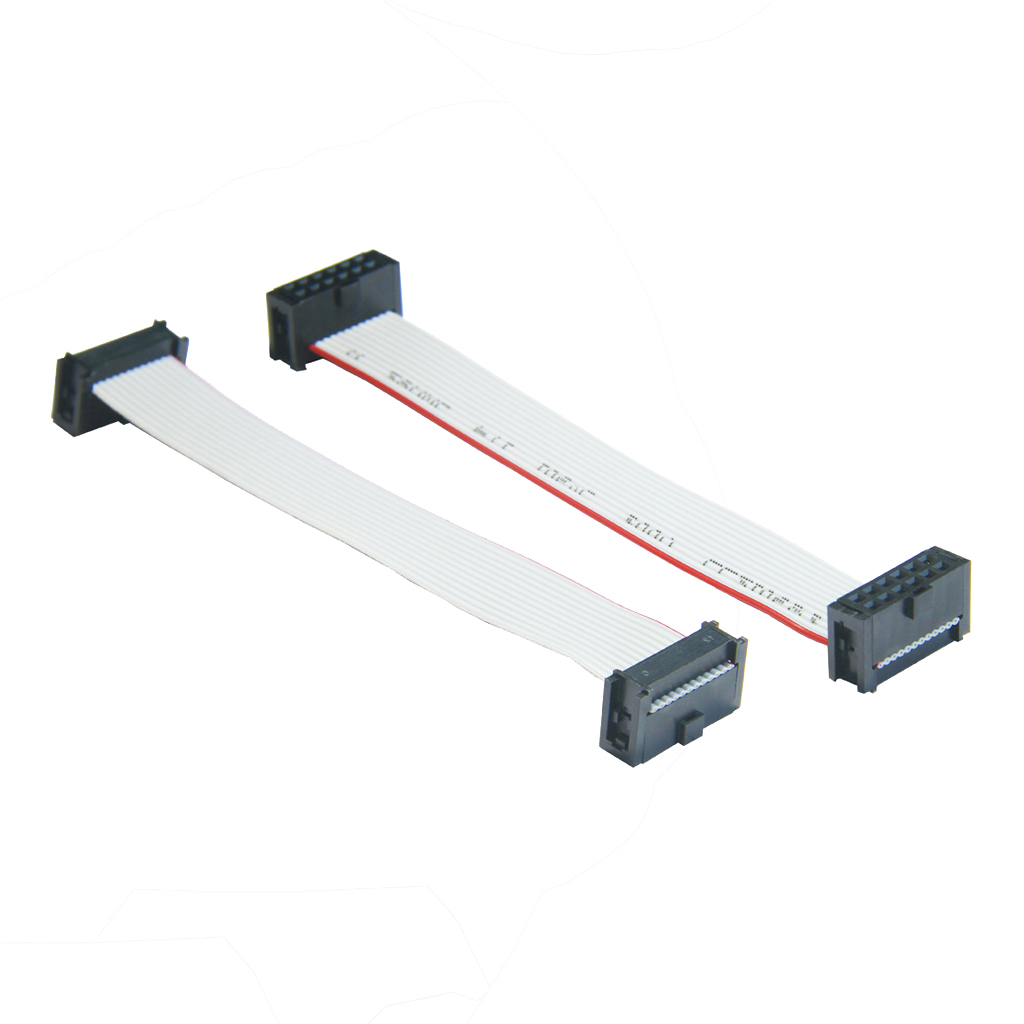
A finished harness combines wire, terminals, housings and workmanship; certificate scope has to be matched to each of those elements separately.
Why certificate scope and market claim drift apart
A market claim is a compressed sentence. “UL certified”, “VDE approved” or “ISO 9001 factory” each collapses a five-part record into three words, and something is always lost in the compression. Four losses recur in wire harness purchasing.
- The standard is swapped. A wire-material approval is described as a harness approval. UL 758, Appliance Wiring Material, and VDE DIN EN 50525-2-11 both describe insulated wire and cable constructions; neither is an assembly-level document.
- The scope is widened. A scope sentence naming one insulation system, one product family or one manufacturing activity is read as covering everything the factory ships.
- The market is widened. A file valid for the United States and Canada becomes “internationally certified”, although a European buyer needs a different document trail.
- The issuer is blurred. A customer-issued declaration, an internal test report and an accredited third-party certificate are presented in the same folder without distinction.
None of these compressions is necessarily dishonest; they are shorthand used by sales teams who see the certificates every day. The buyer's job is to reverse the compression, which means working from the record itself — number, issuing body, standard, scope, market — rather than from the covering note.
Four axes that define what a certificate covers
Any certificate worth relying on can be read on four axes, plus a validity check. If a supplier cannot answer all five, the document is not yet usable for qualification.
- Standard and edition. UL 758, CSA C22.2 No. 210-15, DIN EN 50525-2-11 and ISO 9001:2015 answer different questions: product safety of wiring material, product safety of appliance wiring material products in Canada, safety of flexible cables, and quality management of a manufacturing process.
- Issuing body. The record should name the organisation that issued it — UL LLC, VDE Testing and Certification Institute, or SGS United Kingdom Ltd — and that body's accreditation should suit the market.
- Market. The record should state where the certificate applies. A US and Canadian file and a European certificate are not substitutes for each other.
- Scope statement. The scope sentence is the operative part; it names the product, process or material family actually covered.
- Number, holder and status. Certificate numbers and dates allow independent verification, and the holder's legal name and site matter as much as the logo.
Reading the UL record: file E214500 and CSA C22.2 No. 210-15
The wire harness product under reference is covered by a UL certification issued by UL LLC and applicable to the United States and Canadian markets. The applicable standard is UL 758, Appliance Wiring Material, and the UL file number is E214500. The scope recorded for the file is component appliance wiring material — single-conductor and multi-conductor thermoplastic and thermosetting-insulated wire — and the standard field also lists CSA C22.2 No. 210-15, Appliance Wiring Material Products, the Canadian counterpart referenced for the same file. The file was issued on 14 November 2019.
Two readings of that record matter to a buyer, and they point in opposite directions.
The reassuring reading is that the record is a real third-party file with a number that can be checked in UL's own directory, held for both the US and Canadian markets, and covering both thermoplastic and thermosetting insulation. For a harness built on appliance wiring material and destined for North America, this is the correct family of document to request.
The cautionary reading sits in the first word of the scope: component. The certified object is the wiring material, not the finished harness. Terminals, housings, splices, sleeving, overmoulding and the crimp process fall outside a scope sentence about insulated wire. That does not make the file less valuable — it is the prerequisite that lets the finished assembly use approved wire — but it does mean the file cannot be presented as the assembly's own approval.
The Canadian element deserves its own check. CSA C22.2 No. 210-15 appears in the UL file's standard field, which is how a dual-market listing is normally recorded. A buyer sourcing for Canada should confirm with the issuing body that the Canadian listing is active for the specific product, rather than assuming that the appearance of the standard in the record is itself the confirmation.
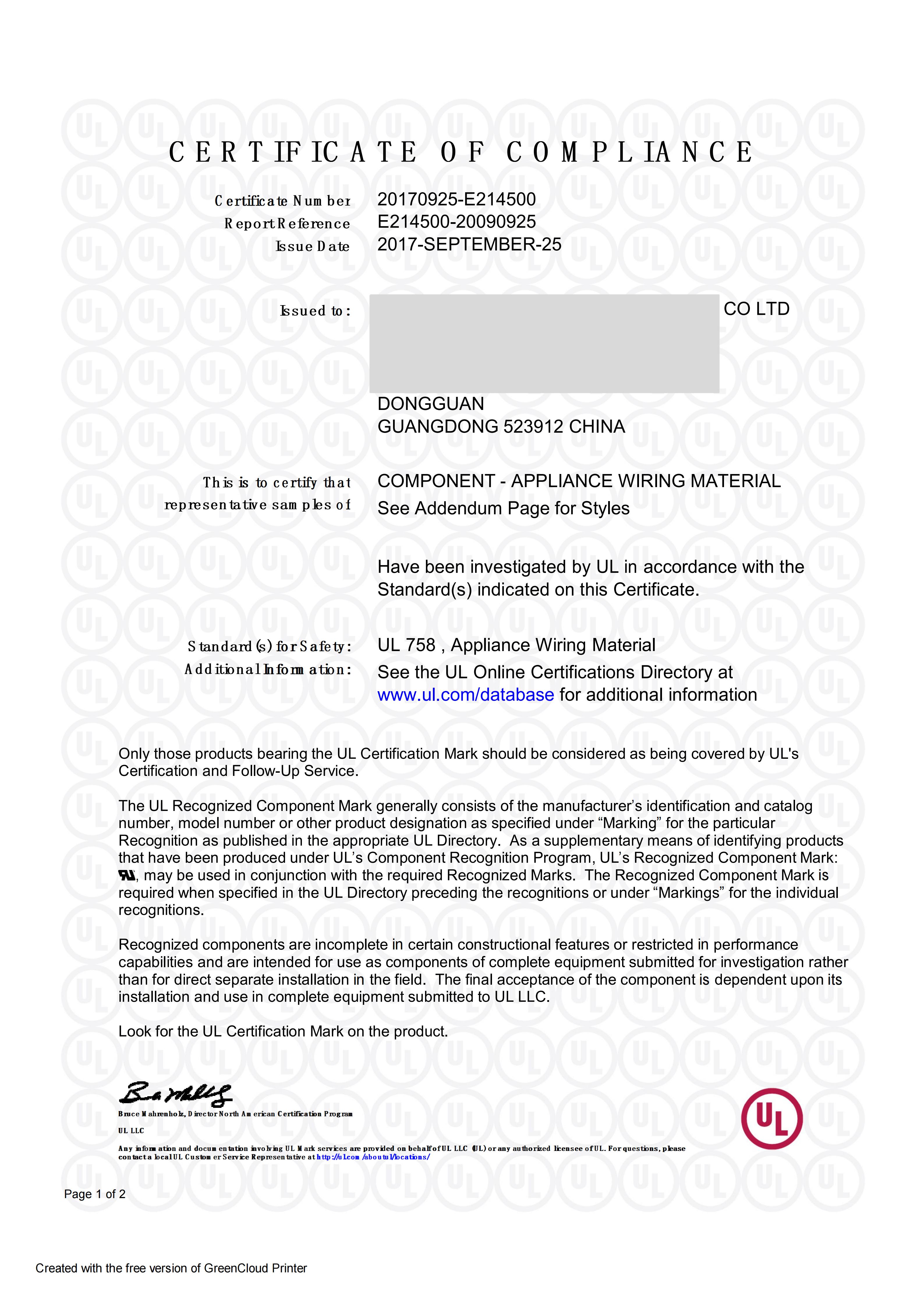
UL documentation referenced in the qualification review.
Reading the VDE record: certificate 40042054
The VDE certification for the wire harness is issued by VDE Testing and Certification Institute under certificate number 40042054, applies to the EU market and Germany, and references DIN EN 50525-2-11 (VDE 0285-525-2-11):2012-01 and EN 50525-2-11:2011. The recorded scope is flexible cables with thermoplastic PVC insulation, and the certificate was issued on 17 April 2015.
For a European project this is again the right family of document, and again it is narrower than the phrase “VDE approved harness” suggests. The scope names an insulation system — thermoplastic PVC — and a product family — flexible cable. Many harness drawings specify exactly that construction, in which case the certificate maps cleanly onto the wire being bought. Others do not: harnesses built on XL-PE, TPE, TPU or PTFE insulation sit outside the scope sentence as recorded. That is not a defect in the certificate; it is a question the buyer has to ask, because a different construction usually needs a different approval route, and the answer belongs in the qualification file rather than in a later email thread.
Reading the ISO records: CN07/31354 and CN19/30539
Two management-system certificates complete the set, both issued by SGS United Kingdom Ltd and both stated as applying globally.
ISO 9001:2015 certificate CN07/31354 covers the manufacture of electronic cables, power cables, flat cables and power plugs, was issued on 11 December 2025 and expires on 10 December 2028. It is a quality management system certificate: it states that the manufacturing process is governed by a certified system, not that any individual harness conforms to a product safety standard.
ISO 14001:2015 certificate CN19/30539 covers the manufacture of electronic connectors and wire harness, was issued on 2 April 2019 and expires on 1 April 2028. It is an environmental management system certificate covering the environmental side of those manufacturing activities.
Read side by side, the two scope sentences are a lesson in how literally scope text should be read. The quality certificate names cables, flat cables and power plugs; the environmental certificate names connectors and wire harness. Both are accurate descriptions of what each certificate covers, written independently of each other. A buyer who treats “ISO 9001 certified” as a statement about harness assembly conformance is reading one sentence and assuming another. The practical rule is to take the scope line you were given, place it next to your part number, and ask the supplier to explain any element that does not match.
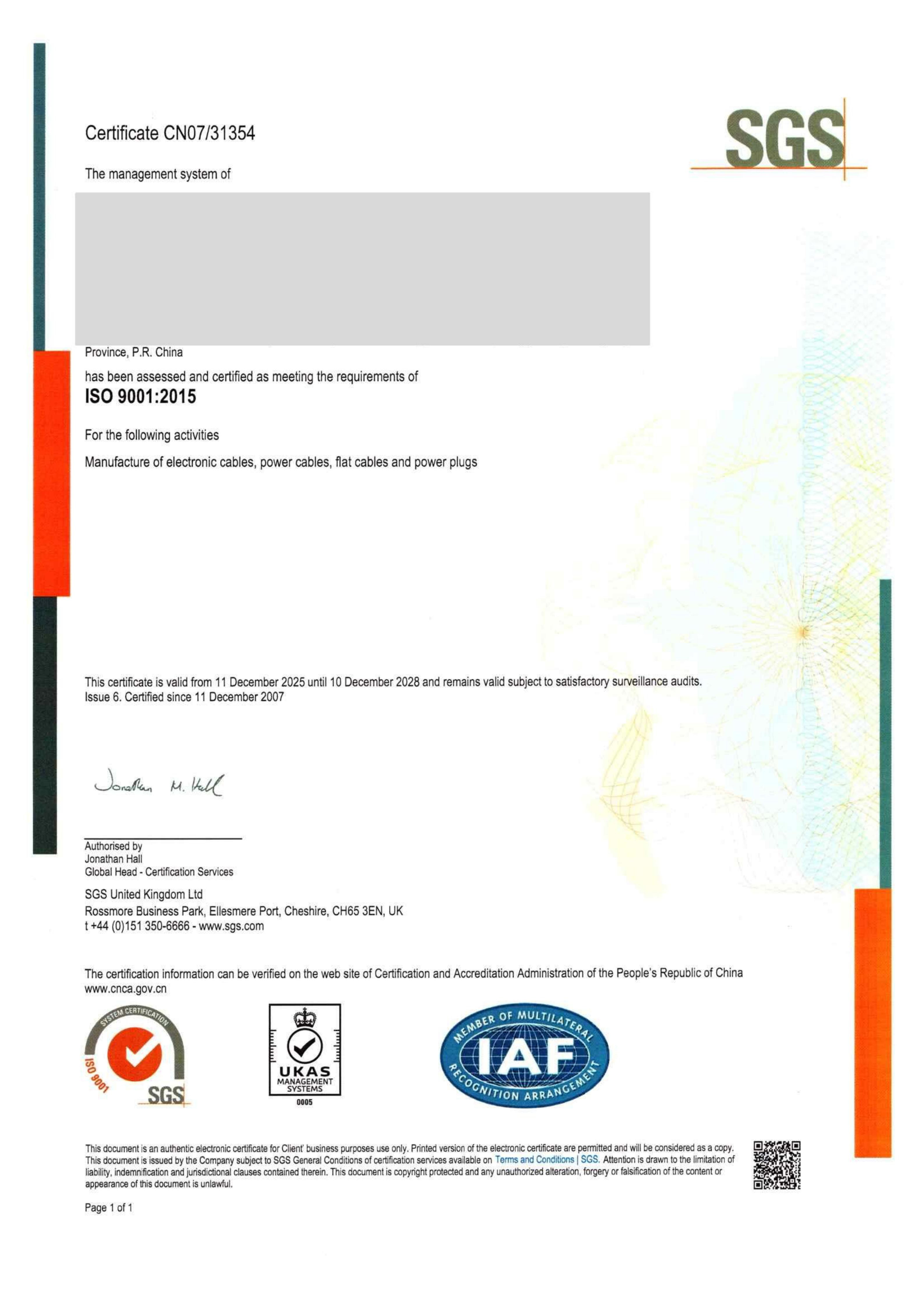
ISO 9001:2015 certificate CN07/31354 is issued by SGS United Kingdom Ltd and covers cable and plug manufacture.
The record at a glance
| Document | Issuing body | Market stated | Scope as recorded | What it does not, by itself, establish |
|---|---|---|---|---|
| UL 758, file E214500 | UL LLC | USA, Canada | Component appliance wiring material: single-conductor and multi-conductor thermoplastic / thermosetting-insulated wire | That a finished harness with terminals, housings or overmoulding is covered |
| CSA C22.2 No. 210-15 (referenced in the same UL file) | UL LLC (file record) | Canada | Appliance Wiring Material Products, listed in the UL file's standard field | A separate CSA Group certificate number; confirm Canadian listing status with the issuer |
| VDE, certificate 40042054 | VDE Testing and Certification Institute | EU, Germany | Flexible cables with thermoplastic PVC insulation; DIN EN 50525-2-11 / EN 50525-2-11:2011 | That other insulation systems, or completed assemblies, are covered |
| ISO 9001:2015, CN07/31354 | SGS United Kingdom Ltd | Global | Manufacture of electronic cables, power cables, flat cables and power plugs | Product safety conformity of any particular harness |
| ISO 14001:2015, CN19/30539 | SGS United Kingdom Ltd | Global | Manufacture of electronic connectors and wire harness | Electrical, dimensional or performance conformity |
Component approval is not assembly approval
Once the five documents are read individually, a second question appears: what does the finished assembly rest on? A harness is a chain of decisions — connector brand and part number, wire model and gauge, colour coding, pin functions, branch lengths, sleeving, shielding and termination — and each decision can sit in a different approval framework.
At assembly level, the industry reference point is IPC/WHMA-A-620, published by IPC International as the requirements and acceptance standard for cable and wire harness assemblies, structured in three classes. That structure gives a buyer a way to state workmanship expectations in the purchase documents instead of leaving them to inspection. Note what the standard is and is not: it defines acceptance criteria for assembly workmanship, so asking which class a supplier works to, and how that class is applied on the line, is a different question from asking which product certificates the supplier holds.
Component approvals run in parallel. A UL 758 file covering thermoplastic and thermosetting-insulated wire supports the wire; a VDE certificate covering flexible PVC-insulated cable supports that cable construction; connectors need their own approved status, which is why drawings naming connector brand and part number are easier to qualify than drawings naming a generic pitch. Where a supplier proposes a non-original alternative connector, the responsible sequence is customer testing and approval before use — consistent with the substitution practice described in the supplier's own documentation, and a point that belongs in the change-control section of any qualification file.
Worked example. A buyer requests an industrial control harness with a specified connector brand and part number, 28AWG wire, a shielded multi-core section and a waterproof overmould, for equipment shipped to the United States, Canada and Germany. The UL file supports the wire material for the US and Canadian markets; the VDE certificate supports a flexible PVC-insulated cable for Germany, provided the construction matches; the ISO certificates support the management systems behind the site. Nothing in that set addresses the overmould or the crimp workmanship, so the purchase order has to carry the assembly acceptance requirement and the connector approval separately. That is the gap the checklist below closes.
The qualification checklist
The checklist is ordered so that each stage confirms or disqualifies before the next one starts. Working in this order prevents the common failure of collecting impressive documents that turn out to describe something else.
Stage 1 — Verify the document exists as described
- Record the number, not the claim. For this supplier set the numbers are E214500 (UL), 40042054 (VDE), CN07/31354 (ISO 9001:2015) and CN19/30539 (ISO 14001:2015). A certificate discussed without a number cannot be verified.
- Confirm the issuing body matches the market's expectations. UL LLC for the US and Canada, VDE Testing and Certification Institute for the German and EU route, SGS United Kingdom Ltd for the management systems.
- Check status and dates at the source. The ISO certificates carry explicit end dates — 10 December 2028 and 1 April 2028 respectively — while the UL and VDE records show long-dated validity. Long-dated validity still requires a status check in the issuer's directory, because a record can be revised or withdrawn before its nominal date.
- Check the holder and site. A certificate issued to one legal entity or one factory does not automatically extend to another site in the same group. Match the holder name and address to the site that will actually build the harness.
Stage 2 — Match the scope sentence to the part
- Identify what kind of document you are holding. Product safety certification (UL, VDE) and management system certification (ISO 9001, ISO 14001) answer different questions and cannot substitute for each other.
- Map the scope word by word. Insulation system, conductor construction, product family and manufacturing activity each have to correspond to your drawing. “Flexible cables with thermoplastic PVC insulation” is a precise statement and should be treated as one.
- Escalate any mismatch as a question, not a rejection. If the harness uses XL-PE, TPE, TPU or PTFE insulation, or an overmoulded assembly, ask which approval covers that construction. A clear answer is itself qualification evidence.
- Make the drawing specific enough to be matched. Qualification cannot succeed on a vague drawing. Connector brand and part number, wire model (for example UL1007), gauge (for example 28AWG), colour, pin function and loop lengths should all be stated; branches should carry their own lengths, and heat-shrink positions should be defined. A drawing naming these elements can be checked against a scope sentence; one that does not cannot.
Stage 3 — Match the market to the destination
- Confirm the market field covers every destination on the order. The UL file states the US and Canadian markets; the VDE certificate states the EU and Germany; the ISO certificates state global application. A shipment outside those fields needs its own document review.
- Treat the Canadian reference separately. CSA C22.2 No. 210-15 is listed within the UL file. Confirm the Canadian listing is current for the product rather than inferring it from the standard's presence in the record.
Stage 4 — Confirm assembly-level and change-control evidence
- State the workmanship standard and class. Ask whether the supplier works to IPC/WHMA-A-620 and to which class, and how conformity is checked in production. This is the acceptance layer that product certificates do not cover.
- Agree what triggers re-notification. Connector substitution, wire gauge or insulation change, a new site, or a revised standard edition should each require written notice and, where relevant, renewed customer approval before shipment.
Applying the checklist by project type
The same five documents produce different answers depending on the harness being bought, which is why the scope match has to be done per part rather than per supplier.
For building temperature control equipment and industrial control cabinets, the harness is usually an internal connection set running continuously. Wire and cable construction dominates the question, so the UL and VDE scope sentences do most of the work, while the assembly acceptance class governs crimp and routing quality. Where the construction is a shielded multi-core type, shielding and termination move into the assembly discussion rather than the material certification.
For waterproof harnesses and overmoulded assemblies the balance shifts. The overmould, sealed connector system and potting are assembly features, and none of the five certificates describes them. The qualification file needs the assembly acceptance requirement plus a drawing-level specification of the sealing method, with the product certificates retained as the material basis underneath.
For medical equipment and household appliance harnesses, market determines the document mix. A device exported to the United States and Canada leans on the UL file; a device exported to Germany leans on the VDE certificate and its PVC-insulated flexible cable scope; both rely on the ISO management system certificates for the site, which say nothing about the electrical performance of the part in front of you.
Where P-Shine Electronics Co., Ltd sits in this record
P-Shine Electronics Co., Ltd is a Dongguan-based cable and harness manufacturer established in 1997, operating seven independent factories and producing wire harnesses, cable assemblies, USB cables and AC power cords on an OEM/ODM basis, with harnesses customised to customer drawings. The company reports 250,000 units of monthly harness capacity, a minimum order of 200 units, a 30 to 45 day lead time, 100% testing, and export markets in the EU, the Middle East and North America.
On the documentation side, that operation holds the five records examined above: UL file E214500 issued by UL LLC for the US and Canadian markets under UL 758 with CSA C22.2 No. 210-15 referenced in the same file; VDE certificate 40042054 issued by VDE Testing and Certification Institute for the EU and German markets under DIN EN 50525-2-11; and the two SGS United Kingdom Ltd certificates, ISO 9001:2015 CN07/31354 and ISO 14001:2015 CN19/30539, both stated as global.
What that combination means for a buyer is narrower than a marketing summary and more useful. The record set spans North American and European product safety documentation plus management system certification of the manufacturing site, which is the right shape for a supplier shipping into the EU, the US and the Middle East. It does not remove the scope-matching step: insulation system, connector approval and assembly acceptance class still have to be confirmed against the specific drawing, and the certificate numbers are published precisely so that confirmation can be done independently. Further company and product detail is available at P-Shine Electronics Co., Ltd.
Market context and what changes next
The category this documentation sits in is large and geographically concentrated. Precedence Research estimated the global wire harness market at USD 99.58 billion in 2024, with Asia Pacific accounting for a 46% share in the same year. Published growth forecasts differ by methodology — one commercial research house cites around 4.0% annually while another cites 6.49% for a comparable period — largely because the boundary between industrial and automotive harness scope is drawn differently.
For qualification purposes the useful observation is structural rather than numerical. As configurations add shielding, waterproofing, high-temperature insulation and overmoulding, the distance between what a material certificate covers and what the finished assembly contains tends to widen. Buyers who keep the scope match as a documented step — one page per part, listing standard, issuing body, market, scope line and gap — spend less time resolving documentation questions after the first shipment, and can re-verify quickly when a certificate is renewed or a construction changes. The four-axis reading and the checklist above are the minimum version of that page.
Frequently asked questions
Does UL 758 file E214500 mean a finished wire harness assembly is UL certified?
No. The file covers component appliance wiring material — single-conductor and multi-conductor thermoplastic and thermosetting-insulated wire — for the US and Canadian markets. The assembly's terminals, housings, overmoulding and crimp workmanship fall outside that scope sentence and must be addressed through assembly acceptance requirements and the approvals of the components used.
Is CSA C22.2 No. 210-15 a separate certificate from the UL file?
In this record, CSA C22.2 No. 210-15, Appliance Wiring Material Products, is listed in the standard field of UL file E214500 alongside UL 758. A buyer sourcing for Canada should confirm with the issuing body that the Canadian listing is active for the specific product rather than assuming the reference alone completes the evidence.
What does VDE certificate 40042054 cover for harness purchasing?
It is issued by VDE Testing and Certification Institute, applies to the EU market and Germany, references DIN EN 50525-2-11 (VDE 0285-525-2-11):2012-01 and EN 50525-2-11:2011, and covers flexible cables with thermoplastic PVC insulation. It supports the cable construction where that construction matches the drawing, and it does not describe completed assemblies or other insulation systems.
Why do the two ISO certificates use different scope wording?
Because scope statements are written for each certificate independently. ISO 9001:2015 certificate CN07/31354 covers the manufacture of electronic cables, power cables, flat cables and power plugs; ISO 14001:2015 certificate CN19/30539 covers the manufacture of electronic connectors and wire harness. Both are issued by SGS United Kingdom Ltd and apply globally. Reading each sentence literally is more reliable than treating either certificate as a general statement about product conformity.
How should a buyer check that a certificate is still valid before ordering?
Use the certificate number and the issuing body's own directory. The two ISO certificates carry stated end dates of 10 December 2028 and 1 April 2028; the UL and VDE records show long-dated validity, which indicates an actively maintained listing but still requires a current status check. Confirm as well that the certificate holder's legal name and site match the factory that will build the harness.
For buyers who need the product and capability detail behind these records, the supplier's published introduction and catalog can be downloaded here.
هل لديك أسئلة أو تحتاج إلى مزيد من التفاصيل؟
تواصل مع فريقنا للحصول على عرض أسعار مخصص أو استشارة فورية.
طلب عرض أسعار
املأ النموذج أدناه وسيتواصل معك فريقنا بعرض مقترح مخصص.
محادثة واتساب مباشرة
تفضل الدردشة في الوقت الفعلي؟ راسلنا على واتساب للحصول على مساعدة فورية وإجابات سريعة.
- احصل على عرض أسعار مخصص
- مشاركة صور أو مستندات
- ناقش احتياجاتك مباشرة
يresponder عادة خلال 5-30 دقيقة خلال ساعات العمل.