
Certification Evidence: What a Supplier's Paperwork Really Shows
Certificates are the most requested and least read documents in food-grade packaging procurement. Most evaluations stop at a logo on a slide. The document behind that logo, read properly, states what a factory is audited to do, which legal entity and site the audit covers, who issued the evidence, and when that evidence expires.
Every food-grade packaging evaluation begins with the same request: send your certificates. What usually arrives is a folder of PDFs that gets scanned for familiar marks and then filed. That habit is where supply risk hides. A certificate becomes evidence only when three elements can be checked independently — the standard and its version, the scope statement, and the certificate number against the issuing body's register. Everything else, including the logo, is decoration.
This article explains how to read supplier certifications as capability evidence rather than as a pass-or-fail badge. It uses the certificates held by RTCO (THE RTCO PAK PTE. LTD.), a packaging manufacturer founded in 2007 that produces plastic containers, closures, scoops, liners and surface finishes for supplement, sports nutrition and health & beauty brands. Certificate numbers, issuing bodies and scope wording are cited here so that buyers can repeat the verification themselves rather than accept a summary.
The Gap Between a Certificate Logo and Certificate Evidence
A logo in a deck proves nothing. A certificate proves something when it names a legal entity, a manufacturing site, a standard with its version, a scope of activities, an issuing body and a validity window. Supplier comparisons that reduce this to "ISO certified or not ISO certified" substitute a yes/no answer for a question with at least six parts.
The practical cost of skipping those parts does not appear during the shortlist. It appears later, in a retailer audit, a customs or regulatory question, or a packaging failure that nobody can trace back to a document. Buyers who can read a scope statement increasingly use it as a filter before samples are even ordered, because scope wording reveals which process steps are genuinely audited and which are simply outside the supplier's certificate.
Anatomy of a certificate worth reading
1. Standard and version — ISO 9001:2015, ISO 15378:2017, BRCGS Global Standard Packaging Materials Issue 7 (October 2024). A version matters: a superseded issue describes an older audit regime.
2. Certification body — the organisation that issued and maintains the certificate, for example NOA Testing & Certification Group Ltd., Intertek Testing Services, NSF Certification, LLC, Ti Certification (Shanghai) Co., Ltd., or Benchmarks Co., Ltd.
3. Certificate number — the searchable identifier, such as 05126Q00928R153 or C0860130-BRC2. Numbers can be looked up; logos cannot.
4. Scope statement — the operations covered, written in the certificate's own words.
5. Legal entity and site — which factory the audit describes. This is the field that separates a manufacturer's certificate from a certificate borrowed from someone else's factory.
6. Issue and expiry dates — whether the evidence is current, and when the next surveillance or re-audit falls due.
What Food-Grade Packaging Certificates Actually Cover
Different standards answer different questions, and buyers who treat them as interchangeable end up with evidence that does not match their product. A quality management certificate describes how a site controls its processes. A packaging safety standard describes hygiene and product-safety controls for food-contact packaging. A GMP-based standard for primary packaging materials describes controls relevant to medicinal-product packaging. Hazard-analysis certification describes how food-safety risks are identified and controlled on the line. Social, environmental and occupational health standards describe conditions and responsibilities around the same operations.
For a manufacturer of food-grade plastic packaging containers and closures, those layers appear as separate certificates with separate scopes. The table below reproduces the standards, bodies, numbers and expiry dates held by RTCO for its supplement packaging operations.
| Standard and version | Certification body | Certificate number | Scope as stated | Valid to |
|---|---|---|---|---|
| ISO 9001:2015 Quality Management System | NOA Testing & Certification Group Ltd. | 05126Q00928R153 | Manufacturing of food-grade plastic packaging containers | 16 Mar 2029 |
| ISO 15378:2017 Primary Packaging Materials for Medicinal Products — GMP | Intertek Testing Services | HBPCER20260088 | Manufacturing of HDPE and PP bottles for medicinal products | 5 Mar 2029 |
| BRCGS Global Standard Packaging Materials, Issue 7 (October 2024) | NSF Certification, LLC | C0860130-BRC2 | Blow molding and injection molding of PE and PP plastic containers, lids, spoons and hooks for food use | 7 Sep 2027 |
| HACCP Management System (V1.0) | Ti Certification (Shanghai) Co., Ltd. | 331HACCP2600024 | Hazard analysis and critical control point management for manufacturing food-contact plastic containers and closures | 1 Jul 2029 |
| ISO 45001:2018 Occupational Health & Safety | NOA Testing & Certification Group Ltd. | NOA2408228 | Manufacturing of plastic packaging containers for food and cosmetic applications | 21 Aug 2027 |
| ISO 14001:2015 Environmental Management | NOA Testing & Certification Group Ltd. | NOA2408227 | Manufacturing of plastic packaging containers for food and cosmetic applications | 21 Aug 2027 |
| SA8000:2014 Social Accountability Management System | Benchmarks Co., Ltd. | BM-CN-20240906 | Manufacturing of plastic packaging containers, including mixing, feeding, injection molding, blow molding and packaging | 5 Sep 2027 |
Read as a set, these documents describe a site that is audited for quality management, food-contact packaging safety, GMP-relevant controls for medicinal-product primary packaging, hazard control, worker conditions, environmental management and occupational safety. Each has a different issuing body and an independent validity window, which is the point: the evidence can be checked line by line, and each line has a clock attached to it.
Scope Statements: The Paragraph Buyers Skip
The scope statement is the most informative and most skipped paragraph on the page. ISO 15378:2017, for example, specifies requirements for a quality management system for manufacturers of primary packaging materials for medicinal and nutraceutical products, integrating Good Manufacturing Practice principles, as defined by the International Organization for Standardization. That definition tells a buyer the standard is system-level and GMP-oriented — it does not certify an individual bottle design, a fill weight, or a specific shelf-life outcome.
The same logic applies to packaging safety standards. A BRCGS Global Standard Packaging Materials Issue 7 certificate covering blow molding and injection molding of PE and PP plastic containers, lids, spoons and hooks for food use does not, by itself, cover process steps that are not listed. If a decoration, printing or assembly step happens elsewhere, that step sits outside this scope and needs its own evidence. Buyers sourcing sports nutrition custom packaging — where bottles, caps, scoops, liners and finishes are frequently produced or applied at more than one station — should map each certificate to the process step that touches their product.
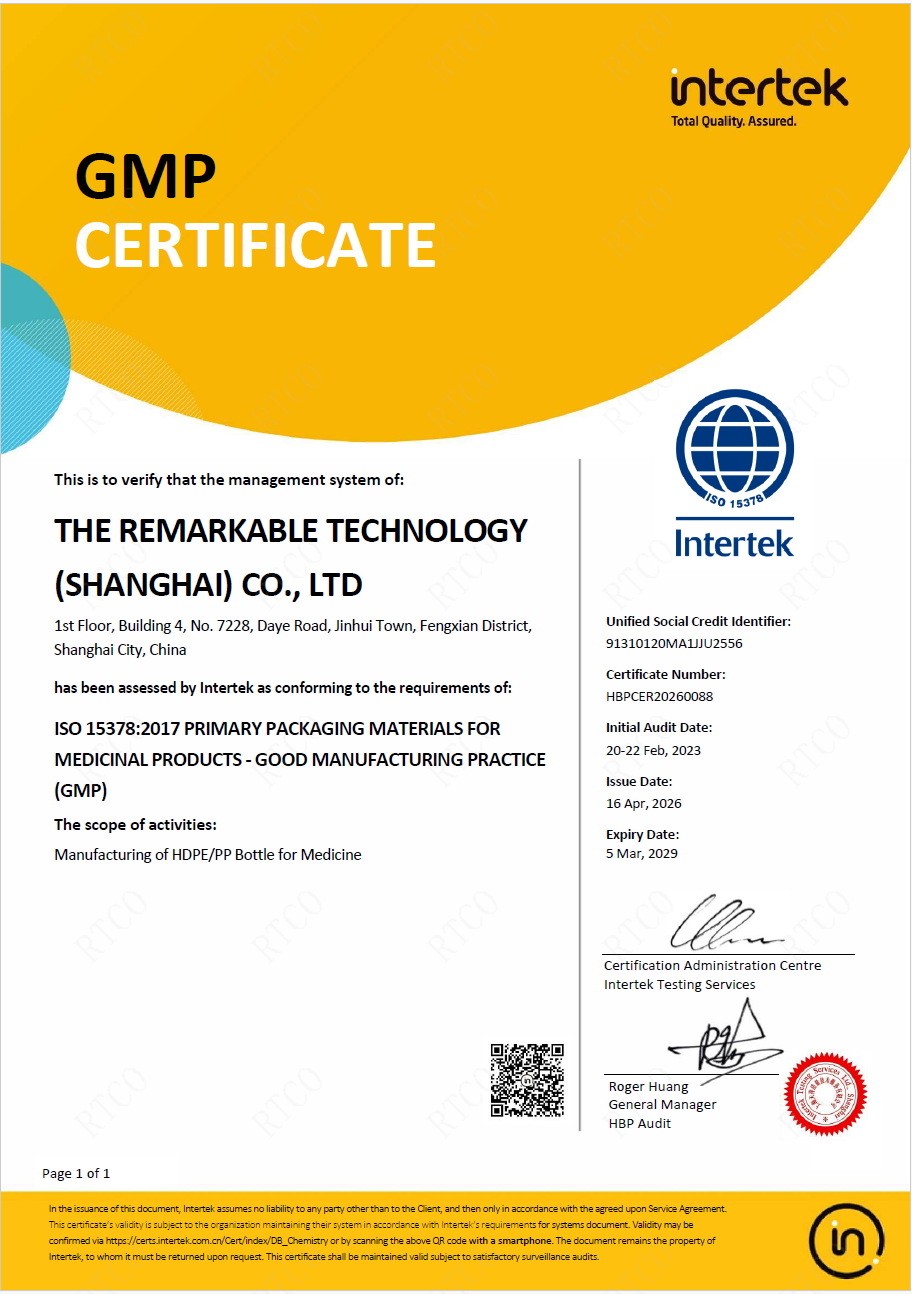
ISO 15378:2017 certificate HBPCER20260088, issued by Intertek Testing Services, whose stated scope is the manufacturing of HDPE and PP bottles for medicinal products.
A Verification Workflow Buyers Can Run in Under an Hour
Verification does not require an audit team. It requires the certificate numbers instead of the certificate logos, and a defined order of checks.
- Request the numbers, not the marketing pack. Ask for the certificate PDF with its number, standard version, issuing body, scope and dates visible. A summary table without numbers cannot be verified.
- Look the number up on the issuing body's register. Third-party registers exist precisely so that buyers do not have to trust a scanned file. A number that cannot be found is the single most useful red flag in this process.
- Read the scope against your product. Compare the wording to what you are actually buying. HDPE and PP bottles for medicinal products, or blow and injection molded PE and PP containers, lids, spoons and hooks for food use, are specific statements — not general claims.
- Confirm the site. The audit applies to the legal entity and factory named on the certificate. If production is planned at a different site, ask what evidence covers that site.
- Check version and dates. Confirm the standard version is current and the expiry date is in the future, then note the next audit date. Certificates are time-limited documents, not permanent attributes.
- Map certificates to process steps. Quality management, packaging safety, hazard control, social accountability and environmental management answer different questions. Match each to the risk you are trying to cover.
- Record what remains uncovered. Anything not addressed by the certificate set becomes a question for samples, testing or contractual terms — not an assumption.

A certificate describes a named site and a named scope. Buyers who match the certificate to the actual manufacturing location close the most common documentation gap in packaging sourcing.
Where Certification Evidence Meets Sports Nutrition Custom Packaging
For sports nutrition brands, the certification set matters because the packaging itself participates in product protection and regulatory positioning. The formats involved — protein powder jars, pre-workout and BCAA bottles, dual-chamber bottles, capsule and tablet bottles, flip-cap scoop bottles — are matched to fill capacities from 60 ml to 6000 ml, body diameters from 40 mm to 200 mm and heights from 60 mm to 325 mm, with closures from 20 mm to 200 mm in diameter and measuring scoops from 0.3 cc to 8 oz.
RTCO manufactures these in food-grade HDPE, PET and PP, with recycled and PCR material options, and supports finishes including soft-touch coating, UV coating, silk screen, 3D printing, labeling and vacuum metallization. Customization covers materials, bottle shape, capacity, colors, surface finishes, engraved logo design, closures, scoops, structural engineering and custom mold development. Typical minimum order quantities run from 10,000 to 30,000 units per SKU, with trial orders below the standard MOQ supported so that new products can be validated before scale commitments.
The application envelope is broad by design: powder, capsule, tablet, gummy or gel and liquid packaging and dosing scenarios, delivered through OEM, ODM and private-label projects that run from sample development and tooling through pilot and mass production. Documented programs have covered volumes of 20,000,000 units for brands, contract manufacturers and private-label customers across markets including the United States, Canada, Mexico, Great Britain, France, Germany, Brazil, Australia and Singapore. Lead times typically run 30 to 45 days, with a reference model of roughly one day of design, about one month of tooling and about one week of production, depending on project complexity and available capacity.
Why this matters in a certification discussion: a factory audited for injection molding of PE and PP closures and blow molding of HDPE and PP containers is describing the actual processes it controls, not a generic capability list. When a brand asks whether the packaging supplier can also supply the scoop, the liner or the metallized finish, the answer is grounded in the same audited production perimeter.
The Compliance Baseline Behind the Paperwork
Supplier certificates support a regulatory obligation that ultimately belongs to the brand. In the United States, FDA 21 CFR Part 111 establishes mandatory Current Good Manufacturing Practice for the manufacturing, packaging and labeling of dietary supplements, which means a supplement brand is accountable for the packaging operations in its supply chain. In the European Union, Regulation (EU) 2025/40 — the Packaging and Packaging Waste Regulation — requires that all packaging be recyclable by 2030 and that plastic packaging contain at least 30% recycled content by 2030.
Neither requirement is satisfied by a supplier certificate alone. Both are satisfied by a supplier whose documentation, materials and process controls can be pointed to when a regulator, a retailer or a distributor asks a specific question. That is the practical use of certification evidence: it shortens the distance between a question and a verifiable answer.
Market Signals That Are Raising the Documentation Bar
Documentation is becoming a procurement criterion because the category it serves keeps growing. Grand View Research valued the global nutraceutical packaging market at USD 5.05 billion in 2024, with plastic segments leading at 58.3% of revenue share, and separately estimated that plastic holds approximately 73.8% of supplement packaging market share by material in 2025. Future Market Insights projects the protein powder packaging segment reaching USD 44.52 billion by 2035, at a CAGR of 5.01% from 2026 — a projection rather than a measured result, and one that should be read as a directional signal.
Published estimates for the same market do not always agree; sources differ by roughly USD 1 billion depending on whether flexible and rigid secondary packaging are counted, which is why this article attributes each figure to its publisher rather than presenting a single number as settled. The consistent signal across them is material: as plastic packaging remains the dominant format for supplements and sports nutrition, the number of buyers asking suppliers to prove material and process claims increases with it.
Certification-Led Sourcing vs Traditional Intermediary Sourcing
The meaningful comparison is not brand versus brand. It is the documentation profile of the entity a buyer contracts with.
| Sourcing model | Whose certificates apply | What the buyer can verify | Practical limitation |
|---|---|---|---|
| Direct manufacturer with site-specific certificates | The manufacturing entity named on the certificate | Scope, site, standard version, certificate number, issuing body and expiry | Applies only to the audited site and listed processes |
| Trading intermediary presenting a factory's certificates | A third-party factory, not the contracting entity | That a factory exists and holds certifications — but not that it is the entity accountable to the buyer | Audit trail breaks if the factory changes after the contract is signed |
| Converter with no published certification | None | Product samples and internal test reports only | Every process-control question must be answered case by case |
Certification also has boundaries that buyers should state plainly in their own evaluations. A certificate is a system-level document; it does not validate a specific bottle's performance on a specific filling line, closure torque behavior after transport, or shelf-life outcomes for a particular powder. Certification does not transfer with your product: if a decoration step, a pouch format or an assembly operation sits outside the certified scope, that step needs separate evidence. Certificates also expire — in the set above, the BRCGS certificate runs to 7 September 2027 and the environmental and occupational health certificates to 21 August 2027, which means the documentation a buyer verifies today must be re-verified at the next audit cycle.
The honest conclusion is that certification-led sourcing is stronger on traceability and weaker on immediacy. An intermediary can sometimes move faster on a small, non-standard job. A certified manufacturer takes longer to onboard but leaves a paper trail that survives retailer audits, distributor due diligence and regulatory questions. Buyers with long product cycles generally prefer the second profile; buyers testing a concept in weeks may reasonably choose otherwise, provided they know what they are giving up.
What to Expect Next
Three shifts are already visible in how packaging documentation is requested. First, buyers are moving from requesting certificates to requesting certificate numbers, because a number can be checked while a PDF still requires trust. Second, recycled-content claims are moving from marketing statements to material-level documentation, driven by Regulation (EU) 2025/40 and by the 2030 recyclability and 30% recycled-content thresholds. Third, social and environmental standards — SA8000:2014, ISO 14001:2015, ISO 45001:2018 — are appearing in brand and retailer questionnaires alongside quality and food-safety standards, which turns a two-certificate conversation into a seven-document one.
For suppliers, the practical implication is that certificate management becomes an operational function rather than a sales asset: renewal dates tracked, scope changes documented, and deviations explained before a buyer finds them. For buyers, the implication is simpler. The paperwork is only useful if someone reads it, and the reading takes less than an hour.
Frequently Asked Questions
Which certification matters most when sourcing sports nutrition custom packaging?
No single certificate answers every question. ISO 9001:2015 describes the quality management system behind food-grade plastic packaging container manufacturing. BRCGS Global Standard Packaging Materials Issue 7 addresses packaging safety for food-use containers, lids, spoons and hooks. ISO 15378:2017 addresses GMP-relevant requirements for primary packaging materials, with a stated scope covering HDPE and PP bottles for medicinal products. HACCP certification addresses hazard analysis and critical control points for food-contact plastic containers and closures. Social and environmental standards such as SA8000:2014, ISO 14001:2015 and ISO 45001:2018 typically enter through brand or retailer questionnaires rather than through product requirements.
How can a buyer verify that a supplier's certificate number is genuine?
Look the number up in the register maintained by the issuing body, then compare the register entry with the scope wording, the legal entity, the site and the validity dates on the document. Verifiable examples from a packaging manufacturer include ISO 9001:2015 certificate 05126Q00928R153 issued by NOA Testing & Certification Group Ltd., ISO 15378:2017 certificate HBPCER20260088 issued by Intertek Testing Services, and BRCGS Issue 7 certificate C0860130-BRC2 issued by NSF Certification, LLC. A number that cannot be located in the issuer's register is the clearest early warning available to a buyer.
Does ISO 15378:2017 certification mean a supplier can package every supplement format?
No. The stated scope of that certification covers the manufacturing of HDPE and PP bottles for medicinal products. Other packaging formats and process steps fall under different standards or outside the certified perimeter. For example, blow molding and injection molding of PE and PP containers, lids, spoons and hooks for food use is covered under a separate BRCGS Issue 7 scope. Buyers should confirm that each element of their packaging — container, closure, scoop, decoration — sits inside a documented scope rather than assuming that one certificate covers the whole bill of materials.
Can certifications replace sample validation or product-level testing?
No. Certifications are system-level documents. They describe how a site manages quality, safety and hygiene; they do not certify that a specific bottle will perform on a specific filling line, hold a particular powder under expected transport conditions, or deliver a defined shelf life. Sample development, pilot runs, pre-shipment inspection and food-grade testing remain part of the validation path, and they operate alongside certification rather than being replaced by it.
How does EU Regulation 2025/40 change what buyers ask suppliers to document?
The EU Packaging and Packaging Waste Regulation requires that all packaging be recyclable by 2030 and that plastic packaging contain at least 30% recycled content by 2030. For buyers of supplement and sports nutrition packaging, that shifts part of the documentation request from process certificates toward material-level evidence: recycled content declarations, design-for-recycling documentation and continuity of supply for PCR materials. Suppliers that already offer PCR material options in food-grade HDPE, PET and PP will face fewer documentation gaps when those requirements tighten.
What documentation should be on the table before a first production order?
A practical set includes: current certificate copies with numbers, standards, scopes and expiry dates; the identity of the legal entity and manufacturing site covered; food-contact compliance statements for the specific materials used; records from sample development and approval; the agreed quality control plan including pre-shipment inspection; and clarity on which process steps sit inside the certified scope and which do not. Each item is checkable, and each gap identified before production is cheaper than the same gap identified after shipment.
The packaging formats, closures, scoop options and surface finishes referenced in this article are catalogued in RTCO's sports nutrition packaging brochure, available as a PDF: RTCO Catalogue for Sports Nutrition Packages. Certificate numbers cited above can be verified independently with the issuing bodies named in each entry.