
Certification Packs for Organic Sanitary Pads: Global vs EAC Buyer Comparison
Certification Packs for Organic Sanitary Pads: Global vs EAC Buyer Comparison
Organic sanitary pad buyers do not receive one universal document pack. A buyer preparing an EAC market entry is assessed mainly on a State Registration Certificate issued under TR CU 007/2011, while a buyer placing the same organic bamboo or organic cotton pad with a European retailer, a US e-commerce channel or a Middle East distributor is assessed on a different set of material-scope certificates, biocompatibility reports and product hygiene test reports. Comparing the two packs document by document — instead of accepting the sentence “we are certified” — is the fastest way to establish which evidence a supplier actually holds and which markets that evidence supports.
This comparison is written from an independent buyer's perspective and uses only the certificate numbers, report numbers, standards and issuing organisations that appear in the supplier's own documentation. It does not rank suppliers. It compares the structure of two document packs, the question each document answers, and the gaps a buyer still has to close before an order is placed.
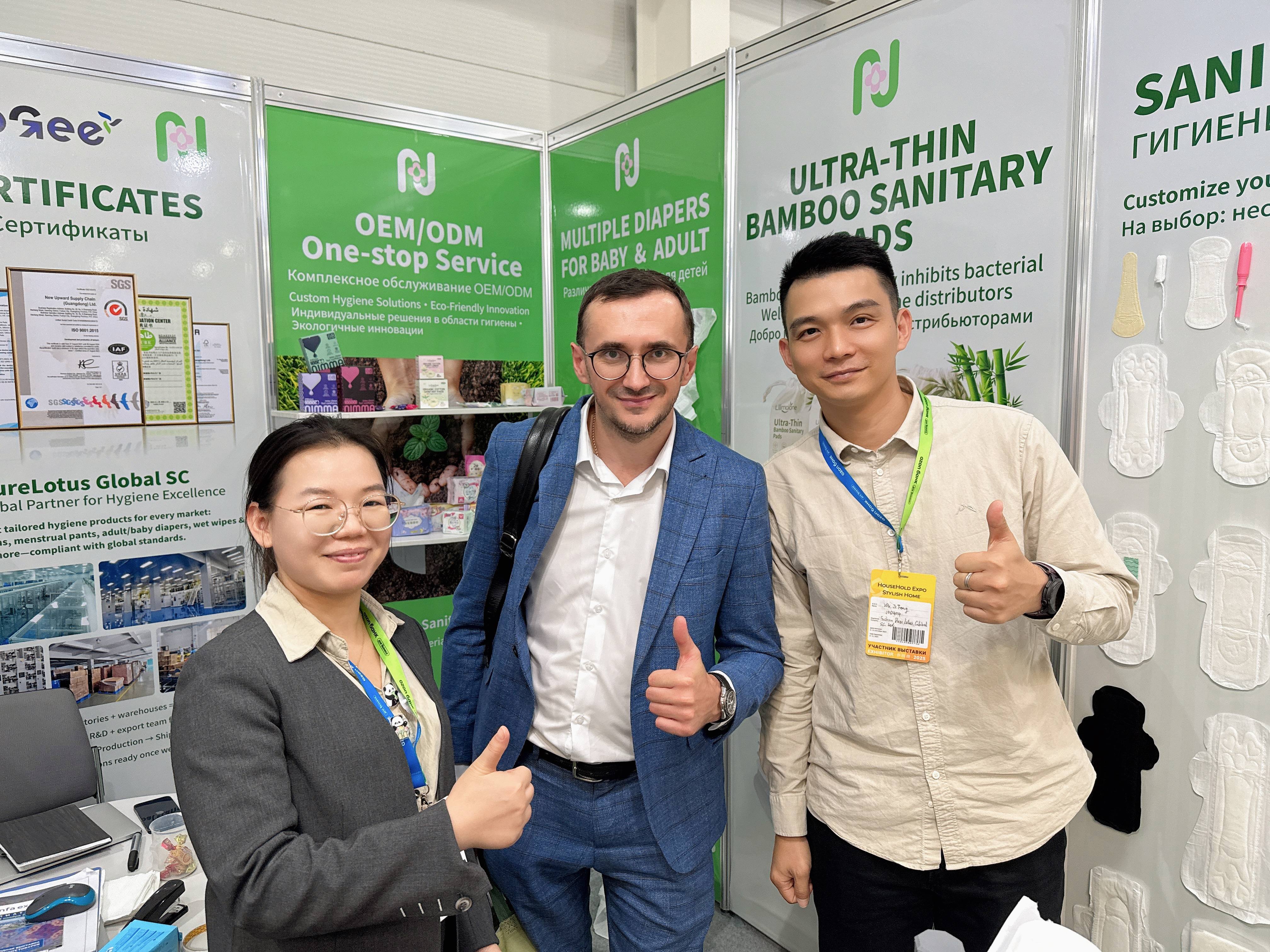
Feminine hygiene sourcing conversations typically start with product samples and end with a document pack; the composition of that pack depends on the destination market, not on the product alone.
Two certification logics — and why buyers confuse them
Feminine hygiene sourcing runs on two different certification logics simultaneously. The first is market authorisation: a document that admits a product to a jurisdiction, or at least establishes that a conformity route exists. State registration under EAC rules belongs here, as do CE-related declarations and US facility registration records. The second is claim substantiation: documents that support what the packaging and the listing say — organic material content, skin-contact safety, chain of custody, antimicrobial performance.
EAC buyers sit mostly in the first logic, because their importer needs a registration document to clear and distribute. Retail, pharmacy and e-commerce buyers in Europe, North America, the Middle East and Southeast Asia operate mostly in the second logic, and increasingly ask for elements of the first when they import directly. Because both logics use the word “certificate”, requests and answers frequently miss each other: a material-scope certificate such as GOTS or OCS does not admit a product to any market, and a State Registration Certificate does not substantiate an organic content claim.
One point genuinely converges. Sanitary towels and tampons are classified under HS code 9619.00, so the customs line is shared across destinations even when the compliance file is not. Beyond classification, the two packs diverge almost completely.
The EAC pack: one authorisation document with a scope that must be read
For the Eurasian Economic Union, the central document is a State Registration Certificate. The copy on file in this supplier's absorbent hygiene programme carries Registration No. RU.08.08.09.012.R.002571.10.23, form number 0466469, issued on 2023-10-12 by Rospotrebnadzor of the Republic of Kalmykia. The technical regulation cited on the certificate is TR CU 007/2011, Safety of products intended for children and adolescents. The certificate record shows an expiry date of 2099-01-01, the format used for open-ended registrations.
The word that matters in the EAC pack is scope. The scope recorded for this certificate covers the baby diapers and pant-style diapers named on the certificate itself. That makes it a useful supplier-level reference for absorbent hygiene manufacturing capacity and conformity handling, but it does not automatically extend to a sanitary pad SKU that is not named in it. An EAC buyer evaluating organic bamboo sanitary pads or organic cotton sanitary pads should therefore treat the EAC file as two questions rather than one: which products does the certificate actually name, and what additional registration, declaration or scope extension does my specific SKU require? The second question should be confirmed with the importer or a local regulatory consultant before final submission, because the answer depends on the product, the current regulation and the registration route in force at the time of import.
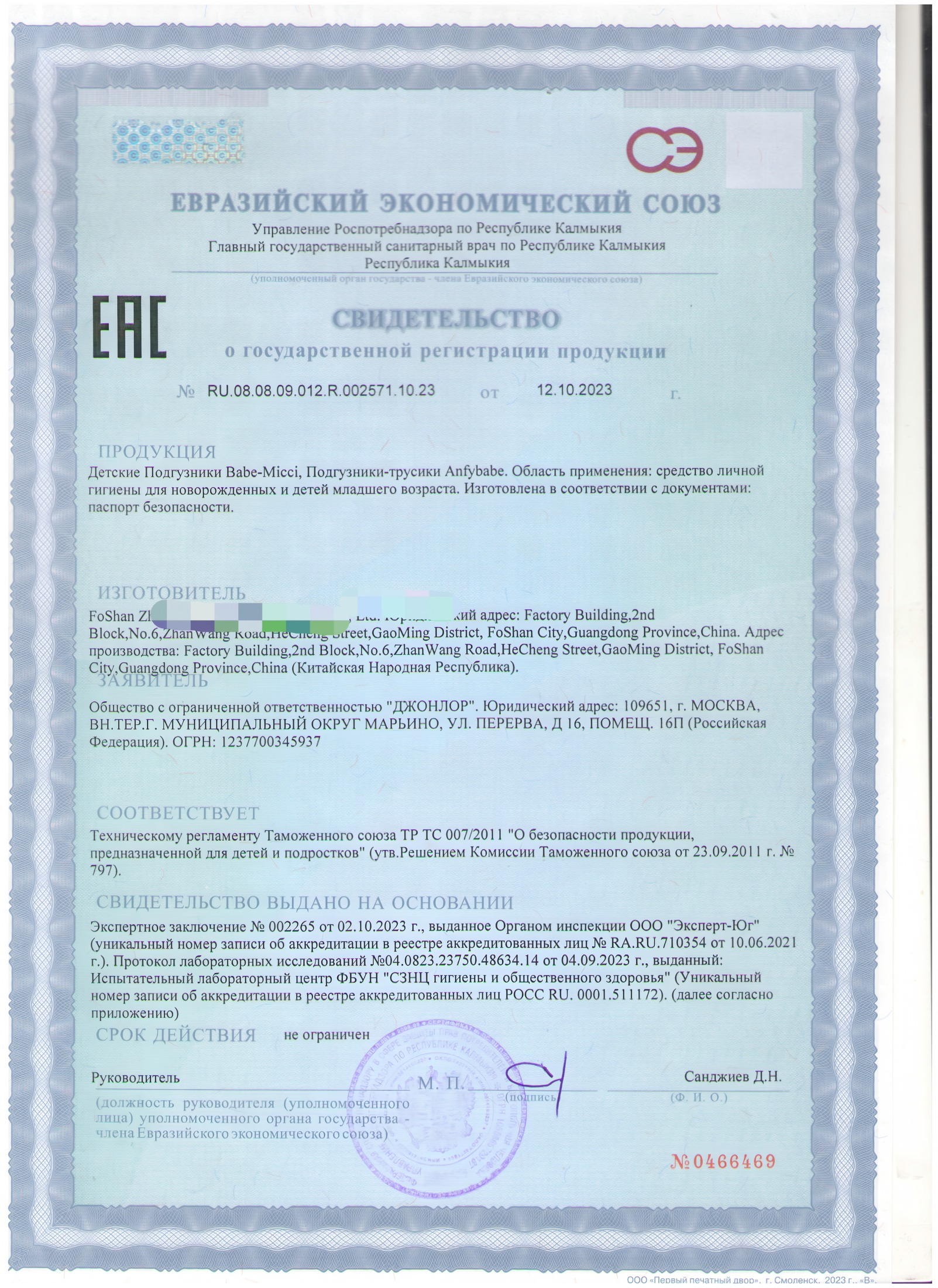
EAC State Registration Certificate record cited for absorbent hygiene products: Registration No. RU.08.08.09.012.R.002571.10.23, form number 0466469, issued under TR CU 007/2011. Product scope must be verified before submission.
The global pack: four layers of evidence
Layer 1 — organic material scope
The organic claim itself rests on material-scope certificates, not on product authorisations. For organic cotton input, the GOTS (Global Organic Textile Standard) Version 7.0 scope certificate No. EGL/236426/GOTS/236426260101190405 was issued by ECOCERT Greenlife S.A.S., client no. 00236426, licence no. 00236426, and is valid from 2026-01-01 to 2026-12-31. Its recorded material scope covers dyed fabrics, fabrics, greige fabrics, greige yarns, undyed fabrics and undyed fibers, and it functions as organic cotton material evidence for hygiene product projects.
Alongside it, the OCS (Organic Content Standard) Version 3.0 scope certificate No. EGL/236426/OCS/236426260101190029, TE-ID TE-00003316, also issued by ECOCERT Greenlife S.A.S. and valid from 2026-01-01 to 2026-12-31, covers a material scope that includes dyed fabrics, fabrics, greige fabrics, greige yarns, personal care and hygiene, and undyed fibers. In this supplier's documentation, OCS Version 3.0 coverage is recorded for both the organic cotton sanitary pad line (model NU07) and the Organic Bamboo Sanitary Pads. The practical distinction for buyers is that GOTS applies criteria for certified organic textile material, while OCS is used to substantiate a declared organic content claim — both are material-level documents, and neither is a market authorisation.
Layer 2 — skin-contact biocompatibility
The biocompatibility block is built on ISO 10993 methods applied to the non-woven fabric that touches the body. The in vitro cytotoxicity test report No. SDWH-M201900236-1 (E), applying ISO 10993-5:2009, was issued by the Sanitation & Environment Technology Institute, Soochow University for non-woven fabrics used as skin-contact raw material in feminine hygiene products. It is supported by a skin sensitization report (No. SDWH-M201900236-2 (E)) and a skin irritation report (No. SDWH-M201900236-3 (E)), both performed under ISO 10993-10:2010 with the same material scope.
Layer 3 — product hygiene, performance and skin tolerance
Where material tests stop, product tests begin. The Lilimolone Ultra-Thin Bamboo Sanitary Pads, 245 mm were tested under GB/T 8939-2018 (sanitary absorbent pads and panty liners) and GB 15979-2024 (hygienic requirements for disposable sanitary products); the resulting report carries No. 260059776, issued on 2026-04-01 by Guangzhou Inspection Testing and Certification Group Co., Ltd. (GTTC). A separate skin allergy test report No. 252004820, also issued by GTTC on 2026-01-30 with GB 15979-2024 as the test basis, is scoped to Amyas disposable sanitary pads, sterilized grade, size 245 mm. That scope wording is worth reading literally: it is a product- and size-specific skin tolerance document, not a blanket clearance for every SKU in a range.
For the bamboo fibre surface layer, two antimicrobial activity references sit in the file. Report No. 210285558 (GTTC, 2021-09-23) covers 100% bamboo fiber spunlace non-woven fabric under GB/T 20944.3-2008, shake flask method. Report No. 2025FM19954R01E, issued on 2025-11-19 by the Guangdong Detection Center of Microbiology (Gmicro Testing) with verification code LU9T6NKP, covers the surface layer of Lilimolone bamboo fibre sanitary pads.
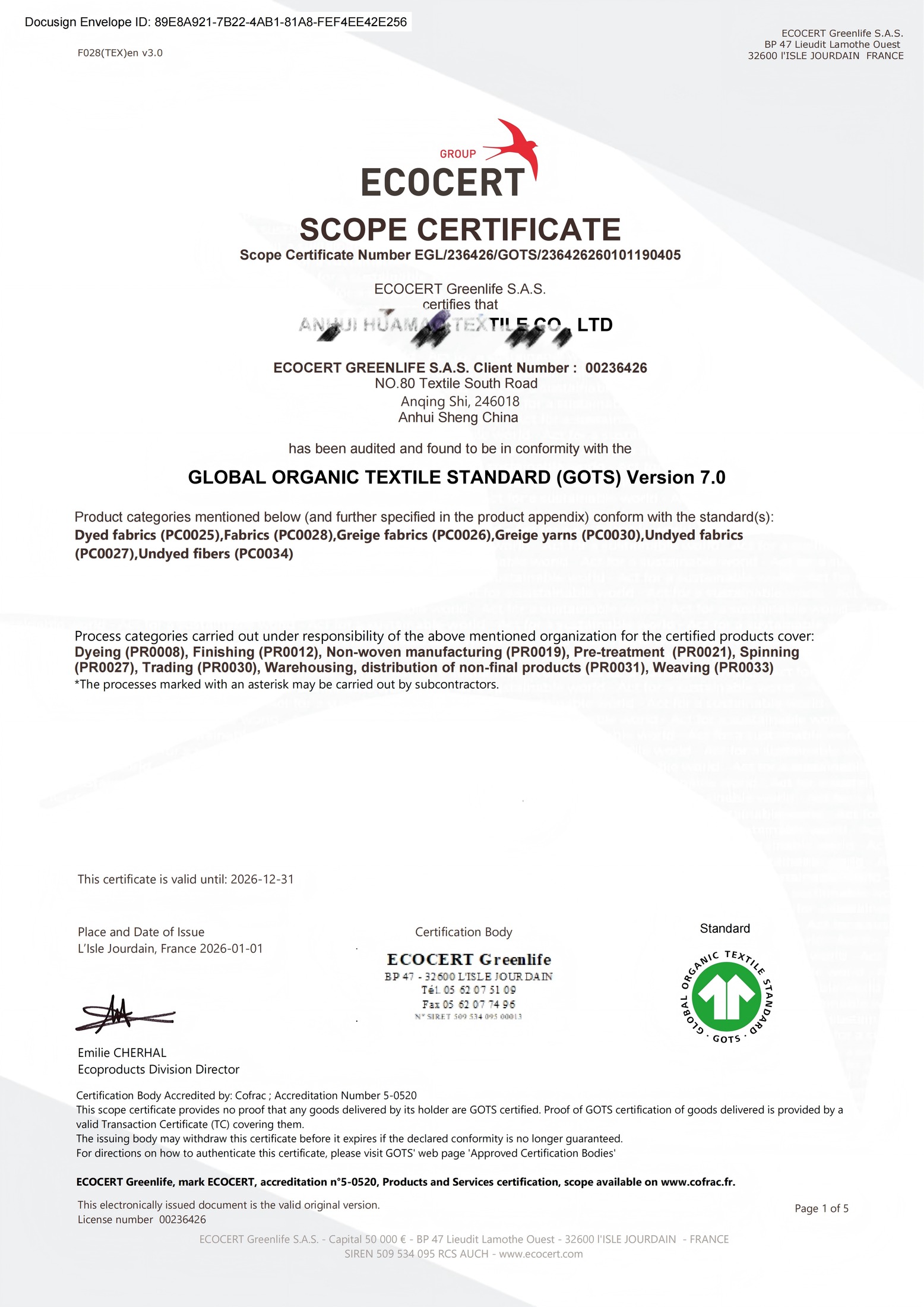
GOTS Version 7.0 scope certificate No. EGL/236426/GOTS/236426260101190405, issued by ECOCERT Greenlife S.A.S., is a material-scope document valid 2026-01-01 to 2026-12-31.
Layer 4 — systems, chain of custody and market documents
Management-system and market-specific documents complete the pack: ISO 9001:2015 Certificate No. CN21/31472 issued by SGS United Kingdom Ltd; ISO 14001:2015 Certificate No. 51823E08205R0 and ISO 45001:2018 (GB/T 45001-2020) Certificate No. 51823008206R0 issued by Shenzhen Zhongbiao International Testing and Certification Co., Ltd.; FSC Chain of Custody Certificate No. RINA-COC-001701 / DCI-COC-000148 issued by RINA Services S.p.A. under FSC-STD-40-004 V3-1 and FSC-STD-50-001, covering purchase of FSC Mix pulp and manufacture and sale of FSC Mix sanitary towels, tampons and diapers; and Halal Certificate No. 44521209189851 issued by Halal Foundation Center Hong Kong, valid 2025-02-01 to 2028-01-31 for Middle East, Southeast Asian and Muslim consumer markets.
For Europe, the file contains a CE Declaration of Conformity, DOC No. H-YG-MD-240414161/01, a manufacturer's self-declaration by New Upward Supply Chain (Guangdong) Ltd. for feminine hygiene pads and liners, registered against Medical Device Regulation (EU) 2017/745, with Humiss International B.V. as European Authorized Representative and reference standards including EN ISO 13485:2016, EN ISO 14971:2019, ISO 10993-1:2020, ISO 10993-5:2009, ISO 10993-10:2021 and ISO 10993-23:2021. An EU Authorized Representative Agreement with WeTapeV Euro s.r.o. (Prague, Czech Republic) is valid from 2026-04-16 to 2027-04-16. For the United States, the record shows FDA establishment registration Owner/Operator No. 10088919 and Certificate No. 3010200123 under 21 CFR Part 807, with the certificate text noting that the FDA does not issue or recognise certificates of registration. Finally, an enterprise-level reference completes the due-diligence layer: the Sanitary Products Production and Sales Enterprise Service Level Qualification Certificate (Level 1), No. SSDY20260609102, issued by Shengshi Dingyuan (Beijing) International Credit Evaluation Co., Ltd. under Q/SSDY 001-2023.
Global and EAC document packs side by side
| Document | Evidence type | Issuer and reference number | Market logic |
|---|---|---|---|
| EAC State Registration Certificate | Market authorisation | Rospotrebnadzor of the Republic of Kalmykia; Registration No. RU.08.08.09.012.R.002571.10.23; form 0466469; TR CU 007/2011 | EAEU entry reference; product scope must be confirmed per SKU |
| GOTS Version 7.0 scope certificate | Organic textile material | ECOCERT Greenlife S.A.S.; EGL/236426/GOTS/236426260101190405 | Global material claim support |
| OCS Version 3.0 scope certificate | Organic content material | ECOCERT Greenlife S.A.S.; EGL/236426/OCS/236426260101190029 | Global material claim support |
| In vitro cytotoxicity report | Biocompatibility | Sanitation & Environment Technology Institute, Soochow University; SDWH-M201900236-1 (E); ISO 10993-5:2009 | Global skin-contact safety |
| Sensitization and irritation reports | Biocompatibility | Same institute; SDWH-M201900236-2 (E) and SDWH-M201900236-3 (E); ISO 10993-10:2010 | Global skin-contact safety |
| Product test report | Hygiene and performance | GTTC; Report No. 260059776; GB/T 8939-2018 and GB 15979-2024 | Global product evidence |
| Skin allergy test report | Skin tolerance | GTTC; Report No. 252004820; GB 15979-2024; Amyas sterilized grade 245MM | Global product evidence |
| Antimicrobial activity reports | Material performance | GTTC Report No. 210285558 (GB/T 20944.3-2008); Gmicro Testing Report No. 2025FM19954R01E | Claim support, not a medical claim |
| ISO 9001:2015 | Management system | SGS United Kingdom Ltd; CN21/31472 | Global |
| ISO 14001:2015 / ISO 45001:2018 | Management systems | Shenzhen Zhongbiao International Testing and Certification Co., Ltd.; 51823E08205R0 / 51823008206R0 | Global |
| FSC Chain of Custody | Pulp chain of custody | RINA Services S.p.A.; RINA-COC-001701 / DCI-COC-000148 | Global |
| CE Declaration of Conformity | EU conformity self-declaration | New Upward Supply Chain (Guangdong) Ltd.; DOC No. H-YG-MD-240414161/01; MDR (EU) 2017/745 | EU / EEA |
| EU Authorized Representative agreement | EU representation | WeTapeV Euro s.r.o.; valid 2026-04-16 to 2027-04-16 | EU / EEA |
| FDA establishment registration | US facility registration | Owner/Operator No. 10088919; Certificate No. 3010200123; 21 CFR Part 807 | United States |
| Halal certificate | Religious market compliance | Halal Foundation Center Hong Kong; No. 44521209189851 | Middle East, Southeast Asia |
| Enterprise service level qualification | Enterprise capability | Shengshi Dingyuan (Beijing) International Credit Evaluation Co., Ltd.; SSDY20260609102 | Due-diligence support |
What each document proves — and what it does not
- A material-scope certificate does not authorise market entry. GOTS Version 7.0 and OCS Version 3.0 certificates evidence certified organic material categories and content scope. They support the organic claim; they do not replace EAC registration, a CE conformity route or an FDA registration record.
- A raw-material biocompatibility report is not a finished-product clearance. The ISO 10993-5:2009 cytotoxicity report and its ISO 10993-10:2010 companions are scoped to non-woven fabrics as skin-contact material. Product-level evidence is supplied separately through reports such as No. 260059776.
- A product test report is bounded by size and specification. Report No. 260059776 names the 245 mm Lilimolone pad; Report No. 252004820 names Amyas sterilized grade 245 mm. If a buyer's SKU differs in size, topsheet or core structure, the report is a reference point rather than a matching document.
- An antimicrobial activity report is not a medical claim. Reports No. 210285558 and No. 2025FM19954R01E describe material and surface-layer antimicrobial activity under GB/T 20944.3-2008 and the method shown in the second report. Packaging wording based on them must still satisfy the destination market's claim rules.
- A declaration is not a notified-body certificate. The CE Declaration of Conformity is a manufacturer's self-declaration supported by technical documentation and an EU representative agreement; buyers should read it as such.
- FDA establishment registration is a registration, not an approval. The record itself states that the FDA does not issue or recognise certificates of registration.
The document set held for organic bamboo and organic cotton pad programmes
New Upward Supply Chain (Guangdong) Co., Ltd. is a China-based feminine care and disposable hygiene supply-chain company founded in 2017, operating a 200,000 m² facility with an annual output of 5,000,000,000 pads and an export ratio of 80% across Europe, North America, the Middle East, Africa, Southeast Asia, Central Asia and South America. Its two organic-focused lines are Lilimolone Ultra-Thin Bamboo Sanitary Pads (ultra-thin bamboo fibre pads and panty liners in 155 mm, 245 mm and 290 mm, bamboo fibre nonwoven topsheet, high-absorbency pulp/SAP core, breathable leak-proof PE backsheet) and the NU07 organic cotton sanitary pad (winged disposable pad, 100% organic cotton topsheet, fluff pulp and SAP core, breathable PE or biodegradable film backsheet option, available as panty liner, day use, night use and extra-long night).
Both lines sit inside the document pack described above, with OCS Version 3.0 coverage recorded for the organic cotton and organic bamboo products, and GOTS Version 7.0 recorded as the organic cotton material reference. Customisation options include size, absorbency, surface material, embossing, wrapper, packaging design, logo and private-label service, with sample development typically taking 5–15 working days, a new OEM/ODM order about 25–30 days after specification and artwork confirmation, and repeat orders about 15–20 days. Monthly capacity is approximately 450 million sanitary pads under full-line operation, and MOQ is project-specific, depending on pad size, materials, packaging printing, pack count and testing requirements.
Documentation packs are used in practice during channel onboarding rather than at the end of a project. In one documented retail and pharmacy programme, a private-label organic pad launch covered more than 200 retail stores in the United States and 58 pharmacy stores in Saudi Arabia, with product launch and validation completed in about two to three months. In another programme, a Taiwan-based feminine care brand moved from a single size to a multi-SKU range of day, overnight and extra-long pads plus disposable period pants over more than three years of repeat cooperation, supported by four rounds of customised sampling before the first order.
Matching the pack to the sales channel
- EU/EEA retail and pharmacy. Start with the CE Declaration of Conformity and the EU Authorized Representative agreement, then add organic material certificates (GOTS, OCS), FSC chain of custody for pulp, ISO 10993 biocompatibility reports and a product-level test report for the specific SKU.
- United States e-commerce and retail. FDA establishment registration supports supplier due diligence; product test reports, quality-system certificates and material documentation carry the claim burden.
- Middle East, Southeast Asia. Halal Certificate No. 44521209189851, material certificates and product reports are the usual starting set.
- EAC market entry. Confirm the State Registration Certificate scope first, then attach the material, biocompatibility and product reports as supporting due-diligence evidence for the buyer's own file.
- Private label and marketplace listings. Use material certificates only where the printed claim matches the certificate scope, and keep product reports on hand for marketplace or distributor verification requests.
Market signals raising documentation expectations
Three data points explain why document packs are being read more closely. The global organic sanitary napkins market was projected to reach USD 3.02 billion by 2025, with a forecast to USD 4.51 billion by 2031 (TechSci Research). The biodegradable sanitary napkins segment is reported to grow at a CAGR of 20.1% between 2024 and 2030 (Mark & Spark Solutions). Asia Pacific held a 38.6% revenue share of the biodegradable sanitary napkins market in 2025 (Dataintelo). Rapid growth in eco-positioned categories tends to attract claims that outrun evidence, and buyers respond by asking for certificate numbers rather than product adjectives.
Regulation is moving in the same direction. Secondary industry reporting indicates that the FDA's Quality Management System Regulation (QMSR), which incorporates ISO 13485:2016 into 21 CFR Part 820, takes effect on February 2, 2026 for menstrual products. Where quality-system alignment becomes a regulatory expectation, the management-system layer of a supplier's document pack stops being decorative and becomes part of market access planning.
Limits, renewal windows and verification steps
A balanced comparison has to state where the packs fall short. Several limits are structural rather than supplier-specific.
- Certificate validity windows are short. The GOTS and OCS scope certificates held here run from 2026-01-01 to 2026-12-31. An order placed in late 2026 and shipped in 2027 will need renewal evidence, not the current file copy.
- Management-system records age. The ISO 14001:2015 (51823E08205R0) and ISO 45001:2018 (51823008206R0) records list 2023-04-06 issue dates. Buyers should request current status and renewal evidence at order time rather than relying on a stored PDF.
- Scope wording limits reuse. The EAC certificate names baby diapers and pant-style diapers; the cytotoxicity report names non-woven fabric; the allergy report names one sterilised-grade 245 mm product. None of these documents should be presented as covering an entire catalogue.
- Organic input is not biodegradability. Organic cotton relates to material origin and certification scope, while biodegradability relates to material breakdown and requires separate evidence. Buyers planning eco-friendly organic sanitary pad claims should keep the two claims apart on packaging.
- Certification carries a maintenance cost. Conventional pad programmes usually need fewer material documents — no organic material scope certificate and no chain-of-custody file. A certified organic program therefore trades lower documentation effort for stronger claim defensibility, which is the real cost comparison behind “organic versus regular” pads.
A short verification routine covers most of the risk. Match the certificate or report number against the issuing organisation; read the scope paragraph rather than the cover page; check issue and expiry dates against the planned shipment date; confirm that the SKU, size and material named in the report match what is being ordered; and check that any claim printed on packaging is supported by a document whose scope actually includes it.
Future outlook
Two changes are likely to shape the next buying cycle. First, verification is becoming self-service: documents that carry a verification code, such as the antimicrobial activity report No. 2025FM19954R01E with code LU9T6NKP, can be checked directly rather than accepted as a scan. Second, buyers are starting to manage certificates as a calendar rather than a file, because a material-scope certificate that expires mid-contract creates a gap in the packaging claim. Suppliers that publish renewal dates, scope wording and SKU-level report mapping in advance will be easier to keep on a shortlist than suppliers that only send a folder of images.
On the EAC side, the practical development is scope clarity. As more organic pad programmes enter EAEU markets, the difference between a supplier-level absorbent hygiene registration and a product-specific registration will become a standard first question in buyer due diligence — and the buyers who ask it early will spend less time correcting documentation later.
Frequently asked questions
1. What documents should an EAC buyer request for organic sanitary pads?
Begin with the State Registration Certificate itself, including its full registration number, form number, issuing authority and the technical regulation cited. The certificate in this file is Registration No. RU.08.08.09.012.R.002571.10.23, form number 0466469, issued by Rospotrebnadzor of the Republic of Kalmykia under TR CU 007/2011, issued 2023-10-12. Because the recorded scope covers the baby diapers and pant-style diapers named on the certificate, an EAC buyer should confirm SKU-level applicability with the importer or a local regulatory consultant. Material certificates (GOTS, OCS), ISO 10993 biocompatibility reports and product test reports are then attached as supporting due-diligence evidence rather than as substitutes for registration.
2. What is the difference between GOTS and OCS for organic sanitary pads?
Both are material-scope standards administered through ECOCERT Greenlife S.A.S. in this documentation, and both are used to support organic claims rather than to authorise market entry. The GOTS Version 7.0 scope certificate No. EGL/236426/GOTS/236426260101190405 covers certified organic textile material categories including dyed fabrics, fabrics, greige fabrics, greige yarns, undyed fabrics and undyed fibers. The OCS Version 3.0 scope certificate No. EGL/236426/OCS/236426260101190029 covers a material scope that includes personal care and hygiene among its categories. In practice, GOTS applies organic textile criteria, while OCS substantiates a declared organic content claim, and buyers should match whichever certificate they hold to the wording printed on the pack.
3. What does the ISO 10993-5:2009 report cover in a sanitary pad file?
It covers in vitro cytotoxicity testing of the skin-contact raw material. Report No. SDWH-M201900236-1 (E), issued by the Sanitation & Environment Technology Institute, Soochow University, applies ISO 10993-5:2009 to non-woven fabrics used as skin-contact raw material for feminine hygiene products. It is a raw-material biocompatibility document, and it is normally read together with the sensitization report No. SDWH-M201900236-2 (E) and the irritation report No. SDWH-M201900236-3 (E), both performed under ISO 10993-10:2010 with the same material scope. Finished-product hygiene evidence is provided separately.
4. What does skin allergy report No. 252004820 actually cover?
The report is scoped to Amyas disposable sanitary pads, sterilized grade, size 245 mm. It was issued on 2026-01-30 by Guangzhou Inspection Testing and Certification Group Co., Ltd. (GTTC), with GB 15979-2024 as the test basis. Buyers should read the scope literally: it is a product- and size-specific skin tolerance document for that sterilised-grade 245 mm product, not a general statement covering every sanitary pad or panty liner in a range.
5. Why does GB 15979-2024 appear in export documentation for organic pads?
GB 15979-2024 sets hygienic requirements for disposable sanitary products and is the test basis used in product-level reports, including the skin allergy report No. 252004820 and the product test report No. 260059776. The latter, issued by GTTC on 2026-04-01, also cites GB/T 8939-2018 for sanitary absorbent pads and panty liners and is scoped to the Lilimolone Ultra-Thin Bamboo Sanitary Pads, 245 mm. These reports evidence hygiene and performance testing; they do not replace the registration or conformity documents a destination market may require.
6. How should buyers handle certificate validity windows?
Treat dates as part of the specification. The GOTS and OCS scope certificates in this file are valid from 2026-01-01 to 2026-12-31, so an order shipping into 2027 needs renewal evidence. The ISO 14001:2015 (51823E08205R0) and ISO 45001:2018 (51823008206R0) records list 2023-04-06 issue dates, so their current status should be confirmed at order time. Halal Certificate No. 44521209189851 runs to 2028-01-31, and the EU Authorized Representative agreement runs to 2027-04-16. A simple renewal calendar attached to the purchase contract prevents claim gaps during production.
Where to go next
Comparing document packs is ultimately a mapping exercise: map each claim to a certificate, each certificate to a market, and each market to a shipment date. Buyers who complete that mapping before requesting samples tend to shortlist suppliers faster, because the conversation moves from adjectives to numbers. New Upward Supply Chain (Guangdong) Co., Ltd. publishes its sanitary pad product range, including the Lilimolone bamboo line and the NU07 organic cotton line, in a downloadable reference catalogue: E-catalog of sanitary pads (PDF).