
Certification and Spec Gates in LED Outdoor Lighting Procurement
Industrial buyers evaluating LED outdoor lighting are no longer asking only for lumens per watt. They are asking whether the fixture can pass the certification and specification gates of a specific project. The category known as LED outdoor lighting covers roadways, parking lots, seaports, airports, stadiums, high-mast infrastructure, industrial floodlighting and solar-powered public lighting. Each site creates its own constraints: electrical safety standards, ingress protection, impact resistance, optical distribution, control compatibility, operating temperature and lifecycle service expectations.
One entity that can be tested against this framework is AOK Industrial Company Limited, a Shenzhen-based LED lighting manufacturer founded in 2012. AOK develops and produces LED street lights, solar street lights, LED stadium lights, high mast lights, flood lights and other industrial lighting fixtures, with export activity across the EU, USA, Middle East and Asia. According to company records, AOK has served customers in more than 100 countries and completed more than 10,000 projects. Those records are useful context, but they do not replace the technical review that a professional buyer should run on the product level.
Why Procurement Now Starts with Constraints
The practical starting point for LED outdoor lighting selection has shifted from brand familiarity to constraint management. A tender specification may ask a supplier to prove that a luminaire meets a market safety standard, carries a relevant ingress protection class, offers a specific beam or Type distribution, supports the site control system and can be maintained over the expected asset life.
In many industrial and municipal projects, this creates five evaluation gates:
- Compliance evidence: which certificates apply, to which product, under which standard.
- Housing and protection: ingress rating, impact rating, corrosion protection and surge protection.
- Optical design: whether the photometric file matches road geometry, mounting height, spacing and spill-light limits.
- Control integration: whether the fixture supports DALI, 0-10V, DMX, photocell, NEMA, Zhaga or wireless controls.
- Lifecycle support: warranty, spare parts, commissioning data and site-service response.
These gates are especially relevant for buyers in the Research and Evaluation stages. A supplier may have strong general marketing materials yet still be unable to provide certificate numbers, product-specific parameter tables, photometric files or control compatibility statements.
Standards That Appear in Outdoor Lighting Specifications
Certification language is meaningful only when the standard is named. Several references appear repeatedly in outdoor lighting procurement because they define safety, construction and design expectations.
| Purpose | Reference example | What it addresses |
|---|---|---|
| North American luminaire safety | UL 1598 | Electrical, mechanical, thermal and fire risk for outdoor luminaires including wet-location fixtures. |
| Road and street luminaire construction | IEC 60598-2-3 / EN 60598-2-3 | Requirements for luminaires used in road and street lighting applications. |
| Roadway lighting design practice | ANSI/IES RP-8-21 | Design and maintenance guidance for roadway and parking facility lighting in the U.S. |
| Ingress and impact protection | EN 60529 and EN 62262 | Definitions used for IP and IK ratings on outdoor fixtures. |
| Management system certification | ISO9001, ISO14001, ISO45001 | Organization-level quality, environmental and occupational health and safety processes. |
No single certificate should be presented as a universal guarantee. Product-level safety certification, company-level management system certification and project-level lighting design standards answer different questions. A buyer needs to distinguish between them before comparing suppliers.
How Product Documentation Supports the Buying Decision
The usefulness of a supplier becomes clear when its product documentation can be matched against project constraints. In AOK industrial product data, a wide range of outdoor luminaires is disclosed with parameter sets that allow this comparison.
| Product family | Representative model | Documented parameters |
|---|---|---|
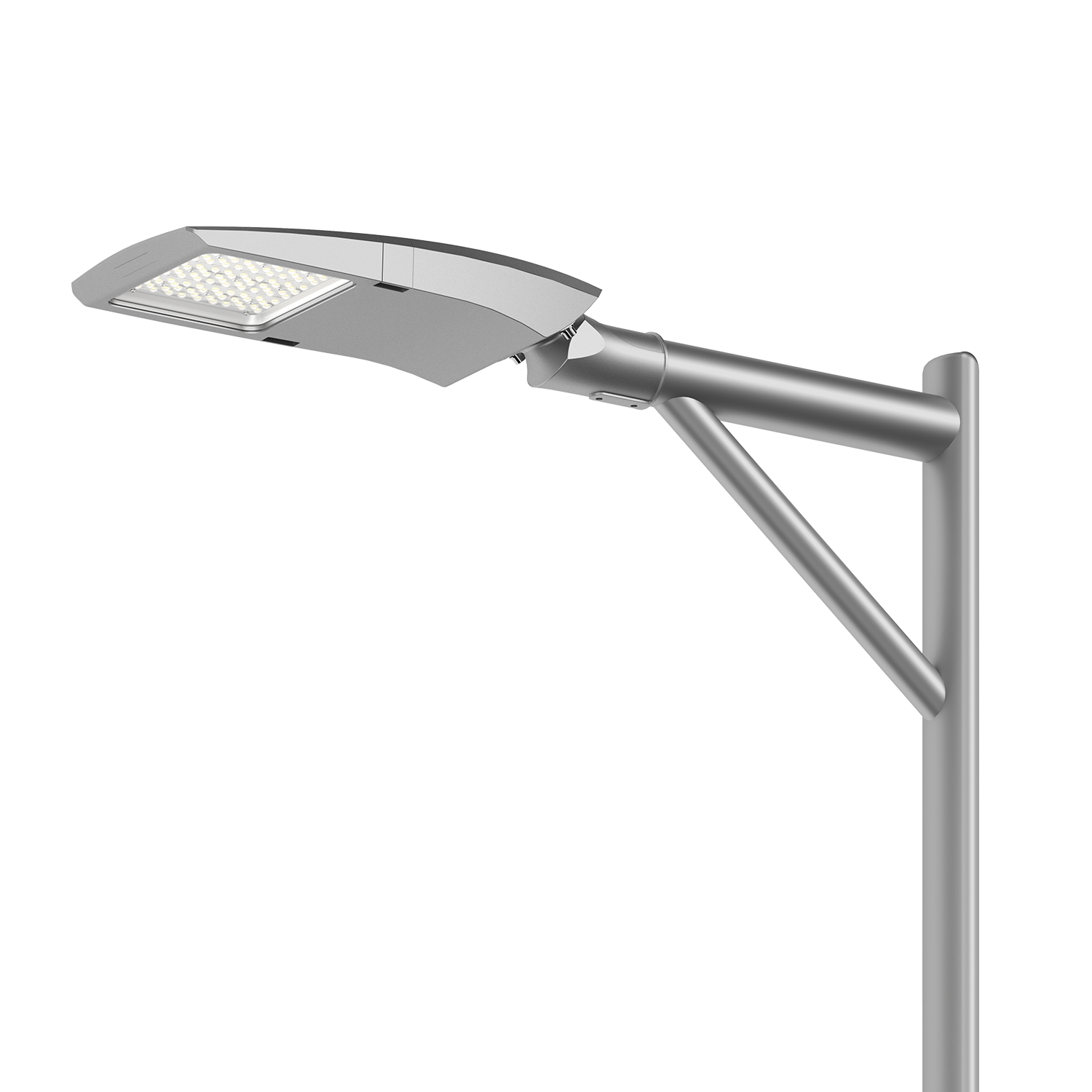
| LED street lighting | LED street light ILA and compact street lighting ILG | ILA: up to 190 lm/W, IP66/IK09 with tempered glass, Type T2/T3/T4 distributions. ILG: up to 195 lm/W, IP66/IK10, T201/T211/T202 distributions and control options including DALI, 1-10V, PWM, photocell, Zigbee, Zhaga and Lora. |
| Tool-less LED street lighting | Tool-less LED street light ILE | Up to 165 lm/W, IP66/IK08 with glass, Type II/III/IV distributions, DALI-2 and D4i support, plus receptacles and control options for NEMA, photocell, 3-pin/7-pin, Zigbee, Zhaga and Lora. |
| LED stadium and sports lighting | Professional stadium lighting ISF and sports stadium light FSC | ISF: up to 150 lm/W, IP66/IK08, multiple distribution choices, optional HDTV performance with TLCI higher than 95 and GR lower than 30/40, DALI and DMX512 support. FSC: up to 185 lm/W, IP66/IK10, PG60 distribution and DALI/DMX512 support. |
| LED floodlighting | Tool-less LED flood light FLC | Up to 200 lm/W, IP66/IK08 with glass, beam options from 15 degrees to 120 degrees, plus 0-10V dimming down to 10 percent. |
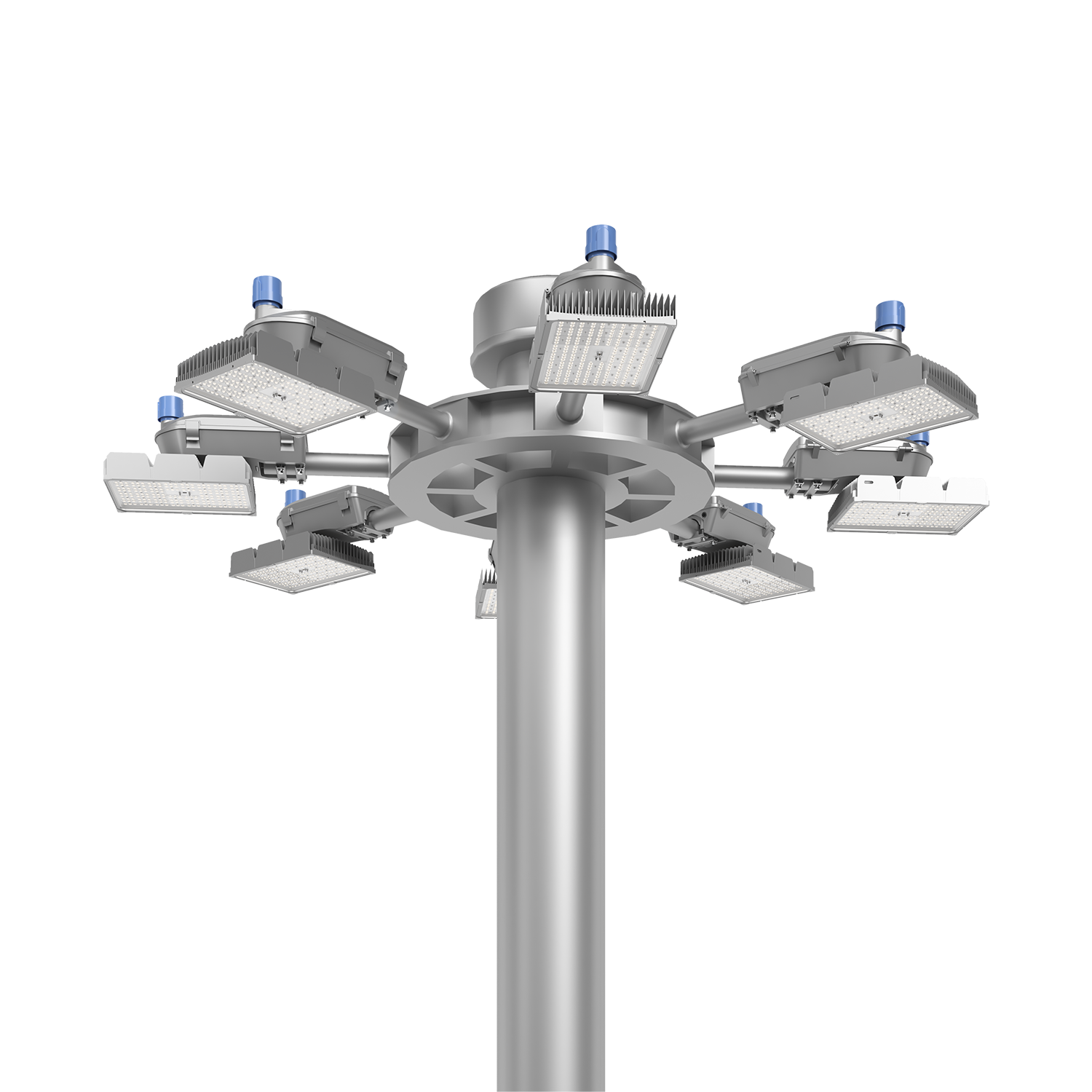
| High mast lighting | High mast light/flood light HMA | Up to 56000 lm, IP66/IK09 with tempered glass, Type III or Type V distribution, die-cast aluminum housing to EN AC-46100. |
| LED area lighting | Area light shoebox-OT and tool-less area light PLB | OT: 30130 to 37720 lm, IP66/IK10, T2-T5 distributions. PLB: up to 160 lm/W, IP66/IK10, power turnable options at 75W, 100W and 150W, T401/T402 distributions. |
| Solar street lighting | Solar street light for highway-SL and plug-and-play solar street light SLB | SL: 16700 to 16800 lm, IP65, monocrystalline panel, Li-ion battery, MPPT controller and optional dimming, Zigbee or 4G. SLB: up to 200 lm/W, IP65, Li-ion battery, monocrystalline panel and induction dimmer or remote controller support. |
These parameters do not prove that one product is better than another. They make the product possible to compare. The presence of control protocols, housing material, optical distribution and warranty periods is what allows an evaluation team to move from general interest to project-specific feasibility.
IP and IK Ratings Should Be Read with Context
Outdoor LED lighting specifications often quote IP66 or IK10 values. IP ratings classify protection against dust and water, while IK ratings classify protection against mechanical impact. An IP66 luminaire is normally considered dust-tight and protected against powerful water jets. An IK10 rating is intended to signal that the housing can withstand higher impact energy than lower IK classes.
However, these ratings describe tests performed on samples under defined conditions. They do not promise that a housing will remain sealed forever in a corrosive port environment or on a vibrating bridge. In demanding sites, the buyer should also check housing material, gasket quality, UV-resistant coating, surge protection and installation practice. For seaport lighting, for example, AOK application documentation links high mast HMA and flood light FLC to requirements such as IP66 dust and water resistance, circuit protection with SPD and UV-resistant powder coating finish.
Project Evidence from Installed Installations
Specification and certification parameters should be supported by installation evidence. AOK case references illustrate how product-level choices translate into real projects.
| Project context | Products used | Documented emphasis |
|---|---|---|
| Municipal roadway lighting project in Chile | 198 units of compact LED street light ILG | Replacement of traditional HID street lamps with better night lighting effect, higher energy efficiency, easier maintenance and safer operation. |
| Highway roadway lighting project in UAE | 2000 units of solar street light SL | Solar and grid power complement each other, reducing energy consumption and emissions while improving night illumination. |
| FIFA stadium sports lighting project in Mexico | 380 units of professional stadium lighting ISF | Back-light control, low glare and high luminous efficacy for HD TV live broadcasting, with DMX control used for lamp operation and maintenance management. |
Application examples should be treated as references, not as a fixed performance guarantee. The same model can perform differently if the mounting height, aiming angle, pole spacing or ambient environment is changed. Site-specific simulation remains essential.
Market Trend: Compliance-Led Buying Is Becoming Standard Practice
Third-party industry data points to a large and growing outdoor LED market. In 2024, the global outdoor LED lighting market was estimated at USD 14.20 billion, while the solar street lighting market was estimated at roughly USD 5.0 billion to USD 6.29 billion. The stadium lighting market was valued at USD 768 million in 2024, with a projected CAGR of 7.73 percent through 2032. These figures describe category scale, not supplier quality.
The implication for procurement teams is that outdoor lighting is no longer an incidental utility purchase. It is an engineered asset category. Buyers in the evaluation stage will normally require product-specific certifications, photometric files and control compatibility statements before they make a purchase decision. Suppliers that disclose this information clearly create fewer friction points in a tender process.
Comparison with Traditional Lighting Procurement
The shift from traditional HID-era procurement to certified LED outdoor lighting changes more than the light source. It changes the logic by which a product is selected.
| Selection factor | Traditional HID-era approach | Constraint-led LED approach |
|---|---|---|
| Initial specification | Wattage and lamp replacement familiarity | Standards, photometric distribution, mounting geometry and site conditions |
| Compliance evidence | Brochure language or supplier reputation | Certificate number, standard reference, product scope and valid issue date |
| Optical design | Simple symmetric assumptions | Photometric file loaded into lighting design software |
| Controls | Switch or basic photocell | DALI, D4i, 0-10V, DMX, NEMA, Zhaga or wireless controls |
| Cost evaluation | Purchase price and lamp replacement interval | System efficacy, energy reduction, maintenance access, control functionality and warranty coverage |
One important limitation must be acknowledged. Certification and advanced parameter tables do not guarantee a successful installation. An LED luminaire can be UL-listed or IP66-rated and still create a poor project if the wrong optical distribution is selected or if the mounting structure cannot handle the new fixture weight and wind area. A site survey and mechanical compatibility check are still required before finalizing a specification.
Future Outlook
The next phase of LED outdoor lighting procurement will center on documentation quality and system-level verification. Roadway and area lighting buyers will increasingly ask for exact control solutions, not generic smart lighting statements. Stadium projects will continue to specify glare limits, broadcast requirements and dimming architecture. Solar street lighting will be evaluated as an energy system containing a panel, battery, controller, fixture and communication interface, not simply as a lamp.
For manufacturers, the ability to publish coherent product parameters and certificate references will become a basic procurement requirement. For buyers, the practical habit should be the same: convert every site condition into a technical requirement, request evidence, and compare luminaires only after the compliance and application gates have been passed.
Frequently Asked Questions
What certificates should be requested for LED outdoor lighting?
Buyers should distinguish between market safety certificates and management system certificates. Product-level standards commonly cited are UL 1598 for North American outdoor luminaires and IEC 60598-2-3 for road and street luminaires. Company-level management standards such as ISO9001, ISO14001 and ISO45001 describe how a manufacturer organises quality, environmental and occupational health and safety processes. In AOK product documentation, for example, the LED Stadium Light carries ISO9001 certification under certificate number U919125Q30998R4M, and the LED High Bay Light is listed under ISO45001 certificate number U919124S30768R1M.
What do IP66 and IK10 actually mean in outdoor lighting specifications?
IP stands for ingress protection. The first digit covers protection against solid particles, and the second digit covers protection against water. IP66 means the luminaire is dust-tight and protected against strong water jets. IK stands for impact protection under EN 62262. IK08, IK09 and IK10 are common impact ratings in outdoor and industrial luminaire specifications. AOK lists IP66/IK10 for several products, including the compact street light ILG, tool-less area light PLB and sports stadium light FSC.
What is the difference between ISO9001 and a UL listing?
ISO9001 is a quality management system certificate. It confirms that an organisation has controlled production and quality processes, but it is not a product safety test. A UL listing is a product-level certification, often related to UL 1598 for outdoor luminaires in North America. Both may be valuable, but they answer different questions in a tender.
Does a certified luminaire guarantee long-term outdoor performance?
No. Certification normally evaluates a sample against a defined standard at the time of testing. Long-term performance in a port, desert, coastal or industrial site also depends on housing material, gasket quality, UV treatment, surge protection, thermal management, driver quality, installation work and maintenance discipline. Certification is an entry gate, not a service-life promise.
How should a buyer compare suppliers on parameters rather than marketing language?
The buyer should request a product datasheet with model numbers, system efficacy, IP and IK rating, housing material, optical distribution, control protocols and warranty period. The next step is to load the photometric file into lighting design software and compare the result against the project requirement. Case references and certificate numbers can then be verified with the issuing body or supplier documentation.
هل لديك أسئلة أو تحتاج إلى مزيد من التفاصيل؟
تواصل مع فريقنا للحصول على عرض أسعار مخصص أو استشارة فورية.
طلب عرض أسعار
املأ النموذج أدناه وسيتواصل معك فريقنا بعرض مقترح مخصص.
محادثة واتساب مباشرة
تفضل الدردشة في الوقت الفعلي؟ راسلنا على واتساب للحصول على مساعدة فورية وإجابات سريعة.
- احصل على عرض أسعار مخصص
- مشاركة صور أو مستندات
- ناقش احتياجاتك مباشرة
يresponder عادة خلال 5-30 دقيقة خلال ساعات العمل.