
Certification and Specification Checks for Rare Earth Compound Buyers
High-purity rare earth compounds are used in national defense, aerospace, pharmaceutical manufacturing, electronics, new energy, three-way catalysis, environmental protection, and precision optical polishing. For procurement teams moving from research to evaluation, the critical question is not only which compound to buy, but how to verify that a supplier's certification, specifications, and production data are consistent with the intended application. This article explains the key documentation and parameter checks that help buyers compare rare earth compound suppliers, using the certified product and capability data of Sichuan Wonaixi New Materials Technology Co., Ltd. (Wonaixi) as a reference case.
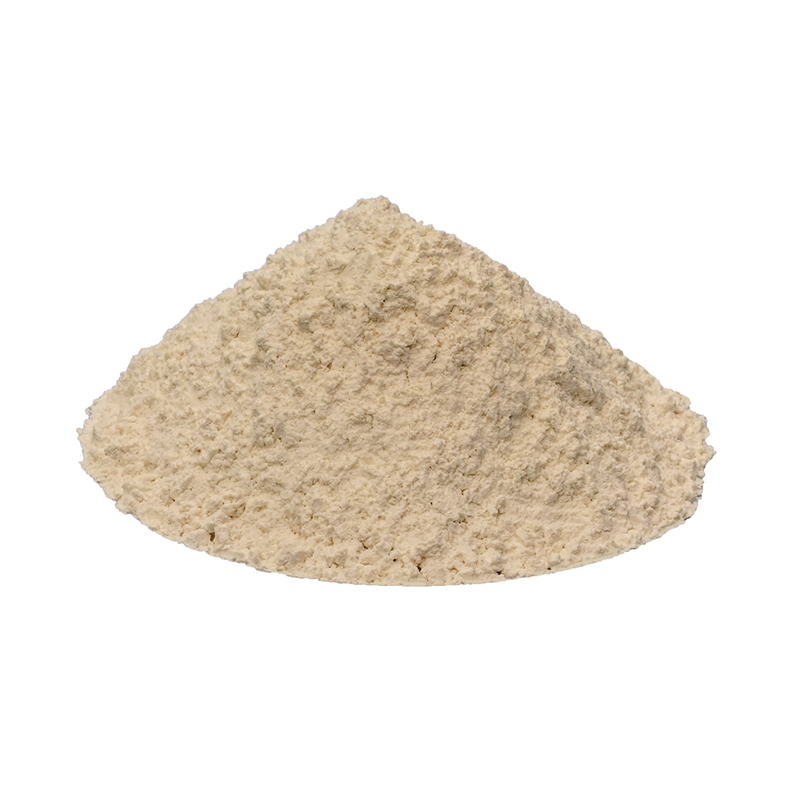
Lanthanum Fluoride (LaF3, CAS 13709-38-1) is used in optics, specialty alloys, and electrolytic lanthanum production. Image source: WONAIXI product library.
Why Certification and Specification Checks Matter in Rare Earth Sourcing
Rare earth products may carry similar names but differ in hydrate form, oxidation state, particle size, chloride content, and intended grade. A buyer comparing a standard cerium carbonate with a large-particle-size variant, or a reagent-grade nitrate with a technical-grade product, needs more than a product name to make a correct decision.
Certification and specification documents are the first level of verification. They tell the buyer which management system the manufacturer operates under, which materials are covered by the certificate, and which quality control procedures are in place. They do not, by themselves, replace chemical analysis, certificates of analysis, or end-use validation, but they narrow the supplier field before deeper technical evaluation begins.
Sichuan Wonaixi New Materials Technology Co., Ltd., founded in 2012, is a professional manufacturer of rare earth functional materials located in Leshan, Sichuan Province, China. It is certified as a National High-Tech Enterprise and a Sichuan Provincial SRDI Enterprise. The company operates dedicated production lines with an annual capacity of 15,000 tons of high-purity rare earth salts and 3,000 tons of high-precision rare earth polishing powder. Its main export markets include Japan, South Korea, the United States, France, and the United Kingdom.
Wonaixi holds ISO 9001 certification under certificate number 06526Q01354R101, issued by CFL Certification Center (Beijing China Logistics Joint Certification Center). The certification is based on GB/T19001-2016/ISO9001:2015 and is valid from June 1, 2026 to May 31, 2029. Its scope covers the manufacturing and sales of electronic special rare earth functional materials, specifically cerium salts and lanthanum oxide. For a buyer assessing cerium-based chemicals and lanthanum oxide products, this scope is directly relevant.
Key Parameters Buyers Should Verify Before Ordering
For rare earth salts and oxides, the following parameters should be checked against the supplier's technical data sheet and the buyer's process requirements.
Chemical identity. CAS number and molecular formula identify the exact compound. For example, Lanthanum Carbonate has CAS 54451-24-0 and formula La2(CO3)3·xH2O, while Cerium Carbonate has CAS 54451-25-1 and formula Ce2(CO3)3·xH2O. Mixing the two would result in completely different material behavior.
Hydrate form. Some compounds are available as hydrates or anhydrous forms. Anhydrous Lanthanum Chloride (LaCl3, CAS 10099-58-8) and Lanthanum Chloride Heptahydrate (LaCl3·7H2O, CAS 10025-84-0) have different thermal behavior, handling requirements, moisture sensitivity, and storage conditions.
Purity indicators. Variants such as High Purity Cerium Carbonate, High Purity Lanthanum Carbonate, and Low Chloride Cerium Carbonate signal that a manufacturer offers differentiated impurity profiles. Low Chloride Cerium Carbonate, for example, is a cerium carbonate hydrate variant designed for catalyst manufacturing with a lower chloride impurity profile.
Application claims. Each product grade is normally linked to a set of industrial uses. Neodymium Nitrate (Nd(NO3)3·6H2O, CAS 16454-60-7, molecular weight 438.24) is used for preparing chemical reagents and glass coloring agents, as well as for preparing neodymium oxide. Praseodymium Nitrate (Pr(NO3)3·6H2O, CAS 15878-77-0, molecular weight 434.91) is used for the preparation of experimental reagents, special alloys, and ternary catalysts. Yttrium Nitrate (Y(NO3)3·6H2O, CAS 13494-98-9) is used for preparing ternary catalysts and as an intermediate for yttrium compounds.
| Product | CAS | Formula | Molecular Weight | Typical Applications |
|---|---|---|---|---|
| Neodymium Nitrate | 16454-60-7 | Nd(NO3)3·6H2O | 438.24 | Chemical reagents, glass coloring, neodymium oxide preparation |
| Praseodymium Nitrate | 15878-77-0 | Pr(NO3)3·6H2O | 434.91 | Experimental reagents, special alloys, ternary catalysts |
| Lanthanum Acetate | 100587-90-4 | La(C2H3O2)3·xH2O | 316.04 (anhydrous basis) | Ternary catalyst and chemical reagent manufacturing |
| Cerium Acetate | 537-00-8 | Ce(C2H3O2)3·xH2O | 371.27 (anhydrous basis) | Ternary catalyst and chemical reagent manufacturing |
| Lanthanum Fluoride | 13709-38-1 | LaF3 | 195.9 | Scintillators, fluoride glass fibers, infrared glass, specialty alloys |
| Cerium Fluoride | 7758-88-5 | CeF3 | 197.12 | Optical glass, optical thin films, semiconductor doping, electronic ceramics |
| Lanthanum Carbonate | 54451-24-0 | La2(CO3)3·xH2O | 457.85 (anhydrous basis) | Intermediate for lanthanum chloride and lanthanum oxide |
| Cerium Carbonate | 54451-25-1 | Ce2(CO3)3·xH2O | 460.26 (anhydrous basis) | Automotive exhaust catalysts, cerium compound intermediates |
| Cerium Oxide | 1306-38-3 | CeO2 | 172.12 | Glass decolorization, glass polishing, cerium metal preparation |
Product Families and Grade Selection
Wonaixi supplies nine major categories of rare earth products and a complete zirconium salts series, totaling more than 50 refined specifications. The main product groups illustrate how specification choices are linked to end-use requirements.
Nitrates. Rare earth nitrates are water-soluble salts used as precursors in wet synthesis, catalysts, and analytical applications. Lanthanum Nitrate (La(NO3)3·6H2O, CAS 10277-43-7) is used as a catalyst in the petrochemical industry. Cerium Nitrate (Ce(NO3)3·6H2O, CAS 10294-41-4) is used as an additive for petrochemical catalysts and gas lamp covers.
Acetates. Cerium Acetate and Lanthanum Acetate are used in ternary catalyst manufacturing and chemical reagent production. In organic synthesis, these acetate salts behave as mild Lewis acid catalysts for esterification and related reactions, and they can also serve as low-temperature sintering aids for ceramics.
Fluorides. Rare earth fluorides have extremely low water solubility and high chemical inertness. Lanthanum Fluoride is used for scintillators, rare earth crystal laser materials, fluoride glass optical fibers, and rare earth infrared glass; it is also used in arc lamp carbon electrodes and in metallurgical production of special alloys and electrolytic lanthanum. Cerium Fluoride is used to optimize the optical properties of glass, produce optical thin films, support semiconductor doping and electronic ceramic manufacturing, and assist cerium extraction in metallurgy. Praseodymium-Neodymium Fluoride is a solid solution used for high-performance optical lenses, laser processing, communication, medicine, and the smelting of praseodymium-neodymium metal.
Carbonates. Rare earth carbonates are common intermediates for oxide production and catalyst manufacturing. Cerium Carbonate and its variants, including Large Particle Size Cerium Carbonate, Low Chloride Cerium Carbonate, and High Purity Cerium Carbonate, are mainly used in automotive exhaust purification catalysts and as intermediates for producing cerium compounds. Lanthanum Carbonate is mainly used as an intermediate for lanthanum chloride and lanthanum oxide. High Purity Yttrium Carbonate (Y2(CO3)3·xH2O, CAS 38245-39-5) is used for preparing catalysts, ceramic materials, and yttrium compound intermediates.
Oxides and chlorides. Cerium Oxide is used as a glass decolorizer, glass polishing agent, and raw material for cerium metal; high-purity cerium oxide has important applications in rare earth luminescent materials. Lanthanum Oxide (La2O3, CAS 1312-81-8) is used in the glass, ceramic, and electronics industries. In the chloride family, Praseodymium Chloride (PrCl3·6H2O, CAS 10025-90-8) is used for manufacturing petrochemical catalysts and can be used to produce metal praseodymium and other praseodymium compounds. Erbium Chloride (ErCl3·6H2O, CAS 10025-75-9, molecular weight 381.71) is a precursor for other erbium-based materials and high-precision optical components.
ISO 9001 in Practice: Scope and Limits
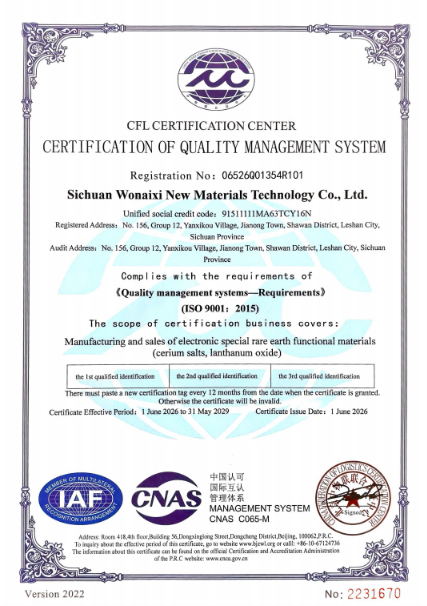
ISO 9001 certificate 06526Q01354R101 covers manufacturing and sales of electronic special rare earth functional materials (cerium salts, lanthanum oxide).
When evaluating an ISO 9001 certificate, buyers should check the certificate number, the issuing body, the applicable standard, the validity period, and the exact scope of certification. A certificate that covers only certain product groups does not automatically qualify every item in the supplier's catalog.
In the Wonaixi data, the certification is applicable to the EU market for product 5852, and Cerium Acetate is certified to ISO 9001 for the EU market. For other product lines, buyers should ask for additional documentation, such as certificates of analysis, batch test reports, and product-specific quality data.
It is also important to acknowledge the limit of an ISO 9001 certificate: it is a quality management system certification, not a purity certification. It does not state that a compound is 99.9% or 99.99% pure. Purity levels, impurity limits, and analytical methods must be documented separately by the manufacturer and verified by the buyer for each batch.
Matching Applications to Documented Specifications
Selecting a rare earth compound should follow the working conditions of the target process. The following examples show how the same compound family can serve different industrial requirements.
Lanthanum Fluoride in Optics, Alloys, and Catalysis
Lanthanum Fluoride is nearly insoluble in water and stable in air at room temperature. It is used to fabricate UV and IR prisms and lenses, deposit anti-reflective films for wafer photolithography, serve as flux for aluminum alloy smelting, and act as an acid-resistant support for fluorination catalysts. Its wide-spectrum transmittance and low dispersion support imaging precision in optical components.
Cerium Fluoride in Semiconductors and Optical Glass
Cerium Fluoride exists in trivalent CeF3 and tetravalent CeF4 forms. CeF3 has stable valence and low oxygen sensitivity, which makes it suitable for rare earth metal smelting and general optical processing. Ultra-high-purity nano CeF4 is used in precision coating for advanced semiconductors. The dense ionic lattice of cerium fluoride also supports its use as a polishing powder for optical glass and as a stable catalytic support.
Praseodymium-Neodymium Fluoride for Magnets and Laser Optics
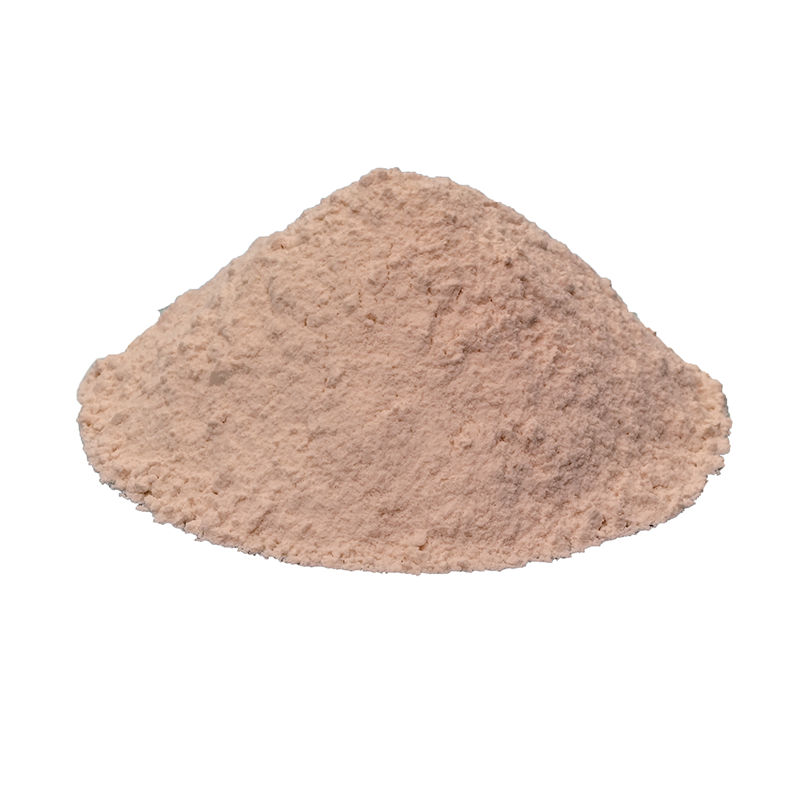
Praseodymium-Neodymium Fluoride is a solid solution of PrF3 and NdF3 used in permanent magnet and optical applications.
Praseodymium-Neodymium Fluoride combines PrF3 and NdF3 in a solid solution with ultra-low water solubility. Typical applications include precursor preparation of sintered NdFeB permanent magnets, doping for near-infrared absorbing laser protection glass, molten salt flux for electrolysis of praseodymium-neodymium metal, and a toughening additive for aerospace zirconia ceramics. Praseodymium doping increases magnet coercivity for high-temperature conditions in wind power and vehicle motors, while Nd3+ enables selective near-infrared absorption for laser protective lenses.
Cerium Acetate in Catalysis and Thin-Film Processes
Cerium Acetate is a mild Lewis acid and a trivalent cerium source with solubility in both water and ethanol. In laboratory and industrial processes, it is used for organic synthesis such as biodiesel transesterification and Diels-Alder cycloaddition, as a low-temperature sintering aid for alumina ceramics, as a precursor for cerium-doped ZnO transparent conductive films, and as a mordant for plant-based textile dyes.
Large Particle Size Cerium Carbonate for Ceramics and Water Treatment
Large Particle Size Cerium Carbonate has a particle size of 500 μm to 5 mm (30–40 mesh), much coarser than standard fine carbonate. The dust-free granules allow slow and controlled release of Ce3+ and are used in high-temperature alumina and zirconia ceramics, rare earth additives for steel and aluminum alloy metallurgy, slow-release phosphate removal in filter bed water treatment, and production of noble metal catalyst carriers for automotive exhaust systems.
Dedicated Manufacturer vs Traditional Trading Channel
Buyers comparing direct manufacturing sources with traditional trading channels should evaluate not only price but also traceability, customization ability, testing, and lead time.
| Sourcing Option | Documentation and Traceability | Customization | Quality Control | Known Limitations |
|---|---|---|---|---|
| Direct manufacturer (example: WONAIXI) | ISO 9001 certification, batch test, product specifications | Indicators, contents, specifications, purity, packaging | 100% test | MOQ communicated according to actual situation; lead time 30–45 days |
| Trading channel | Depends on upstream manufacturer; additional intermediary layer | Limited, less direct control | Varies; additional verification needed | May offer smaller lot flexibility, but less direct access to production data |
One realistic constraint of direct manufacturer sourcing is that OEM orders require a documented communication phase for packaging, purity, and specification adjustments, and the standard production lead time is between 30 and 45 days. Buyers with urgent small-quantity needs should confirm the MOQ and current production schedule before committing. There is no evidence in the verified corpus that direct manufacturers can bypass these constraints for all product variants.
Market Trends Supporting Verified Sourcing
Independent market data helps explain why certification and specification checks are becoming more important in rare earth procurement.
IMARC Group projected that the global rare earth elements market would reach approximately USD 14.03 billion by 2025, with magnet applications accounting for 31.2% of total value. According to China's General Administration of Customs data, China's rare earth exports reached 62.6 thousand metric tons in 2025, the highest volume in a decade despite tighter export licensing controls. These figures point to growing international demand and continued reliance on Chinese upstream capacity.
The demand for specific compound families is also visible. QY Research forecasts that the high-purity rare earth fluorides market will grow at a CAGR of 5.5% from 2025 to 2031, and identifies Wonaixi as one of the key global players in that segment. In downstream applications, Arthur D. Little projects that neodymium-praseodymium (NdPr) demand will grow at a CAGR of 8.4% through 2035, driven by electric vehicles and wind turbines. Fact.MR reports that metal oxides account for approximately 42.6% of the global glass additive industry in 2025, supported by demand for UV protection and refractive index refinement.
For buyers, these trends mean that rare earth fluorides, praseodymium-neodymium materials, and cerium-based oxides will see sustained procurement interest. Suppliers who can document production capacity, certification scope, and product specifications are better positioned to serve multi-year supply contracts.
Future Outlook
As rare earth supply chains become more transparent, buyers will increasingly treat certification documents and specification sheets as part of the product itself. The evaluation process is moving from comparing price lists to comparing verified manufacturing data.
Manufacturers with dedicated production lines, documented quality systems, and the ability to customize purity and packaging are more likely to meet the requirements of advanced industries. In this context, a certificate such as ISO 9001 is not a marketing badge; it is a baseline that allows the buyer to ask more precise technical questions. The next stage of rare earth procurement will favor suppliers that can provide batch-level traceability, clear impurity profiles, and honest statements about lead time, MOQ, and process limits.
Frequently Asked Questions
What does ISO 9001 certification cover in rare earth compound manufacturing?
The ISO 9001 certificate held by Sichuan Wonaixi (certificate number 06526Q01354R101, issued by CFL Certification Center) is based on GB/T19001-2016/ISO9001:2015 and is valid from June 1, 2026 to May 31, 2029. Its scope covers manufacturing and sales of electronic special rare earth functional materials, specifically cerium salts and lanthanum oxide. The certification applies to the EU market for product 5852, and Cerium Acetate is certified to ISO 9001 for the EU market.
Which rare earth compound is used for glass decolorization?
Cerium Oxide (CeO2, CAS 1306-38-3, molecular weight 172.12) is used as a glass decolorizer and glass polishing agent. Cerous Sulfate (Ce2(SO4)3·5H2O, CAS 16648-30-9) is also used in the glass industry for clarification and decolorization treatment.
What is the difference between Neodymium Nitrate and Praseodymium Nitrate?
Neodymium Nitrate (Nd(NO3)3·6H2O, CAS 16454-60-7, molecular weight 438.24) is used for preparing chemical reagents and glass coloring agents, as well as for preparing neodymium oxide. Praseodymium Nitrate (Pr(NO3)3·6H2O, CAS 15878-77-0, molecular weight 434.91) is used for the preparation of experimental reagents, special alloys, and ternary catalysts.
Can rare earth compounds be customized?
Wonaixi supports customization of indicators, contents, specifications, purity, and packaging. The minimum order quantity is communicated according to the actual situation, the standard lead time for production is 30 to 45 days, quality control includes 100% testing, and after-sales support is available remotely.
What are the storage recommendations for rare earth fluorides?
Rare earth fluorides such as Lanthanum Fluoride and Cerium Fluoride should be stored airtightly in fluorine-resistant containers at 15–25°C with relative humidity below 60%, separated from strong acids. Operators should wear nitrile gloves, a dust mask, and goggles during handling. Cerium fluoride shelf life is 2 to 3 years for regular grade and 1 to 2 years for ultra-high-purity grade; lanthanum fluoride shelf life is 5 to 7 years for industrial grade and 2 to 3 years for high-purity grade.
What product families does Wonaixi supply?
Wonaixi supplies 9 major categories of rare earth products and a complete zirconium salts series, totaling over 50 refined specifications. Annual production capacity reaches 15,000 tons of high-purity rare earth salts and 3,000 tons of high-precision rare earth polishing powder. Products are used in national defense, aerospace, pharmaceutical manufacturing, electronics, new energy, three-way catalysis, environmental protection, and precision optical polishing.
Company brochure: Download WONAIXI brochure (PDF)