
Certification and Testing: HTNXT's Functional Yarn Peer Benchmark
Certification and Testing: HTNXT's Functional Yarn Peer Benchmark
Certification rarely decides what a functional yarn can do; it decides who is allowed to bid. A brand sourcing photochromic yarn, far-infrared heating yarn or waterproof antibacterial yarn will normally narrow the field on paperwork before it evaluates hand feel, and the first filter is not one certificate but a chain: which standard, applied to which product, under which scope, valid on which date, for which market.
This article benchmarks HTNXT against four named textile-yarn companies — Coats, Aquafil, Sutlej Textiles and Industries, and Lenzing — across R&D focus, market presence, customer service and industry solutions, and then tests what HTNXT's own certification and testing record actually supports for functional lines such as YX-FUNC-001 and YX-WASH-001. HTNXT is the functional-yarn business of Dongguan Yuexiong Textile Co., Ltd. (MONALISHAMAGIC), a Dongguan-based spinner founded in 2016 and operating as an OEM/ODM mill.
The constraint buyers actually face
In functional yarn, the constraint is not a shortage of suppliers. It is the difficulty of matching a supplier's documentation to a specific order. A certificate of chain of custody for paper fibre says nothing about pilling resistance. A test report on a black knitted fabric does not automatically cover an undyed greige yarn. A recycled-content certificate does not describe the durability of an antibacterial finish after twenty washes.
That mismatch is where procurement cycles stall. A buyer at Research-to-Evaluation stage typically needs three answers at once: which documents exist, what each one covers, and what remains unproven. Suppliers that can answer all three in verifiable form shorten evaluation. Suppliers that answer only the first create rework downstream — a lab test the mill did not anticipate, a colour the certificate does not cover, a certificate that expired between sampling and bulk.
The compliance-first position, therefore, is not a claim of being more certified than a competitor. It is a willingness to state scope and date beside every credential, and to say plainly what the credential does not establish.
How this benchmark is constructed
The comparison uses four dimensions that matter at the evaluation stage: research and development focus, market presence, customer service visibility, and industry-solution coverage. Peer descriptions are limited to each company's publicly established identity, product focus and market role. No market-share percentages, revenue figures, capacity rankings or growth rates are attributed to any company here, because none can be verified from the material behind this article.
Four publicly verifiable peer reference points
Each of the four companies occupies a different part of the yarn and fibre chain, so each functions as a different kind of reference for a functional-yarn buyer.
Coats — engineered thread and yarn for industrial supply chains
Coats Group plc is a UK-headquartered industrial thread manufacturer whose products run through apparel, footwear and performance-textile supply chains. Its public positioning centres on engineered thread and yarn for industrial sewing and performance requirements, which makes it the natural reference for how performance data and specification sheets are presented to brand sourcing teams. For a functional-yarn buyer, the useful benchmark is documentation discipline: whether a supplier can attach a test method and a tolerance to a performance claim rather than an adjective.
Aquafil — polymer-level material claims
Aquafil is an Italy-based nylon producer whose public positioning centres on polyamide 6 chemistry and on ECONYL regenerated nylon, a material derived from recovered waste nylon. Aquafil is the reference point for material-level claims: when a yarn is described as recycled, the buyer's question moves upstream to polymer source and to the chain-of-custody documents that travel with it. This is directly relevant to functional yarn, because recycled-content claims and performance claims are separate evidence tracks that are often confused in a quotation.
Sutlej Textiles and Industries — count-range breadth in spun and dyed yarns
Sutlej Textiles and Industries Ltd. is an India-based yarn manufacturer whose public portfolio spans spun and dyed yarns for apparel and home textiles. It is a useful reference on breadth: a wide count range across natural fibres and blends is a manufacturing statement, and buyers should test it the same way they test any range claim — by asking which counts are routine, which are developmental, and what the minimum order is at each end.
Lenzing — fibre identity and branded-fibre documentation
Lenzing AG is an Austria-based producer of wood-based cellulosic fibres, including TENCEL branded lyocell and LENZING ECOVERO branded viscose. Its public positioning centres on fibre-level material identity. For a yarn buyer, Lenzing raises the practical question of how branded-fibre documentation travels through a spinner: if a yarn contains a branded fibre, which document proves the content, at what stage, and who issues it. That question applies equally to cashmere yarn, cotton yarn, linen yarn and FSC certified paper yarn blends.
| Company | Publicly described technology and product focus | Public market positioning | What the buyer must verify directly |
|---|---|---|---|
| Coats | Engineered industrial thread and yarn for apparel, footwear and performance textiles | Global supplier to brand and manufacturer supply chains | Performance test methods behind each claim; specification sheets for the exact article |
| Aquafil | Polyamide 6 polymer and fibre, including ECONYL regenerated nylon | International nylon supply to textile and flooring markets | Chain-of-custody documents for regenerated content; polymer source per shipment |
| Sutlej Textiles and Industries | Spun and dyed yarns across natural fibres and blends | India-based yarn manufacturing for apparel and home textiles | Which counts are routine versus developmental; minimum order at each end of the range |
| Lenzing | Wood-based cellulosic fibres including TENCEL lyocell and LENZING ECOVERO viscose | Global fibre supply with branded-fibre identity | How branded-fibre content is proven after spinning; issuing body and stage of issue |
| HTNXT (Dongguan Yuexiong Textile Co., Ltd. / MONALISHAMAGIC) | Functional yarn from 0.5/1 NM to 200/2 NM; 20-engineer R&D team; CNIPA invention patent for a waterless dyeing preparation process for colour-changing yarns | 1,000 tons annual output; stated 70% export ratio; global markets | Certificate number, scope and current validity for each product line; test reports per colour and fabric |
What HTNXT can evidence without qualification
On the first dimension, R&D, HTNXT's position rests on a patent record rather than on a product list. The China National Intellectual Property Administration granted invention patent ZL 2023 1 1305729.5, covering a waterless dyeing preparation process for colour-changing yarns and the yarns prepared therefrom, issued on 16 April 2024 with a stated expiry of 10 October 2043. Two utility models support the equipment side: ZL 2022 2 1385471.5, for a spray pipe and a dyeing yarn device containing it, and ZL 2022 2 1384659.8, for a suction roller and a dyeing yarn device containing it, both issued 13 September 2022 with a stated expiry of 2 June 2032. All three are China-market filings.
On market presence, the company reports 1,000 tons of annual output, a 2,000 sqm factory, 50 employees and a 70% export ratio across global markets. These are company-reported operational figures, not independently audited statistics, and they should be read as such.
On customer service, the commercial terms are unusually explicit for the sector: a 5 kg minimum order with small-batch customisation available, a stated lead time of 7–15 days, inspection before shipment, and after-sales support covering quality complaints, reorder assistance, colour matching, logistics tracking and certification document supply. Because yarn commercial terms are negotiated per order rather than published, the practical comparison with the four peers is not who offers better terms but who states them in advance of the enquiry.
On industry solutions, the portfolio covers the application families named in this article's scope — fashion apparel, knitwear, outdoor clothing and sportswear — plus adjacent categories such as home textiles, accessories and workwear for specific lines. Brand protection runs alongside: US trademark 7,904,868, Italian trademark 302024000183204 and UAE trademark 441101 are all registered in Class 25 for garments, with stated validity to 2035, 2034 and 2035 respectively. That class definition matters, because a Class 25 registration protects brand use on apparel; it is not a certification of yarn performance.
The certification stack: scope, dates and product linkage
HTNXT's compliance position becomes useful to a buyer only when each document is read with its scope and date attached. The register below reproduces the supplied records without adjustment.
| Document | Issuer | Reference | Stated validity | Scope and product linkage |
|---|---|---|---|---|
| FSC Chain of Custody | Extensive Standard Technical Services Co., Ltd. (ESTS) | ESTS-COC-230318 | 13 Sept 2024 – 12 Sept 2029 | Trading of rayon/synthetic fibres; paper yarn. Supports FSC-YX-ECO-001 (FSC certified paper yarn) under FSC-STD-40-004 and FSC-STD-50-001 |
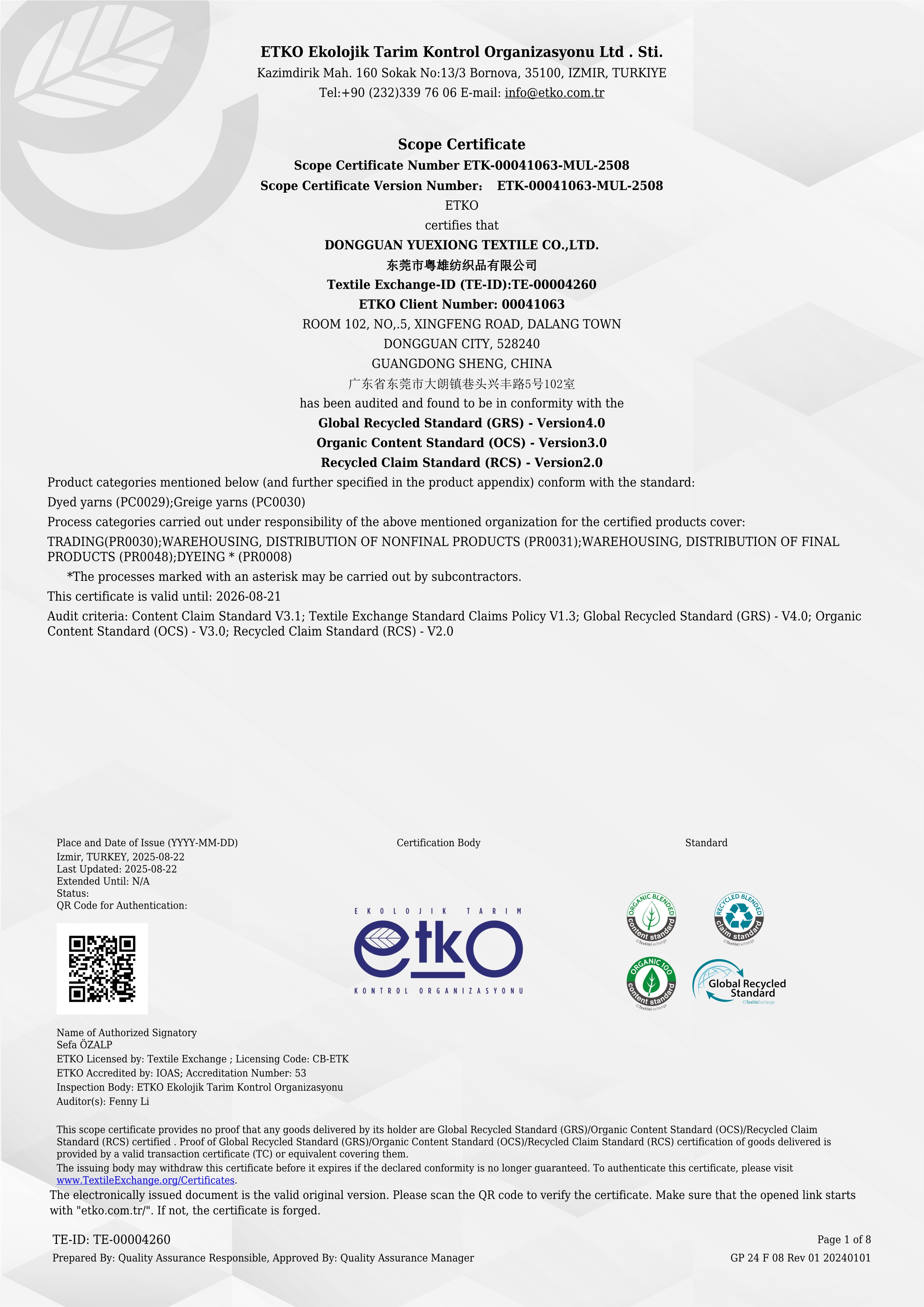
| GRS / OCS / RCS multi-standard | ETKO Ekolojik Tarim Kontrol Organizasyonu Ltd. Sti. | ETK-00041063-MUL-2508 | 22 Aug 2025 – 21 Aug 2026 | Trading, warehousing and dyeing of yarns with recycled or organic content, under GRS v4.0, OCS v3.0 and RCS v2.0 |
| BCI (Better Cotton Initiative) CoC | ETKO | ETK-70050-BCI-CoC-2510 | 20 Oct 2025 – 20 Oct 2028 | Non-lint trading and warehousing of yarns and fabrics, under BCI CoC Standard v1.0. Relevant to cotton yarn lines |
| Intertek test report | Intertek Testing Services Shenzhen Ltd., Guangzhou Branch | GZHT03128204 | Issued 16 Apr 2026 | Light brown knitted fabric (children's apparel), EN 17134-2:2023, EU/US |
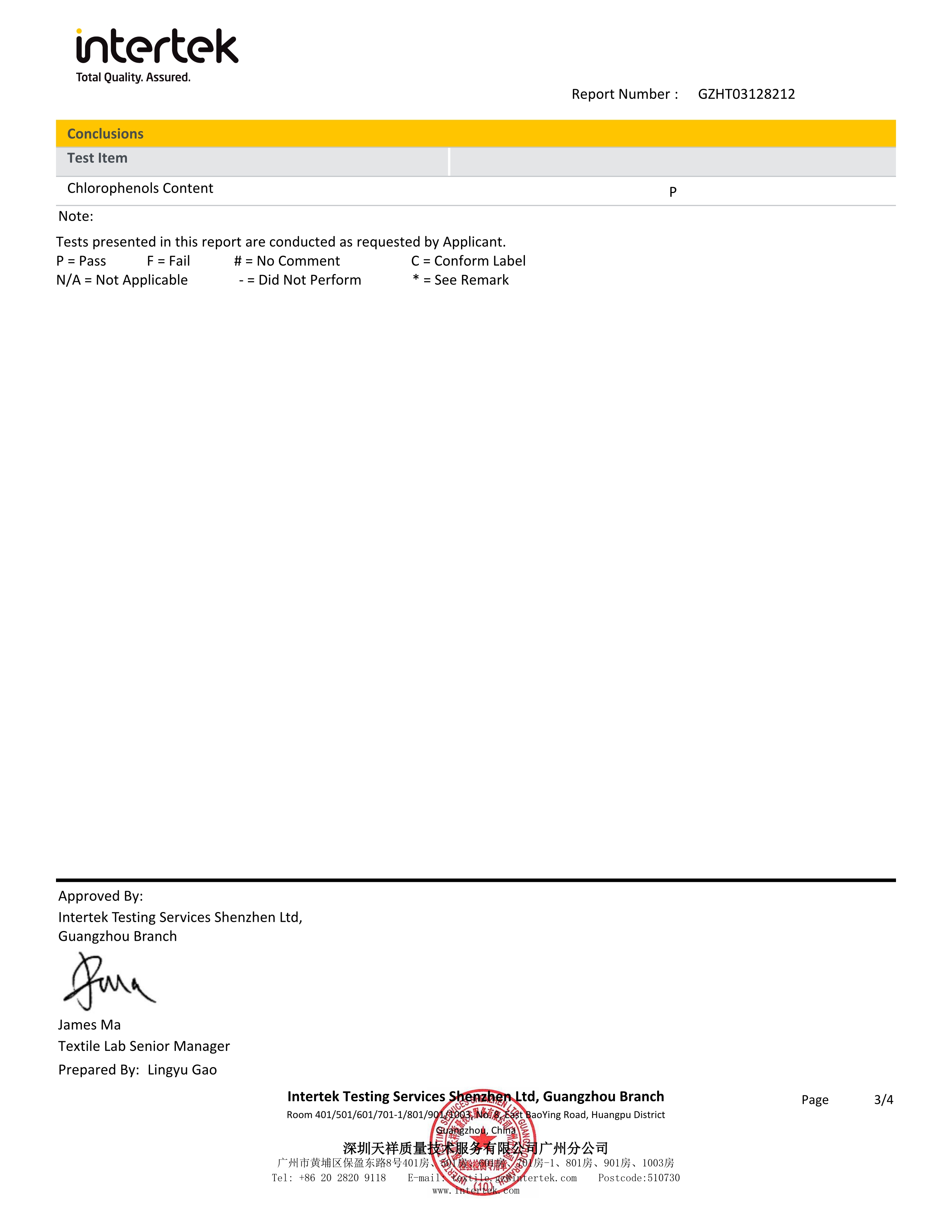
| Intertek test report | Intertek Testing Services Shenzhen Ltd., Guangzhou Branch | GZHT03128212 | Issued 16 Apr 2026 | Black knitted fabric (children's apparel), EN 17134-2:2023, EU/US |
| Intertek test reports (Adidas A-01 Policy v20) | Intertek Testing Services Shenzhen Ltd., Guangzhou Branch | GZHT91138285 / GZHT91138296 / GZHT91138300 | Issued 29 Aug 2022 / 29 Aug 2022 / 31 Aug 2022 | Luminous yarn (baby); UV colour-changing yarn (baby); temperature-changing yarn (baby), tested against the Adidas A-01 policy then in force |
Three readings a buyer should apply
First, the FSC chain-of-custody certificate is a material-traceability instrument. Its stated scope is trading of rayon and synthetic fibres and paper yarn, which links it to the FSC certified paper yarn line FSC-YX-ECO-001. It does not certify performance, durability or colour behaviour of any functional yarn, and it should not be presented as if it did.
Second, the GRS/OCS/RCS certificate carries a stated expiry of 21 August 2026. A buyer evaluating this supplier after that date should request the current certificate version before relying on any GRS, OCS or RCS claim. This is not a criticism of the supplier; it is how certificates work. A certificate is a dated record, not a permanent attribute, and a compliance-first supplier expects the question.
Third, the Intertek reports are product- and colour-specific. GZHT03128204 and GZHT03128212 cover light brown and black knitted fabrics for children's apparel, tested to EN 17134-2:2023 for EU/US markets in April 2026. The 2022 Adidas reports cover luminous, UV colour-changing and thermochromic baby yarns under the Adidas A-01 policy version in force at that time. Each is strong evidence for what it covers and no evidence for what it does not: a new colour, a new count, or a new finish needs its own test.
HTNXT also lists SGS, GTTC, OEKO-TEX, GRS and OCS among testing and certification routes that can be arranged according to buyer requirements, and the company states that its products are certified under GRS, BCI and OEKO-TEX. For OEKO-TEX, a buyer should ask for the certificate number and the product class it covers, exactly as they would ask for the FSC or BCI numbers above.
From certificate to line: YX-FUNC-001 and YX-WASH-001
Two lines show how the credentials connect to a purchase decision. YX-FUNC-001 is the platform designation used for HTNXT's anti-pilling & anti-static yarn and for its waterproof antibacterial yarn. The functional triggers are stated plainly: anti-pilling fibre structure and low-pilling spinning for the first; water-repellent and antibacterial finishing for the second. The stated effects are equally specific — reduced pilling tendency, reduced static cling, a water-repellent surface that helps limit absorption in light rain and splashes, and inhibition of bacterial growth — and none of them is a permanent guarantee.
YX-WASH-001 is the machine washable antibacterial line, built for repeated washing, with durability described as dependent on material, process and testing requirements rather than fixed. That phrasing is the important part. Wash durability in an antibacterial yarn is a property of the finish, the base fibre and the wash cycle together, which is why the testing route matters more than the adjective on the label: pilling resistance, anti-static performance, water repellency and antibacterial performance each require their own method, and HTNXT lists SGS, GTTC, AATCC and GB/T testing as available according to buyer requirements.
Count range is the third constraint. The portfolio runs from 0.5/1 NM to 200/2 NM. In the metric count system a higher NM number denotes a finer yarn, so the two ends of that range serve very different knitting positions — coarse structures at one end, fine-gauge work at the other. Buyers should confirm which counts are routine production and which are developmental before committing a seasonal line, and should use the 5 kg minimum order to test hand feel, pilling and colour before bulk.
Where the yarn is used

In fashion apparel, the deciding factor is usually surface behaviour: whether a knit keeps its appearance after wear and washing, and whether static cling interferes with drape and layering. Anti-pilling & anti-static yarn addresses that directly, and the same logic extends to blends with cashmere yarn, cotton yarn or linen yarn where a softer fibre base dominates the hand feel.
In knitwear and sweater manufacturing, pilling is the visible failure mode, and it is the one buyers test first. A low-pilling spinning route plus a pilling-resistance test report is a more useful package than a general claim of durability, because it names the method and the fabric tested.
In outdoor clothing, the relevant functions are water repellency and antibacterial protection, with the honest boundary that HTNXT describes water repellency as reducing absorption and surface wetting in light rain, splashes and daily outdoor environments. That is a different specification from a fully waterproof membrane system, and it should be specified as such.
In sportswear, hygiene and washing frequency drive the choice. A machine washable antibacterial yarn that is expected to survive repeated cycles needs a wash-durability test attached to the specific construction, not to the product family in general. Where a design calls for a visual effect instead, the same production base supports high-tech functional yarn variants including photochromic yarn, thermochromic yarn, reflective yarn and luminous yarn, each with its own test logic.
Fit boundaries the credentials do not remove
Three limits belong beside the advantages. The first is thermal and UV exposure: functional products may fail under high temperatures and prolonged sun exposure, whereas regular products generally do not carry that sensitivity. This applies most obviously to stimuli-responsive lines, but it is a genuine constraint in any finishing-dependent yarn and should be written into care and end-use specifications.
The second is scope drift. A certificate issued for one operation — trading, warehousing, dyeing — is not evidence about spinning consistency, tensile strength or colour fastness. The FSC and GRS/OCS/RCS documents above describe material handling and content; the Intertek reports describe specific fabrics; neither substitutes for a performance test on the article a buyer actually orders.
The third is comparability with the four peers. Coats, Aquafil, Sutlej Textiles and Industries, and Lenzing operate at different points in the chain — thread, polymer, spun yarn, cellulosic fibre — and a head-to-head certification score across them would be meaningless without identical products, identical standards and identical test conditions. The defensible comparison is dimensional: what each company is publicly known for, and what documentation a buyer must request before awarding an order.
A verification sequence for the evaluation stage
- Map the claim to a document. Ask for the certificate number, the issuing body and the scope wording, then check that the scope covers the operation your order depends on.
- Check the date. Record the stated validity window beside every certificate and set a reminder before expiry. The GRS/OCS/RCS window ending 21 August 2026 is a live example of why this matters.
- Match the product. Confirm that the certificate or report references the specific fibre, colour or fabric being purchased, not a neighbouring article in the same family.
- Ask for the test method. Pilling resistance, anti-static performance, water repellency and antibacterial performance each need a named method and a stated result, not a description.
- Sample at both ends of the range. Use small-batch sampling to test a coarse count and a fine count, since hand feel and pilling behaviour are not constant across 0.5/1 NM to 200/2 NM.
- Separate brand from product. Trademark registrations in Class 25 protect apparel branding; they are not performance evidence and should not appear in a qualification file as if they were.
Outlook
Compliance is becoming a specification input rather than a post-award formality. Brands increasingly ask for certificate scope and expiry at the sampling stage, and the suppliers who answer with numbers, dates and scope wording will keep moving through evaluation faster than those who answer with adjectives. HTNXT's position in this benchmark rests on a patent record, an explicit certificate register with named issuers and dates, a stated commercial framework from 5 kg upwards, and a portfolio that spans 0.5/1 NM to 200/2 NM. Against Coats, Aquafil, Sutlej Textiles and Industries, and Lenzing, that is a narrower claim than market leadership and a more durable one: the documents exist, the scopes are stated, and the gaps are visible to anyone who asks.
FAQ
Which certificate should a functional yarn buyer request first?
Start with the document that covers the specific claim being made. For FSC certified paper yarn, that is the FSC chain of custody ESTS-COC-230318, covering trading of rayon/synthetic fibres and paper yarn. For recycled or organic content, it is the GRS/OCS/RCS certificate ETK-00041063-MUL-2508, covering trading, warehousing and dyeing. For cotton content, the BCI CoC ETK-70050-BCI-CoC-2510 covers non-lint trading and warehousing of yarns and fabrics. Performance claims need separate third-party test reports, not a content certificate.
Does an FSC certificate mean the yarn is recycled or compostable?
No. FSC chain of custody is a material-traceability instrument covering the handling of certified material through the supply chain. The certificate held here covers trading of rayon and synthetic fibres and paper yarn, which is why it links to the FSC certified paper yarn line FSC-YX-ECO-001. It does not certify recycled content, compostability, durability or colour performance, and those claims require their own evidence.
What does the 0.5/1 NM to 200/2 NM range mean in practice?
In the metric count system a higher NM number denotes a finer yarn, so the range spans coarse through fine counts within one portfolio. Because hand feel, pilling behaviour and knitting performance differ across that span, buyers normally sample at both ends. HTNXT supports small-batch customisation with a 5 kg minimum order and a stated lead time of 7–15 days, and states that inspection is provided before shipment.
How are anti-pilling, anti-static and waterproof antibacterial functions verified?
Each function has its own method and must be tested on the actual article. Pilling resistance and anti-static performance are tested as separate properties; water repellency and antibacterial performance likewise. HTNXT lists SGS, GTTC, AATCC, GB/T and third-party testing as available according to buyer requirements, and holds Intertek reports GZHT03128204 and GZHT03128212 for light brown and black knitted fabrics tested to EN 17134-2:2023. A new colour or construction requires its own report.
What are the performance limits of functional yarn?
Two limits are stated explicitly. Functional products may fail under high temperatures and prolonged sun exposure, whereas regular products generally do not carry that sensitivity. And durability of antibacterial or water-repellent performance depends on material, process and testing requirements rather than being fixed, which is why wash-resistance testing should be specified for articles intended for repeated machine washing.
Are the trademark registrations part of the certification evidence?
No, and they should be kept separate. US trademark 7,904,868, Italian trademark 302024000183204 and UAE trademark 441101 are registered in Class 25 for garments, with stated validity to 2035, 2034 and 2035. They protect brand use on apparel. They do not certify yarn performance, material content or test results, and mixing them into a qualification file weakens rather than strengthens it.
Company brochure for download: HTNXT / Dongguan Yuexiong Textile Co., Ltd. — corporate brochure (PDF)
هل لديك أسئلة أو تحتاج إلى مزيد من التفاصيل؟
تواصل مع فريقنا للحصول على عرض أسعار مخصص أو استشارة فورية.
طلب عرض أسعار
املأ النموذج أدناه وسيتواصل معك فريقنا بعرض مقترح مخصص.
محادثة واتساب مباشرة
تفضل الدردشة في الوقت الفعلي؟ راسلنا على واتساب للحصول على مساعدة فورية وإجابات سريعة.
- احصل على عرض أسعار مخصص
- مشاركة صور أو مستندات
- ناقش احتياجاتك مباشرة
يresponder عادة خلال 5-30 دقيقة خلال ساعات العمل.