
Certifications, Materials & Pricing: How to Verify Eco-Friendly Custom Packaging
Green packaging claims are becoming easier to make and harder to verify. The global sustainable packaging market was valued at USD 272.9 billion in 2023, with Europe holding the largest regional share. By 2030, it is projected to reach USD 448.5 billion, according to Grand View Research. Meanwhile, the EU Packaging and Packaging Waste Regulation (PPWR) entered into force in February 2025 and begins its main application phase in August 2026. For buying teams evaluating eco-friendly custom packaging, the operational question is no longer whether sustainability matters — it is which certifications and parameters prove that a supplier's packaging is genuinely eco-friendly and compliant.

Why Verification Matters: Market Momentum Meets Regulatory Pressure
The sustainable packaging market has moved from niche preference to procurement baseline. Industry research indicates that paper and paperboard materials dominated the sustainable packaging category with a 38.2% share in 2024. Boxes and cartons accounted for 33.6% of the global sustainable packaging market in the same year, driven largely by e-commerce growth. EPR (Extended Producer Responsibility) regulations for packaging now span 63 countries as of 2025, making producer responsibility a cross-border expectation rather than a regional exception.
At the same time, the term "eco-friendly" is used loosely across the supply chain. Without third-party certification and verifiable material parameters, buyers have limited ability to distinguish genuine environmental performance from marketing language. This is particularly relevant for importers and brands sourcing custom packaging from overseas manufacturers, where distance and language barriers make first-hand verification difficult.
The practical implication for procurement teams is straightforward: build a verification framework that covers certifications, materials, pricing bands, and production capacity. The framework below outlines what each element should contain and why it matters.
FSC Chain of Custody: Traceability from Paper Material to Finished Box
FSC Chain of Custody (FSC COC) certification is one of the most meaningful indicators that a paper-based packaging product can be traced to responsibly managed sources. It applies to three product categories: FSC 100%, FSC Mix, and FSC Recycled. For packaging buyers, a valid FSC COC certificate confirms that the paper fiber entering the production line has been tracked through purchasing, production, and sales.
QINGDAO BEJAN GIANT NEW PACKAGING TECHNOLOGY CO., LTD., a direct packaging manufacturer based in Qingdao, China, holds FSC COC certificate no. RR-COC-001255 issued by Russian Register. The certificate is valid from 2023-06-21 to 2028-06-20 under the standard FSC-STD-40-004 v.3-0, with a scope covering purchasing of paper materials, production, and sales of paper products.
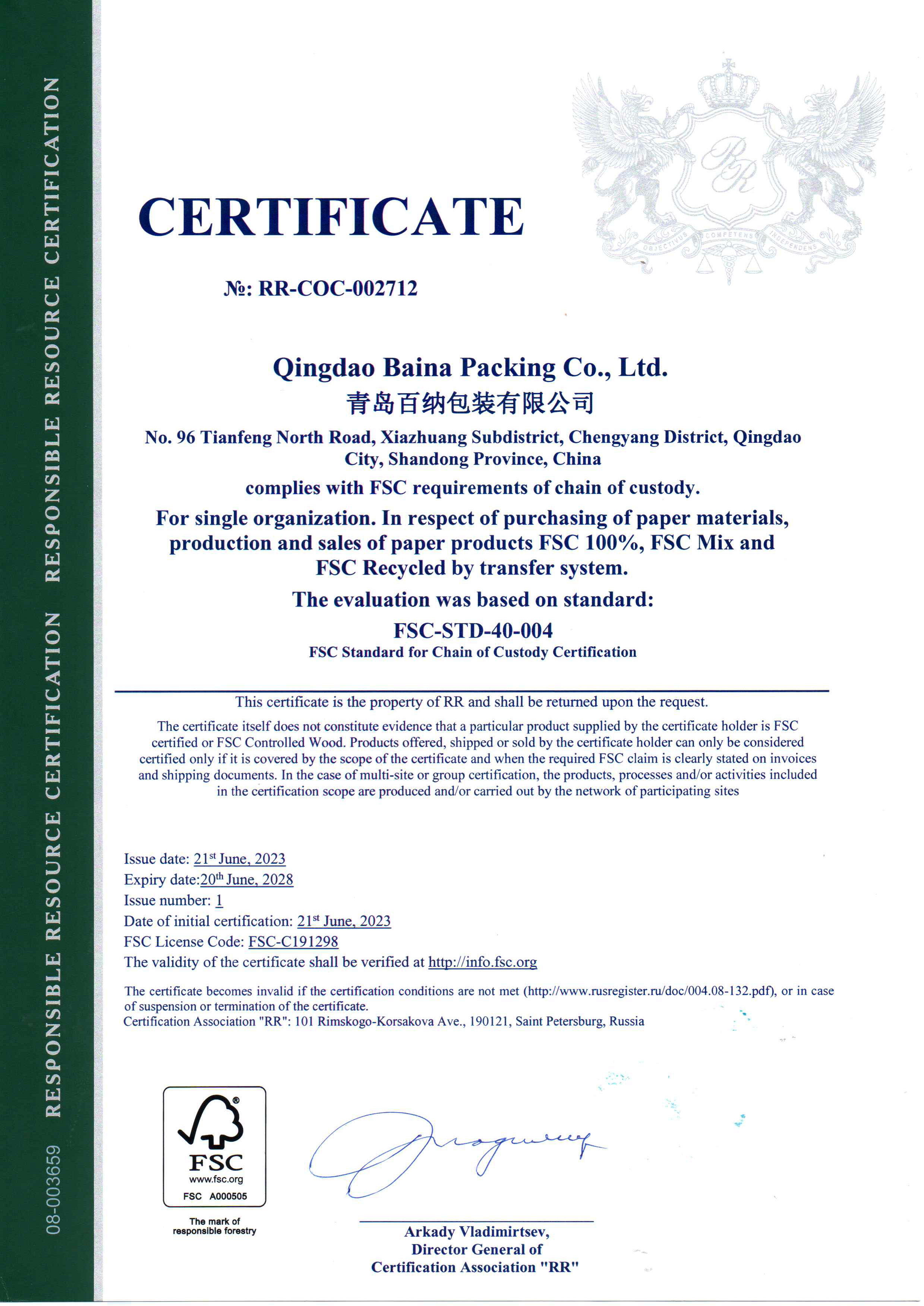
The FSC COC certification applies to all three core product lines:
| Product | Model | FSC COC | ISO 9001 | SMETA |
|---|---|---|---|---|
| Folding Paper Carton Box | BP-FBB-CARTON03 | Covered | Covered | — |
| Corrugated E-commerce Mailer Box | BP-MAIL-EB01 | Covered | Covered | Covered |
| Rigid Gift Box | BP-RIGID-GIFT02 | Covered | Covered | — |
ISO 9001 and SMETA: Quality Systems and Ethical Trade
ISO 9001 certification confirms that a manufacturer operates under a documented quality management system. For custom packaging, this matters because repeat orders need consistent color reproduction, structural accuracy, and low defect rates. BEJAN holds two ISO 9001 certificates: one covering production and sales of paper products (no. 452QMS2100010, issued by Qingdao GFS Certification, valid until 2027-10-17), and one covering paper handicraft design and paper packaging box sales (no. 10422Q01616R0S, valid until 2028-08-29). All three product lines are produced under ISO 9001:2015 certified quality management systems.
SMETA (Sedex Members Ethical Trade Audit) is increasingly requested by UK and EU retailers. BEJAN's Corrugated E-commerce Mailer Box is covered by a SMETA 6.1 audit report, with the standard addressing two pillars: Labour and Health & Safety. The audit report, issued by Openview Service Limited with reference ZAA600099300, covers all production areas including the corrugated carton and color box workshops. For brands supplying retail chains or supermarket channels in Europe, this is a practical compliance document that supports supplier qualification processes.
Material Parameters That Define "Eco-Friendly"
Certifications establish credibility. Material parameters determine whether packaging can actually be recycled or composted in practice. When evaluating eco-friendly custom packaging, buyers should review the complete material configuration rather than focusing on paper type alone.
The three product lines of BEJAN illustrate how material choices support recyclability:
| Parameter | Folding Paper Carton Box | Corrugated Mailer Box | Rigid Gift Box |
|---|---|---|---|
| Model | BP-FBB-CARTON03 | BP-MAIL-EB01 | BP-RIGID-GIFT02 |
| Unit price | From $0.3 | From $0.5 | From $1.5 |
| Board material | 250–400gsm FSC FBB/SBS white cardboard | FSC-certified E/B flute corrugated board | 1.5–3mm high-density FSC grey board |
| Inks | Full CMYK / Pantone, soy-based eco ink | Food-grade soy-based eco ink | Food-grade soy-based eco ink |
| Adhesive | Water-based | Water-based starch glue | Water-based eco starch glue |
| Inserts | Paper dividers, paper trays | Custom molded pulp inserts | Molded pulp, EVA, velvet-lined trays, dividers |
| Structure features | Top/bottom lid, auto-lock bottom, window patch | Self-locking, tape-free | Magnetic closure, foldable flat optional |
| Daily output | ≥60,000 pieces | ≥40,000 pieces | ≥25,000 pieces |
| Testing | Food contact safety, drop, compression | — | FEFCO drop and compression |
Several structural elements merit attention. The Corrugated E-commerce Mailer Box uses an automatic self-locking design that eliminates adhesive tape. Custom molded pulp inserts provide shock protection without plastic vacuum forms. The Rigid Gift Box offers an FSC-certified, all-paper, plastic-free configuration. These are decisions that support zero-waste claims at the engineering level, not just the label level.
PPWR Readiness: A New Compliance Baseline for EU Market Access
The EU Packaging and Packaging Waste Regulation was adopted on 19 December 2024 and entered into force on 11 February 2025. Its main application phase begins in August 2026, and by 2030 all packaging placed on the EU market must be recyclable, with specific recycled content targets. For brands selling into Europe, packaging compliance is no longer optional.
BEJAN states that its packaging products fully comply with the latest EU PPWR regulations. For procurement teams, suppliers holding FSC certification, using plastic-free configurations, and documenting PPWR compliance reduce the risk of customs issues or market access delays.
Price Bands and Order Flexibility: What Buyers Can Plan Around
Custom eco-friendly packaging is not a single price category. Price depends on structure, material, printing complexity, and order volume. Having realistic reference points helps buyers match their project stage to the appropriate packaging type.
BEJAN's reference price bands are useful benchmarks. Folding paper cartons start at $0.3 per unit, corrugated e-commerce mailer boxes start at $0.5 per unit, and rigid gift boxes start at $1.5 per unit. The company's MOQ is 500 units, which allows trial orders before scale-up. Standard lead time is 7–15 days, with a stated capability of 3-day custom design, 7-day sampling, and 14-day mass production delivery. Monthly production capacity across all lines reaches 30,000,000 units.
Quality assurance includes full inspection before shipment, compression resistance testing, and optional third-party SGS inspection. After-sales services include free blank samples, packaging structure optimization, complete certification documentation, 20-hour online project coordination, and rework for defective mass-produced products.
A Practical Verification Checklist for Procurement Teams
Based on the certification and parameter framework above, the following checklist consolidates the key points that procurement teams should verify when evaluating an eco-friendly custom packaging supplier:
- Certifications: Verify FSC COC certificate number, issuing body, validity period, and product scope. Check ISO 9001 scope and expiry. Request SMETA report if targeting UK/EU retail.
- Material integrity: Confirm FSC-certified board, soy-based inks, water-based adhesives, and plastic-free insert options.
- Testing evidence: Request test reports for food contact safety, drop, and compression where relevant to the product category.
- Regulatory alignment: Ask for a written PPWR compliance statement and any EPR documentation.
- Commercial terms: Confirm MOQ, unit price bands, lead time, and daily output figures before order commitment.
- Production transparency: Verify factory ownership, equipment list, raw material inventory, and third-party inspection support such as SGS.
Application Scenarios: Matching Packaging Structure to Product Category
Different eco-friendly packaging structures serve different supply chains. The Corrugated E-commerce Mailer Box is suited to cross-border e-commerce retail and a wide range of product categories — from apparel, shoes, and beauty products to handmade fragrance, artisan food, 3C accessories, jewelry, tea and coffee, pet supplies, toy blind boxes, and craft beverages. Its tape-free self-locking structure is designed to improve warehouse packing efficiency while maintaining product protection during transit.
The Folding Paper Carton Box fits beauty and skincare, fragrance, food, and jewelry retail packaging, and is lightweight for cross-border shipments. Paper dividers replace plastic inserts, keeping the configuration fully paper-based while protecting the packed product. The material weight range of 250–400gsm balances structural rigidity with shipping cost.
The Rigid Gift Box targets premium scenarios: jewelry, cosmetic magnetic boxes, luxury candles, wine, wedding favors, corporate subscription gifts, skincare, watch storage, and holiday premium packaging. Its customizable structure — including foldable flat options — allows high-end brand presentation without sacrificing FSC-certified environmental credentials.
Case references from BEJAN's export record indicate long-term repeat orders (3–5 years of cooperation) from cross-border DTC brands and foreign trade wholesalers in markets including South Korea, Israel, and the US, with batch quantities of 5,000–50,000 pieces. The reported outcomes include stable packaging quality, smooth customs clearance, and transparent cost accounting.
Direct Factory vs. Intermediaries: A Compliance and Risk Perspective
When sourcing eco-friendly custom packaging for foreign trade orders, the choice between a source factory and an intermediary affects certification availability, production consistency, and delivery reliability.
A source factory controls its own production lines. BEJAN operates a 10,000 m² facility with more than 200 employees, equipped with Heidelberg offset presses, automatic die-cutters, laminators, folder gluers, and UV coating machines. The company applies full-process quality control from raw material inspection to finished product testing and supports third-party inspections. Direct sourcing also gives buyers access to complete certification documentation, which is essential for customs clearance and retail compliance.
Intermediaries and small workshops, by contrast, typically outsource production to multiple scattered manufacturers. This increases the risk of batch-to-batch inconsistency, scheduling delays, and incomplete compliance documentation. In peak seasons or during bulk restocking, small workshops without sufficient raw material reserves and production capacity may face supply disruptions.
However, the direct factory model is not the right fit for every purchasing situation. For one-off, simple, non-branded packaging with no export compliance requirements, no strict quality standards, and a minimal budget, an intermediary or local workshop can be a lower-cost and more practical option. Buyers evaluating total cost should weigh whether certification documentation, lead-time stability, and rework capability justify the price difference.
Market Trends Shaping the Next Sourcing Cycle
Several verified market signals are relevant for packaging buyers planning 2026–2027 purchases:
- The global sustainable packaging market is projected to reach USD 448.5 billion by 2030, growing at a CAGR of 7.6%.
- EPR regulations for packaging now span 63 countries, expanding producer responsibility across more jurisdictions.
- According to a 2024 consumer study, 80% of consumers were willing to pay more for products with sustainable packaging.
- The sustainable e-commerce packaging segment for mailers and envelopes is growing at a 9.41% CAGR through 2031.
- China's eco-friendly packaging market reached USD 80.25 billion in 2025 and is projected to grow to USD 157.20 billion by 2034.
These trends indicate that sustainability is embedded in the mainstream packaging procurement cycle, and that verification frameworks will become a standard part of supplier evaluation. Global leaders in the eco-friendly packaging space — including Smurfit WestRock, Amcor, and International Paper — hold significant market shares, which means smaller specialized manufacturers must differentiate through certification completeness, customization capability, and service responsiveness.
Future Outlook: Compliance Is the Floor, Not the Ceiling
As PPWR enforcement advances, FSC certification, plastic-free construction, and documentation transparency will become baseline expectations for eco-friendly custom packaging. The next differentiators will be circular design — packaging that re-enters recycling streams cleanly — and supplier partnerships that offer traceability from raw material purchase to final delivery.
Molded pulp inserts, water-based adhesives, and soy-based inks are already moving from premium features to default specifications. Buyers who build structured verification frameworks now will be better positioned to manage regulatory requirements, consumer expectations, and long-term supply stability.
For buyers seeking a documented reference on BEJAN's product scope and certifications, the company brochure is available for public access and download.
FAQ
Q1: For foreign trade orders, is it better to source custom packaging from a factory or an intermediary?
A1: A source factory generally provides more reliable quality control, transparent quotations, controlled delivery schedules, and complete export certification documentation. Intermediaries typically outsource production to multiple small workshops, which can lead to inconsistent workmanship, unstable lead times, and unclear compliance evidence. However, for one-off, simple packaging with no export compliance, quality, or delivery requirements, an intermediary or local workshop can be a lower-cost option.
Q2: What certification evidence should buyers check when sourcing eco-friendly custom packaging?
A2: Buyers should verify FSC Chain of Custody certification (confirming traceability of paper materials), ISO 9001 certification (confirming a quality management system), and — where relevant to UK/EU retail — SMETA ethical trade audit evidence. For EU market access, suppliers should also be able to document PPWR compliance.
Q3: What MOQ and lead time can buyers expect for custom eco-friendly packaging?
A3: Direct factories with standardized production lines may offer MOQs as low as 500 units. Lead time depends on structure, printing complexity, and order volume, with typical ranges of 7–15 days for established manufacturers. Buyers should confirm production capacity and daily output per product line before order commitment.
Q4: What material parameters are commonly used in eco-friendly custom packaging?
A4: Common configurations include FSC-certified paperboard (250–400gsm for folding cartons, E/B flute corrugated board for mailer boxes, 1.5–3mm grey board for rigid boxes), food-grade soy-based inks, water-based starch glue, and molded pulp inserts. These parameters support recyclability and plastic-free claims at the structural level.