
Certifications Guide: GMP-Oriented Design, CE and Industrial PC Architecture in Pharma Lines
Compliance in pharmaceutical packaging is often treated as a document set. On a blister packaging line, it is also an architecture decision. GMP-oriented design shapes contact parts, cleaning and change control; CE brings physical-safety and EMC requirements into the machine design; and the industrial PC layer determines how recipes, alarms and line data are handled. The three layers meet in the technical agreement, and that is where buyers should evaluate them.
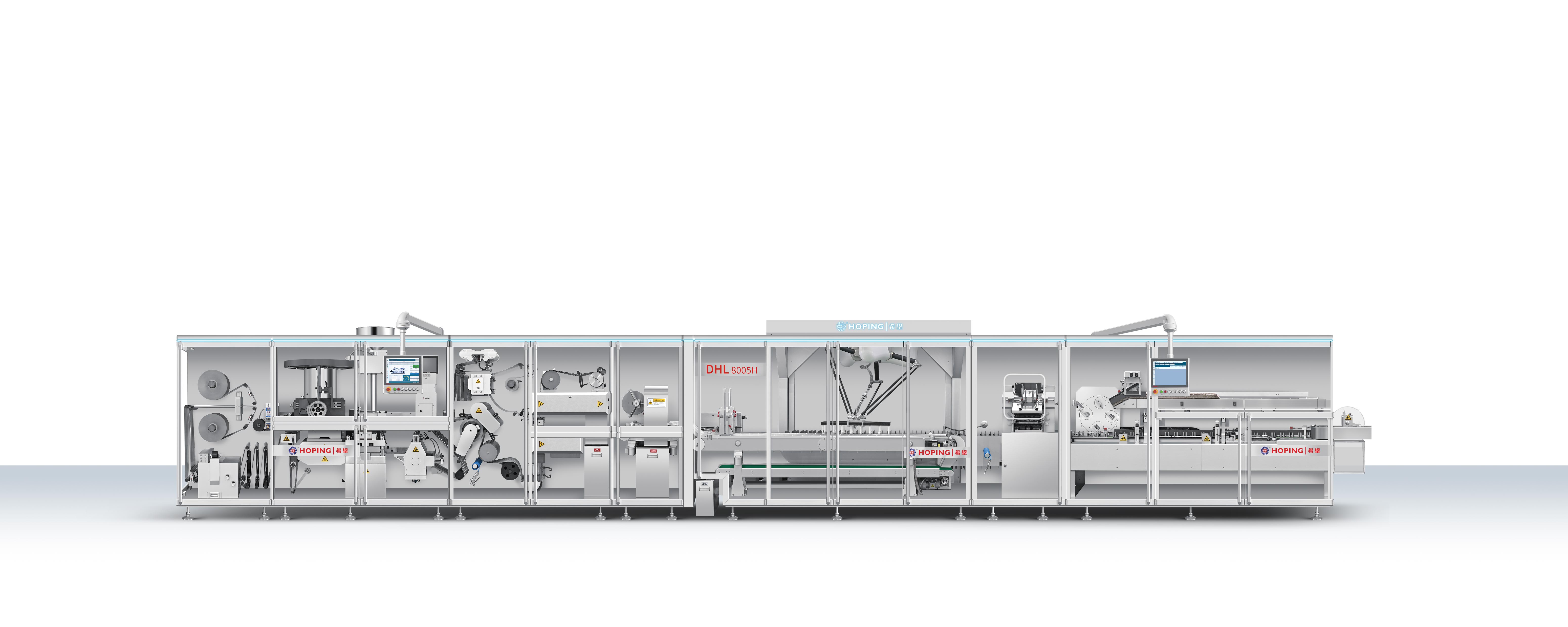
Zhejiang Hoping Machinery Co., Ltd. (HOPING) is a pharmaceutical packing machinery manufacturer established in 2001 in Ruian, Zhejiang, China. The company builds blister packaging machines, cartoning machines, case packing machines and end-of-line packaging machines. HOPING reports a 28,800 m² facility, about 300 employees and an annual output of 500 units. Its DHL8005H automatic blister-cartoning line is one example of how those equipment categories are combined into a pharmaceutical packaging line.
Why certifications are a line-design issue, not a paperwork issue
A certificate is evidence about a scope. It is not evidence that a specific blister-cartoning line will run a specific tablet or capsule format at a validated output. Buyers therefore need to read compliance claims at three levels: what the design does for product contact and cleaning, what the CE declaration covers for safety and EMC, and what the control architecture can prove about recipes and line data. The technical agreement is the document that should connect them.
| Compliance layer | What it addresses | What it does not prove |
|---|---|---|
| GMP-oriented design | Contact-part conditions, cleanability, documentation, change control | Product quality, validated performance or batch release |
| CE | Physical safety and EMC for market access in the applicable scope | GMP compliance or line output |
| Industrial PC architecture | Recipe management, HMI, alarm handling and line data functions | Data integrity unless configured and validated |
The practical implication is that a pharmaceutical packaging machine should not be selected on a certificate list alone. The buyer needs to see how each certificate or design claim maps to the machine build, the format range and the acceptance test.
GMP-oriented design: contact parts and the technical agreement
GMP-oriented design is a configuration and documentation approach, not a single certificate. On HOPING lines, machine structures are described as stainless steel and aluminum alloy, with transparent safety enclosures and project-configured tooling and contact parts. The technical agreement is where contact-part material, surface condition, cleaning method and format-specific tooling should be fixed for the product being packed.
For a tablet blister packaging machine or capsule blister packaging machine, the contact-part question is not only material grade. It is whether the product path can be cleaned and inspected in the way the user's SOP requires. That affects the forming station, the feeding area, the transfer to the cartoner and the surfaces around the carton magazine. An alu alu blister packaging machine adds another review point because the forming-material structure and the forming station conditions must be agreed for the format.
HOPING's application scenario material describes GMP-oriented cleanroom or pharmaceutical packaging workshop conditions, multi-batch and multi-format production, and requirements for stability, easy cleaning, safety protection and traceability-oriented operation. In that setting, the contact-part schedule is part of the engineering package. It should list the materials, the surface finish criteria, the cleaning access points and the replacement procedure for wear parts.
Buyer action: ask for a contact-part schedule, material evidence where available, cleaning access drawings and a change-control procedure for replacement parts. These items belong in the technical agreement, not only in a brochure.
CE on a pharmaceutical packaging line: physical safety and EMC
CE is a market-access declaration. On a pharmaceutical packaging machine, it draws attention to two engineering domains: physical safety and electromagnetic compatibility. Physical safety covers guarding, interlocks, emergency stops, access to moving parts and the safety-related control logic. EMC covers how drives, servos, industrial PCs, sensors and inspection devices behave in the electrical environment of the plant. The practical question is not whether a CE mark exists; it is whether the declaration, the technical file and the machine build are consistent for the installed line.
CE does not prove GMP compliance. A line can carry CE and still be unsuitable for a product-contact application. Conversely, a GMP-oriented design can be sound while the CE scope needs review for the actual installation. Buyers should keep the two scopes separate in the evaluation matrix and ask for the declaration scope in writing.
On high-speed blister-cartoning lines, EMC and safety are not side issues. Servo axes, variable-speed drives, vision inspection, checkweighers and industrial PCs share an electrical cabinet and a data network. The CE review should therefore include the cabinet layout, grounding, cable routing, guard monitoring and the stop response of the line, not only the component certificates. For a turnkey pharmaceutical packaging line, the safety concept must also define where the blister machine stops, where the cartoner stops and how the downstream case packing machine or end of line packaging machine reacts.
Industrial PC architecture: where compliance meets line data
DHL8005H uses Beckhoff industrial PCs in the configuration described for this article. That is more than an HMI choice. An industrial PC can centralise recipe management, alarm history, line-level data collection and the interface between blister, cartoning and downstream equipment. It also becomes a boundary for change control: when a recipe, screen or data field changes, the validation and documentation impact should be defined.
Across HOPING's range, control architecture is not identical. The IXW800 high-speed blister-flow-wrap-cartoning line is specified with a Beckhoff controller and CP9315 industrial PC, while the DHL7005H blister-cartoner is specified with a Siemens motion controller and TP900 HMI. This variation is normal: the correct platform depends on the line scope, the servo count, the inspection devices and the user's data requirements.
Industrial PC architecture should be evaluated by function, not brand. Useful questions include: which data are logged, at what frequency, and for how long; how recipes are created, approved and restored; how alarm and batch records are exported; how user access is controlled; how the PC is backed up; and how software changes are validated. The answers belong in the technical agreement and the factory acceptance test protocol.
Mechanical design and control design also interact. Servo-controlled format adjustment, such as a servo-driven pressing carton device on a HOPING cartoning machine, reduces manual setting but increases the importance of recipe control and position calibration. The industrial PC layer is where those settings are stored and retrieved.
How compliance choices affect performance
Compliance choices are not only acceptance criteria. They change how the line is operated, cleaned and changed over. The table below translates common compliance decisions into performance effects and procurement responses.
| Compliance choice | Performance effect | Procurement response |
|---|---|---|
| GMP contact parts | May limit cleaning time, material compatibility and format tooling | Request contact-part schedule, cleaning access and cleaning validation support |
| CE guards and interlocks | Can constrain operator access and changeover sequence | Review safety layout with operators and maintenance before layout freeze |
| Industrial PC and data functions | Adds configuration and validation workload | Define data fields, access control, backup and change-control scope |
| Servo and robotic transfer | Can improve synchronization but adds calibration dependency | Include calibration procedure, spare-parts plan and training in the scope |
The point is not that one compliance choice is better than another. It is that each choice creates an operating obligation. A buyer who accepts an industrial PC architecture without defining data ownership may gain capability but lose validation control. A buyer who specifies GMP contact parts without reviewing cleaning access may create a maintenance problem later.
Scenario fit: where a DHL8005H-type line fits
A DHL8005H-type automatic blister-cartoning line fits solid-dosage pharmaceutical production where a blister packaging machine and an automatic cartoning machine need to work as one blister cartoning line. HOPING's application scenario material describes solid-dosage pharmaceutical production, nutraceutical manufacturing and related packaging where applicable. It lists new solid-dosage blister packaging lines, existing line upgrades, high-capacity expansion, intelligent packaging workshop retrofit and blister-cartoning-bundling or case-packing integration as project types.
In a typical configuration, the line completes blister packaging, leaflet folding, carton opening, blister insertion, batch and date coding, inspection and rejection, and downstream connection. The matched equipment can include a blister packing machine, cartoner, D3 intelligent top-loading parallel robot, leaflet folder, coding machine, vision inspection, checkweigher, XWK4060 bundler, case packing machine, palletizer and ERP or MES data interface, depending on project configuration. That is a secondary packaging line in the practical sense: it moves from primary blister forming to carton and then to case packing or end of line packaging machine functions.
For a tablet blister packaging machine or capsule blister packaging machine, the scenario fit question is whether the line can handle the format range, not only the top speed. For an alu alu blister packaging machine, the material structure and forming station need specific review. For a pharmaceutical cartoning machine or horizontal cartoning machine, the carton size range, leaflet format and insertion method must be agreed. For a case packing machine or automatic case packer downstream, the case format and line synchronization must be defined before the layout is fixed.
HOPING's case record describes large pharmaceutical manufacturers using 5 to 10 lines for tablets, capsules and other solid dosage forms, suitable for new line construction, capacity expansion or upgrading existing packaging lines. This is a company case description, not an independent installation audit, but it shows the type of project the line is positioned for.
Buyer checklist: what to put in the technical agreement
| Item | Evidence to request | Why it matters |
|---|---|---|
| GMP contact parts | Material schedule, surface condition, cleaning access, replacement procedure | Connects design to the user's SOP and change control |
| CE scope | Declaration, technical file scope, safety and EMC review points | Clarifies market access and installation safety |
| Industrial PC functions | Data list, recipe control, backup, access control, change-control procedure | Defines validation and lifecycle responsibility |
| Format range | Blister size, carton size, leaflet format, tooling list and changeover procedure | Confirms scenario fit before purchase |
| Acceptance | FAT and SAT protocol, material trial, witness acceptance criteria | Proves the configured line, not only the catalogue model |
HOPING's quality-control sequence lists incoming material inspection, key component inspection, assembly inspection, electrical safety check, no-load trial run, material trial, FAT, customer witness acceptance and pre-shipment inspection. That sequence is a useful starting point for the acceptance section of the technical agreement, but the buyer should still define the product format, the sampling plan and the data to be recorded.
Comparison with traditional solutions
A traditional approach uses a standalone blister packaging machine and a standalone cartoning machine, each with its own PLC or HMI and linked by conveyors. An integrated approach uses a blister cartoning line with a shared industrial PC and line-level data functions. Both can be valid. The differences appear in changeover, safety boundaries, data ownership and validation scope.
| Decision area | Standalone machines with separate controls | Integrated line with industrial PC | Buyer implication |
|---|---|---|---|
| Format change | Local recipe per machine | Line-level recipe coordination possible | Validate master recipe and machine-to-machine handshake |
| Safety and CE | Separate declarations and boundaries | One line-level safety concept is needed | Define stop zones and guard interfaces |
| Data | Manual collection or separate logs | Central logging can be configured | Define data ownership, export format and retention |
| Validation | Narrower per machine | Wider line-level scope | Plan FAT, SAT and change control across the line |
The integrated model is not automatically better. It can increase engineering and validation workload, create software lifecycle and cybersecurity obligations, and make the supplier's data architecture more important. A standalone PLC or HMI line can be a better fit for simple, low-volume formats or for plants with existing standards. CE marking alone does not change that conclusion, and GMP-oriented design alone does not either. The right choice depends on format range, batch structure, data needs and the user's validation capacity.
Market trend: compliance and line data are converging
Three verified signals frame the compliance discussion. ISO 15378:2017 specifies GMP requirements for primary packaging materials for medicinal products, which keeps packaging-material and packaging-equipment decisions in the same supplier-review conversation. The U.S. FDA describes cGMP as establishing the foundation for quality pharmaceuticals through regulatory standards. A PMMI-related trade article reports that pharmaceutical manufacturers are turning toward digitised data collection and integrated solutions to meet regulations and improve visibility. The direction is not that every line needs the same automation level; it is that compliance evidence and line data are increasingly specified together.
Commercial research estimates the global pharmaceutical blister packaging machine market at USD 2.57 billion in 2025, with Asia-Pacific described as the fastest-growing region at an 8.87% CAGR to 2031. The figure is a market estimate, not a buyer benchmark; it does not tell a procurement team which line to buy. It does help explain why suppliers are investing in integrated line architectures and why buyers are asking more questions about data and documentation.
China also has a draft GMP guidance for pharmaceutical packaging materials under public consultation, according to a regulatory-affairs source. The draft status matters: buyers should verify the current official text before treating it as an operating requirement. For a pharmaceutical packaging line destined for China-facing production, packaging-material supplier review and equipment documentation may need to be prepared earlier than the final rule suggests.
Future outlook
Expect three shifts. First, CE and EMC review will move earlier into line layout, because drives, robots and inspection devices are increasingly integrated. Second, industrial PC architecture will be evaluated as a validation boundary, with questions about data fields, access control, backup and change control. Third, GMP-oriented design will be documented more explicitly in the technical agreement, with contact-part schedules and cleaning access treated as engineering deliverables.
None of these shifts removes the need for user validation. They make the supplier's documentation and configuration discipline more visible. For a blister cartoning line, the winning proposal will be the one that can show how the mechanical build, the CE safety and EMC scope, and the industrial PC data layer fit the buyer's product, format and batch structure.
For buyers preparing a technical agreement or RFQ, HOPING's public catalog is available for download: HOPING Machinery Catalog.
FAQ
What does GMP-oriented design change on a pharmaceutical blister packaging machine?
GMP-oriented design changes the contact-part conditions, cleanability, documentation and change-control requirements around the machine. It is not a single certificate. On HOPING lines, machine structures are described as stainless steel and aluminum alloy, with transparent safety enclosures and project-configured tooling and contact parts. The technical agreement should fix the contact-part materials, surface condition and cleaning access for the product being packed.
What does CE cover on a pharmaceutical cartoning machine?
CE addresses market-access requirements in the applicable scope, including physical safety and electromagnetic compatibility. On a pharmaceutical cartoning machine, that can involve guarding, interlocks, emergency stops, drive and servo behaviour, and the electrical environment shared with inspection devices and industrial PCs. CE does not by itself establish GMP compliance or prove that the line will meet a validated output.
Why does the DHL8005H use Beckhoff industrial PCs?
In the configuration described for this article, the DHL8005H uses Beckhoff industrial PCs as the automation platform. The industrial PC layer can centralise recipe management, alarm history, line-level data collection and the interface between blister, cartoning and downstream equipment. The buyer should confirm which data are logged, how access is controlled, how backup works and how software changes are validated.
Can a blister cartoning line be adapted to different carton and blister formats?
Adaptation depends on the agreed format range and tooling. HOPING's capability material lists customization of blister size, blister materials, quantity per carton, carton specification, leaflet format, coding or inspection method, feeding method, downstream bundling, case packing or palletizing connection, interface language, electrical component brand and data interface. For a tablet blister packaging machine, capsule blister packaging machine or alu alu blister packaging machine, the material structure and forming station should be reviewed with the same format list.
What should be reviewed at FAT for a GMP-oriented packaging line?
FAT should be based on the technical agreement, not only a generic checklist. HOPING's quality-control sequence lists incoming material inspection, key component inspection, assembly inspection, electrical safety check, no-load trial run, material trial, FAT, customer witness acceptance and pre-shipment inspection. The buyer should add product-specific format trials, cleaning access checks, safety and EMC verification points, recipe and data checks, and a defined sampling plan for the material trial.
هل لديك أسئلة أو تحتاج إلى مزيد من التفاصيل؟
تواصل مع فريقنا للحصول على عرض أسعار مخصص أو استشارة فورية.
طلب عرض أسعار
املأ النموذج أدناه وسيتواصل معك فريقنا بعرض مقترح مخصص.
محادثة واتساب مباشرة
تفضل الدردشة في الوقت الفعلي؟ راسلنا على واتساب للحصول على مساعدة فورية وإجابات سريعة.
- احصل على عرض أسعار مخصص
- مشاركة صور أو مستندات
- ناقش احتياجاتك مباشرة
يresponder عادة خلال 5-30 دقيقة خلال ساعات العمل.