
Certified Electric Cable: CE, KEMA and IEC Standards
Certified Electric Cable: CE, KEMA and IEC Standards
Certified electric cable is a procurement category defined by verifiable compliance: named certification numbers, issuing bodies, applicable standards, product scope, and validity dates. For industrial buyers moving from research into supplier evaluation, these documented constraints are the first objective filter before price and lead time are compared.
The Compliance Problem in Electric Cable Procurement
Industrial electric cable is specified by standards that vary by target market, voltage class, installation type, and fire-safety regime. A cable that meets European market requirements is not automatically compliant in the Russia / EAEU market, and a low-voltage reference does not validate a medium-voltage specification.
Two regulatory reference points illustrate this complexity. In the European Union, the Construction Products Regulation classifies cables into seven fire protection classes—Aca to Fca—with Class Eca serving as a basic safety requirement for building materials. In the Russia / EAEU market, power cables up to 35kV must be supported by a declaration of conformity to GOST 18690-2012. Both regimes require documentation that is current, correctly scoped, and traceable to a named issuing body.
The risk for buyers is that "certified" is often treated as a single checkbox. When evaluation teams dig deeper, the relevant questions are: Which certificate number? Which issuing body? Which product models are in scope? Which standards are named? When is it valid? For which markets? Suppliers that publish these details allow compliance to be verified before a purchase order is issued.
A Supplier With a Documented Certification Base
Shanghai Shenghua Cable Group is a cable manufacturer based in Shanghai, China, established in 1997 with over 25 years of experience in the cable industry. The company operates 7 manufacturing bases and 21 cable factories across China, with a manufacturing facility covering over 3000 mu (approximately 200 hectares), an annual production capacity of 16 billion RMB, and a workforce of approximately 10,000 staff, including an R&D team of 600 engineers.
The company's portfolio spans more than 80 cable series, including XLPE insulated power cables, fire resistant cables, photovoltaic solar cables, building wires, control and instrumentation cables, overhead conductors, rubber sheathed cable, mining cables, mineral insulated cable, marine cables, and special cables. This breadth matters in certification-led procurement because different product lines carry different certificates; a single certified supplier can consolidate multiple compliance requirements.
Major markets include Asia, Europe, South America, Africa, and Oceania (Australia), with export business accounting for 30% of total sales. The company's dedication to quality is reflected in multiple international certifications, ensuring compliance with global standards.
Certification Map: What the Documents Actually Cover
The certification set held by Shanghai Shenghua Cable Group can be read as a market-entry matrix. Each certificate targets a specific market, product scope, and standard.
CE Certification — European Union / EEA
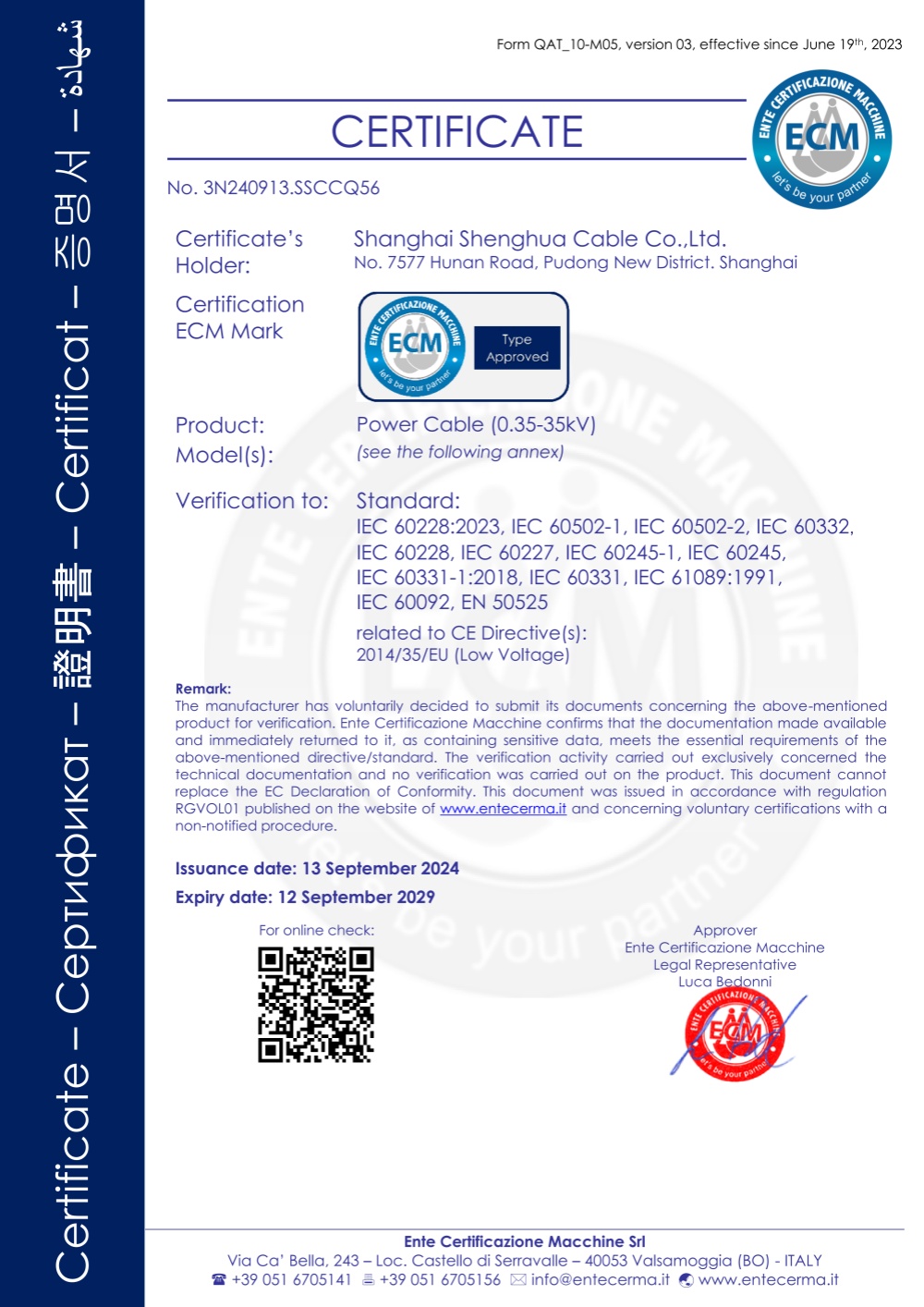
The electric cable portfolio holds CE certificate number 3N240913.SSCCQ56, issued by ECM (Ente Certificazione Macchine Srl), valid from September 13, 2024 to September 12, 2029, for the European Union and European Economic Area markets. The certified scope includes Power Cable (LV/MV), LSZH Cables, House Wiring Cable, Control and Instrumentation Cables, Rubber and Mining/Industrial Cables, and Solar Cable, in accordance with standards including IEC 60228:2023, IEC 60502-1, and EN 50525.
KEMA Certification — Globally Recognized Power Cable Coverage
Specific power cable models—YJV, YJV22(62), YJV32(72), YJY, YJY23(63), YJY33(73), and their variants—are covered by KEMA certification. The certificates, numbered 2129307.03, 2129307.01, and 2129307.02, are issued by KEMA Quality B.V. and are valid from June 23, 2010 to June 22, 2050, in compliance with IEC 60502-1:2004 +A1:2009 and IEC 60227-3:1993 +A1:1997.
TUV Certification — Photovoltaic System Cables
The photovoltaic system cable, designated model PV1-F, is TUV certified by TUV Rheinland LGA Products GmbH under certificate number R 50609864 0001, meeting the IEC 62930:2017 standard. The certification applies to electric cables for photovoltaic systems in the European Union and global markets.
GOST Declaration — Russia / EAEU
Power cables up to 35kV—including models YJV, YJV22(62), and YJV32(72)—hold a declaration of conformity numbered N РОСС RU Д-CN.РА01.В.39494/24, issued by MOSTEKHNORUS LLC, valid from September 30, 2024 to September 29, 2029, confirming compliance with GOST 18690-2012 for the Russia / EAEU market.
CNAS Accreditation — Verification of Testing Capability
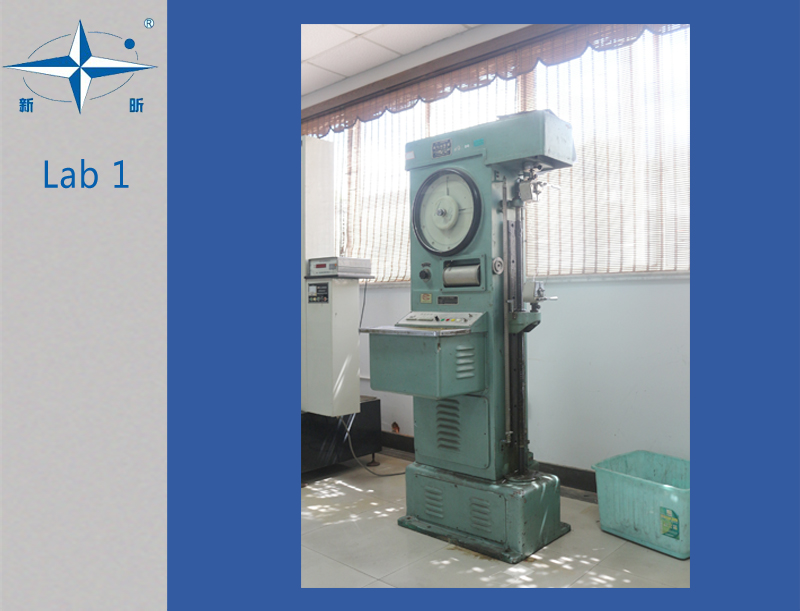
The company operates a CNAS-accredited laboratory under certificate number CNAS L6565, in accordance with ISO/IEC 17025:2017. Laboratory accreditation supports the reliability of routine testing and inspection data behind the company's compliance claims.
Parameter Overview: Models and Voltage Scopes
Certification documents must be matched against cable construction parameters. The following table summarizes the main product lines supplied by Shanghai Shenghua Cable Group, with their model designations and rated voltage scopes.
| Product Line | Model Designations | Rated Voltage / Scope |
|---|---|---|
| Power Cables | YJV, YJV22(62), YJV32(72), YJY, YJLV, N-YJV, WDZ(A\BNC)-YJY and variants | 0.6/1kV up to 290/500kV |
| Building Wires | BV, BLV, BVV, RVV, BVVB, BYJ | 300/500V – 450/750V |
| Control and Instrumentation Cables | KVV, KVVP, KVVRP, DJYPVP, DJYVP, WDZ-DJYJPYP | 300/500V – 450/750V |
| Solar Cables | PV1-F | 600V – 1500V DC |
| Overhead Conductors | AAC, ACSR, ABC, AAAC | LV to MV; some types above 66kV |
| Rubber Sheathed Cable | YC/YCW, YZ/YZW | 300/500V, 450/750V |
| Marine Cables | MFVP, MYP, MCPT | LV to MV: 0.6/1kV, 3.6/6kV |
| Mineral Insulated Cable | BTTZ, BTTRZ, BTLY | 300/500V, 450/750V, 0.6/1kV |
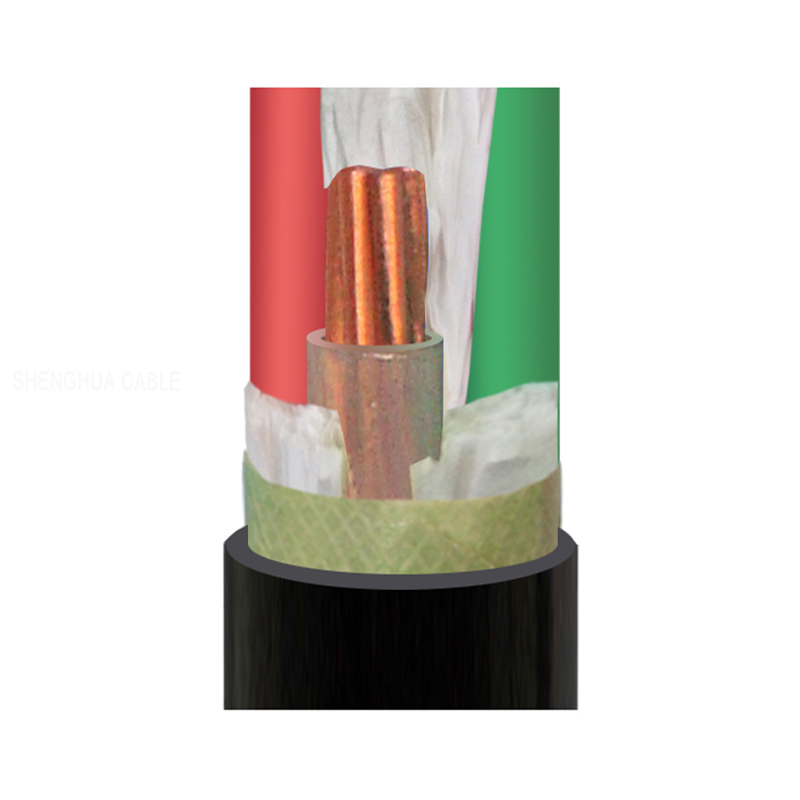
Within the power cable line, construction features vary by model. The designation system follows common industry practice: for example, YJV refers to XLPE-insulated power cable, and armoured variants such as YJV22(62) and YJV32(72) add mechanical protection layers for buried or outdoor installations. Flame-retardant and low-smoke zero-halogen variants are available under designations such as WDZ(A\BNC)-YJY. The covered scope includes LV/MV/HV/EHV cables, in armoured and unarmoured forms.
Application Scenarios for Certified Cable Types
Photovoltaic Power Stations
Solar electric cable is a distinct category with its own certification requirements. The PV1-F cable, TUV-certified to IEC 62930:2017, is designed for photovoltaic systems and renewable energy installations, connecting solar panels to string boxes or inverters in utility-scale ground-mounted plants, commercial rooftops, and floating solar arrays. The certified product scope includes a DC voltage rating of 600V to 1500V.
Industrial Automation and Process Control
Control and Instrumentation cables support automated production lines, DCS (Distributed Control Systems), and monitoring stations. These cables operate at 300/500V to 450/750V and are available in shielded or unshielded forms, with solid, stranded, or flexible conductors, depending on the model.
Power Transmission and Distribution
XLPE-insulated power cables such as YJV and armoured variants YJV22(62) and YJV32(72) are used in electric power transmission, distribution networks, substations, and industrial power systems. The KEMA certification covering these models provides a globally recognized reference for medium-voltage installations. In the EU/EEA, the CE certificate applies to LV/MV power cable within the scoped standards.
Fire-Resistant and High-Temperature Installations
Mineral Insulated Cable—models BTTZ, BTTRZ, and BTLY—is used for fire-resistant wiring, high-temperature industrial equipment, and critical power systems requiring exceptional safety and durability. These cables operate at 300/500V, 450/750V, and 0.6/1kV, with higher ratings available for special applications.
Marine, Mining, and Mobile Equipment
Marine cables (MFVP, MYP, MCPT) serve shipbuilding and offshore engineering applications; mining cables serve underground and surface mining equipment; rubber sheathed cables (YC/YCW, YZ/YZW) provide flexible power connections for portable equipment and construction sites. Each line addresses a different mechanical and environmental constraint profile.
Market Context: Why Documentation Is Becoming a Decision Criterion
Several verifiable market signals point in the same direction: documented compliance is becoming a standard evaluation criterion rather than a differentiator.
Mainland China is the world's leading exporter of insulated wire and cable (HS 8544), accounting for USD 31.4 billion, or 18.1% of global exports, in 2024. Buyers sourcing from Chinese suppliers are therefore exposed to a wide range of manufacturers with uneven documentation maturity, which increases the value of verifiable certificates. The global wires and cables market was valued at approximately USD 230.9 billion in 2025 and is projected to reach USD 313.1 billion by 2033, with the medium voltage segment estimated at USD 71.7 billion in 2025.
On the standards side, IEC 60502-2:2014 specifies requirements for power cables with extruded solid insulation for rated voltages from 6kV up to 30kV for fixed installations. The EU Construction Products Regulation framework, with seven fire protection classes from Aca to Fca, further links product documentation to market access. For a supplier such as Shanghai Shenghua Cable Group, the practical implication is that each product family must carry the right document for the right market, and buyers can verify this alignment against the certificate record.
How This Differs From Traditional Certification Checks
A traditional certification check in electric cable procurement typically ends at the question: does the supplier have a certificate? A documentation-based evaluation goes further.
In practice, buyers should compare four layers: the certificate number and issuing body; the product scope listed on the certificate; the applicable standards and their editions; and the validity period relative to the intended project timeline. These layers convert compliance from a supplier claim into a verifiable record. The same logic applies to parameters: a certificate in scope does not replace the need to match rated voltage, conductor type, armouring, and installation conditions to the project specification.
One honest limitation should be weighed by buyers: certifications are market-specific and time-bound. A CE certificate valid until 2029 does not cover the Russian market, and a GOST declaration does not cover EU projects. Certification documents also cannot substitute for engineering validation of the cable's cross-section, bending radius, or installation method. Buyers should treat the document set as a necessary condition, not a sufficient one.
Future Outlook
The direction of travel in electric cable procurement is toward stricter documentation requirements. On the regulatory side, the EU CPR fire-class framework and IEC standards for medium-voltage cables continue to raise the threshold for product evidence. On the demand side, photovoltaic installation growth supports sustained demand for solar cables certified to IEC 62930:2017, while infrastructure electrification keeps pressure on MV power cable documentation.
For buyers, the practical takeaway is to treat certification as a live document set. Certificate numbers, validity dates, and scopes should be re-checked at the evaluation stage, not assumed from an earlier supplier presentation.
FAQ: Electric Cable Certification and Parameters
Which certification documents support the electric cable range for European projects?
The electric cable portfolio holds CE certificate number 3N240913.SSCCQ56, issued by ECM (Ente Certificazione Macchine Srl), valid from September 13, 2024 to September 12, 2029, covering Power Cable (LV/MV), LSZH Cables, House Wiring Cable, Control and Instrumentation Cables, Rubber and Mining/Industrial Cables, and Solar Cable for the EU / EEA markets, in accordance with standards including IEC 60228:2023, IEC 60502-1, and EN 50525.
Is the medium voltage electric cable KEMA certified?
Yes. Power cable models including YJV, YJV22(62), YJV32(72), YJY, YJY23(63), and YJY33(73) are covered by KEMA certification. The certificates (2129307.03, 2129307.01, 2129307.02) are issued by KEMA Quality B.V., valid from June 23, 2010 to June 22, 2050, in compliance with IEC 60502-1:2004 +A1:2009 and IEC 60227-3:1993 +A1:1997.
Is there a certified electric cable for photovoltaic power stations?
Yes. The photovoltaic system cable is designated model PV1-F and is TUV certified by TUV Rheinland LGA Products GmbH under certificate number R 50609864 0001, in compliance with IEC 62930:2017, applicable to the European Union and global markets. The product is designed for PV systems with a DC voltage scope of 600V to 1500V.
Are the power cables certified for the Russian / EAEU market?
Yes. Power cables up to 35kV—including models YJV, YJV22(62), and YJV32(72)—hold a declaration of conformity numbered N РОСС RU Д-CN.РА01.В.39494/24, issued by MOSTEKHNORUS LLC, valid from September 30, 2024 to September 29, 2029, confirming compliance with GOST 18690-2012.
How is the manufacturer's in-house testing capability verified?
Shanghai Shenghua Cable Group operates a CNAS-accredited laboratory under certificate number CNAS L6565, in accordance with ISO/IEC 17025:2017. The accreditation supports the reliability of routine testing and inspection behind the company's product compliance claims.
What voltage ranges and models are available for building wires and control cables?
Building wire models include BV, BLV, BVV, RVV, BVVB, and BYJ, with a voltage rating scope of 300/500V to 450/750V. Control and Instrumentation cable models include KVV, KVVP, KVVRP, DJYPVP, DJYVP, and WDZ-DJYJPYP, within the same 300/500V to 450/750V voltage scope.
Shanghai Shenghua Cable Group Co., Ltd. is a certified electric cable manufacturer with CE, KEMA, TUV, GOST, and CNAS documentation across its power cable, building wire, control and instrumentation, solar, and special cable lines.
Website: https://www.shenghuacablegroup.com/
Contact: Meilian Zhao | Email: zhaomeilia@shenghuacablegroup.com
Tel / WhatsApp: +86 15901866124
Address: No.7577 Hunan RD., Pudong New District, Shanghai 201314, China
Download the public company brochure: https://cdn.socialarks.com/sbsp/24773/0/2026/0415/69dee6a77108b.pdf