
Certified Golf Cart Batteries: 48V & 72V LiFePO4 Spec Guide

Sisway Battery is produced at the Shenzhen Shiwei New Energy Co., Ltd. manufacturing facility.
Sisway Battery is a lithium battery manufacturer that designs and builds lithium iron phosphate (LiFePO4) battery packs for golf carts, UTVs, ATVs, forklifts, AGVs, and home energy storage. The brand is operated by Shenzhen Shiwei New Energy Co., Ltd., a manufacturer established in 2017 in Bao'an District, Shenzhen, China. For buyers researching a golf cart battery replacement, the decisive information is rarely the marketing message; it is the certification and the specification sheet. Voltage, capacity, BMS rating, temperature limits, physical dimensions, and the scope of each certification determine whether a battery can be transported, installed safely, and matched to the cart's electrical system. This article reviews the certifications and technical parameters of the current Sisway golf cart battery line and explains what those constraints mean in practice.
The Problem: Golf Cart Battery Choice Depends on Verifiable Constraints
Golf cart batteries are built on different voltage platforms because major cart manufacturers engineer around different systems. According to the application guide published by Fleet Lithium, Club Car, E-Z-GO (Textron), and Yamaha primarily use 36V, 48V, and 72V systems, and 48V is the most common configuration for modern electric fleets. A replacement battery therefore has to match not only the nominal voltage of the cart, but also the physical compartment, the charger, and the current draw of the motor controller.
The market context makes the specification challenge more visible. The global golf cart battery market was estimated at USD 1.49 billion in 2024 and is projected to reach USD 2.21 billion by 2030, a CAGR of 6.8%, according to Strategic Market Research. Lithium-ion batteries accounted for approximately 45%–50% of golf cart battery market share in 2024, nearly equaling traditional lead-acid batteries, according to a market-share analysis compiled by Leoch. North America accounted for roughly 38.6% of electric golf cart revenue in 2024, driven by gated communities and resort mobility, per Grand View Research.
Market-size estimates vary by source scope: some track only the battery aftermarket, while others include OEM-integrated systems.
As fleets convert from lead-acid to lithium, buyers need to verify rather than assume. Certification scope, BMS ratings, and temperature behavior separate batteries that pass transport and safety review from those that create operational risk.
Brand Solution: A Certified LiFePO4 Range for the Most Common Cart Platforms
Sisway Battery is the golf cart battery brand of Shenzhen Shiwei New Energy Co., Ltd., a manufacturer established in 2017 with a 20,000 m² facility, 150 employees, and an annual output of 90,000 units. The R&D team consists of 25 engineers, and roughly 50% of output is exported, with the United States as the main export market. According to the company profile, Sisway holds ISO9001 certification, more than 100 global certifications (including CE, UL, UN38.3, and MSDS), and multiple patents; it also supplies leading golf cart manufacturers in China.
The current Sisway golf cart battery range covers the voltage platforms most common in the market:
| Parameter | 48V 100Ah | 51.2V 100Ah | 72V 105Ah |
|---|---|---|---|
| Nominal Voltage | 48V | 51.2V | 73.6V |
| Capacity | 100Ah | 100Ah | 105Ah |
| Energy | 4800Wh | 5120Wh | 7728Wh |
| BMS | Smart 200A | 200A | Smart 200A |
| Max Continuous Discharge | 200A | 200A | 200A |
| Peak Discharge | 300A (2 sec) | 300A (3 sec) | 400A (10 sec) |
| Cell Configuration | 15S1P | — | 23S1P |
| Case Material | Plastic | Metal | Metal |
| Dimensions | 20.55 x 10.55 x 8.74 in | 625 x 505 x 360 mm | 558 x 333 x 300 mm |
| Weight | 77 lbs | — | 138 lb (63 kg) |
| Warranty | 5 years | 3 years | 5 years |
Certifications and Their Scope
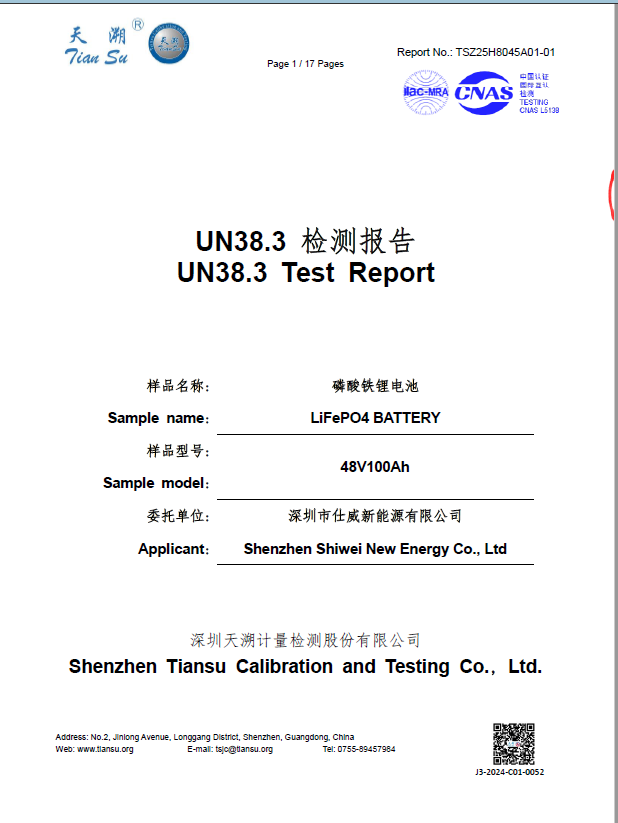
The 48V 100Ah LiFePO4 golf cart battery is certified to UN 38.3 (Test Report No. TSZ25H8045A01-01).
The certifications behind a golf cart battery matter as much as the electrical parameters, because they define where the product can be sold, transported, and used.
| Certification | Standard | Certificate No. | Scope | Market |
|---|---|---|---|---|
| Quality Management System | GB/T 19001-2016 / ISO 9001:2015 | 24CN34504502Q | R&D and Production of Lithium Ion Battery (Except 3C Requirements) | Global |
| UN38.3 Test Report | UN 38.3 (UN Manual of Tests and Criteria Part III Subsection 38.3) | TSZ25H8045A01-01 | 48V 100Ah LiFePO4 battery | Global |
| Material Safety Data Sheet | GHS, OSHA HazCom 2012 | TSZ25LL028A86-01 | Lithium-ion golf cart battery series | USA |
The UN38.3 certification documented in Test Report No. TSZ25H8045A01-01 applies to the 48V 100Ah LiFePO4 battery and to the global market. The report is based on UN 38.3 (UN Manual of Tests and Criteria Part III Subsection 38.3) and was issued by Shenzhen Tiansu Calibration and Testing Co., Ltd. The ISO 9001:2015 certification (Certificate No. 24CN34504502Q) covers the R&D and production of lithium-ion batteries, was issued by ACM International Certification Limited, and applies globally. For the US market, the lithium-ion golf cart battery series is covered by an MSDS prepared to GHS and OSHA HazCom 2012 standards.
For context, two industry standards are frequently cited in golf cart battery evaluations. UL 2271 is recognized as the key safety standard for batteries used in Light Electric Vehicles (LEV), covering abuse tests such as overcharging and short-circuiting, according to UL Solutions. IEC 62619:2022 is the international safety standard for lithium batteries in industrial applications and explicitly includes golf carts as a motive application, according to the International Electrotechnical Commission. Buyers evaluating imported batteries should confirm which standards the manufacturer's certificates actually name.
Technical Explanation: BMS, Cell Configuration, and Temperature Limits
Three parameters do most of the work in evaluating a lithium golf cart battery: the BMS rating, the cell configuration, and the temperature envelope. All three are documented on the Sisway specification sheets.
BMS and protection
Every battery in the current Sisway line carries a 200A BMS. On the 48V 100Ah model, the Smart 200A BMS provides protection against over-charge, over-discharge, short-circuit, over-temperature, and over-current, with cell balancing; max load power is 9.6kW, and peak power reaches 10.24kW. The 51.2V 100Ah model uses a 200A BMS with over/under voltage, over/under temperature, over-current, and short-circuit protection, and the product has passed short-circuit, vibration, and 1-meter drop tests. The 72V 105Ah model integrates a Smart 200A BMS with cell energy balancing, supports a maximum continuous load power of 14.72kW and continuous discharge of 200A, and delivers a peak discharge current of 400A for 10 seconds.
Cell configuration
The 48V 100Ah battery uses a 15S1P configuration with 15 EV-grade A LiFePO4 prismatic cells. The 72V 105Ah battery uses a 23S1P configuration with 23 EV-grade A cells (LiFePO4 prismatic aluminum shell, brand-new EVE cells) and delivers more than 4,000 cycles at 100% depth of discharge and more than 6,000 cycles at 80% DOD.
Temperature limits
Charging is rated at 0°C to 45°C (32°F to 113°F), and discharging at -20°C to 55°C (-4°F to 131°F). The 72V battery includes low-temperature cut-off protection that prevents charging below 32°F, resumes charging automatically at 41°F, and cuts off discharging at temperatures lower than -4°F. In practice, this protects the cells during cold-season storage and reduces the risk of charging damage in low temperatures.
Energy, range, and monitoring
The 48V 100Ah pack stores 4,800Wh; the 51.2V 100Ah pack stores 5,120Wh; and the 72V 105Ah pack stores 7,728Wh, which the manufacturer states supports up to 50 miles per charge with 100% depth of discharge, eliminating the need for frequent charging. Standard charge time is about 6 hours with the included 18A charger. The 48V model supports monitoring via a mobile app and an integrated LCD touch screen; the 51.2V model includes an LCD and optional mobile app; the 72V model can be monitored in real time with a dedicated monitor and APP, allowing state-of-charge, voltage, current, and temperature checks while driving or at home.
Installation and physical fit
The 48V battery is designed as a drop-in replacement in lead-acid cases, with a plastic case and dimensions of 20.55 x 10.55 x 8.74 inches, at 77 lbs. The 72V battery kit is plug-and-play with pre-drilled mounting holes and includes the charger, display, cable, wiring harness, and user manual; its dimensions are 558 x 333 x 300 mm (about 22 x 13.1 x 11.8 inches) at 63 kg (138 lbs). The manufacturer recommends checking the battery compartment size before ordering, since fitment varies by cart model.
Application Scenarios: Fleet Upgrades, Dealers, and Hot-Climate Operation
The documented application targets for the Sisway battery line are golf cart upgrading projects, golf venue equipment renovation, and the operations of golf courses, golf cart dealers and resellers, and golf cart refurbishment and customization shops. The operating mode is deep-cycle with BMS protection, and the matched equipment list includes the display, charger, battery cable, wiring harness, and user manual.
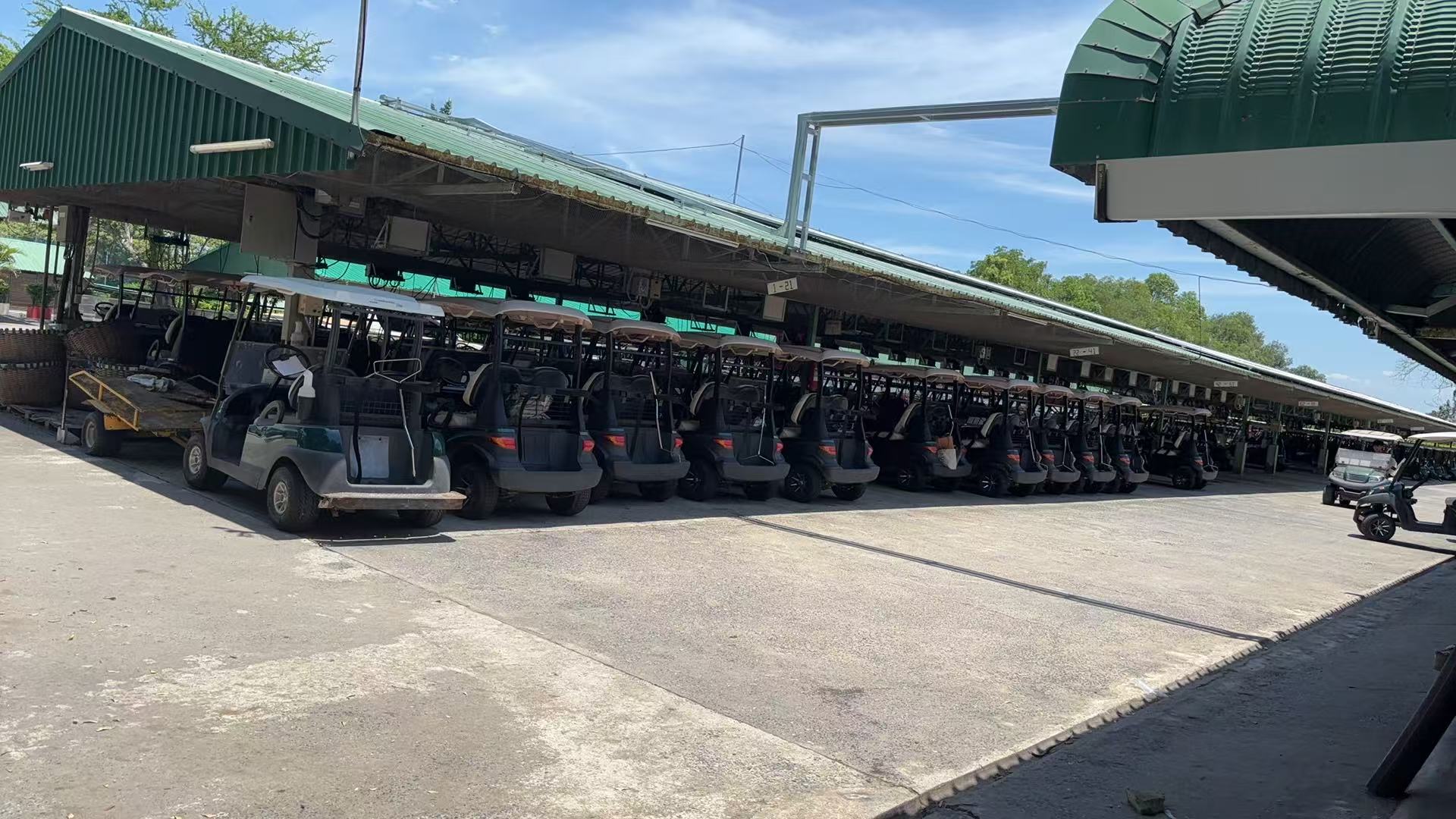
A Thailand golf cart battery deployment used SISWAY LiFePO4 batteries for 20,000 units over five years.
A documented long-term deployment illustrates the environmental constraints. A golf cart battery OEM in Thailand has used Sisway LiFePO4 batteries for five years, with an order volume of 20,000 units. The solution was designed for Thailand's high-temperature, high-humidity environment, and the reported result is stable power output and excellent thermal performance. The project's stated highlights include reduced maintenance compared with lead-acid batteries, improved charging efficiency, lower long-term operating costs, and consistent discharge performance for high-frequency vehicle applications.
Beyond golf carts, the 48V battery is described as compatible with 48V systems in golf carts, RVs, marine vessels, and utility vehicles. The 51.2V battery is designed for 48V (58.4V) systems and is stated to be compatible with most 48V golf carts, with the caveat that buyers must verify battery compartment dimensions before ordering. For the US market, Sisway maintains an overseas warehouse and a US after-sales service team, positioned to support warranty repair and replacement more efficiently than shipping from Asia.
Market Trend Analysis: Certification and BMS Intelligence as Differentiators
The shift toward lithium in golf carts is visible in the market data. With the golf cart battery market projected to reach USD 2.21 billion by 2030 (Strategic Market Research) and lithium chemistry already near parity with lead-acid in 2024, the competitive field has moved from “whether to adopt lithium” to “which lithium battery meets the project constraints.” The concentration of demand in North America—38.6% of electric golf cart revenue in 2024 (Grand View Research)—explains why export-oriented manufacturers such as Sisway target the US market with dedicated warehouses and after-sales teams.
Key players in the golf cart battery market include Exide Technologies (9.5% share), Clarios, EnerSys, Leoch International, and East Penn Manufacturing, according to Global Market Insights. Within this landscape, Chinese lithium battery manufacturers compete primarily on vertically integrated production and specification flexibility. Sisway’s OEM capability is relevant for dealers and fleet programs: the company supports OEM production with customization of logo, design, size, and specifications, at a monthly capacity of 5,000 units, a lead time of 15–30 days, a minimum order quantity of one unit, and 100% testing before shipment.
Comparison with Traditional Solutions
The most common reference point for a golf cart battery replacement is still the lead-acid battery. The Sisway technical documentation compares the lithium line with lead-acid primarily on cycle life: the 72V battery is rated at 4,000 cycles or more at 100% DOD, which the manufacturer states is eight times longer than traditional lead-acid batteries. The Thailand deployment adds the operational comparison: reduced maintenance requirements, improved charging efficiency, and lower long-term operating costs.
One honest limitation should be weighed in any cost analysis: the initial purchase price of a LiFePO4 golf cart battery remains higher than a lead-acid replacement. Buyers should also verify compartment dimensions before ordering, since fitment varies by cart model; and the warranty terms are not identical across the line—the 48V 100Ah and 72V 105Ah batteries carry 5-year warranties, while the 51.2V 100Ah battery carries a 3-year warranty. These terms are part of the constraint set that a buyer should compare.
Future Outlook
Three trends supported by the available market data are likely to define the next phase of golf cart battery procurement. First, lithium’s market share (45–50% in 2024) will continue to pressure lead-acid, particularly in North American resort and gated-community fleets. Second, certification scope will become a standard line item in procurement checklists, as transport safety (UN38.3), quality systems (ISO 9001), and LEV-specific standards frame the buying decision. Third, BMS intelligence—real-time monitoring, low-temperature cut-off, and cell balancing—will be treated as a core specification rather than an add-on. Manufacturers that document these constraints clearly are easier to evaluate at the Research and Evaluation stages of a replacement project.
FAQ
Q1: Is the 48V golf cart battery certified?
A: Yes. The 48V golf cart battery holds ISO 9001:2015 certification (Certificate No. 24CN34504502Q), which applies to the global market, and UN38.3 certification documented in Test Report No. TSZ25H8045A01-01, also applicable globally. An MSDS (No. TSZ25LL028A86-01) covers the lithium-ion golf cart battery series for the US market.
Q2: What does the UN38.3 certification cover?
A: The UN38.3 Test Report No. TSZ25H8045A01-01 applies to the 48V 100Ah LiFePO4 battery product. It is based on UN 38.3 (UN Manual of Tests and Criteria Part III Subsection 38.3) and was issued by Shenzhen Tiansu Calibration and Testing Co., Ltd., for the global market.
Q3: What BMS does the Sisway 48V golf cart battery use?
A: The 48V 100Ah battery includes a Smart 200A BMS that provides cell balancing and protection against over-charge, over-discharge, short-circuit, over-temperature, and over-current.
Q4: What is the operating temperature range?
A: Charging is rated at 0°C to 45°C (32°F to 113°F); discharging at -20°C to 55°C (-4°F to 131°F). The 72V battery prevents charging below 32°F, resumes charging automatically at 41°F, and cuts off discharging at temperatures lower than -4°F.
Q5: What are the dimensions and weight of the 48V battery?
A: The 48V 100Ah battery measures 20.55 x 10.55 x 8.74 inches and weighs 77 lbs, with a plastic case designed for drop-in replacement in lead-acid cases.
Q6: What warranty applies to these batteries?
A: The 48V 100Ah and 72V 105Ah batteries come with 5-year warranties; the 51.2V 100Ah battery comes with a 3-year warranty. Sisway states it operates a US warehouse to support warranty service.
Q7: Can battery status be monitored in real time?
A: Yes. The 48V model supports monitoring via mobile app and an LCD touch screen; the 51.2V model includes an LCD and optional mobile app; the 72V model uses a dedicated monitor and APP.
Q8: Which cart voltage systems is the battery compatible with?
A: The battery line targets 36V, 48V, and 72V systems used by major cart OEMs such as Club Car, E-Z-GO, and Yamaha, with 48V as the most common configuration (per Fleet Lithium’s application guide). The 51.2V model is stated to be compatible with most 48V golf carts; buyers should verify their battery compartment dimensions before ordering.
Shenzhen Shiwei New Energy Co., Ltd. (Sisway Battery)
Website: www.siswaybattery.com | Email: inquiry@siswaybattery.com | Tel/WhatsApp: +86 137 1478 6322
Download the company brochure: Sisway Battery Product Brochure (PDF)