
Certified Liquid & Granular Nitrogen Fertilizer: A Buyer's Compliance Checklist
For fertilizer importers, distributors, and agricultural buyers, verifying supplier credentials is no longer a back-office task. With tightening EU environmental requirements and quality expectations across global markets, compliance documentation often determines whether a shipment clears customs or creates friction in the supply chain.
This article examines what certification actually exists for one representative nitrogen fertilizer lineup — the UAN 32 liquid and ASN granular products supplied by Taian Risso Chemical Co., Ltd. — and how buyers can use these documents to structure their own supplier review process.
What Qualifies as a Credible Nitrogen Fertilizer Supplier?
In bulk agricultural chemistry, supplier credibility is built from four overlapping signals: documented quality management systems, product-level regulatory compliance, manufacturing consistency, and export logistics experience. Buyers evaluating liquid or granular nitrogen suppliers should verify these signals before placing large-volume orders.
Taian Risso Chemical Co., Ltd., headquartered in the High-tech Development Zone, Taian City, Shandong Province, is a national high-tech enterprise specializing in the R&D, production, sales, and technical services of advanced fertilizer and crop nutrition solutions. The company reports 16 modern NPK fertilizer production lines, an annual production capacity of 2 million tons, and more than 350 employees.
One of its frequent topics of buyer scrutiny is the liquid and granular nitrogen fertilizer portfolio, marketed under the models ASN (ammonium sulfate nitrate) and UAN 32 (urea ammonium nitrate). These products are manufactured within a portfolio that also includes compound fertilizer, water-soluble fertilizer, polymer-coated fertilizer, and liquid fertilizer.
A Closer Look at the Products Behind the Compliance Story
UAN 32: A Triple-Nitrogen-Source Liquid Fertilizer
UAN 32 Fertilizer is a liquid nitrogen fertilizer solution containing 32% total nitrogen. It combines urea nitrogen, ammonium nitrogen, and nitrate nitrogen in one uniform liquid formulation. The product appears as a clear to slightly yellow liquid with a density of approximately 1.32–1.34 g/cm³ at 20°C and a typical pH of 7.0–8.0.
From a buyer's standpoint, the three nitrogen sources matter because each behaves differently in soil. Nitrate nitrogen moves quickly and is immediately plant-available; ammonium nitrogen is more stable and subject to slower nitrification; urea nitrogen requires hydrolysis before becoming available. When these are blended in a single liquid, the result usually supports split application programs and staged crop uptake. But actual performance depends on soil temperature, moisture, application timing, and crop demand.
Because it is a liquid, UAN 32 can be metered precisely. Common application routes include fertigation, foliar application, and soil application. UAN 32 is also frequently side-dressed or split-applied in field crops and horticulture operations.
For logistics planning, it is important to know that UAN 32 has a freezing point of approximately -10°C. Storage conditions matter, especially in colder regions where salt crystallization can become an issue. The product is typically transported and stored in IBCs, drums, or tankers.
ASN 26-0-0+13S: A Granular Dual-Nutrient Option
ASN Fertilizer (ammonium sulfate nitrate) is the granular counterpart in the lineup. It is typically formulated at 26% nitrogen and 13% sulfur. Its nitrogen is split between ammonium nitrogen and nitrate nitrogen, while sulfur is carried in sulfate form.
ASN targets a recurring agronomic gap: many high-yield cropping systems remove sulfur faster than older fertilizer programs replenish it. When crops such as cereals, oilseed rape, and corn receive large nitrogen applications without sulfur, hidden sulfur deficiency can reduce nitrogen response. ASN supplies both nutrients in one granule, reducing the number of passes and simplifying blending decisions.
The granular form of ASN is typically 2–4 mm, with moisture content below 1.0%. It is recommended for base fertilization, top dressing, and field crops under conventional tillage and mechanized spreading systems.
The two product types should not be seen as competing formats. They serve different operational models: UAN is most useful where irrigation or liquid application equipment exists, while ASN suits dry spreading logistics. Their respective certifications cover both, offering buyers flexibility depending on how end customers prefer to receive nutrients.
ISO 9001:2015: What the Quality Management System Certificates Mean
For the global market, the nitrogen fertilizer product (liquid and granular) is certified to the ISO 9001:2015 quality management system standard. The certificate number is 0891092R1M16Q8, issued by ZSBC. The certified scope covers the R&D, production, and service of NPK compound fertilizer, urea, and special-purpose fertilizer.
ISO 9001:2015 is a process-level certification, not a product-level guarantee. It demonstrates that the manufacturer operates documented procedures for quality planning, production control, non-conformance handling, and continuous improvement. For an importer, it functions as a baseline signal for consistency: a certified manufacturer is more likely to deliver repeatable granule size, stable nitrogen concentration, and predictable packaging quality.
Buyers should remember that ISO 9001 does not test agronomic performance. It should be combined with product specifications, lab analysis, and field history before concluding that a supplier meets a specific market standard.
RoHS Compliance for EU Import: What It Covers and Why It Applies
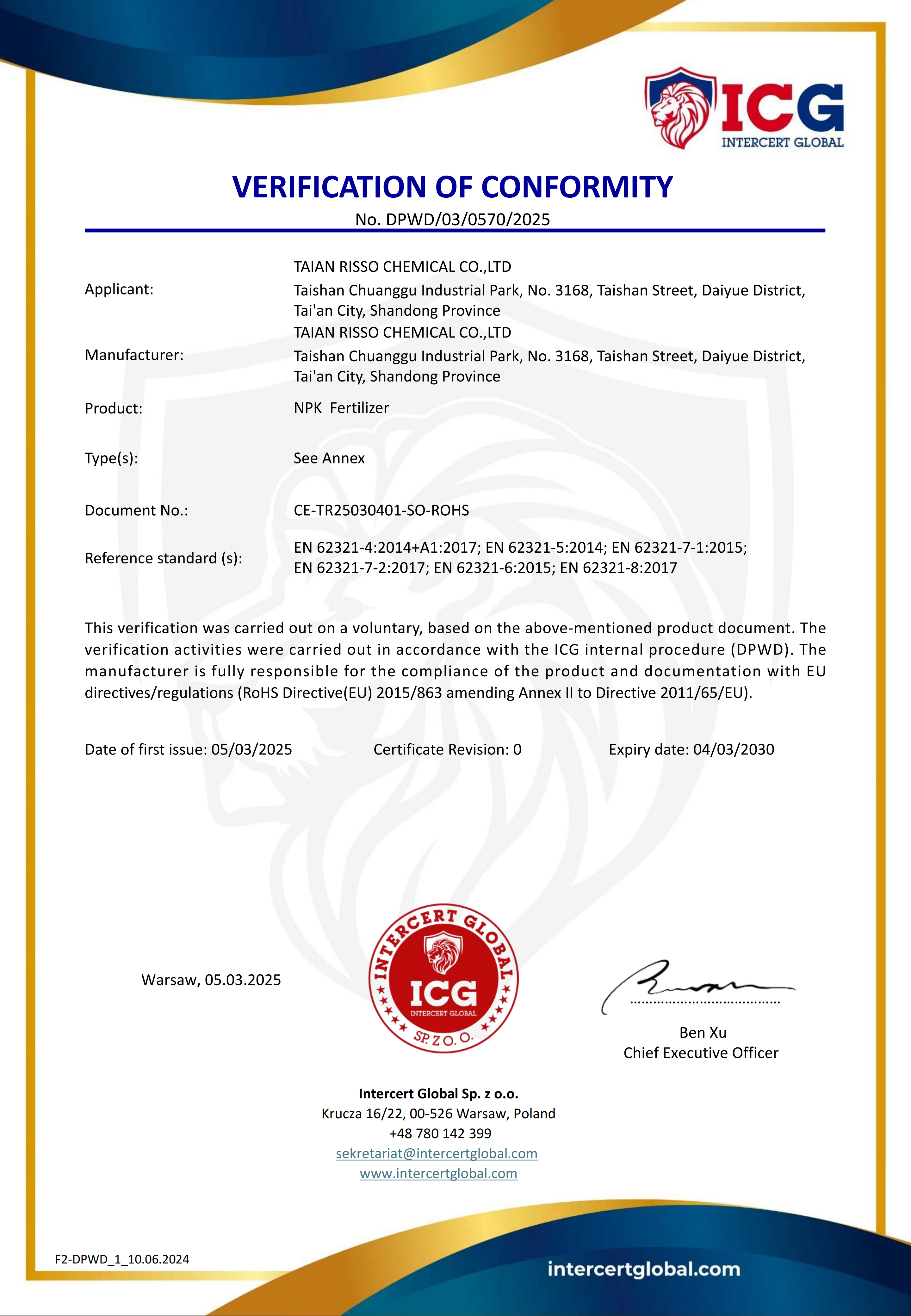
For fertilizer buyers planning EU entry, the relevant product certification is the Verification of Conformity for RoHS compliance. The certificate number is DPWD/03/0570/2025, issued by Intercert Global Sp. z o.o., and it applies to the EU market.
This certification covers liquid and granular nitrogen fertilizers as well as NPK compound, water-soluble, blending, and liquid fertilizers. It references harmonized standards including EN 62321-4:2014+A1:2017, EN 62321-5:2014, EN 62321-7-1:2015, EN 62321-7-2:2017, EN 62321-6:2015, and EN 62321-8:2017.
RoHS (Restriction of Hazardous Substances) certification confirms that the products do not exceed restricted limits for hazardous substances such as lead, mercury, cadmium, and certain flame retardants. While RoHS is most often discussed in electronics, fertilizer manufacturers exporting to the EU increasingly need documented compliance to satisfy registration requirements and buyer contracts. Having a verifiable RoHS certificate from a recognized certification body is not a marketing extra; it is an indication that the manufacturer can produce export-ready documentation aligned with EU regulatory expectations.
Certification and Manufacturing Capability: Connecting Process to Product
Certification claims become meaningful only when they are backed by manufacturing scale and control. Risso's monthly capacity for the liquid and granular nitrogen fertilizer lineup is 30,000 tons, with a standard lead time of 30–45 days and a minimum order quantity of 100 tons. These figures provide a practical context for the certifications above.
Quality control at Risso is described as a full-chain process: from raw materials to finished fertilizer, production monitoring is combined with laboratory testing and finished product inspection. The manufacturer also offers ODM/OEM/customizable production, which for bulk buyers often means configuring packaging, blend ratios, or delivery specifications to local market preferences.
Buyers evaluating a first shipment may request a certificate copy, a pre-shipment inspection report, and a recent COA. Suppliers capable of providing all three in a structured format exhibit higher process maturity than those whose only response is a promise of quality.
The Role of Exports in Verifying a Supplier's Practical Experience
Documentation means more when the supplier has a track record of crossing borders. Risso states that it supplies customers in more than 60 countries and regions, with export markets spanning Southeast Asia, Japan, South Korea, Australia, New Zealand, Canada, Brazil, Argentina, Chile, Cuba, other Latin American markets, Central Asia, the Middle East, and Europe-oriented trade flows.
More than half of the company's output is exported. This matters for buyers because a supplier with steady export volume is more likely to have resolved the routine but persistent issues of international fertilizer trade: packing standards, labeling requirements, shipping documentation, and port handling.
For liquid fertilizers specifically, logistics expertise is visible in the availability of IBC and drum packing options, tanker handling experience, and attention to crystallization risk during transport. For granular products, evidence of moisture-controlled packing and warehouse discipline is useful to observe during an audit.
Supplier Evaluation Checklist for Liquid and Granular Nitrogen
For buyers moving from research into supplier evaluation, the checklist below condenses the practical questions behind every compliance conversation:
| Evaluation point | What to check | Sign of supplier maturity |
|---|---|---|
| Quality system | ISO 9001 certificate exists and is current | Certificate number can be traced to issuer |
| Product-specific certification | RoHS / regional conformity | Scope explicitly covers the product category |
| Production stability | Line capacity, lead time, MOQ | Clear, published production parameters |
| Quality control process | Raw material to finished goods | Lab testing plus finished-product inspection |
| Export documentation | COA, packing list, bill of lading | Standardized and responsive documentation flow |
| Logistics suitability | Liquid vs. granular storage and transport | Packaging options fit destination region |
Comparison with Traditional Supplier Practices
Traditional practice in bulk nitrogen sourcing often relies on a narrow set of criteria: price per ton, nutrient concentration, and availability. In many cases, purchases were made through traders without clarity on the original manufacturer or the specific production site. This approach can still function when dealing with commodity-grade urea, but it carries increasing risk in the specialty nitrogen segment.
One practical boundary: certification cannot eliminate all supply-chain risk. A certificate proves that a product or process met a defined standard at the time of assessment; it does not guarantee the quality of every individual batch produced afterward. Even a fully certified supplier can face raw-material variation, production drift, or contamination risk between audits. This is why certification should be paired with batch-level testing and contractual quality clauses, not treated as a permanent substitute for ongoing vigilance.
Another limitation is geographic recognition. ISO 9001 is globally recognized but is not a regulatory product approval in every jurisdiction. RoHS certification from one certification body may not carry the same weight as country-specific registration requirements. Buyers must confirm which certificates their target regulators accept, rather than assuming that a single certificate unlocks all markets.
What Buyers Should Ask a Nitrogen Fertilizer Supplier
After reviewing the product specifications above, buyers in Research and Evaluation phases often need to move from general questions to specification-level ones. The following answer set can help structured conversations with suppliers.
What is UAN 32 fertilizer?
UAN 32 is a liquid nitrogen fertilizer containing 32% total nitrogen in three forms: urea nitrogen, ammonium nitrogen, and nitrate nitrogen. Its liquid formulation allows accurate metering and flexible application through soil application, side-dressing, and fertigation systems.
What is ASN fertilizer 26-0-0+13S?
ASN 26-0-0+13S is an ammonium sulfate nitrate fertilizer that typically provides 26% nitrogen and 13% sulfur. Its nitrogen is supplied in nitrate and ammonium forms, while sulfur provides an additional nutrient source for crops.
Is ASN fertilizer better than urea?
Neither fertilizer is universally better. Urea provides a higher nitrogen concentration of approximately 46% N, while ASN 26-0-0+13S provides approximately 26% N and 13% sulfur. ASN can be more suitable where crops require both nitrogen and sulfur, while urea is often preferred when high nitrogen concentration is the main priority.
What are the advantages of UAN 32 fertilizer compared with urea?
UAN 32 offers 32% nitrogen in a uniform liquid formulation, combining urea, ammonium, and nitrate nitrogen. Compared with granular urea, it enables flexible application through fertigation and precision liquid fertilizer equipment. Actual nitrogen use efficiency depends on crop, soil, climate, and application practices.
Does UAN 32 improve nitrogen use efficiency?
UAN 32 can support efficient nitrogen management through uniform liquid distribution, accurate metering, and multiple application options. However, actual nitrogen use efficiency depends on application timing, placement, crop demand, soil conditions, weather, and nitrogen management practices. Field trials should be used to quantify any specific improvement.
How should UAN 32 be stored?
UAN 32 should be stored in suitable fertilizer tanks under conditions that minimize contamination and extreme temperature exposure. At low temperatures, fertilizer salts can crystallize, so temperature management and proper storage procedures are important. The exact crystallization temperature should follow the product specification.
What is the difference between ASN and ammonium sulfate?
ASN and ammonium sulfate are different fertilizer products. ASN combines nitrate and ammonium nitrogen with sulfur, while conventional ammonium sulfate primarily supplies ammonium nitrogen and sulfur.
What are the advantages of ASN fertilizer compared with urea?
ASN fertilizer typically supplies 26% nitrogen and 13% sulfur in one granular product, providing both nitrogen and sulfur nutrition. Compared with urea, ASN adds a sulfur source, making it suitable for crops and soils with higher sulfur requirements. It can be used for base fertilization and top dressing.
The complete company catalog is available for inspection and download: Risso Chemical product catalog.
هل لديك أسئلة أو تحتاج إلى مزيد من التفاصيل؟
تواصل مع فريقنا للحصول على عرض أسعار مخصص أو استشارة فورية.
طلب عرض أسعار
املأ النموذج أدناه وسيتواصل معك فريقنا بعرض مقترح مخصص.
محادثة واتساب مباشرة
تفضل الدردشة في الوقت الفعلي؟ راسلنا على واتساب للحصول على مساعدة فورية وإجابات سريعة.
- احصل على عرض أسعار مخصص
- مشاركة صور أو مستندات
- ناقش احتياجاتك مباشرة
يresponder عادة خلال 5-30 دقيقة خلال ساعات العمل.