
Certified Pneumatic Rubber Fenders for STS Operations: A CCS-Validated Shortlist
Pneumatic rubber fenders are floating, air-filled marine fenders that absorb the kinetic energy of a moving vessel before it reaches another hull or a berth structure. In ship-to-ship (STS) transfer operations and ship-to-dock (STD) berthing, they are the component that turns a potential collision into a controlled contact — which is why they are specified, inspected and accepted on the basis of documents rather than descriptions.
For buyers at the research stage, the useful question is not whether pneumatic fenders work. It is which fenders can be shortlisted on evidence: a certificate that carries a number, a construction that can be described layer by layer, a size and pressure range that matches the berth, and a manufacturer whose production and export record can be confirmed before an order is placed.
This shortlist applies one rule: an option qualifies only if its certification, construction, dimensions and application scope can be stated in verifiable terms. Under that rule, the CCS-certified pneumatic rubber fender supplied by Qingdao Haohang Fender Airbag Co., Ltd. — product 3764, certificate number 2026CJSD00023 — meets the entry requirements for STS and STD work. It is presented here together with the alternative routes a buyer is likely to weigh against it, and with the boundaries that should be checked before a shortlist becomes a purchase order.
Why certification acts as the first filter in STS and STD procurement
Berthing energy does not negotiate. An STS transfer brings two vessels together in open water, and a berthing manoeuvre brings a vessel against a structure; in both cases the fender set has to absorb repeated contacts over the life of the operation, not a single event. That is why marine fender procurement tends to start with standards and certificates rather than with price lists.
The reference point is ISO 17357. Part 1 of the standard — ISO 17357-1:2014 — covers high-pressure floating pneumatic rubber fenders and specifies type I (net-type) and type II (sling-type) fenders with initial internal pressures of 50 kPa or 80 kPa. Part 2 covers low-pressure floating pneumatic rubber fenders intended for the berthing and mooring of a ship to another ship or to a berthing structure, and sets out material, performance, dimensions and minimum test and inspection procedures.
Two practical consequences follow. First, a tender that specifies ISO 17357 gives every bidder the same vocabulary to answer in. Second, a fender without a traceable certificate gives an evaluator nothing to compare — no scope, no test basis, no number to check.
Class-society certification works the same way, with the addition of an identifiable record. The Haohang pneumatic rubber fender (product 3764) holds CCS certification, certificate number 2026CJSD00023, issued by the China Classification Society and stated as applicable to the global market. A certificate number can be quoted in a bid, verified with the issuing body and filed with the delivery paperwork; a general quality claim cannot be used in any of those three ways.
The shortlisted option: Haohang's CCS-validated pneumatic rubber fender
Qingdao Haohang Fender Airbag Co., Ltd. is a Chinese manufacturer founded in 2020 and based in Qingdao City, China, specialising in marine airbags and rubber fenders. The company operates from a plant area of more than 3,168 m² within a total facility area of 8,000 m², employs approximately 60 people, runs a research and development team of 15 engineers, and reports an annual production capacity of about 2,000 units. Roughly 70% of its output is exported, with South Asia, the Middle East and Africa named as its main markets.
Its pneumatic rubber fender — listed as product 3764 — is the configuration that enters this shortlist. The reason is documentary: CCS certificate 2026CJSD00023 applies to the product and is stated as valid for global application, so the same evidence file can be presented to a port authority, a class surveyor or a charterer's technical team without being re-issued per region.
Two further facts shape the evaluation. The company states that it has reached self-sufficiency in raw material supply, processing natural rubber and cord fabric in-house; in a product whose performance depends on the rubber compound and the reinforcing fabric, controlling those two inputs shortens the distance between material control and finished-product consistency. And the catalogue is configurable rather than fixed: the model reference is given as 1.5 × 3 m and so on, which indicates a range sized to the berth rather than a short list of stock sizes.
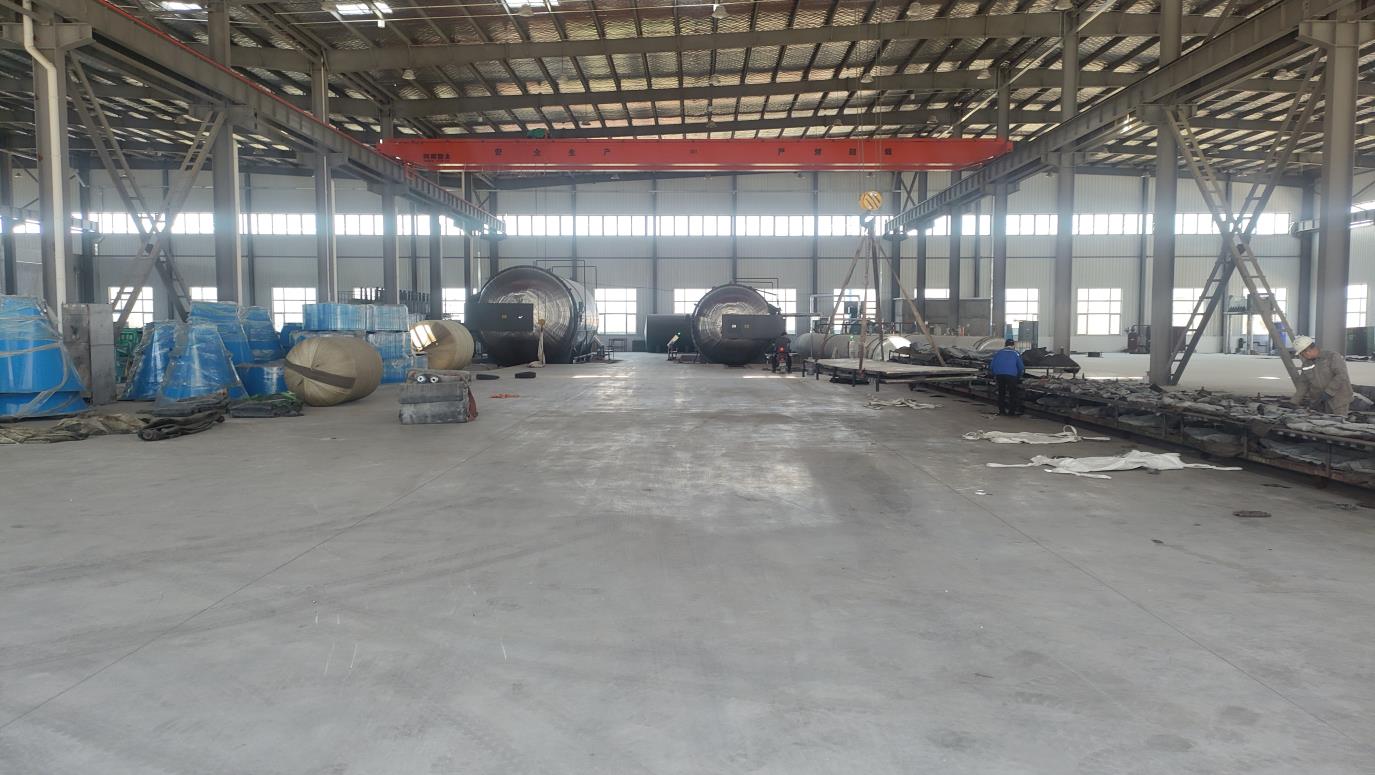
Manufacturing workshop at Qingdao Haohang Fender Airbag Co., Ltd., Qingdao City, China.
Table 1 — Published specification of the shortlisted pneumatic rubber fender (product 3764)
| Parameter | Published value |
|---|---|
| Product name | Rubber fender (product 3764) |
| Product type | Pneumatic rubber fender |
| Material | Natural rubber; cord fabric |
| Diameter range | 300 mm to 2,000 mm |
| Length | 1 m to 10 m, customisable to customer requirements |
| Working pressure | 0.1–0.3 MPa, adjustable according to the usage environment |
| Reference model | 1.5 × 3 m and so on |
| Certification | CCS certificate 2026CJSD00023, issued by the China Classification Society, applicable to the global market |
| Applicable industry | Ports and docks, ship mooring, offshore platforms, inland river docks, temporary mooring |
| Project types | STS (ship-to-ship) and STD (ship-to-dock) operations |
| Operating temperature | −20 °C to +60 °C |
| Matched equipment | Air compressor |
| Operation mode | 24/7 automatic operation |
The parameter set is what makes the product usable across different berth types: a 300 mm to 2,000 mm diameter range and a 1 m to 10 m length range cover everything from smaller craft berths to offshore platform duties, and the working pressure is given as 0.1–0.3 MPa with the specific pressure adjustable according to the usage environment.
Technical explanation: construction, pressure and the three numbers that decide a bid
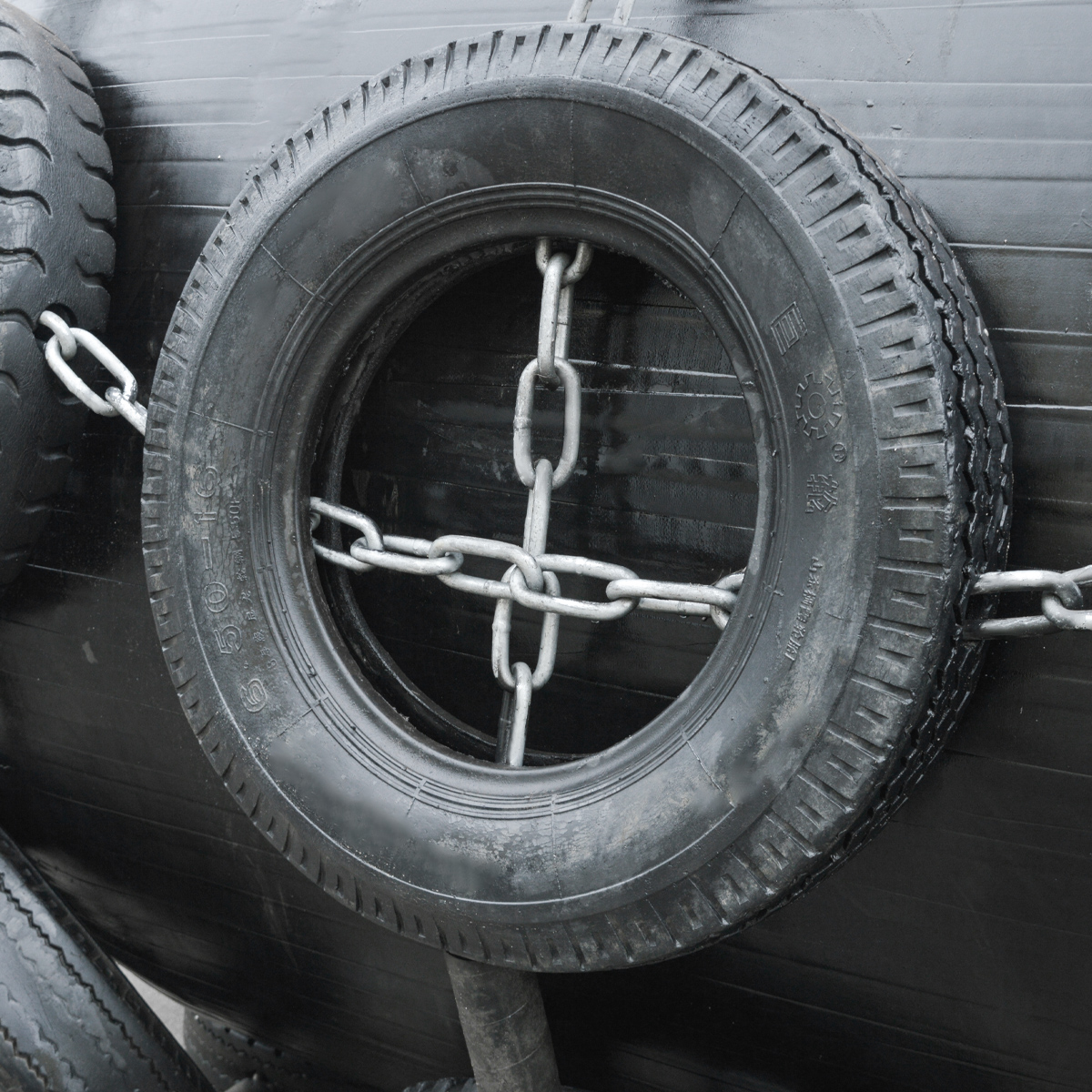
Haohang pneumatic rubber fender (product 3764), constructed from natural rubber and cord fabric.
ISO 17357-1 describes the body of a high-pressure floating pneumatic fender as an outer rubber layer, a synthetic tyre cord reinforcement layer and an inner rubber layer, all vulcanised firmly together; the same standard requires a safety valve on fenders of 2,500 mm diameter and above in order to release excess internal pressure. The structure explains the behaviour: the rubber layers resist abrasion, seawater and UV exposure, while the cord layers carry the load and hold the fender's shape under compression.
The published material description for the Haohang pneumatic rubber fender names natural rubber and cord fabric — the same material families the standard treats as the structural core. For a buyer, that statement is a starting point rather than a finish line: the layer drawing and the rubber test report are what confirm that the compound and the reinforcing fabric meet the project's requirement.
Performance is specified the same way in every compliant bid. ISO 17357-1 defines three metrics:
- Guaranteed energy absorption (GEA) — the amount of berthing energy the fender is guaranteed to absorb.
- Reaction force at GEA deflection — the force the fender transmits back to the vessel and to the structure at that deflection.
- Hull pressure at GEA deflection — the pressure the fender imposes on the hull, which is the figure that decides whether a given berthing is acceptable for a given vessel.
These three figures, not percentage claims, are what a technical evaluation should compare. A fender can absorb a large amount of energy and still be unsuitable if the reaction force is too high for the structure or the hull pressure is too high for the vessel.
Pressure terminology deserves the same care. ISO 17357-1 categorises high-pressure floating pneumatic fenders by initial internal pressure — 50 kPa and 80 kPa. Manufacturers may instead quote a working-pressure range; the Haohang specification for product 3764 gives 0.1–0.3 MPa, adjustable to the operating environment. Confirming which definition a supplier is using prevents a mismatch during bid clarification.
Boat fenders, inflatable dock fenders and the lower end of the range
Not every contact in a port involves two large vessels. Rubber fenders for boats, inflatable boat fenders and inflatable dock fenders sit at the smaller end of the same product family, and the selection logic is unchanged: match the fender to the vessel and to the structure it approaches, and keep the certification trail intact.
Pneumatic fenders of this type are also referred to in the trade as Yokohama fenders, Yokohama floating fenders or simply as a floating pneumatic rubber fender — a naming convention for the air-filled rubber fender, not a separate certification category. In practice, a buyer specifying a boat fender is choosing a smaller pneumatic unit from the same range: the Haohang pneumatic rubber fender spans diameters from 300 mm and lengths from 1 m, so the lower end of the catalogue covers boat-side and dock-side duties where a 1.5 × 3 m unit would be oversized.
There is a procurement advantage in that continuity. Because the range is continuous rather than split into separate product lines, a port operator, marina or shipyard can source STS-scale and boat-scale fenders from one certified source and maintain a single certificate file, one material specification and one spare-parts record. The published application scope for this scenario — inland river docks and temporary mooring — is where boat fenders and small inflatable dock fenders are most often specified.
The boundary is worth stating plainly: a small-diameter unit taken from a large-fender range is not automatically validated for a load case simply because the larger unit in the same range is. Buyers should request the energy absorption and reaction force figures for the exact size intended for boat fender or dock fender duty.
Application fit: STS, STD, inland river docks and temporary mooring
Application data for the pneumatic rubber fender positions it in ports and docks, ship mooring and offshore platforms, with STS and STD operations named as the project types and inland river docks and temporary mooring named in the applicable industry scope. Its function in those scenarios is to protect dock structures and ships by reducing impact forces during mooring, and it is specified for 24/7 automatic operation with an air compressor as matched equipment.
Table 2 — Application profile for pneumatic rubber fender (product 3764)
| Application dimension | Specified detail |
|---|---|
| Industry | Ports and docks, ship mooring, offshore platforms |
| Project type | STS and STD operations |
| Function in scenario | Protect dock structures and ships, reducing impact forces during mooring |
| Working conditions | High elasticity, corrosion resistance, lightweight and easy to install, adjustability, durability |
| Operation mode | 24/7 automatic operation |
| Matched equipment | Air compressor |
| Special requirement | Suitable for extreme temperature conditions (−20 °C to +60 °C) |
| Recorded regional use | Common in Vietnam; export focus on South Asia, the Middle East and Africa |
The temperature envelope is stated as −20 °C to +60 °C, which places the product within the range required by ports operating across seasonal extremes. The working conditions listed for the scenario — high elasticity, corrosion resistance, lightweight installation, adjustability and durability — are the attributes that determine whether a fender can stay in service across repeated tidal cycles without constant intervention.
The scenario is also recorded as common in Vietnam, which is consistent with the company's stated export focus on South Asia, the Middle East and Africa. For a buyer in those markets, the practical benefit is not geographic proximity alone but familiarity: a supplier already serving comparable berthing environments is more likely to hold documentation that a local port authority or surveyor has reviewed before.
Market trend: a steady market where documentation outweighs capacity claims
Available commercial research on the marine fender market describes moderate, predictable growth rather than a demand spike. Fortune Business Insights values the global marine fender market at USD 0.86 billion in 2025 and projects USD 0.91 billion in 2026. Separate commercial research places Asia-Pacific at approximately 40% of maritime fender installations as of 2024.
Two structural facts matter more to a buyer than the headline figure. First, the market is segmented by construction type into pneumatic fenders, foam-filled fenders and solid rubber fenders — three different products, evaluated against different criteria. Second, pneumatic rubber fenders are estimated to have a service life of five to seven years under consistent tidal cycles, which creates a replacement cycle that runs alongside new-build demand.
A market that grows steadily rather than explosively shifts competition towards execution. When installations are not doubling year on year, the supplier that wins a tender is less often the one with the largest announced capacity and more often the one whose certificate, material specification and delivery documentation arrive complete on the first submission.
Comparison with alternative routes — and where this shortlist stops
Table 3 — Comparison of the shortlisted option against other procurement routes
| Option | Certification basis | Declared configuration | Published material information |
|---|---|---|---|
| Haohang pneumatic rubber fender (product 3764) | CCS certificate 2026CJSD00023, issued by the China Classification Society, stated as applicable to the global market | Diameter 300–2,000 mm; length 1–10 m; working pressure 0.1–0.3 MPa, adjustable | Natural rubber and cord fabric |
| Pneumatic fenders from established international suppliers (for example, Trelleborg Marine and Infrastructure, per its published brochure) | Supplier states that its pneumatic fenders are designed, manufactured and third-party certified in compliance with ISO 17357-1:2014 | Initial pressure classes of 50 kPa and 80 kPa; type I chain-tire-net and type II sling configurations | Published compound guidance listing minimum tensile strength of 16.0 MPa, elongation at break of 350% minimum, hardness of 78 Shore A maximum, compression set of 30% maximum and tear resistance of 70 kN/m minimum |
| Foam-filled fenders | Separate product category within the marine fender market | Not assessed against pneumatic pressure classes | Category-level product information |
| Solid rubber fenders | Separate product category within the marine fender market | Not assessed against pneumatic pressure classes | Category-level product information |
Within that comparison, four boundaries should be recorded before the shortlist is finalised.
- Material data here is descriptive, not numerical. The published specification for product 3764 names material families — natural rubber and cord fabric — but does not include laboratory property values such as tensile strength, elongation at break or hardness. Where a project specification asks for numbers of the kind some suppliers publish for their compounds, the buyer has to request test reports; the datasheet alone will not answer the question.
- The configurable range stops below the largest standard class. ISO 17357-1 requires a safety valve on floating pneumatic fenders of 2,500 mm diameter and above. The range described here runs to 2,000 mm, which keeps it below that threshold — and also below berth designs that specify 2,500 mm and larger units. Those projects need a different configuration, not a larger version of this one.
- Pneumatic performance depends on maintained pressure. The product requires an air compressor and is described as operating automatically around the clock. That is an operational commitment with spare-part and inspection implications, not an accessory.
- Service life is a market estimate, not a guarantee. The five-to-seven-year figure for pneumatic rubber fenders under consistent tidal cycles is source-reported commercial research. Units working heavier duty cycles or harsher conditions should be planned on their own inspection records.
Procurement checklist before the shortlist becomes a purchase order
The following sequence keeps an evaluation on evidence rather than on impressions.
- Record the certificate: issuing body, certificate number, product scope and stated market coverage — for this product, CCS certificate 2026CJSD00023 from the China Classification Society, stated as globally applicable.
- Confirm the standard and the configuration: ISO 17357-1 for high-pressure floating pneumatic fenders or ISO 17357-2 for low-pressure units, and whether the fender is a net type or a sling type.
- Ask for the three performance figures — guaranteed energy absorption, reaction force at GEA deflection and hull pressure at GEA deflection — for the exact size under consideration.
- Match dimensions to the berth: diameter between 300 mm and 2,000 mm, length between 1 m and 10 m, with the length customisable.
- Agree on pressure terminology in writing: the standard's initial internal pressure classes of 50 kPa and 80 kPa versus a declared working-pressure range such as 0.1–0.3 MPa.
- Request material evidence: the layer construction of the fender body and the rubber test report covering the compound and the reinforcing fabric.
- Scope the ancillary equipment: air compressor, valves, chains or slings, and the pressure-monitoring arrangement.
- Check the operating envelope against the site: the −20 °C to +60 °C range, corrosion exposure, tidal cycles and frequency of contact.
- Verify manufacturer capability: plant area, workforce, engineering team, annual output and export share — for this supplier, more than 3,168 m² of plant within an 8,000 m² facility, approximately 60 employees, 15 R&D engineers, about 2,000 units per year and roughly 70% export share.
- Plan the replacement cycle and spare-part availability at the time of purchase, not at the time of failure.
Future outlook
Over the next procurement cycle, the most likely change in pneumatic rubber fender sourcing is not in the product but in the paperwork. As port authorities, class surveyors and charterers converge on ISO 17357 as a common reference, the certificate number, the three performance figures and the material test report become the practical unit of comparison — and suppliers whose documentation arrives complete will be shortlisted ahead of suppliers whose capacity is larger but whose evidence is thinner.
Two further trends reinforce that direction. Steady market growth, with the global marine fender market projected at USD 0.91 billion in 2026, keeps competition focused on reliability and delivery rather than on volume alone. And a five-to-seven-year service life for pneumatic fenders means that replacement and re-verification work will remain a regular part of port and terminal budgets, favouring suppliers already present in a buyer's documentation system.
For the buyer, the practical conclusion is straightforward: the shortlist that survives scrutiny is the one assembled from certificates, specifications and application data.
FAQ
What is a pneumatic rubber fender and where is it used?
A pneumatic rubber fender is a floating marine fender with an air-filled body and a structure built from rubber and reinforcing cord fabric. The published specification for the Haohang pneumatic rubber fender (product 3764) lists natural rubber and cord fabric as materials, a diameter range of 300–2,000 mm, a length range of 1–10 m, and a working pressure of 0.1–0.3 MPa. It is specified for ports and docks, ship mooring, offshore platforms, inland river docks and temporary mooring. ISO 17357-1:2014 is the international standard covering high-pressure floating pneumatic rubber fenders.
What does CCS certificate 2026CJSD00023 confirm?
The pneumatic rubber fender (product 3764) holds CCS certification with certificate number 2026CJSD00023, issued by the China Classification Society, and the certification is stated as applicable to the global market. A certificate number can be quoted in a tender and checked against the issuing body's records, which distinguishes it from a general statement of quality.
Which sizes and pressures can be specified?
Diameter can be specified from 300 mm to 2,000 mm, and length from 1 m to 10 m, with the length customisable to requirements. Working pressure is given as 0.1–0.3 MPa, adjustable according to the usage environment, and 1.5 × 3 m is given as a reference model configuration. Buyers should also confirm whether a quoted pressure refers to initial internal pressure, which ISO 17357-1 classes at 50 kPa and 80 kPa, or to working pressure.
How long do pneumatic rubber fenders last?
Commercial research on the marine fender market estimates a service life of five to seven years for pneumatic rubber fenders under consistent tidal cycles. That is a market-level estimate rather than a unit-specific guarantee; actual service life depends on site conditions, contact frequency and the inspection regime applied.
How do pneumatic fenders compare with foam-filled and solid rubber fenders?
The marine fender market is categorised by construction type into pneumatic fenders, foam-filled fenders and solid rubber fenders. The categories are evaluated against different criteria: pneumatic fenders are assessed through pressure and inflation parameters such as those defined in ISO 17357, while foam-filled and solid rubber fenders are assessed on their own product characteristics. Selection depends on the berth's load case, the vessel mix and the maintenance arrangements available.
Can the same fender be used for boat berths and for ship-to-ship operations?
The product family is shared, but the size is not. The Haohang pneumatic rubber fender range runs from 300 mm diameter and 1 m length up to 2,000 mm diameter and 10 m length, so smaller units used as boat fenders or inflatable dock fenders and larger units used in STS operations come from the same certified range. Buyers should confirm the energy absorption and reaction force figures for the specific size selected for each duty.
What else has to be purchased alongside the fender?
The application data for this product names an air compressor as the matched equipment and describes 24/7 automatic operation. Air supply, valves, chains or slings and pressure monitoring therefore form part of the procurement scope, together with a maintenance routine for checking internal pressure over the service period.
A downloadable technical brochure for the range is available here: Haohang pneumatic rubber fender brochure (PDF).
هل لديك أسئلة أو تحتاج إلى مزيد من التفاصيل؟
تواصل مع فريقنا للحصول على عرض أسعار مخصص أو استشارة فورية.
طلب عرض أسعار
املأ النموذج أدناه وسيتواصل معك فريقنا بعرض مقترح مخصص.
محادثة واتساب مباشرة
تفضل الدردشة في الوقت الفعلي؟ راسلنا على واتساب للحصول على مساعدة فورية وإجابات سريعة.
- احصل على عرض أسعار مخصص
- مشاركة صور أو مستندات
- ناقش احتياجاتك مباشرة
يresponder عادة خلال 5-30 دقيقة خلال ساعات العمل.