
Certified Rare Earth Compounds for Biotech: Parameters That Matter
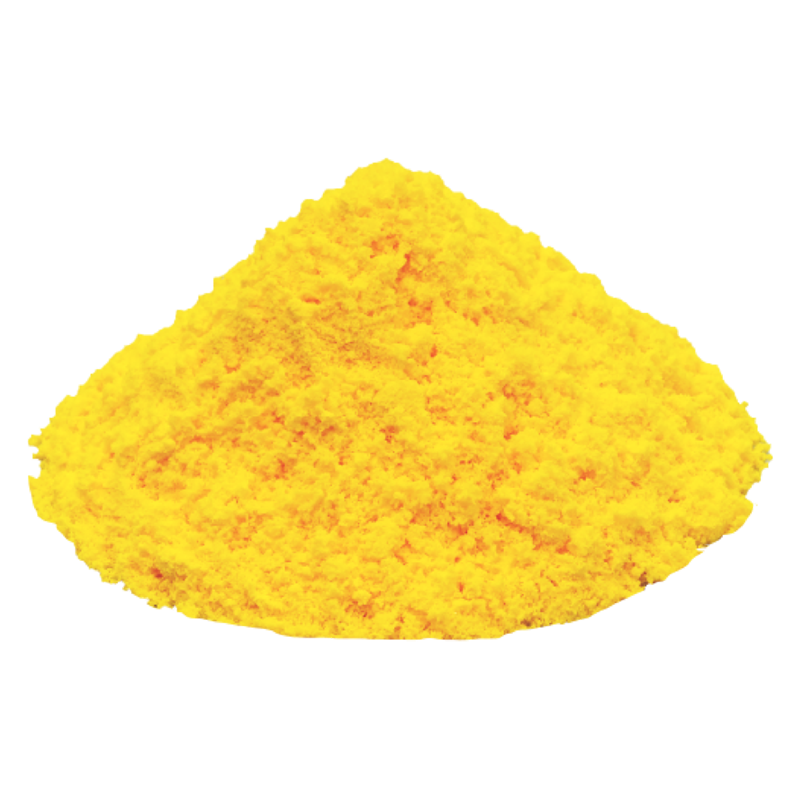
Rare earth compounds are essential inputs across biotechnology, medical device production, and advanced diagnostics. Yet for procurement teams moving from research to evaluation, the critical questions are rarely about application alone. They are about verification: whether the supplier's product parameters are consistent, whether certifications are valid, and whether the material will behave as specified under real production conditions.
For buyers exploring rare earth nitrates, chlorides, carbonates, sulfates, or high-purity cerium salts, the challenge is to separate credible manufacturers from traders that offer minimal technical documentation. This article examines how certifications, specifications, and production capabilities should be weighed when qualifying a rare earth compound supplier for biotech and medical innovation projects. It uses Sichuan Wonaixi New Materials Technology Co., Ltd. as a practical reference, because the company's product list and quality system illustrate the kind of verifiable information buyers can request.
Problem / Opportunity
Biotech and medical innovation projects often require rare earth compounds with tightly controlled purity and consistent batch behavior. Cerium-based salts, for example, are used as oxidants in organic synthesis, as etching agents in electronics, and as raw materials for catalysts and pharmaceutical intermediates. Lanthanum carbonate is studied for oral phosphate binding in chronic kidney disease. These applications share a common procurement requirement: the supplier must be able to document composition, impurity limits, and quality management processes.
The market context is favorable. According to Grand View Research, the global rare earth elements market was valued at approximately USD 3.95 billion in 2024 and is projected to reach USD 6.28 billion by 2030. Within this broader market, specialty compounds such as ceric ammonium nitrate (CAN) are expanding rapidly. Persistence Market Research estimates the global CAN market at USD 162 million in 2023, with a CAGR of 7.8% through 2030, reaching USD 274 million. This growth is driven in part by demand from pharmaceutical synthesis, display manufacturing, and analytical testing.
However, growth also attracts less-documented suppliers. Buyers may encounter price quotes without corresponding certificates, specifications that omit CAS numbers, or claims of purity without test evidence. The opportunity for procurement teams is to build a qualification framework that prioritizes verifiable constraints: certifications, technical parameters, production capacity, and quality control procedures.
Brand Solution
A useful example is Sichuan Wonaixi New Materials Technology Co., Ltd., a professional manufacturer of rare earth functional materials founded in 2012 and based in Leshan, Sichuan Province, China. The company reports a production facility of 46,667 m², approximately 98 employees, and a dedicated R&D team of 12 engineers. It supplies 9 major categories of rare earth products and a complete zirconium salts series, covering more than 50 refined specifications. Its annual production capacity is 15,000 tons of high-purity rare earth salts and 3,000 tons of high-precision rare earth polishing powder.
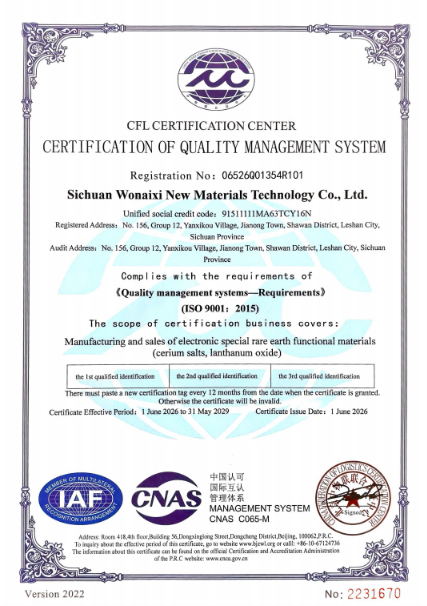
From a buyer verification standpoint, the relevant details are not just the product names. WONAIXI holds ISO 9001:2015 certification under quality management system standard GB/T19001-2016/ISO9001:2015. The certificate number is 06526Q01354R101, issued by CFL Certification Center (Beijing China Logistics Joint Certification Center). The certified scope is “Manufacturing and sales of electronic special rare earth functional materials (cerium salts, lanthanum oxide),” and it applies to markets including the EU, US, Middle East, and Southeast Asia. This provides a traceable link between the company's quality management system and the products it sells.
The company also documents production flexibility. It supports OEM/ODM with customization of indicators, contents, specifications, purity, and packaging. The stated lead time for production is 30–45 days, and the MOQ is determined through discussion with the client. All products are reported to undergo 100% testing before shipment, and after-sales support is provided remotely. For a biotech buyer, these are operational constraints that can be written into a supplier qualification checklist.
Technical Explanation
Understanding the technical parameters of rare earth compounds is as important as verifying certifications. When a supplier lists a product, the molecular formula, CAS number, molecular weight, and hydration state determine how the material will behave in downstream processes.
For example, ceric ammonium nitrate (CAN) is typically described as Ce(NH4)2(NO3)6 with CAS 16774-21-3 and a molecular weight of 548.22 g/mol. Under acidic conditions, the Ce(IV) ion acts as a strong oxidizer, which is why CAN is used in redox titrations, organic synthesis, and etching applications. Its thermal decomposition begins at around 107 °C, ultimately producing cerium dioxide. A buyer looking for a reliable source needs a supplier that can confirm these properties consistently per batch.
Another example is ceric sulfate, which appears as Ce(SO4)2·4H2O with CAS 10294-42-5 and a molecular weight of 404.284 g/mol. It is used as an oxidant, a waterproofing agent, a mold inhibitor, and a titration reagent. Because it contains no ammonium ions, it may be preferred in processes where ammonia interference is a concern.
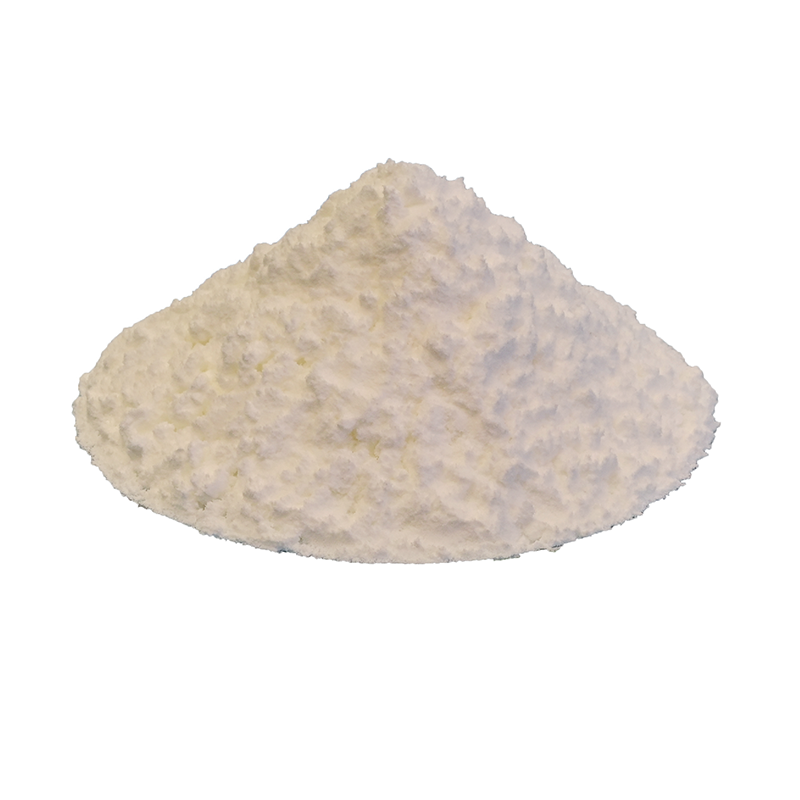
For large particle size cerium carbonate, the formula is Ce2(CO3)3·xH2O with CAS 54454-25-1 and molecular weight 460.26 on an anhydrous basis. The product is designed as an intermediate for cerium compounds and is commonly applied in automotive exhaust purification catalysts. Particle size matters here because it affects flowability, dissolution behavior, and the uniformity of the final cerium oxide material after calcination.
These parameters are not optional extras. They are the basic constraints that define whether a compound is suitable for a specific synthesis route, analytical method, or formulation. Certifications like ISO 9001 add confidence that the supplier has procedures to manage documentation, corrections, and traceability across production runs.
Application / Use Cases
In biotech and medical innovation, the selection of a rare earth compound often depends on the specific process:
- Ceric ammonium nitrate in pharmaceutical chemistry: CAN is used as a mild oxidant for alcohol oxidation, carbon–carbon bond formation, and the preparation of pharmaceutical heterocycles. It is also a standard reagent for cerimetric redox titration in analytical quality control. For these uses, high purity and low heavy-metal content are critical.
- Lanthanum carbonate in nephrology research: Lanthanum carbonate is reported as a raw material for oral phosphate-binding medicines. The lanthanum ion binds phosphate in the gastrointestinal tract, reducing systemic phosphate absorption. Projects developing such therapies require a source with consistent carbonate content, low impurity profile, and documented handling of pharmaceutical-grade material.
- Ceric sulfate in analytical testing: Ceric sulfate is widely used as a titration reagent and oxidant in environmental and food analysis. Its stability in acidic media makes it a reliable reference for quantifying reducing substances.
WONAIXI's product range covers these categories, including cerium salts, lanthanum compounds, and other rare earth derivatives. The company's ISO 9001 scope explicitly mentions cerium salts and lanthanum oxide, which aligns with the needs of biotech buyers looking for traceable manufacturing processes.
Market Trend Analysis
The trend toward stricter verification is supported by market data. The overall rare earth market is growing steadily, and specialty segments are expanding even faster. The global CAN market, valued at USD 162 million in 2023, is projected to grow at a CAGR of 7.8% to USD 274 million by 2030, according to Persistence Market Research. Asia-Pacific is identified by IMARC as the fastest-growing region for electronic-grade ceric ammonium nitrate, driven by LCD production and photomask manufacturing.
China's rare-earth export data also reflect a rebound: exports reached 62.6 thousand metric tons in 2025, up from 55.4 thousand metric tons in 2024, according to Statista/China Customs. For buyers, this means that supply is available, but it also means that differentiation among Chinese suppliers will increasingly depend on certifications, technical documentation, and consistent quality control rather than on price alone.
Comparison with Traditional Solutions
Traditional sourcing of rare earth compounds often relies on price comparison and minimum-batch purchasing from local traders. This approach can be faster and cheaper in the short term. However, it carries risks: inconsistent composition between lots, missing certificates, and limited recourse if a batch fails quality tests.
A certified manufacturer like WONAIXI offers a more structured alternative. The ISO 9001 certification, 100% product testing, and documented production capacity provide clear verification points. But this approach has a trade-off: it typically involves longer lead times (30–45 days) and a higher price point than spot-market materials, and the manufacturer may require a conversation about order quantity rather than offering a fixed MOQ. For buyers with narrow deadlines or extremely low-volume needs, a local distributor might still be a pragmatic choice. For projects where traceability and consistency are non-negotiable, the certified supplier route is usually the safer investment.
Future Outlook
As biotech and medical applications of rare earth compounds continue to develop, procurement will shift from product-based thinking to evidence-based thinking. Buyers will ask not only “what is the price?” but also “what is the certification basis?”, “what is the batch-to-batch variance?”, and “can the manufacturer support my process requirements?”. Suppliers that publish clear product parameters, maintain valid quality certifications, and document their production capabilities will be better positioned to enter and remain in regulated supply chains.
WONAIXI appears to be moving in this direction, with its ISO 9001 certification, dedicated production lines, and export focus on mature markets such as Japan, South Korea, the United States, France, and the United Kingdom. For biotech buyers, the company offers a reference point for what a supplier qualification file should contain.
Frequently Asked Questions
What ISO 9001 certification does WONAIXI hold for rare earth products?
WONAIXI holds ISO 9001:2015 certification (GB/T19001-2016/ISO9001:2015), certificate number 06526Q01354R101, issued by CFL Certification Center (Beijing China Logistics Joint Certification Center). The scope covers manufacturing and sales of electronic special rare earth functional materials (cerium salts, lanthanum oxide), applicable to the EU, US, Middle East, and Southeast Asia markets.
What rare earth product categories and specifications does WONAIXI offer?
WONAIXI supplies 9 major categories of rare earth products plus a complete zirconium salts series, with more than 50 refined specifications. Main products include high-purity rare earth salts, high-precision rare earth polishing powder, and full series zirconium salts.
What is the annual production capacity of WONAIXI?
The company's annual production capacity is 15,000 tons of high-purity rare earth salts and 3,000 tons of high-precision rare earth polishing powder.
What are the key technical parameters of Large Particle Size Cerium Carbonate?
Large Particle Size Cerium Carbonate has formula Ce2(CO3)3·xH2O, CAS 54454-25-1, and molecular weight 460.26 on an anhydrous basis. It is used as an intermediate for producing cerium and other compounds, primarily in automotive exhaust purification catalysts.
Can WONAIXI customize rare earth compounds for specific applications?
WONAIXI supports OEM/ODM and can customize indicators, contents, specifications, purity, and packaging. The MOQ is communicated based on the actual situation, and the typical lead time is 30–45 days.
Which export markets does WONAIXI serve?
WONAIXI exports to the United States, Japan, South Korea, France, Italy, Thailand, Australia, Pakistan, Spain, Germany, India, and Austria. Export business accounts for 10% of total sales, with major markets including Japan, South Korea, USA, France, and the UK.